


Los Volcanes National Park lies in western El Salvador between San Salvador and Santa Ana, high on the Cerro Verde ridge that overlooks Lake Coatepeque. Road access is via the paved Cerro Verde road that climbs from the Pan American Highway near El Congo and Santa Ana, using local routes such as Route 20 and Route 209 to reach the park entrance and the main trailheads. This article focuses on the practical question every independent traveler faces: how to get from San Salvador, Santa Ana, the international airport or popular surf towns to the park gates and the Santa Ana volcano hike, using public buses, tours, private drivers or a rental car.
Get the latest updates straight to your inbox!
Understanding the Basic Transport Pattern
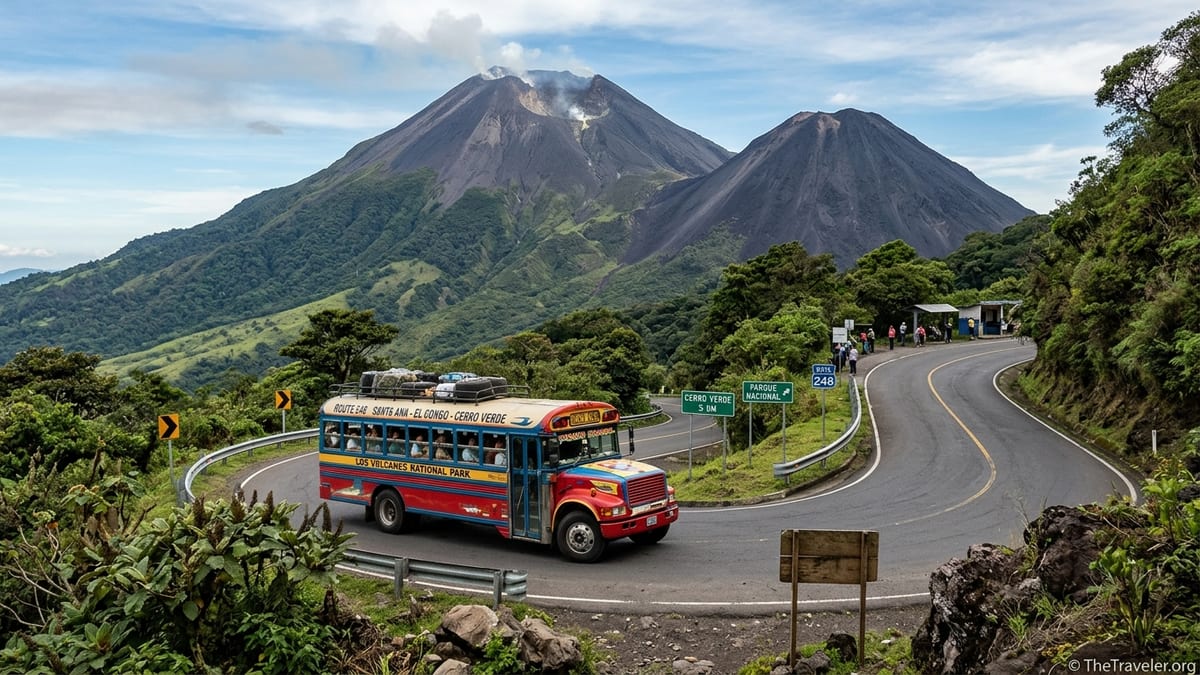
Reaching Los Volcanes National Park and the Santa Ana volcano trailheads typically involves first traveling to Santa Ana or the El Congo area, then ascending the Cerro Verde road to the park. Public transport follows a widely used pattern. Travelers ride an intercity bus from San Salvador’s western bus terminal, commonly called Terminal de Occidente, to Santa Ana. From there they transfer to a local bus, most often identified as Route 248, which runs via El Congo to Cerro Verde and serves visitors heading to the park and the Santa Ana volcano hike.
Official and traveler reports agree that Route 248 and the main San Salvador to Santa Ana buses are the backbone of budget access to the park. However, schedules, bus numbers, departure times, operating days and even fares change frequently, and special services sometimes operate only on certain days. Any article prepared for publication in 2026 must therefore verify at least one current timetable or firsthand report for Route 248 and one for the primary San Salvador to Santa Ana route shortly before release, and then present journey times and fares as approximate ranges with an explicit verification month and year instead of fixed promises.
For travelers who prefer to avoid bus transfers, organized tours and private drivers now connect San Salvador, Santa Ana and several coastal surf hubs directly with the volcanoes and Lake Coatepeque. Many visitors also choose to rent a car, which gives maximum schedule control but introduces its own issues: mountain driving, parking and security considerations. The sections below break down each option in practical detail so readers can match the route to their budget, experience and language comfort.
In all cases it is important to remember that access depends on both transport and park operating rules. Hikes to Santa Ana volcano usually depart in a defined late morning window controlled by park rangers and guides. Travelers should always confirm the current daily ascent window and any temporary closures due to volcanic activity, storms or maintenance before locking in transport, and build enough margin into their schedule to handle delays.
San Salvador to Santa Ana: Core Intercity Connection
Almost every independent trip to Los Volcanes by public transport starts in San Salvador with a ride to Santa Ana. Buses for Santa Ana depart from Terminal de Occidente in the west of the capital and are usually labeled with route numbers such as 201, operated by several companies. Typical reports in 2025 and 2026 suggest a journey time of about 1.5 to 2 hours under normal traffic, with fares in the range of about 1 to 2 US dollars depending on whether you choose a basic or air conditioned service and whether the bus is “directo” with limited stops.
Because companies adjust schedules and fares, a writer preparing a current guide must check at least one live timetable, terminal noticeboard or firsthand account from 2026 for the main San Salvador to Santa Ana route shortly before publication. All journey times and price examples should then be presented as approximate, for instance noting that as of mid 2026 most direct buses take roughly 90 minutes and cost around a dollar or slightly more, rather than giving a single exact figure that may soon be outdated.
For travelers starting from the international airport east of San Salvador, there is no single dedicated airport bus to Santa Ana. The most common pattern is to take a licensed taxi, rideshare or hotel shuttle into San Salvador, then continue by intercity bus from Terminal de Occidente. Under light traffic the airport transfer into the city can take about 45 minutes, although at peak times it is often longer. When arrival is in the evening, many visitors choose to overnight in San Salvador and travel on to Santa Ana early the next morning, rather than trying to piece together buses after dark.
From Santa Ana back to San Salvador, travelers can usually return the same way, again using frequent intercity buses. As with outbound trips, evening services may be slower and busier, and safety-conscious visitors often aim to be off the highway and back in the city before full dark, particularly if they then need to connect to another bus or neighborhood.
Santa Ana and El Congo to the Cerro Verde Access Road
Once in Santa Ana, travelers heading for Los Volcanes National Park need to connect to the Cerro Verde access road, which climbs from the El Congo area up to the main visitor zone on the ridge. Local sources describe Route 248 as the classic bus used by both day trippers and local hikers. It typically runs Santa Ana–El Congo–Cerro Verde, passing near the bridge at El Congo and then making the ascent to the park entrance and parking area, where visitors can join guided hikes to Santa Ana volcano and other trails within the protected area.
Reports suggest that Route 248 departures from Santa Ana are limited, often concentrated in the early morning in order to arrive at Cerro Verde in time for the late morning hike departure window. Recent information indicates that one of the key departures passes the El Congo bridge around 8:00 in the morning, giving a reasonable margin to reach the park before the usual mid morning group hike start, though exact times vary by day and operator. Because of these fluctuations, a writer must confirm at least one up to date timetable or firsthand account for Route 248, including departure and approximate arrival times, shortly before publication and note the verification date clearly.
Fares on Route 248 have been reported recently in the range of less than one US dollar from El Congo to Cerro Verde, and only slightly more from Santa Ana. In practice the ride up from Santa Ana to the park can take around 1 to 1.5 hours depending on traffic, weather and intermediate stops. Buses can become crowded on weekends and holidays when both local families and international visitors travel to the park, so travelers should be prepared to stand or to wait for a later departure. If a bus is full or delayed, contingency options may include negotiating a ride on a pickup truck or shared taxi from El Congo or Santa Ana, often at a higher cost but still manageable when split among several travelers.
The Cerro Verde access road itself is fully paved but steep and winding, with sections that feel slow in a heavily loaded bus. During or after heavy rain the road surface can be slick, although the route is not normally considered technically difficult. Travelers should expect cool temperatures and mist near the top, even when Santa Ana city is warm, and bring layers for the bus ride and the waiting period before the hike begins.
Tours and Private Drivers from San Salvador, Santa Ana and the Coast
A significant proportion of visitors now avoid the logistics of public buses by booking organized volcano day trips that bundle transport, guiding and park coordination into a single product. Operators based in San Salvador, Santa Ana and coastal hubs such as El Tunco and El Zonte advertise full day excursions that include hotel pickup, round trip transport to the park, a certified guide for the Santa Ana volcano hike, and often a post hike stop at Lake Coatepeque for lunch and swimming before returning to the origin city or beach.
Recent listings and traveler reports from 2025 and 2026 suggest that shared group tours from San Salvador or the main surf towns typically cost somewhere in the range of roughly 60 to 110 US dollars per person, depending on group size, inclusions and marketing channel. Private tours or hired drivers with a dedicated vehicle for your party generally sit higher, often starting around 90 to 100 dollars per person for small groups when booked through agencies, although the per person cost can fall significantly if four or more travelers split a flat vehicle rate. Prices quoted here are indicative only and any article should cross check a handful of current offers in 2026 before publication.
Tours from Santa Ana itself are often cheaper because the distance is shorter. Many hostels and guesthouses work with local guides and drivers to offer volcano hikes that include transport to the trailhead, the mandatory guide service and sometimes a side trip to the lake, at prices that budget travelers describe as moderate compared with capital based tours. In both the city and the coast, booking through a reputable accommodation provider gives a measure of vetting and often ensures that pick up is at the door rather than a central plaza.
Private drivers, which can be arranged through local agencies, rideshare apps or dedicated transfer platforms, sit between a fully packaged tour and independent travel. They usually include door to door transport and waiting time during the hike, but guiding and park fees remain separate. The main advantages are flexibility in departure time, the ability to choose your own lunch stop, and more scope to communicate in English if you book through an operator that markets to international visitors. The tradeoffs are higher total cost compared with buses, and the need to coordinate details such as return time and contingency plans if park conditions change on the day.
Driving Yourself: Routes, Road Conditions and Parking
For travelers comfortable with Central American driving, renting a car provides the most control over schedule and routing to Los Volcanes. From central San Salvador, the standard route runs west along the Pan American Highway toward Santa Ana, passing through or around urban areas such as Ciudad Arce. Under normal conditions, the drive from San Salvador to the turnoff for the Cerro Verde road near El Congo can take around 1.5 hours, though morning and late afternoon traffic around both the capital and Santa Ana often lengthens that time.
From the airport region south of the capital, drivers can join the main highway system and either skirt San Salvador or pass through the city to connect with the Pan American Highway toward Santa Ana. Depending on traffic and the exact route, the total time from the airport area to the Cerro Verde turnoff commonly ranges from about 2 to 2.5 hours. Regardless of starting point, once you reach the junction near El Congo you follow the signed road that climbs steeply through agricultural landscapes and forest to the national park entrance and the Cerro Verde visitor zone.
Recent traveler accounts highlight several practical considerations for self drivers. First, the Cerro Verde road, while paved, is narrow in places with sharp curves and slow moving buses and trucks. Second, parking at the top near the main visitor area and trailhead is finite and can feel tight during weekends and holidays, although attendants usually help organize vehicles and may collect a small parking fee. Third, multiple travelers warn against driving on intercity highways and mountain roads in the dark, especially for those unfamiliar with local conditions, due to limited street lighting, variable road markings and occasional security concerns. The safest practice is to plan your visit so that the ascent and descent of the Cerro Verde road occur in daylight.
Before publication, a writer must confirm current road conditions and any construction or closure affecting the Cerro Verde access road or the key approach sections of the Pan American Highway. It is also prudent to check for recent security advisories that might influence the wisdom of long intercity drives at night. When in doubt, advise readers to start early, avoid tight same day connections such as late evening flights after a hike day, and leave a time buffer for unforeseen delays such as weather, slow traffic or extended check in procedures at the park gate.
Reaching the Park from Surf Towns and the Airport
Popular surf villages such as El Tunco and El Zonte on the coastal highway are increasingly used as bases for inland excursions. However, public bus connections from the coast to Los Volcanes that align neatly with the late morning ascent window for Santa Ana volcano are awkward at best and often impractical. A purely public route would typically involve taking a coastal bus or series of local buses toward San Salvador, transferring at or near one of the main terminals, then continuing to Santa Ana and onward to Cerro Verde, with every transfer increasing total journey time and the risk of delay.
Because of this complexity, many surfers and short stay visitors based on the coast opt for day tours or private drivers that run directly from El Tunco, El Zonte or neighboring beaches to the park. These trips usually leave early in the morning, sometimes before sunrise, to ensure arrival at Cerro Verde in time to register and join the guided ascent. As with tours from San Salvador, they commonly include round trip transport, guiding and a stop at Lake Coatepeque, with prices that broadly overlap capital based offerings. Travelers should confirm pickup points carefully; some operators collect guests from beach hotels and hostels, while others may use a central roadside meeting point in each settlement.
From the international airport, hiring a private driver or renting a car is the most straightforward option for those keen to head straight toward Los Volcanes without detouring into San Salvador. However, arrival time is critical. If your flight lands late in the afternoon or evening, overnighting near the airport or in the capital and starting early the next morning is almost always preferable to attempting the full airport to volcano journey at night. In addition, travelers should factor in immigration formalities, baggage claim and possible delays when estimating whether they can realistically reach the park in time for the daily guided hike window.
For visitors with flexible itineraries, one effective strategy is to structure the trip as an arc: airport to Santa Ana for a night or two, then Los Volcanes and Lake Coatepeque, followed by continuation to the Ruta de las Flores or the coast. This reduces backtracking and allows you to use a mix of intercity buses, occasional taxis and prearranged day trips rather than committing to a rental car for the entire stay.
Comparing Buses, Tours, Private Drivers and Rental Cars
When comparing the main transport options to Los Volcanes, it is useful to think in terms of several criteria: total door to door travel time, cost per person, degree of schedule control, language demands and the need to manage transfers. A descriptive “table” would place public buses at one end of the spectrum and private tours or self drive at the other, with shared tours and hired drivers in the middle.
Public buses generally offer the lowest cost, with the San Salvador to Santa Ana leg plus Route 248 and any urban transfers typically adding up to only a few US dollars each way. The tradeoff is time: a full journey from San Salvador to the park by bus can easily take three hours or more once terminal waits and connections are included. Schedule control is limited, and travelers benefit from at least basic Spanish to understand conductors, route signage and any last minute changes. Managing transfers at busy terminals can also be stressful for first time visitors.
Shared tours from San Salvador, Santa Ana or the coast occupy the middle ground. Per person prices are much higher than buses but still moderate compared with fully private arrangements, and costs often include guiding services and a Lake Coatepeque stop. Door to door travel time can be efficient, since vehicles run directly from hotels to the park without long terminal stops, and the need to speak Spanish is greatly reduced if the operator advertises bilingual guides. The downside is that departure times and pacing are fixed by the group itinerary, leaving limited room for detours or lingering.
Private drivers and rental cars provide the greatest flexibility. A private driver allows door to door transfers on your chosen schedule, with no need to handle navigation or parking, but still at a price that can be shared across several people. A rental car minimizes per person cost for families or small groups staying several days, and allows you to decide when to leave, where to stop for food and whether to visit Lake Coatepeque before or after the hike. Both options reduce or eliminate transfers but require more planning. With a rental car you must also be comfortable driving in mixed urban and rural conditions, as well as respecting recommendations to avoid night driving on intercity and mountain roads.
Timing, Contingencies and Adapting to Changing Conditions
Whatever transport mode you choose, timing is crucial because the Santa Ana volcano hike usually has a defined daily ascent window controlled by park rangers and authorized guides. In recent years, official information has commonly cited a mid morning departure for the main group hike, with last entry before late morning, but exact times can and do shift. Travelers should always confirm the current schedule through recent local sources and then work backward to select an appropriate bus, tour pickup or departure time by car, allowing a generous safety margin for traffic or delays.
Contingency planning is particularly important for those relying on public buses. If you miss a San Salvador to Santa Ana departure or the bus is slower than expected due to congestion, you may arrive too late to catch Route 248 in time to make the hike window. In that case, options include taking a taxi or negotiating with a local driver to continue from Santa Ana or El Congo to Cerro Verde at short notice, accepting a higher cost but salvaging the day. Alternatively, you can adjust plans and visit Santa Ana city, Lake Coatepeque or nearby towns instead, then attempt the volcano hike the next day with an earlier start.
Park and trail conditions can also change swiftly due to weather or volcanic activity. Authorities sometimes close the summit, limit access to certain sections of the trail or cancel hikes for safety reasons if winds are extreme or monitoring data indicate elevated risk. Heavy rain or storms may likewise disrupt access roads or make hiking unsafe. Travelers should prepare mentally and logistically for the possibility that even perfectly arranged transport might deliver them to a closed trailhead, and have a backup plan such as exploring the viewpoints and forest trails around Cerro Verde, visiting Lake Coatepeque or reallocating time to other regional attractions.
If conditions change significantly, the best approach is to stay flexible and prioritize safety. Speak with park staff, guides and your driver or tour operator about alternatives, and avoid pressuring anyone to proceed against official advice. When using public buses or self driving, remember that descending the mountain roads in fog or heavy rain can be more hazardous than delaying departure for an hour or two. Keeping your schedule slightly loose, especially on the return journey, makes it easier to adjust without the added stress of imminent flights or tightly scheduled onward connections.
Recommendations for Different Types of Travelers
For budget conscious backpackers with basic Spanish and a taste for local transport, the classic route remains attractive. An early morning bus from San Salvador’s Terminal de Occidente to Santa Ana, a timely connection to Route 248, and a night or two based in Santa Ana city can keep costs very low while still allowing for a rewarding hike. This profile should emphasize double checking current bus times, starting early and accepting that delays are part of the adventure.
Short stay visitors with limited Spanish, including many first time travelers to Central America, are usually better served by shared tours or private drivers that bundle transport and guiding. A well chosen group tour from San Salvador or the main surf towns simplifies logistics, ensures arrival within the ascent window and reduces stress at terminals, while still leaving room for scenic stops at Lake Coatepeque. Those willing to pay a little more can opt for a private driver or private tour to gain control over departure time and avoid pickups at multiple hotels.
Groups of friends and families with older children often find that either a rental car or a private driver offers the best overall value. Splitting fuel, tolls and vehicle costs among several people reduces the per person burden, and the added flexibility makes it easier to accommodate different hiking speeds, extended lunch breaks or spontaneous swims at the lake. Families with younger children or anyone uneasy about local driving conditions may prefer a private driver so that an experienced local handles mountain roads and traffic while they focus on the experience.
Whatever your profile, the keys to a smooth trip are early starts, verified up to date information and realistic expectations. By understanding how San Salvador, Santa Ana, El Congo and the Cerro Verde road connect, weighing the tradeoffs between buses, tours, private drivers and rental cars, and building contingency time into your schedule, you can reach Los Volcanes National Park with confidence and focus on the extraordinary landscapes that await on the slopes of Santa Ana, Izalco and Cerro Verde.