


Glaciers shape both the landscape and the travel dream in Alaska, but they are not equally easy to reach. Some tower over cruise ships, others sit beside the highway, and a few reward hours of hiking with the chance to step onto the ice. This guide focuses on nine of the most iconic and logistically practical glaciers for visitors, explaining how most people actually see them, how much time to allow, and what to know about current access and safety so you can prioritize the experiences that fit your trip.
Get the latest updates straight to your inbox!
Mendenhall Glacier: Juneau’s Signature, Evolving Icon
Mendenhall Glacier is the classic glacier stop for visitors to Juneau, especially cruise passengers. It spills out of the Juneau Icefield into a lake about 12 miles from downtown, with a Forest Service visitor center, viewing platforms, and short trails offering relatively easy access by shuttle, taxi, or tour bus. Most independent visitors experience Mendenhall on a half-day visit, often as a three to four hour shore excursion that combines transport, time at the visitor center, and a walk to prime viewpoints. The glacier has retreated significantly in recent decades, which means the face is now farther from the visitor center than older photos suggest, but the setting of blue ice, waterfalls, and surrounding peaks remains dramatic.
Typical first-time visits focus on self-guided viewing from maintained trails and platforms, including paved paths suitable for most families and mobility levels. Some operators also offer guided kayak trips on Mendenhall Lake or glacier treks that involve separate transport and specialized gear. Short walks can be done in under an hour, but building in two to three hours on site allows time for exhibits, films, and leisurely viewing. Because Mendenhall is so close to Juneau and popular with cruise tours, it is one of the more crowded glacier experiences, especially in mid-summer afternoons.
Recent glacial lake outburst floods have periodically caused road and trail closures near Mendenhall, and local agencies in 2026 have been monitoring infrastructure and posting temporary restrictions when water levels rise. That means access can change quickly, with parking lots, campgrounds, or specific trails occasionally closed for safety and later reopened after inspections. Visitors should plan for possible detours, follow all posted closures, and be cautious near rivers and lake shores where water levels and channels can shift. Helicopter landings and recreational drone flights are also subject to aviation restrictions when emergency measures are in place.
Mendenhall suits travelers who want a straightforward, short excursion with solid educational context and do not need to step onto the glacier itself. It is especially good for families, cruise passengers with limited port time, and photographers who value accessible viewpoints over isolation. For a more remote feeling, travelers can pair a Mendenhall visit with a fjord cruise out of Juneau, but even on its own, this glacier offers one of the most convenient introductions to Alaska’s ice.
Exit Glacier and Kenai Fjords’ Tidewater Glaciers: Roadside Ice and Cruise Adventures
Exit Glacier and the nearby tidewater glaciers of Kenai Fjords National Park give visitors two very different glacier experiences from the same base in Seward. Exit Glacier is one of Alaska’s best known roadside glaciers, reached by a spur road from the Seward Highway. A network of short trails leads to viewpoints over the outwash plain and, in past years, closer views near the ice, while the more strenuous Harding Icefield Trail climbs above treeline to overlook the vast icefield that feeds the glacier. Typical visits to Exit Glacier range from a one to two hour stroll on the lower trails to a full day hike for those attempting the Harding route in good conditions.
Park managers adjust access for safety, especially as the glacier retreats and terrain at the terminus changes. Sections of the Harding Icefield Trail above the main junction are subject to seasonal closures due to lingering snow hazards, steep slopes, and wildlife concerns, and the terminus area can be roped off when crevasses, icefall, or unstable rivers make closer approaches unsafe. That means many visitors now experience Exit Glacier primarily as a scenic hike to viewpoints rather than as an opportunity to walk onto the ice. Independent hiking on the lower trails remains realistic for most reasonably fit visitors in the snow-free season, but walking on the glacier itself is best left to guided mountaineering parties.
From Seward’s small boat harbor, day cruises of around six to eight hours reach tidewater glaciers like Aialik and Holgate in Kenai Fjords National Park. High-sided fjords and productive waters mean a mix of wildlife viewing and glacier time, with boats lingering near active ice cliffs when conditions allow. Access to these glaciers is by commercial tour boat only, typically offered from mid-May through early September, and itineraries vary between companies and seasons. On many trips, passengers see at least one major calving glacier front up close from the boat, often with the sound of cracking ice echoing off the cliffs.
This combination suits a wide spectrum of visitors. Exit Glacier’s lower trails work well for families and road trippers who want a flexible, self-guided outing that can be as short or as long as desired. The full-day Harding Icefield climb appeals to strong hikers seeking sustained elevation gain and expansive views rather than close-up ice contact. The Kenai Fjords day cruises are ideal for photographers and travelers who want a classic calving-glacier experience without technical hiking, as well as cruise-ship passengers extending their trip with an independent Seward stay before or after their main voyage.
Prince William Sound: College Fjord and Blackstone Bay
Prince William Sound, accessed most easily from Whittier or Valdez, offers some of the richest concentrations of tidewater glaciers in Alaska, yet the waters are relatively sheltered compared with the open Gulf. Day cruises from Whittier commonly explore Blackstone Bay or the broader Sound, while longer itineraries reach College Fjord, where multiple glacier tongues pour off the Chugach Mountains. Typical tours run four to six hours, with departures concentrated from mid-May to mid-September to match daylight and sea ice conditions. Many operators use fast catamarans or mid-size tour boats designed with large windows, outdoor decks, and naturalist commentary.
In Blackstone Bay, boats can position near several active ice faces and hanging glaciers, sometimes within a landscape ringed by waterfalls and steep rock walls. College Fjord offers a different feel, with numerous long glacier tongues flowing toward the water and a strong sense of being deep inside a glaciated mountain basin. These are primarily boat-based experiences; independent kayakers can access some parts of the Sound with proper skills and outfitter support, but most first-time visitors rely on scheduled cruises. Some tours are sold as stand-alone day trips from Anchorage that bundle rail or coach transport to Whittier, while others can be booked locally.
Because many vessels operate on set schedules and have to consider tides, wildlife, and passenger safety, captains may vary how close they approach a calving face on a given day. Ice conditions can change quickly as bergs shed from the terminus; distances that felt safe one day may not be appropriate the next. Travelers should understand that no operator can guarantee a particular distance or calving display, though the likelihood of seeing glacier ice up close on these tours is generally high in mid-summer.
Prince William Sound is well suited to visitors based in Anchorage who want a big glacier experience without flying farther afield, and to photographers looking for a compact day with multiple glacier views and a good chance of wildlife. The cruises work well for families and multi-generational groups because they require minimal walking and have onboard amenities. They feel a bit more remote and wild than the typical port-area excursions on large-ship cruises, while still fitting into a single travel day.
Matanuska Glacier: Roadside Ice with Guided Access
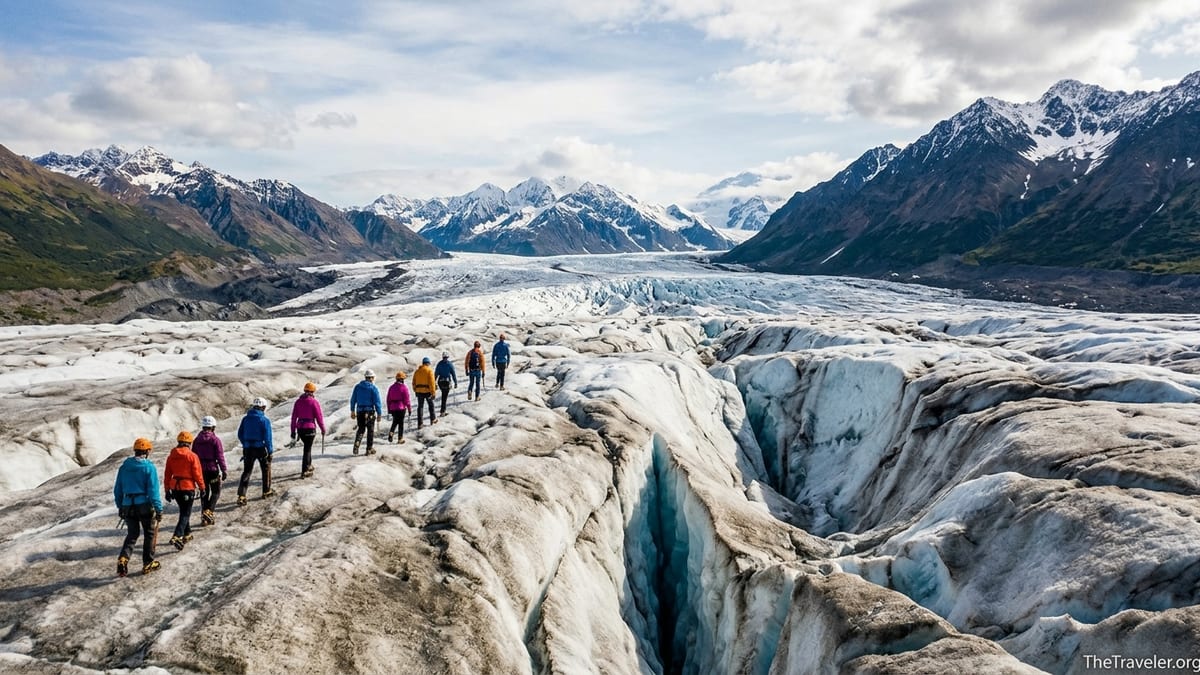
Roughly two hours northeast of Anchorage along the Glenn Highway, Matanuska Glacier is one of Alaska’s most popular roadside glaciers for travelers who want to get onto the ice with a guide. The glacier’s toe is reached by a private access road at Mile 102, and current landowner rules require visitors who wish to walk on the glacier to join an authorized guided tour. Several operators based near the access point and in the broader region run year-round or seasonal trips that include helmets, crampons or microspikes, and instruction in how to navigate the uneven surface safely.
Standard guided walks on Matanuska typically last three to four hours including check-in, gearing up, van transport down the access road, and time on the ice. Some companies also offer longer, more technical hikes that venture farther from the access point or emphasize instruction in glacier travel skills. Because of crevasses, meltwater channels, and unstable ice formations, unguided walking on the glacier is not permitted from the private access road. However, travelers can still view the glacier from the Glenn Highway and from the state recreation site at Mile 101, where a short nature trail leads to established viewpoints overlooking the valley and glacier.
Conditions on Matanuska can shift with the seasons, particularly in spring and late summer when meltwater channels deepen and surfaces soften. Tour operators adjust their routes and may cancel or modify trips during periods of high wind, rain, or extreme cold. Access policies and per person fees for guided tours are reviewed periodically, so it is essential to confirm current requirements, pricing, and age restrictions with operators when planning a visit.
Matanuska suits independent travelers based in Anchorage or Palmer looking for a dedicated glacier day without the need for backcountry mountaineering skills. It is particularly attractive to photographers and adventurous families with older children who can handle several hours of walking over uneven terrain. Compared with more remote glacier treks, it offers a relatively direct drive and a high likelihood of actually setting foot on the ice, though it lacks the deep fjord scenery and wildlife of boat-based tidewater glacier tours.
Worthington Glacier: A Short Stop on the Road to Valdez
Worthington Glacier lies along the Richardson Highway east of Thompson Pass, roughly 30 miles from Valdez. It is protected as a state recreation site and is one of the few glaciers in Alaska that can be seen very close to the road without a long hike. Most visitors stop here on the drive between the interior and the coast, using the paved parking area and short established paths to reach viewpoints. For many travelers it is a 30 minute to one hour break to stretch legs, read interpretive signs, and take photos of the steep ice tongue and surrounding peaks.
Facilities and trail conditions at Worthington vary with weather and maintenance cycles. In recent years, state managers have emphasized staying on marked trails and viewing areas as the glacier retreats and exposes unstable terrain near the terminus. In early season, snow patches can linger on the paths, and later in summer, streams and loose rock may complicate informal routes people once used to approach the ice. Unlike Matanuska, there is no formal guided walking operation on the glacier here, and independent travel on or near steep ice surfaces is risky.
Worthington works best as a scenic roadside stop rather than as a full-day glacier outing. It is ideal for road trippers driving to or from Valdez, families who want an easy leg-stretcher in a dramatic setting, and travelers who may not have time for a dedicated guided glacier tour but still want to see active ice relatively close. For those with more time in the region, pairing a short visit here with a Prince William Sound or Columbia Glacier cruise out of Valdez can deliver both land and sea perspectives on Alaska’s ice.
Root Glacier and Kennecott: Hiking to the Ice in Wrangell–St. Elias
In Wrangell–St. Elias National Park, Root Glacier offers one of Alaska’s most rewarding hiking approaches to glacier ice. The trail begins near the historic company town of Kennecott, which itself requires a long but scenic journey. Most visitors drive the Glenn and Richardson Highways and then the unpaved McCarthy Road to a footbridge over the Kennicott River, park on the west side, and then cross on foot or by shuttle into McCarthy and onward to Kennecott. From the Kennecott mill site, a well-used trail of a little over two miles leads to an established access point on the edge of Root Glacier.
The hike to the glacier is typically described as moderate, with rolling terrain and expansive views of mountains and the glacier tongue below. The National Park Service suggests allowing two to six hours or more for the outing, depending on pace, time spent on viewpoints, and whether visitors continue beyond the main access point. Local guiding companies based in Kennecott and McCarthy offer half-day and full-day glacier hikes that include traction gear, helmets, and instruction, allowing participants to travel safely onto relatively low-angle ice to explore features like meltwater pools and shallow crevasses. Independent hikers often walk only to the edge of the glacier and enjoy the view without venturing onto the ice itself.
Trail and glacier conditions around Root Glacier can change through the season as snow melts, creeks swell, and ice surfaces evolve. While the access route from Kennecott has remained one of the more stable and popular hikes in the park, hikers should be prepared for uneven footing, exposed roots and rock, and potentially muddy sections. Those considering stepping onto the glacier almost always benefit from hiring a guide, since what appears solid can hide thin snow bridges or slick ice. There are no road-accessible visitor centers or services directly at the trailhead beyond what is available in Kennecott.
Root Glacier is best suited to reasonably fit hikers who want a more immersive, day-long experience and are willing to invest the travel time to reach McCarthy and Kennecott. It appeals to photographers interested in both historic mining structures and glacier landscapes, and to travelers who prefer smaller groups and a backcountry feel rather than large tour boats or crowded port excursions. Families with active teenagers may also find this a highlight, provided everyone is comfortable with a several-mile hike and following guide instructions on the ice.
Glacier Bay: Classic Cruise Ship Glacier Country
Glacier Bay National Park, in Southeast Alaska west of Juneau, is a highlight on select Inside Passage cruise itineraries. Most visitors see the park from the decks of large cruise ships that obtain daily entry permits and spend much of a day transiting the bay. Ships typically enter from Icy Strait in the early morning, proceed past smaller glaciers and inlets, and spend prime midday hours near major tidewater glaciers such as Margerie and, when conditions and wildlife closures allow, viewpoints toward Johns Hopkins Glacier. Park rangers and naturalists board ships to provide commentary and host informal talks during the visit.
Because cruise lines must reserve limited Glacier Bay slots long in advance, not all Inside Passage cruises include this park. Those that do usually market the day in Glacier Bay as a central selling point, and the experience is largely ship based. Passengers move between open decks and indoor lounges rather than going ashore, except for occasional park concessions that offer small-boat or lodge-based experiences for overnight guests separately from the large-ship itineraries. For mainstream cruises, the commitment is built into the voyage as a full day on the ship rather than an add-on excursion that can be booked independently.
Access patterns in Glacier Bay are shaped by conservation rules that limit the number of cruise ships and manage wildlife impacts in sensitive inlets. That can mean a ship may not always be able to approach a particular glacier as closely as photos suggest, especially in areas with seal pupping or heavy ice concentrations. Weather can also affect visibility, with low clouds or rain muting views that on a clear day are spectacular. Travelers should bring warm layers, hats, and gloves even in midsummer, since the combination of wind, speed, and glacier-cooled air can make decks feel significantly colder than ports.
Glacier Bay is ideal for travelers who have chosen a cruise-centered Alaska trip and want to maximize glacier scenery without arranging separate flights or day tours. It rewards those who enjoy quieter observation from the ship as the landscape slowly unfolds. Serious photographers may appreciate the long, continuous viewing time and the option to shoot from multiple ship angles, though they will not have the shore-based flexibility of smaller-boat trips or independent hikes.
Hubbard Glacier: A Massive Tidewater Front off the Main Ship Routes
Hubbard Glacier, northwest of Glacier Bay near Yakutat, is one of the widest active tidewater glaciers visited by large cruise ships. Its immense, high ice face and reputation for frequent calving make it a dramatic sight when conditions cooperate. Several big-ship lines include Hubbard as a dedicated glacier-viewing day on their Gulf of Alaska or one-way itineraries between Seward or Whittier and Southeast Alaska ports. As with Glacier Bay, passengers experience Hubbard Glacier entirely from the ship, with captains maneuvering as close as ice conditions and safety allow and then slowly rotating the vessel so people on both sides can see.
Because Hubbard flows directly into open waters affected by ocean swells and shifting ice fields, conditions can vary significantly. Some voyages are able to approach relatively close to the towering ice front, while others must hold farther back in heavy drift ice. Calving events can be spectacular but are inherently unpredictable; passengers may see huge ice blocks collapse into the sea, or may witness quieter periods focused more on the broader glacial landscape. Access to Hubbard for independent travelers not on a cruise is limited, and there are no common short hikes that bring road-based visitors to its face the way Mendenhall or Exit Glacier do.
Hubbard Glacier suits cruise passengers who value a single, signature glacier moment and are comfortable with the fact that the experience is ship based and weather dependent. Compared with Glacier Bay, the focus is more on one enormous glacier rather than a sequence of different fjords and inlets. Photographers seeking powerful close-up shots of a very tall glacier front, and travelers who appreciate raw scale even from a distance, will often rate this day at sea as a highlight of their voyage.
Glacier Safety: Why Guided and Informed Is Essential
Across Alaska, glacier access has changed as ice has retreated, lakes have formed, and river channels have shifted, and that evolution will continue. Trails that once led directly to the ice now sometimes end at steep banks or open water, and new hazards such as ice caves, overhanging seracs, and unstable moraine slopes develop from year to year. Even where the terrain looks inviting, thin snow bridges can cover crevasses, and apparently solid ice can crack without warning. For this reason, walking onto glaciers without a qualified guide is strongly discouraged, and on some popular glaciers restricted outright.
Visitors should treat all glacier areas as dynamic environments rather than static viewpoints. Rockfall from surrounding cliffs, sudden calving events at tidewater faces, and rapid changes in meltwater streams are common. Getting too close to a calving front in small private boats, kayaks, or on shorelines can be dangerous, since falling ice can trigger waves that sweep ice and debris outward. On land, people should respect barriers, warning signs, and roped-off zones even when they see others edging closer for photos.
The most reliable safety step travelers can take is to seek up-to-date local advice. This means checking current conditions with park rangers, state recreation staff, or tour operators on the day of the visit, since recent storms, wildlife activity, or floods can alter access with little notice. For guided glacier hikes, reputable operators provide helmets, traction devices, and clear briefings; following their instructions closely is essential. Visitors should also dress in layers, carry rain protection, and be prepared for cold wind and spray on boats or exposed ridges even during warm spells in town.
Planning Your Glacier Trip: Smart Combinations and Seasonal Timing
Because glacier visits often anchor an Alaska itinerary, combining a few complementary experiences can deliver variety without overscheduling. One popular Southeast Alaska combination pairs a Juneau stay that includes Mendenhall Glacier with a separate day trip or cruise itinerary that features either Tracy Arm Fjord or Glacier Bay. This approach offers both an easily accessed land-based glacier viewpoint and at least one full day in a deep fjord surrounded by tidewater glaciers. Travelers arrive or depart Juneau by air, use ship shuttles or local transport to reach Mendenhall, and then rely on cruise lines or independent tour companies for the fjord portion.
A second, Anchorage-centered combination links Prince William Sound and a roadside glacier. Travelers might base themselves in Anchorage, drive or take the train to Whittier for a four to six hour Prince William Sound cruise focused on Blackstone Bay or College Fjord, and then spend another day on the Glenn Highway joining a guided hike on Matanuska Glacier. This pairing balances the ease of a boat tour with the hands-on feel of walking on glacier ice, all within a few hours of the state’s main air gateway. Adding a short stop at Worthington Glacier becomes possible for those continuing by road toward Valdez.
For visitors with more time and a taste for adventure, a longer route might weave together Kenai Fjords and Wrangell–St. Elias. After spending two or three nights in Seward to hike Exit Glacier’s lower trails and take a day cruise to Aialik or Holgate Glacier, travelers drive or shuttle back toward Anchorage and then east toward McCarthy for a multi-night stay. From there, a guided hike on Root Glacier provides a contrasting inland, foot-powered glacier experience that feels far removed from busy ports. This combination requires more driving and planning but offers some of the most diverse glacier perspectives available in a single trip.
Regardless of which glaciers you choose, success depends on confirming operating dates, routes, and access rules close to your travel dates. Boat tours, guided hikes, and park services in Alaska are highly seasonal, with many operations running only from roughly May to early or mid-September, and with occasional adjustments due to weather, ice, and infrastructure conditions. Building flexibility into your schedule and being willing to shift a glacier outing by a day if wind, rain, or floods intervene will greatly increase the odds that your time with the ice is both safe and unforgettable.