


You could chase perfect corduroy on a glacier above an Austrian village, or glide under Arctic twilight before warming up by a crackling log fire in Finnish Lapland. Both Lapland and the Alps promise snow, ski runs and mountain air, yet the reality of these two winter worlds could not feel more different. Deciding where to go is less about which is objectively better and more about which atmosphere, activities and conditions match the way you like to travel. This guide walks through the real differences, with concrete examples from well known resorts in both regions, so you can choose the winter adventure that genuinely fits you.
Get the latest updates straight to your inbox!
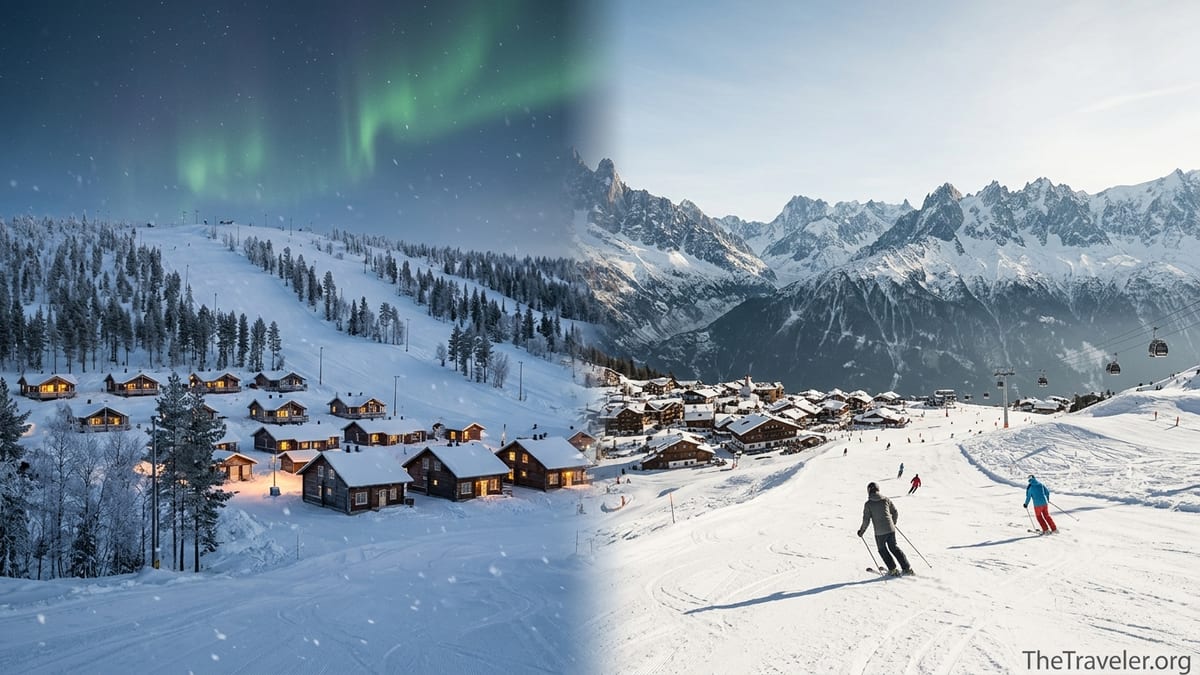
Overall Vibe: Arctic Wilderness vs Mountain Playground
Lapland feels like stepping into a quiet Arctic storybook. Resorts such as Levi, Ylläs and Ruka sit among low, rounded fells, dense pine forest and frozen lakes rather than towering peaks. The ski areas are compact, evenings are calm and most visitors split their time between gentle skiing and off slope experiences like husky sledding or aurora chasing. It suits travelers who like space, silence and a strong sense of being in the far north.
The Alps, by contrast, are about scale and drama. Think of the sheer rock faces above Chamonix, the vast bowl of Les Trois Vallées in France or the long valley of St Anton in Austria. Villages often buzz late into the evening, with busy bars, bakeries, ski shops and lifts all within a short walk. Here, skiing is usually the main event and everything from lift infrastructure to village layout reflects that focus.
This difference in atmosphere shapes daily life. In Lapland, you might ski a few relaxed hours at Levi in the late morning, warm up over salmon soup in a wooden kota hut, then spend the evening on a reindeer sleigh ride or sitting in a glass igloo outside Rovaniemi watching the sky. In a French or Swiss resort you are more likely to catch the first lift, ski hard until mid afternoon, then go straight into après ski on a sun terrace in Val d’Isère or Verbier.
Personality matters. If your ideal winter trip is as much about stillness, Arctic light and trying new snow activities as it is about vertical meters, Lapland has the edge. If you feel happiest racking up mileage on varied pistes, hopping between villages and staying out late, the Alps will probably feel more satisfying.
Ski Terrain, Snow and Daylight: What You Actually Ski
Lapland’s ski hills are modest in height but generous with snow and season length. Levi, Finland’s largest resort, tops out around 531 meters, with roughly 40 to 45 marked slopes and extensive snowmaking. The season typically runs from late October or early November into late April, and in some years early May, which is longer than many mid altitude Alpine resorts. Snow cover is usually reliable thanks to long, cold winters, though runs are shorter and gradients gentler overall.
The Alps offer dramatically more vertical and variety. A linked area like Les Trois Vallées in France gives access to more than 600 kilometers of pistes, with high altitude slopes above 2500 meters and glaciers staying cold well into April. Resorts such as Tignes, Val Thorens, Saas Fee or Obergurgl build their reputation on long, sustained descents, steeps and sidecountry options that simply do not exist around Lapland’s fells. For strong intermediates and experts who want technical terrain, tree skiing and off piste, the Alps are hard to beat.
Daylight is a key difference that many first timers underestimate. In mid winter in northern Lapland, around late December and early January, the sun barely rises. At Levi or Ylläs you might have just a few hours of blue twilight in the middle of the day. Resorts compensate with extensive floodlighting, so many pistes and cross country tracks are lit until evening. This creates a unique atmosphere, skiing under pink skies and later under stars, but it also means you spend much of your day in low light and cold temperatures often well below freezing.
Visit the Alps during the heart of the season, from January to early March, and you enjoy much longer days. Even lower resorts in Austria or Italy usually have full sunlight from late morning to mid afternoon, and by March many south facing slopes feel almost spring like at lunchtime. If you rely on strong daylight for confidence or simply enjoy long, bright ski days and sun terraces, the Alps are the safer choice. If you are intrigued by Arctic twilight and the idea of skiing under floodlights with a chance of northern lights overhead, Lapland turns that into part of the charm.
Experiences Beyond the Slopes
Where Lapland really stands apart is in what you do when you are not on skis. A typical week in Levi or Rovaniemi might include an evening snowmobile safari, a half day husky sled tour through the forest, a visit to a reindeer farm, ice fishing on a frozen lake and multiple sauna sessions with snow roll or ice hole dips. Specialized operators in towns like Rovaniemi, Saariselkä and Ylläs bundle these into packages aimed at families and first time Arctic visitors.
Perhaps the most iconic Lapland experience is hunting the northern lights. Between roughly September and April, clear dark nights north of the Arctic Circle bring frequent aurora displays. Many hotels now offer “aurora wake up” calls so you do not have to stay outside all night. Glass roofed cabins near Levi, igloo style domes in Saariselkä and remote eco lodges in Swedish Lapland are designed so you can watch the sky from bed, something the Alps cannot realistically match.
Christmas themed trips are another Lapland specialty. In December, short breaks to Rovaniemi often revolve around Santa experiences, sleigh rides and gentle ski taster sessions rather than full days on the slopes. This appeals strongly to families with younger children who want snow, magic and manageable activities instead of a week of intense skiing.
Alpine resorts offer their own style of off slope fun but it tends to orbit ski culture. In Austria you might finish a day in Ischgl or Kitzbühel with loud après ski bars, live bands and table dancing. In Italy’s Dolomites, long, indulgent lunches at mountain rifugi with local wine and homemade pasta can easily steal hours from skiing. Many larger French and Swiss resorts add spas, swimming pools and non ski activities such as toboggan runs or paragliding, yet the core focus remains downhill skiing or snowboarding rather than Arctic excursions.
Budget, Value and Practical Costs
Both Lapland and the Alps cover a wide price range, but they differ in what you get for your money. In Levi, for example, a four day adult ski pass for the 2025 to 2026 main season is typically under 200 euros, and children’s passes are significantly cheaper. Prices can fluctuate by period, but overall lift passes in Lapland’s main resorts tend to come in below headline prices in large French or Swiss domains for the same number of days, partly because the areas are smaller and operate fewer high altitude lifts.
In the Alps, a six day adult pass for a major linked region such as Les Trois Vallées, Paradiski or Val d’Isère Tignes can cost well over 300 euros in high season. Austria and Italy can be a little cheaper, especially in smaller local areas, but big name resorts still command premium prices. On the other hand, the sheer extent of terrain means that committed skiers often feel the cost is justified by the kilometers skied each day.
Flights and accommodation complicate the picture. Reaching Lapland from North America generally means at least one connection via a European hub to Rovaniemi, Kittilä or Ivalo, before a transfer to your resort. Seasonal charter packages can make this efficient for European travelers, but independent trips may add up quickly. On the ground, Nordic countries are known for high living costs: a casual restaurant meal in Levi or Rovaniemi can easily run 20 to 30 euros per person without drinks, and specialty activities like husky safaris often cost well over 100 euros per adult for a half day.
The Alps, by contrast, are closer to major European cities and have intense competition among airlines, trains and coaches. If you are based in Europe it is often cheaper and quicker to reach Geneva or Innsbruck than Lapland’s airports. In resort, prices vary widely. A coffee on the mountain in Switzerland can feel steep, while in smaller Italian Dolomites villages you may still find affordable pizza and house wine. Budget conscious travelers can base themselves in satellite towns like Bourg Saint Maurice or Zell am See and commute to the lifts, which is harder to replicate in sparsely populated Lapland.
Who Each Destination Suits Best
If your main aim is skiing, the Alps typically suit intermediates and advanced skiers who want long runs, challenging terrain and a sense of covering distance each day. A confident skier from Colorado or British Columbia will likely feel more at home in places such as St Anton, Verbier or La Plagne than on the shorter, mellower slopes of Levi or Ruka. Snowboarders who enjoy parks and freeride terrain also tend to gravitate toward Alpine resorts with purpose built snowparks and readily accessible off piste zones.
Lapland shines for mixed ability groups, cautious beginners and families who do not need extreme terrain. Many visitors are first time skiers or people who have skied only once or twice before. The gentle gradients, uncrowded pistes and extensive English speaking ski schools make learning less intimidating, and you can easily skip a day of skiing without feeling you are “wasting” a big area pass. Children often respond well to the combination of snow fun, Santa visits and animal based activities, which break up the week.
Lifestyle preferences matter too. Night owls and social travelers usually find more nightlife, varied restaurants and spontaneous encounters in mid to large Alpine resorts. If you picture yourself moving between wine bars, live music and buzzing hotel lounges after dark, France, Austria, Switzerland and Italy all provide plenty of options. In Lapland, evenings tend to be quieter and revolve around saunas, early dinners and maybe an aurora excursion rather than late night partying.
For nature lovers and photographers, Lapland’s Arctic setting is a strong pull. Low winter sun, hoarfrost covered trees and open tundra landscapes create a very different look from the rugged, sharp peaks of the Alps. If your dream is to photograph northern lights over a frozen lake or to experience temperatures far below zero in a controlled, safe way, Lapland clearly has the advantage.
When To Go and How Weather Shapes Your Trip
In Lapland, winter conditions arrive early and stay late. Snow on the ground from late October right through to April is common in areas like Levi, Ylläs and Saariselkä. Deep winter months, roughly December and January, bring the coldest temperatures and shortest days, while February and March often balance better daylight with reliable snow and frequent aurora activity. For many travelers, late February to mid March is the sweet spot, combining good skiing, slightly milder cold and strong chances of dark, clear nights.
The Alps are more sensitive to altitude and recent weather patterns. Early season skiing in December can be superb at high altitude resorts like Val Thorens or Ischgl, but lower areas may rely heavily on snowmaking. January often brings the coldest, driest conditions and some of the best snow quality, while February is peak season for both snow depth and crowds. March and early April can be wonderful, especially in the higher French and Swiss resorts, but south facing slopes may turn soft in the afternoon and spring conditions can vary year to year.
Your tolerance for cold is an important factor. In northern Lapland, temperatures of minus 15 to minus 25 degrees Celsius are not unusual in mid winter, and windchill on exposed chairlifts can be harsh. Resorts are well equipped with heated indoor areas, frequent cafés and saunas, but you will still need proper cold weather gear, including insulated boots, mittens, face protection and multiple base layers. By comparison, many Alpine destinations feel comparatively mild, especially in March when terrace lunches in light jackets become realistic.
Weather also impacts non ski plans. In Lapland, heavy cloud cover can reduce northern lights visibility for days at a time, so you should never travel solely for aurora without enjoying the other aspects of the trip. In the Alps, strong winds can close high lifts, especially on exposed ridgelines, and storms may affect visibility on big, treeless glaciers. Building a flexible itinerary, with spare days and alternative activities, helps in both regions.
The Takeaway
Choosing between Lapland and the Alps is ultimately about what kind of winter story you want to live through. The Alps deliver big mountain skiing, extensive lift networks and lively resort towns where skiing sits at the center of everything. They suit travelers who define a successful trip by the number of runs skied, the challenge of the terrain and the energy of après ski.
Lapland, by contrast, offers a broader Arctic experience in which skiing is one element among many. Snow sure fells, floodlit pistes and gentle gradients make it accessible to beginners and families, while husky safaris, reindeer encounters, snowmobiles and northern lights hunts create memories you simply cannot replicate elsewhere. The tradeoff is less vertical, fewer steep runs and quieter nights.
If you can imagine being perfectly happy spending half your time off the slopes, savoring Arctic silence and chasing auroras, Lapland will likely feel magical. If you know that you come alive when carving long descents, exploring huge linked ski areas and lingering over mountain lunches in the sun, then the Alps will serve you better. Many skiers eventually discover there is room in their travel life for both types of winter: one year an Alpine marathon of ski days, another year a slower, more contemplative Arctic adventure.
FAQ
Q1. Is Lapland or the Alps better for a first time skier?
For a complete beginner, Lapland can be easier thanks to gentle slopes, smaller crowds and strong English speaking ski schools, but many Alpine resorts also offer excellent beginner areas.
Q2. Where are ski trips generally cheaper, Lapland or the Alps?
Lift passes in Lapland’s main resorts are often slightly cheaper than big Alpine domains, but higher general living costs and paid activities can narrow the gap.
Q3. Can I reliably see the northern lights if I choose Lapland?
Lapland gives you a good chance in winter, especially from late autumn to early spring, but aurora sightings are never guaranteed and depend on weather and solar activity.
Q4. Which destination has better snow conditions?
Lapland benefits from long, cold winters and reliable snow cover, while high altitude Alpine resorts often have deeper snow and more varied terrain, especially for advanced skiers.
Q5. Is it too dark to enjoy skiing in Lapland in December?
It is very dim and short on daylight in northern Lapland in December, but resorts use extensive floodlighting, so you can still ski; expect more twilight and night skiing than bright sun.
Q6. Which is better for nightlife and après ski?
The Alps win for nightlife, with busy bars, live music and late opening venues in many resorts, while Lapland evenings tend to be quieter and more focused on saunas and nature.
Q7. Are Lapland ski resorts suitable for strong expert skiers?
Experts will find some enjoyable runs and park features in Lapland, but the terrain is limited compared with the Alps, which offer steeps, couloirs and extensive off piste options.
Q8. How far in advance should I book a Lapland ski and aurora trip?
For peak weeks in December and popular February and March dates, it is wise to book flights, accommodation and key activities several months, often six or more, in advance.
Q9. Can I combine skiing in the Alps with other winter activities like husky sledding?
Some Alpine areas offer dog sledding or snowmobile tours, but they are generally shorter and less central than in Lapland, where such activities are a core part of most itineraries.
Q10. Which destination is better for families with young children?
Both can work well, but many families choose Lapland for its gentle ski terrain, Christmas activities and animal experiences, while the Alps appeal to families focused on full days of skiing.