


The Canary Islands deliver an unusually dramatic mix for such a small Atlantic archipelago: snow-dusted volcanoes, Sahara-style dunes, subtropical forests, resort beaches and some of Europe’s most reliable winter sun. Whether you base yourself in Tenerife, Gran Canaria, Lanzarote or Fuerteventura, the real magic lies in getting beyond the hotel pool and into the islands’ lava fields, ravines and ocean. This guide focuses on the standout experiences most travelers remember long after their tan has faded: Teide and Timanfaya’s volcanic landscapes, the Maspalomas and Corralejo dunes, whale watching, hiking, old towns, Atlantic beaches and boat trips.
Get the latest updates straight to your inbox!
Teide National Park: Volcano Views Above the Clouds
Teide National Park in Tenerife is one of the most striking volcanic landscapes in Europe, dominated by Mount Teide, a 3,715 meter peak that on clear days rises above a sea of clouds. Most visitors experience it via the Teide Cable Car, which runs from the base station at roughly 2,356 meters to La Rambleta station just below the summit. Standard return tickets typically start around 40 to 45 euros per adult when booked directly and often sell out in peak months, so it is worth reserving online several days in advance, especially for sunrise or sunset slots.
If you are reasonably fit, combine the cable car with short walks from La Rambleta to the official viewpoints such as Mirador de la Fortaleza or Mirador Pico Viejo. These paths are paved or well-graded but at high altitude, so even a 20 minute stroll can feel demanding. To stand at the very crater rim you need a free summit permit issued by Spain’s national parks authority, which must usually be requested several weeks, sometimes months, before your trip; commercial “ascent to the peak” tours bundle this permit with guides and cable car tickets to simplify the process.
Independent travelers can reach the park by car along TF-21 from either La Orotava in the north or Vilaflor in the south, both scenic mountain drives with plenty of miradores where you can pull over for photos of lava flows and pine forests. Without a car, there are a few public TITSA buses that run to the park from Puerto de la Cruz and Costa Adeje, but timetables are limited and often suit day trippers rather than sunrise chasers, so many visitors opt for organized day tours that handle transport and timings. In all cases, pack warm layers even in August, as temperatures around the upper cable car station can be close to freezing once the sun drops.
Another memorable way to experience Teide is at night. The park is a Starlight Reserve with very low light pollution, and several local companies offer stargazing sessions that combine sunset viewpoints, simple telescopes and hot drinks. Prices vary, but group tours with transport commonly range from about 60 to 100 euros per adult depending on whether dinner is included. If you prefer to go alone, you can drive up after dark and park at one of the official lay-bys, but check the lunar calendar in advance: the Milky Way is spectacular around new moon, while full moon nights are better for easy moonlit walks such as the relatively gentle Siete Cañadas trail.
Timanfaya National Park and Lanzarote’s Lava Sea
Timanfaya National Park on Lanzarote showcases the aftermath of 18th century eruptions that buried villages beneath lava and ash, leaving a terrain that still looks freshly scorched. There is only one public road crossing the park; from the visitor parking area at Islote de Hilario you board official coaches for the Ruta de los Volcanes tour, a roughly 35 to 40 minute loop through cinder cones and contorted lava fields. Commentary is provided on board in multiple languages and emphasizes the geology and local history. Because private cars and independent hikers are not allowed off the access road, this coach circuit is the standard way to see Timanfaya’s core.
At Islote de Hilario, staff demonstrate the heat that continues to simmer just below the surface by pouring water into boreholes to create artificial geysers and by showing how dry brush catches fire in shallow pits. These demonstrations run throughout the day and are included once you have paid the park entrance fee at the road control point. Expect queues to form from late morning, especially in high season and on cruise ship days, so it is wise to arrive close to opening time or visit in the late afternoon when temperatures ease and buses thin out.
Most travelers combine Timanfaya with nearby attractions created by the Lanzarote artist and architect César Manrique, such as the Jameos del Agua lava tube complex or the cactus garden at Guatiza. Rental cars are the easiest way to connect these sites on a day loop, but if you prefer not to drive there are “Grand Tour of Lanzarote” excursions that usually bundle Timanfaya’s coach route, a short camel ride just outside the park boundary, and one or two additional Manrique-designed spaces. As a rule of thumb, budget something like 40 to 70 euros per adult for a full day with transport from resorts like Puerto del Carmen or Costa Teguise.
Even outside the national park fence, Lanzarote’s southwest coast feels otherworldly. The coastal road between El Golfo and Los Hervideros passes wave-battered cliffs and roadside viewpoints over old lava deltas. If you base yourself in Playa Blanca, you can pair a morning in Timanfaya with a detour to the Papagayo coves, where short dirt tracks lead from parking areas down to small horseshoe bays with clear water ideal for snorkeling on calm days.
Maspalomas and Corralejo Dunes: Desert Meets the Atlantic
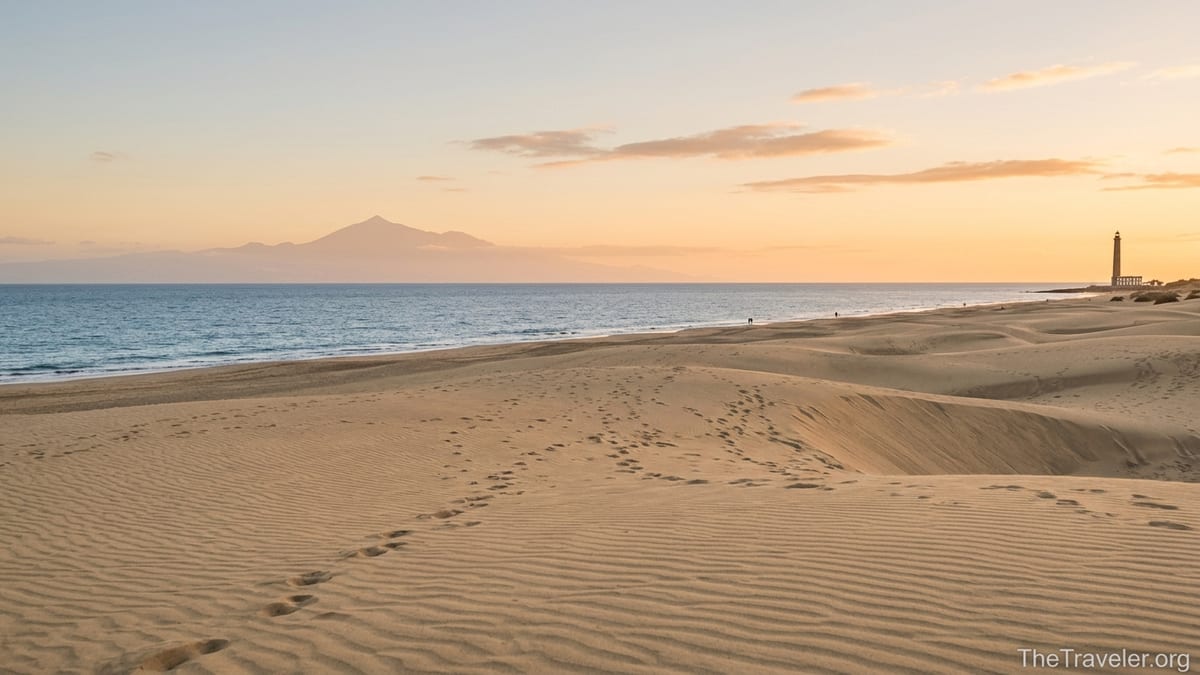
On Gran Canaria, the Maspalomas Dunes form a 400-plus hectare protected nature reserve where wind-sculpted sand ridges roll down to a long, shallow beach. The most common access points are from the Maspalomas Lighthouse promenade or from Playa del Inglés further east, both fringed with hotels, shops and beach bars. Within a few minutes’ walk you leave the resort noise behind and find yourself on soft, shifting sand that can feel almost Saharan in strong sun. The dunes are fragile, so follow marked paths and wooden walkways where provided, and avoid climbing fenced-off ridges.
Conditions change through the day, and timing your visit can improve the experience. Early morning just after sunrise tends to be cooler and quieter, with easier walking before the sand heats up. By mid-afternoon, trade winds often pick up; on particularly windy days you may prefer to enjoy the dunes in short forays from the beachfront to avoid sand blowing into eyes and cameras. Families often base themselves at resort complexes such as those near Campo Internacional or along Avenida de Tirajana, where it is a 10 to 20 minute walk to reach the main dune access beside shopping centers like Cita or Yumbo, making a quick pre-breakfast dune walk very feasible.
Across the water in Fuerteventura, Corralejo Dunes Natural Park offers a more open, road-side dune landscape. The main FV-1 highway south of Corralejo town runs between sand hills and the Atlantic, and informal lay-bys allow you to pull over and clamber straight onto the dunes. Travelers often pair a few hours here with time on nearby beaches like Playa del Moro or with windsurfing and kitesurfing lessons, as this stretch of coast is breezier and draws water sports schools. Corralejo town itself remains the primary base, with a compact center of restaurants and apartment-style hotels and regular ferries across to Lanzarote for day trips.
Wherever you explore dunes in the Canaries, basic preparation makes a big difference: closed shoes or sandals that secure to your feet, a refillable water bottle, high-factor sunscreen and a light scarf or buff for windy days. Photographers might prioritize late afternoon and sunset, when the dune ridges cast long shadows and the sky often glows pink over the horizon, especially behind the Maspalomas Lighthouse or looking towards the islet of Lobos from Corralejo.
Whale Watching and Ocean Boat Trips
The deep channel between Tenerife and La Gomera is one of Europe’s most reliable places to see wild cetaceans. Resident short-finned pilot whales and bottlenose dolphins are present year round, and migratory species such as sperm whales or various types of dolphin pass through seasonally. Most whale watching tours depart from ports in south Tenerife such as Puerto Colón in Costa Adeje or Los Cristianos, where kiosks along the marina promenade advertise two to five hour trips. Group catamaran excursions with basic drinks can start from roughly 20 to 30 euros per adult on promotional deals, while smaller sailing boats with fewer passengers and snacks often cost in the 55 to 70 euro range.
For a more responsible experience, look for operators that highlight their compliance with Spanish whale watching regulations, limit their approach distances, and mention having marine biologists on board. Companies based in Puerto Colón and Los Cristianos increasingly promote “no chase” policies and cap the number of boats near a pod at any one time. If you are traveling in high season, pre-booking online can secure a preferred departure time and allow you to choose between quieter morning sailings or livelier afternoon trips that may combine whale watching with swimming stops in coves such as Bahía del Duque or along the Los Gigantes cliffs.
Beyond Tenerife, other islands also offer worthwhile offshore experiences. From Gran Canaria, boat trips run from Puerto Rico, Puerto de Mogán and Las Palmas, mixing dolphin watching with coastal cruises; families often choose glass-bottomed boats so children can peer at fish near artificial reefs. In Lanzarote, catamaran days out from Puerto del Carmen or Puerto Calero usually head to the Papagayo area for swimming and kayaking, while in Fuerteventura sailing trips from Corralejo might circle the low-lying islet of Lobos. Prices fluctuate with season, but budgeting around 35 to 70 euros per adult for a half-day trip with snacks or lunch is reasonable.
Sea conditions in the Atlantic can be choppy, particularly in the afternoon and in the windier months of winter and early spring, so motion sickness tablets, light clothing you do not mind getting splashed and a waterproof pouch for your phone are all sensible. For photography, a zoom lens in the 70 to 200 millimeter range on a camera or a smartphone with a decent telephoto setting will help you capture distant dorsal fins without needing to lean over railings.
Hiking, Viewpoints and Volcanic Landscapes Inland
While the coast draws most visitors, the Canary Islands’ interiors are where you truly feel their volcanic bones. On Gran Canaria, the hike to Roque Nublo, a freestanding basalt monolith and island symbol, is one of the classic walks. The standard route from the La Goleta parking area takes around 60 to 90 minutes return for most people, climbing gently along a rocky but well-marked path through pine forest to panoramic views across central ravines. On clear days you can see Mount Teide on neighboring Tenerife floating above the horizon, especially around late afternoon when the light softens.
Tenerife’s Anaga Rural Park, in the island’s far northeast, offers a very different mood: steep green ridges, laurel forests and tiny hamlets like Taganana clinging to slopes above the ocean. Waymarked trails range from short interpretive loops near the Cruz del Carmen visitor center to longer point-to-point hikes, and buses from Santa Cruz and La Laguna make it feasible to do some walks without a car. Weather here is often cooler and wetter than on the coasts, so bringing a light rain jacket is wise even if you are staying under blue skies around Costa Adeje or Los Cristianos.
On Lanzarote, several official trails skirt the edges of Timanfaya or traverse older volcanic cones outside the national park, such as the route into the Caldera de Los Cuervos crater. These walks usually start from roadside parking bays and take around one to two hours, with interpretive panels explaining how eruptions reshaped the island in the 1730s. Because the surfaces are sharp and dusty, sturdy trainers or hiking shoes are much more comfortable than flip flops, and carrying at least a liter of water per person is recommended in the drier months.
Whichever island you choose, keep in mind that driving distances on maps can be misleading: mountain roads are sinuous, with frequent hairpins and scenic stops. A drive from Maspalomas to the central highlands of Gran Canaria, for example, may take 60 to 90 minutes even though the straight-line distance is modest. Building in buffer time for unscheduled viewpoints, coffee stops in villages like Tejeda or Vilaflor, and short spontaneous walks will make days more enjoyable and less rushed.
Beaches, Old Towns and Coastal Promenades
For many travelers, the appeal of the Canary Islands lies as much in their urban waterfronts and historic quarters as in their wilder landscapes. On Gran Canaria, the capital Las Palmas has one of Spain’s great city beaches in Las Canteras, a broad bay protected by an offshore reef where you can swim or paddleboard in relatively calm waters. Behind the sand runs a car-free promenade lined with cafes and ice cream kiosks, ideal for evening strolls after a day trip inland. A short bus ride away, the Vegueta district offers cobblestone streets, colonial-era houses and the Cathedral of Santa Ana, giving a sense of the islands’ role in Atlantic trade routes.
Tenerife’s north coast rewards those willing to leave the resort belt. The old port city of Puerto de la Cruz mixes black-sand beaches like Playa Jardín, designed with tropical gardens, with traditional plazas and local eateries. Nearby La Orotava, perched above the valley, contains some of the island’s best-preserved Canarian balconies and courtyards in houses that are still lived in rather than staged museum pieces. Visitors staying in the south can reach these areas in about an hour by car, or slightly longer via interurban buses that climb over the island’s central spine.
Lanzarote’s main resort beaches around Puerto del Carmen and Costa Teguise feature long, gently shelving sands suited to families and first-time swimmers, while the sheltered bay at Playa Blanca and the coves of Papagayo provide clearer water for snorkeling on calmer days. Inland, the town of Teguise hosts a busy Sunday market where local crafts and food products, such as cheeses from island dairies and aloe-based cosmetics, share space with more generic souvenirs. On Fuerteventura, Corralejo’s town beach and the vast, wilder stretches south of it cater to both casual bathers and kitesurfers, with equipment rental shops and surf schools dotted through the town center.
Accommodation choices across the islands range from large all-inclusive complexes to small rural houses and boutique hotels in old quarters. Travelers focused on activity might choose a base in Costa Adeje for easy access to Teide and whale watching, Maspalomas or Playa del Inglés for the dunes and south Gran Canaria hikes, Puerto del Carmen for Timanfaya and Lanzarote’s northern viewpoints, or Corralejo for dunes and inter-island ferry links. Public transport exists and is improving, but renting a small car for at least part of your stay will dramatically expand what you can realistically see in a week.
The Takeaway
Exploring the Canary Islands is less about ticking off beaches and more about embracing variety. In a single week you might ascend above the clouds on Teide, walk barefoot over desert-like dunes at Maspalomas or Corralejo, peer into the lava fields of Timanfaya, and watch pilot whales surface off Costa Adeje. Add in laurel-forested hikes, old town rambles and simple pleasures like sunset promenades along Las Canteras or Puerto del Carmen’s seafront, and you begin to understand why so many travelers return year after year.
To make the most of a trip, think of your island not as a single resort but as a small continent in miniature. Plan a couple of headline experiences, such as a Teide cable car ride or a whale watching tour, then leave space for slower, unscripted days of village exploring and coastal walks. Prioritize early starts to beat heat and crowds in popular spots like Maspalomas, book key tickets such as summit permits or boat trips a little in advance, and pack layers so that you can comfortably move from warm beaches to cool highlands. The reward is a holiday that feels rich and varied rather than repetitive, with enough texture and contrast to stay with you long after your flight home.
FAQ
Q1. Which Canary Island is best if I want to combine volcanoes, beaches and whale watching?
Tenerife is usually the most practical choice because it offers easy access to Teide National Park, a wide range of south coast beaches around Costa Adeje and Los Cristianos, and year round whale watching trips from ports like Puerto Colón. You can still take day trips to quieter northern towns such as La Orotava or Puerto de la Cruz if you want a mix of resort and local atmosphere.
Q2. How far in advance should I book the Teide cable car and summit permit?
For standard cable car tickets, booking a few days ahead is often sufficient outside peak school holiday periods, but in August, at Easter and around Christmas it is safer to reserve as soon as you know which day you plan to visit. Summit permits to reach the very top of Teide are limited and free, and they are commonly snapped up weeks or even months in advance, so check availability early and consider a guided tour that includes the permit if your dates are not flexible.
Q3. Do I need a car to visit Maspalomas Dunes or Corralejo Dunes?
You can reach both dune areas without a car, but having one increases flexibility. Maspalomas Dunes are within walking distance of many hotels in Maspalomas and Playa del Inglés, and local buses serve the lighthouse and beachfront frequently. In Corralejo, most accommodations are a short taxi or bus ride from the roadside dune area, and some visitors simply walk from town along the coast. A rental car, however, allows you to time visits for sunrise or sunset and easily combine dune stops with nearby beaches or villages.
Q4. Are whale watching tours in Tenerife suitable for young children?
Most standard catamaran and boat trips welcome families and offer life jackets for children, and two to three hour itineraries are generally manageable for kids. If your child is prone to motion sickness, choose a larger, more stable vessel and morning departures when the sea is often calmer. Bringing snacks, a light jacket and something to occupy younger children between sightings helps keep the experience enjoyable for everyone.
Q5. What should I wear for hiking in the Canary Islands?
For most day hikes, comfortable trainers or light hiking shoes with good grip, breathable clothing, a hat and sunscreen are enough. In higher areas like Teide, Roque Nublo or Anaga Rural Park, temperatures can be much cooler and weather can change quickly, so pack a thin fleece and a windproof or rain jacket in your daypack even if it feels hot at the coast when you set out in the morning.
Q6. Can I visit Timanfaya National Park on my own, or do I need a tour?
You can drive your own car to the Timanfaya entrance, pay the park fee and join the official coach tour from the Islote de Hilario parking area without joining a larger excursion. Many visitors do exactly this if they have a rental car. Organized tours become useful if you do not want to drive or if you prefer a day that also includes other sites around Lanzarote, saving you from navigating and parking in multiple locations.
Q7. Is swimming safe on Canary Island beaches with volcanic sand?
In general, swimming is safe on many Canary beaches, whether the sand is golden or black and volcanic, provided you follow local warnings. Pay attention to flag systems that indicate sea conditions, respect lifeguard instructions where present, and be cautious on exposed Atlantic stretches where waves and currents can be strong. Sheltered bays such as Playa de las Teresitas in Tenerife, Las Canteras in Las Palmas or Papagayo coves in Lanzarote are especially popular with families because of their calmer waters.
Q8. When is the best time of year to visit the Canary Islands for outdoor activities?
The islands are a year round destination, but late spring and autumn often offer the best balance of mild temperatures, lower crowds and generally stable weather. Winter months are excellent for escaping colder European climates and still enjoying hiking and boat trips, though seas can be rougher and higher elevations cooler. In peak summer, you will likely want to start hikes and dune visits early in the morning and save beach time or pool breaks for the hotter midday hours.
Q9. Are the Maspalomas and Corralejo dunes accessible to people with limited mobility?
Walking deeply into the dunes themselves can be difficult for anyone with limited mobility because the sand is soft and uneven. However, both Maspalomas and Corralejo have long beachfront promenades and nearby paved areas with sea views where wheelchairs and strollers can move comfortably. In Maspalomas, wooden walkways and viewing platforms near the lagoon and lighthouse area allow you to appreciate the dunes from firmer ground without having to cross loose sand.
Q10. How long should I plan to stay in the Canary Islands for this kind of activity-focused trip?
If you want to experience a mix of volcano visits, dune walks, whale watching, a couple of hikes and time in at least one old town, a week on a single island is a good starting point. Ten to fourteen days let you move more slowly, add another island via a short inter-island flight or ferry, and build in rest days by the pool or on the beach between bigger excursions, which many travelers find makes for a more relaxed and memorable trip.