


Walking into the Vatican district for the first time, I expected my day to begin in the shadow of St Peter’s dome. Instead, it began on a wide, traffic-ringed square just outside the Vatican walls: Piazza del Risorgimento. That short walk across the piazza quietly rewired how I navigate this dense and often chaotic corner of Rome, and it might do the same for you.
Get the latest updates straight to your inbox!
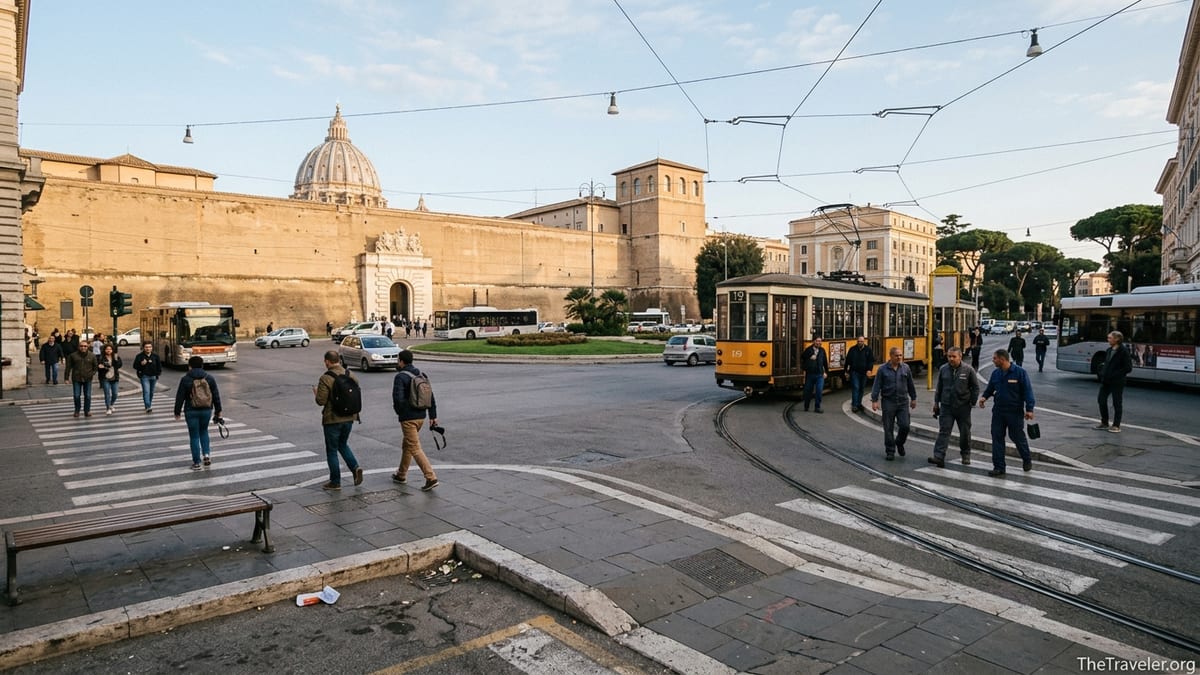
Discovering Piazza del Risorgimento Before the Vatican Walls
I first reached the Vatican area the way most visitors do, on Metro Line A. When I stepped out at Ottaviano – San Pietro – Musei Vaticani, the crowd surged instinctively toward Via Ottaviano, funnelling straight toward St Peter’s Square. I followed for a few minutes before peeling away onto a side street and being pulled instead toward an open, light-filled square: Piazza del Risorgimento.
Piazza del Risorgimento is not postcard-pretty in the way of Piazza Navona, but it is one of the most practical landmarks in modern Rome. A tram tracks a curve along one side, buses idle in a row, and the Vatican walls rise just behind it. From here, the massive queue curling along Viale Vaticano makes sense in a way it never does in photos: you can see where it starts, how it turns, and where you actually must go to reach the museums’ entrance.
Standing in the middle of the square in the early morning, I realized that this was the true gateway to the Vatican for city commuters. Locals stepped off tram 19, shrugged their bags over their shoulders and cut purposefully toward the walls. School groups gathered by the bus stops, guides lifted colored umbrellas, and taxis circled the central garden. It felt less like a religious destination and more like a transport hub at the edge of a tiny independent state.
Instead of rushing straight toward the basilica, I stopped, watched and let the geography sink in. That few minutes of orientation in Piazza del Risorgimento changed the rest of my day. Streets and gates stopped being abstract names on a map and became visible paths radiating out from a single, understandable square.
From Confusion to Clarity: Mapping the Vatican Area on Foot
Before that walk through Piazza del Risorgimento, the Vatican had always felt like a tangle of names: St Peter’s Square, the Museums, the Sistine Chapel, Castel Sant’Angelo. On the map, everything looked close. On the ground, visitors constantly complained that what looked like a five minute walk between the basilica and the museums could stretch to fifteen or twenty minutes along the outside of the Vatican walls.
Standing at the northern edge of Piazza del Risorgimento, I could finally see why. Directly ahead, the high, honey-colored walls wrap around the Vatican like a fortress. The entrance to the Vatican Museums sits along Viale Vaticano on the far side of those walls, not next to the basilica at all. From the square, you can trace the line of people already queueing at the museum entrance and estimate how long the walk will take from where you are staying, or from St Peter’s later in the day.
This new mental map changed how I planned my routes. Instead of thinking “go to the Vatican,” I began to think in segments: Ottaviano Metro to Piazza del Risorgimento; from Piazza del Risorgimento up to the museums; later, museums to St Peter’s Square via the long walk around the walls; then perhaps across the Tiber toward Castel Sant’Angelo. Once you understand that everything revolves around the piazza and those encircling walls, moving between the Vatican’s different sights becomes much less stressful.
The square also gave me a fixed reference point. When I emerged from a side street or a residential block north of the museums, I knew that if I could find Piazza del Risorgimento again, I could find my way back to the metro, the tram line, or a taxi stand without wrestling with an offline map. In an area where GPS often jumps because of tall buildings and walls, that physical reference is surprisingly valuable.
Why Piazza del Risorgimento Is the Smart Arrival Point
Most first-time visitors aim straight for St Peter’s Square as their arrival point. There is romance in walking toward the basilica along Via della Conciliazione, but in practical terms, arriving first at Piazza del Risorgimento can make the whole day smoother. It concentrates nearly every mode of transport you might use to reach the Vatican Museums and the basilica area.
If you are coming by public transport, several bus lines used by visitors from central Rome stop directly at the square, including lines that pass major landmarks on the way, such as the Colosseum, Piazza Venezia and the historic center. Tram 19 also terminates here, giving a straightforward surface alternative if you are staying in neighborhoods like San Lorenzo or near Porta Maggiore. From the Ottaviano metro station on Line A, it is only a short walk to the southern side of the piazza.
For those relying on taxis or ride-hailing services, Piazza del Risorgimento is one of the few spots close to the Vatican with an official taxi stand. In practice, this matters at the end of a long day in the museums when your feet have finally had enough. Rather than jostling with crowds near St Peter’s Square or searching side streets, you can simply aim back toward the piazza and find a regulated taxi rank where cars cycle through regularly, especially in high season.
Budget-conscious travelers also benefit from treating the piazza as base camp. Coffee at a bar just off Piazza del Risorgimento often costs a little less than on Via della Conciliazione, where some venues openly charge higher prices for cappuccinos and bottled water. By grabbing breakfast or a late-afternoon espresso just off the square, I avoided the most inflated prices while still being only a short walk from either the museums or the basilica.
Learning to Read the Vatican Queues From the Square
One of the biggest frustrations around the Vatican is queuing. On busy days between spring and autumn, the line for on-the-spot Vatican Museums tickets can snake far along the outer walls and keep people standing for two or even three hours. From ground level at the museum entrance, it is hard to judge where that line ends or how quickly it moves.
From Piazza del Risorgimento, the picture becomes clearer. Looking up toward Viale Vaticano in the early morning, I could see three distinct patterns. First, a long, slower-moving line hugging the wall in the direction of the square, made up of people hoping to buy tickets on arrival. Second, a separate queue closer to the entrance doors, consisting mainly of visitors with online tickets. Third, small clusters of tour groups forming on the pavements as guides checked names before walking them toward an often faster-moving dedicated entrance.
Watching this play out for twenty minutes was like an informal masterclass in Vatican logistics. I saw families arriving at the piazza without tickets, staring in disbelief at how far back the pay-on-the-day line already reached. I watched couples holding printed vouchers or QR codes stride confidently past them, heading for the shorter queue, only occasionally being redirected by staff to have their vouchers validated before queuing. I noticed that groups meeting at the piazza about thirty minutes before their scheduled entry time seemed to time it well, walking up as the main doors opened to their slot.
This simple act of observation changed my own strategy. Rather than showing up at the museums at the exact time printed on my online ticket, I began to plan my morning around arriving first in Piazza del Risorgimento, grabbing a quick coffee, and then walking up to the entrance roughly twenty to thirty minutes before. That window was usually enough to go through the separate security check and be inside close to my slot without rush or panic.
Walking Routes From Piazza del Risorgimento That Actually Work
Once Piazza del Risorgimento became my mental anchor, my walking routes around the Vatican transformed. Instead of blindly following whichever tour group happened to be in front of me, I walked more deliberately, saving both time and energy. The most useful routes all began in the same place: the northern edge of the square, where the Vatican walls first come into view.
For the Vatican Museums, I would start at the tram stop side of the piazza and follow the walls uphill along Viale Vaticano. The walk takes about five to seven minutes at a relaxed pace. Locals stride past, but there is no need to hurry. You will pass sellers offering hats and scarves, then reach the slowly gathering museum queues. Because you have seen them from a distance, the sight is less intimidating. You know which line is which, where the guided tours gather, and approximately how long it will take to reach the doors.
To reach St Peter’s Square from Piazza del Risorgimento, the logic is different. Instead of heading up the hill, you angle slightly south and follow the walls in the opposite direction, then slip through side streets that open suddenly onto the vast expanse of the square. The walk is flatter, and in the late afternoon there is often shade cast by apartment buildings, a relief on hot days. Knowing that you might later have to walk twenty minutes back around the walls to reach the museums, you can plan to visit the basilica and the museums on separate days or at least leave a clear gap between them.
Perhaps the most satisfying route, though, begins and ends in Piazza del Risorgimento but loops across the Tiber. After visiting the museums in the morning, you can walk back down to the piazza, cut across the neighborhoods of Prati, and reach the pedestrian bridge near Castel Sant’Angelo. From there, the view back to St Peter’s dome is one of the most memorable perspectives on the Vatican, and your path still leads logically home via the metro or tram at Risorgimento.
Small, Grounded Choices That Make the Area Less Overwhelming
What surprised me most is how small, grounded choices made around Piazza del Risorgimento had a big impact on how I experienced the Vatican area. Choosing where to buy water, where to use a restroom, and where to take a break all became easier once I treated the piazza as a home base instead of simply a place to rush through.
Instead of buying the first bottle of water offered by a vendor near the museums entrance, I started stocking up at a supermarket a block off the square, where prices were closer to what locals pay. I discovered that some of the side-street cafes near the piazza offered reasonably priced lunch menus, so I could eat between the museums and the basilica without the sticker shock of the most touristed streets.
The square also provided a mental escape valve. On one visit, the museums were especially crowded, and after a few hours of navigating through the galleries toward the Sistine Chapel, my patience was wearing thin. Exiting the complex, instead of plunging straight toward St Peter’s with everyone else, I walked back down to Piazza del Risorgimento, found a bench, and simply watched trams and people for fifteen minutes. The distance from the holy intensity of the museums to the mundane rhythm of a city square reset my mood completely.
For families or older travelers, this kind of break is not a luxury but a practical strategy. Knowing in advance that you will build in time at the piazza to rest, regroup, or change plans reduces the sense that every moment around the Vatican has to be used for sightseeing. You can allow for weather changes, children’s energy levels, or a sudden desire to skip a queue and come back later.
The Takeaway
By the end of my first full day using Piazza del Risorgimento as my anchor, the Vatican area no longer felt like a confusing cluster of must-see sights. It felt like a neighborhood that I could move through thoughtfully. The square was not the highlight of the day in any traditional sense, but it was the vantage point from which everything else made sense.
If you are planning your own visit, consider starting your Vatican day here. Step off the tram or the metro, walk into the open space of the piazza, and take a few minutes to watch how locals and tour groups move. Trace the lines of the Vatican walls with your eyes and picture your routes not as isolated attractions but as loops starting and ending at this single, highly practical square.
In a district where so many visitors feel rushed and disoriented, that small act of orientation can change everything. You will still face crowds and queues, but you will face them with a clear mental map, a sense of where to rest and refuel, and a realistic idea of the walks between each stop. Piazza del Risorgimento turned my Vatican day from a blur into a connected experience, and it can do the same for you.
FAQ
Q1. How do I get to Piazza del Risorgimento from central Rome?
From many central neighborhoods, the simplest option is Metro Line A to Ottaviano, then a short walk following signs toward the Vatican until the square opens up in front of the walls. Several city buses and tram 19 also stop directly in the piazza, which you can identify on transit maps as a hub just north of the Vatican.
Q2. How long does it take to walk from Piazza del Risorgimento to the Vatican Museums entrance?
At a relaxed pace, plan on about five to ten minutes. You follow the Vatican walls uphill along Viale Vaticano until you reach the area where the queues begin to form. Allow extra time if you are with children, in a large group, or visiting during peak season when pavements are crowded.
Q3. Is Piazza del Risorgimento a good place to meet a Vatican tour group?
Many tour operators use points close to the museums entrance, but meeting in or near Piazza del Risorgimento can be more straightforward. It is clearly marked on maps, easy to reach by metro, bus, or tram, and open enough that guides can find groups without fighting the tight crowds right at the museum doors.
Q4. Can I walk easily between the Vatican Museums and St Peter’s Basilica?
Yes, but they are farther apart on foot than maps suggest. If your museum visit does not include direct access to the basilica, expect a fifteen to twenty minute walk around the outside of the Vatican walls.Using Piazza del Risorgimento as a midpoint can help you break up that walk and rest along the way.
Q5. Are there affordable places to eat around Piazza del Risorgimento?
Streets just off the piazza in the Prati district offer more local-style cafes and small trattorias, where prices are often lower than on the main approaches to St Peter’s. It is a practical area to grab a sandwich or coffee before or after your Vatican visit without paying the highest tourist premiums.
Q6. Is Piazza del Risorgimento safe early in the morning or late in the evening?
The square is generally busy during museum opening hours and into the early evening, with commuters, visitors, and locals passing through. As in any major city, it is wise to keep an eye on your belongings, but its open layout and steady foot traffic make it a reasonably comfortable place to wait for transport or meet companions.
Q7. Where is the closest taxi stand to the Vatican Museums?
Piazza del Risorgimento hosts one of the closest regulated taxi stands to the museums. After your visit, you can walk back down from the entrance to the square and usually find official white taxis lining up, an easier and more reliable option than trying to hail a car on the surrounding side streets.
Q8. Do I need a paper map, or is a phone enough to navigate the Vatican area?
A phone map works well for most visitors, but around tall buildings and the Vatican walls the signal can sometimes be imprecise. Using Piazza del Risorgimento as a visual reference, combined with basic offline maps, provides a good balance, especially if your battery runs low or your data connection is patchy.
Q9. Is it better to visit the Vatican Museums or St Peter’s Basilica first?
It depends on your priorities and timing. Many travelers start with the museums early in the morning to avoid the heaviest indoor crowds, then head down toward St Peter’s later in the day. Others prefer a quiet early visit to the basilica and dome, saving the museum’s long corridors for later. In both cases, planning your movements through Piazza del Risorgimento can help keep the day’s walking manageable.
Q10. What is one simple tip for reducing stress during a Vatican visit?
Plan to arrive at Piazza del Risorgimento at least thirty minutes before your timed museum entry or basilica visit, and give yourself five or ten minutes just to observe. Watching how people and traffic flow, locating the walls and entrances, and spotting nearby cafes or shops will make the rest of your time around the Vatican feel far more controlled and less overwhelming.