


Travelers often talk about “doing Europe” in one grand loop, hopping effortlessly between cultures, cuisines, and landscapes. Yet the United States, with its 50 states spread across a continent and beyond, can feel just as varied. In a single multi‑stop trip you can move from Nordic‑style fjords to subtropical reefs, from Creole street parades to desert pueblos. With smart routing and a flexible mindset, exploring the United States can feel like visiting 50 countries wrapped into one passport‑free adventure.
Get the latest updates straight to your inbox!
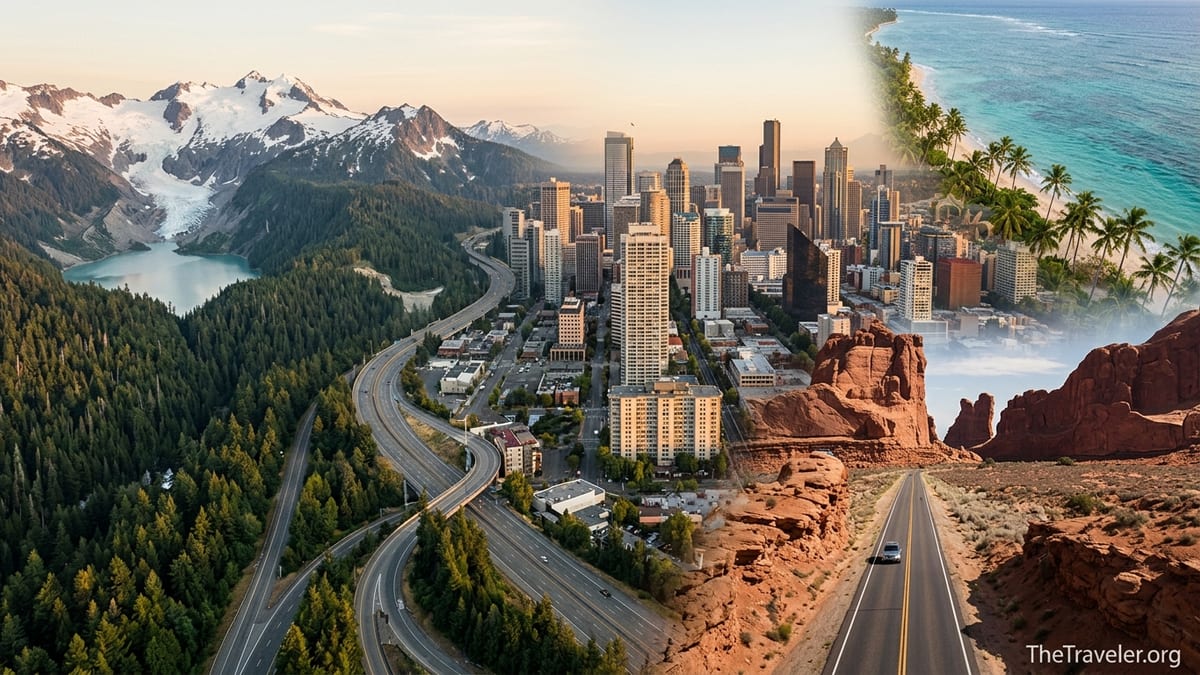
From Arctic Alaska to Tropical Hawaii: Climate Zones of a Continent
Start at the extremes and it becomes clear why the United States rarely feels like a single country. In Alaska, summer visitors heading to Anchorage or Fairbanks find long daylight hours, spruce forests, and mountain ranges that resemble northern Scandinavia. In June, a day trip from Anchorage to the coastal town of Seward puts you on a boat weaving through fjord‑like inlets, past tidewater glaciers dropping ice into the sea. Even in high summer, temperatures can hover in the 50s and 60s Fahrenheit, and you might pack a down jacket, hat, and gloves for glacier walks or evening wildlife cruises.
Fly roughly six hours south from Anchorage and you land in Honolulu, where the air is warm, plumeria scented, and often 30 degrees warmer on the same day. On the island of Oahu, the drive from the high‑rise skyline of Waikiki to the quieter North Shore passes volcanic craters, white‑sand beaches, and roadside trucks serving plate lunches of rice, macaroni salad, and garlic shrimp. In winter, big‑wave surf competitions at Waimea Bay or Sunset Beach feel like a different planet compared to the snowbound streets of Anchorage, even though both are within the same national borders.
The continental United States adds more climate extremes. In Florida’s Everglades you explore subtropical wetlands by airboat while watching for alligators and roseate spoonbills. A short drive from Miami brings you to Key Largo and the beginning of the Florida Keys, where palm trees, coral reefs, and colorful wooden houses recall the Caribbean more than the mainland. Contrast this with a winter visit to northern Minnesota or North Dakota, where temperatures routinely slide below zero Fahrenheit and locals embrace ice fishing, snowmobiling, and cross‑country skiing.
What makes these shifts so striking is how reachable they are within a single trip. A traveler might book a multi‑city ticket that connects Anchorage, Seattle, Las Vegas, and Honolulu over two or three weeks, using a combination of major carriers and low‑cost airlines. Average domestic one‑way fares in the United States often fall in the low‑ to mid‑$300 range depending on route and season, making it feasible to string together climates that would span multiple borders in other parts of the world.
Landscapes That Feel Like Different Worlds
The United States also compresses radically different landscapes into a single, navigable map. In Arizona and Utah, red‑rock canyons and sculpted sandstone arches recall parts of Jordan or Morocco. Standing on the South Rim of Grand Canyon National Park at sunrise, you look out over a chasm deeper than 5,000 feet, with layered rock that glows orange and purple in changing light. Visitors drive in on well‑paved highways from Phoenix or Las Vegas and stay in lodges or motels that, in peak season, often book out months in advance.
Drive a day and a half north and you could be among the geysers and hot springs of Yellowstone National Park, where steam vents hiss out of frozen ground in winter and bison wander across open meadows in summer. Continue east into South Dakota and the Badlands present eroded buttes and prairie reminiscent of Mongolia’s steppe. These landscapes are not remote in the logistical sense. Car rentals are readily available from regional airports like Rapid City or Jackson Hole, and national‑park gateway towns are lined with familiar hotel brands, independent motels, and campgrounds that let you customize how adventurous you want the trip to feel.
On the coasts, the contrasts sharpen further. The rocky shores of Acadia National Park in Maine bring to mind Atlantic Canada or parts of coastal Ireland: waves crashing against granite cliffs, working harbors filled with lobster boats, and lighthouses guiding ships home in the fog. In the Pacific Northwest, Olympic National Park in Washington wraps temperate rainforests, glacier‑capped peaks, and wild beaches into a single peninsula. Mossy trees, fern‑lined trails, and persistent drizzle can feel closer to New Zealand or the Scottish Highlands than to the cactus‑lined trails of Arizona or the cornfields of Iowa.
National parks knit these “countries” together under one familiar management system. From Glacier National Park’s alpine passes to Death Valley’s salt flats, entry fees, visitor centers, and campground reservations follow similar rules. In 2025, hundreds of millions of visits were logged across the park system, a reminder that this diversity is not theoretical but experienced by travelers every year. For visitors, an annual parks pass can turn this variety into a single, cost‑effective itinerary where each day reveals a new ecosystem that might otherwise require a long‑haul flight.
Cities as Cultural Capitals: New Orleans, New York, Santa Fe and Beyond
Urban America can feel just as fragmented and fascinating. New Orleans offers perhaps the clearest example of a city that feels like its own cultural country. In the French Quarter, wrought‑iron balconies and pastel facades overlook streets where brass bands march during second‑line parades and bars keep their doors open late into the night. Menus in neighborhood restaurants list gumbo, crawfish étouffée, and beignets dusted in powdered sugar. Annual events like Mardi Gras or Jazz Fest blend African, Caribbean, French, and Spanish influences into a frenetic, unmistakably local experience.
Fly a couple of hours north and you arrive in New York City, which functions more like a federation of global neighborhoods than a single place. Queens alone offers food from dozens of immigrant communities, from Tibetan momos in Jackson Heights to Greek bakeries in Astoria. In one day you can walk from Chinatown through Little Italy, then ride the subway to Brighton Beach, where Cyrillic signs and Russian grocery stores make the boardwalk feel like a slice of the Black Sea relocated to Brooklyn.
In the Southwest, Santa Fe and nearby Taos lean into adobe architecture, Native American art, and desert light. Santa Fe’s central plaza is framed by low, earth‑toned buildings and the Palace of the Governors, where Native artisans sell jewelry and pottery under the long portal. Galleries along Canyon Road show contemporary and traditional works that take inspiration from Pueblo, Spanish, and Mexican traditions. Even the food reflects the blend: enchiladas smothered in red or green chile, posole stews, and blue‑corn pancakes are common on local menus.
These cultural capitals sit within a national framework of shared currency, language, and transportation networks, but the daily experience of walking their streets, listening to local accents, and tasting regional dishes can feel as distinctive as crossing a border. For travelers without time to visit 50 states, choosing three or four sharply different cities like New Orleans, New York, Santa Fe, and Seattle can deliver an almost dizzying mix of cultures in a single trip.
Languages, Food and Festivals: Micro‑Cultures Across States
Cultural variety in the United States is not confined to big cities. Regional micro‑cultures often feel like crossings into new countries as you move from one state to another. Louisiana’s Cajun and Creole communities, descendants of French‑speaking Acadians and a mix of African, Caribbean, and European settlers, keep French expressions alive in everyday speech. Roadside boudin shops sell spiced sausage links by the pound, and small‑town dance halls still host zydeco nights where accordions and washboards set the rhythm well past midnight.
Drive west into Texas and you enter a different culinary and linguistic world. In Houston or San Antonio, Spanish flows as readily as English, and menus highlight smoked brisket, breakfast tacos, and pan dulce from panaderías. Farther south, in the Rio Grande Valley, communities have close ties across the Mexican border, and weekend markets carry imported candies, hot sauces, and handmade crafts you might expect to see in Monterrey or Reynosa.
In the Upper Midwest, strong Scandinavian and German roots shape local identity. In Minnesota, winter festivals celebrate Nordic heritage with ice sculptures, cross‑country ski races, and even sauna events on frozen lakes. Wisconsin towns host summer bratwurst cookouts and Oktoberfest celebrations where polka bands and beer gardens recall Central Europe more than mainstream American culture. Meanwhile, in Hawaii, you find a completely different blend of Japanese, Filipino, Native Hawaiian, and American influences in everything from plate lunches and poke bowls to traditional hula performances and modern surf culture.
Festivals knit these cultures into the travel calendar. A traveler might plan a late‑winter loop that takes in Mardi Gras in New Orleans, a rodeo in Houston, and a powwow in the Great Plains, each with its own protocols, foods, and rituals. There is no border control between these experiences, but the changes in music, language, and social rhythms can feel as profound as crossing from one nation to another.
Traveling Between “Countries”: Trains, Road Trips and Smart Air Hops
Connecting all this diversity are transportation networks that turn the abstract idea of “50 countries in one” into a workable itinerary. For some travelers, the classic American road trip remains the most flexible tool. Renting a car in Los Angeles and driving to Albuquerque along portions of old Route 66, for example, lets you watch palm trees give way to Joshua trees, then to high desert and adobe towns. Motels along the way range from budget chains to retro neon‑lit properties that feel unchanged since the 1960s, and fuel costs can be shared among friends to keep expenses manageable.
Others prefer to let someone else handle the driving. Long‑distance Amtrak routes like the California Zephyr and Empire Builder have become destinations in their own right. The California Zephyr links Chicago with the San Francisco Bay Area and is widely praised for its varied scenery, from the cornfields of the Midwest to the canyons and high deserts of Colorado and Utah, then the Sierra Nevada mountains before descending toward California’s Central Valley. Observation cars with large windows turn the journey into a moving panorama. Travelers can book simple coach seats, mid‑range roomettes, or larger bedrooms that include meals, allowing them to choose a comfort level that suits their budget.
The Empire Builder, which runs between Chicago and the Pacific Northwest, offers a different slice of the country. East of the Rockies, the train glides through prairies and farm towns; farther west, it skirts Glacier National Park, where snow‑streaked peaks and alpine lakes flash past the windows. For travelers used to Europe’s dense rail networks, the idea of spending two nights on a single train may feel exotic, but it provides a front‑row seat to the geographic shifts that define the American interior.
Air travel, despite its frustrations, also makes it possible to hop between “countries” quickly. Large hubs like Atlanta, Dallas–Fort Worth, Chicago, and Denver serve as interchangeable crossroads, where a morning arrival from Miami can connect to an afternoon departure for Bozeman, Anchorage, or Honolulu. With basic economy fares and sale periods, travelers can often find competitive one‑way flights that cost less than a long highway drive when shared car rental, fuel, and overnight stops are factored in. For time‑pressed visitors, a mix of one or two scenic train segments, a couple of strategic flights, and local car rentals in key regions can deliver a remarkably varied trip in two or three weeks.
Planning a Multi‑Region Itinerary That Feels Like 10 Countries
Designing an American journey that captures this variety starts with being deliberate about contrast. Instead of spending two weeks only on the East Coast, a traveler might carve the same time into three very different chapters: five days in New York City, five days split between New Orleans and the surrounding bayous, and five days in the national parks of Utah. That single itinerary takes you from skyscrapers and international art museums to live jazz clubs and Creole kitchens, then to star‑filled desert skies and sandstone arches. Each segment involves a flight or long train ride, but internal travel is straightforward to book online and supported by a wide range of accommodation choices.
Another practical structure is to choose one “anchor” region and then add side trips that contrast with it. For example, a two‑week Pacific Coast anchor might include time in Seattle, Portland, and San Francisco, with a side trip to Hawaii or the high desert around Bend, Oregon. Daily life in Seattle’s coffee shops and public markets shares almost nothing with an afternoon snorkeling among tropical fish off Oahu or hiking through volcanic craters in Hawai‘i Volcanoes National Park. Yet a few hours in the air connect them.
Travelers on tighter budgets can still sample the sense of multiple countries by focusing on one state with strong internal variety. California alone can deliver Mediterranean‑style wine valleys in Napa and Sonoma, surf towns and taco stands in San Diego, high‑alpine landscapes in the Sierra Nevada, and desert oases around Palm Springs. Using regional airports and intercity trains, visitors can move between these micro‑countries without ever crossing a state line. Similarly, a Colorado trip might combine Denver’s urban food scene, Rocky Mountain National Park’s alpine trails, and the canyon country near the Utah border.
Regardless of route, it helps to remember the distances involved. Crossing the United States from coast to coast is roughly comparable to traveling from Lisbon to Moscow. It is realistic but ambitious, and first‑time visitors often underestimate travel times. Building rest days into the schedule, choosing a few high‑impact experiences rather than trying to “see everything,” and using open‑jaw tickets that arrive in one city and depart from another all make the trip feel more like a series of distinct countries and less like a blur of airport security lines.
The Takeaway
Seeing the United States as 50 countries in one is not just a poetic metaphor. From the Arctic conditions of Alaska’s interior to the tropical reefs of Hawaii, from Creole parades in New Orleans to adobe plazas in New Mexico, each region delivers its own language rhythms, food traditions, and everyday rituals. What ties them together is not sameness but shared infrastructure: common currency, a single visa for most visitors, and well‑established networks of flights, trains, and highways.
For travelers willing to lean into the contrasts instead of chasing a single postcard image of “America,” the country becomes a vast, flexible canvas. You can string together cities that feel like different nations, national parks that span half the world’s climate zones, and festivals that would normally require multiple international trips to experience. The result is a journey that can be as ambitious or as modest as your schedule and budget allow, yet still deliver the sense of having passport stamps from half a dozen countries, all without leaving one.
FAQ
Q1. How long do I need to plan a trip that feels like visiting multiple “countries” within the United States? For a meaningful sense of contrast, plan at least 10 to 14 days and focus on three very different regions, such as a major city, a national park area, and a culturally distinct region like New Orleans or Santa Fe.
Q2. What is a realistic budget for a multi‑region U.S. trip? Budgets vary widely, but many travelers aim for a mid‑range daily spend that covers a standard hotel, meals in casual restaurants, and local transport. Domestic flights can add significantly, so look for fare sales and consider trains or buses for one or two segments to keep costs manageable.
Q3. Is it better to fly or drive between regions? For long distances, flying usually saves time, especially between coasts or when including Alaska or Hawaii. Driving works well for exploring a single broad region, such as the Southwest or the Pacific Coast, where scenic routes and small towns are part of the appeal.
Q4. Are long‑distance Amtrak trains worth including in an itinerary? For travelers who value scenery and a slower pace, long‑distance trains like the California Zephyr or Empire Builder can be highlights. They offer a window onto landscapes you might otherwise only glimpse from the air, and sleeper accommodations add comfort on overnight legs.
Q5. How can I experience different climates in one trip without overspending on flights? Focus on regions that already pack in variety, such as California or the Mountain West, where you can move from beaches to high mountains or deserts with short flights or day‑long drives instead of multiple cross‑country hops.
Q6. Do I need a car to enjoy the United States’ diversity? A car offers maximum flexibility outside major cities and is especially helpful for national parks and rural regions. However, many itineraries can combine car‑free days in cities with short car rentals or guided tours in more remote areas.
Q7. When is the best time of year to plan a varied U.S. trip? Spring and fall often offer the best balance of milder weather, lighter crowds, and reasonable prices in many regions. Summer is ideal for high‑elevation parks and Alaska, while winter works well for desert landscapes and certain cultural festivals.
Q8. How many destinations should I include in a two‑week trip? Three to four main bases is usually ideal. This allows time to settle into each place, take day trips, and appreciate local culture without feeling like you are living out of a suitcase.
Q9. Are there safety considerations when traveling across very different U.S. regions? As in any large country, it is wise to stay aware of your surroundings, follow local guidance on weather and outdoor activities, and research neighborhoods and driving conditions. In most tourist areas, common‑sense precautions are sufficient.
Q10. How can I make my trip feel more like visiting different countries rather than just moving between similar cities? Choose destinations that maximize contrast in culture, landscape, and climate, and seek out local experiences such as regional foods, festivals, neighborhood markets, and guided tours with residents who can explain how their corner of the country differs from the rest.