


Travelers flock to Canada’s national parks and historic sites for mountain vistas, wild coastlines and quiet forests. What most visitors never see is the web of work happening behind the scenes: Indigenous governance tables, underwater archaeological digs, wildfire command posts, climate research projects and urban greenway plans that stretch far beyond park boundaries. Parks Canada does far more than protect nature, and understanding that hidden role can deepen how you experience these places on your next trip.
Get the latest updates straight to your inbox!
From Scenic Backdrop to National Storyteller
For many visitors, Parks Canada is synonymous with places like Banff, Jasper or Gros Morne: postcard landscapes with a campground, a visitor centre and a park gate where you buy a pass. Yet the agency’s mandate is broader than scenery. It also manages more than 170 national historic sites and canals, from Quebec City’s intact 17th to 19th century fortifications to small memorial sites like Cartier-Brébeuf in an inner-city park in Quebec City. These places tell stories of colonial power, commerce, conflict and community that shaped the country as travelers know it today.
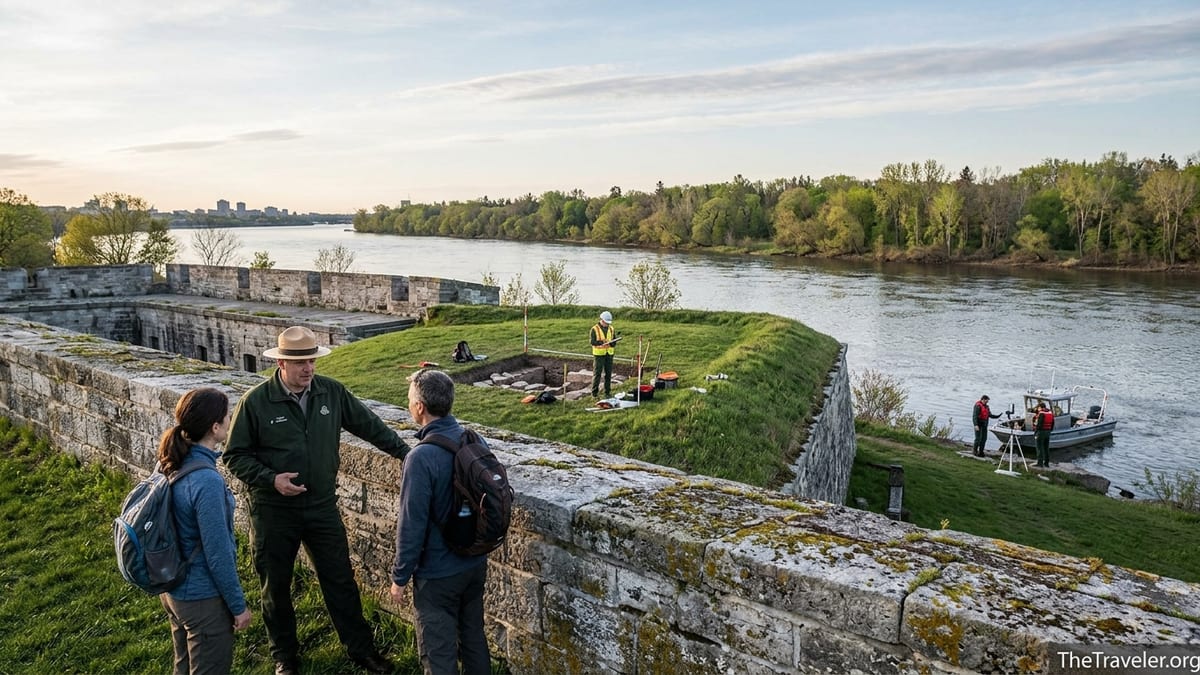
Walk the ramparts at the Fortifications of Québec National Historic Site and you are not just looking at stone walls. You are inside a layered defense system that spans redoubts, powder magazines, barracks and the star-shaped Citadelle overlooking the St. Lawrence River, all protected and interpreted by Parks Canada staff and historians. Nearby, the Artillery Park complex includes restored officers’ quarters, barracks and a powder magazine where interpreters in period clothing explain how military engineering, trade and social life intertwined over three centuries in this city.
On the Atlantic coast at Red Bay National Historic Site in Labrador, Parks Canada has spent decades working with underwater archaeologists to recover and protect the remains of 16th century Basque whaling ships. The work there goes far beyond a simple museum. Divers document wrecks in the cold water off Saddle Island, conservators stabilize artifacts like wooden barrels and cauldrons, and historians collaborate with Basque institutions to reinterpret early transatlantic industries. When you stand at the lookout over the harbour today, the tidy boardwalk and interpretive panels are the visible tip of a long-running scientific and cultural project.
Even the most natural-seeming sites have deep cultural layers. Hiking a forest trail in the Gulf Islands or paddling in the Thousand Islands, you may pass unmarked shell middens, former village locations or historic lightstations that Parks Canada evaluates and manages with archaeologists and Indigenous partners. Much of this work is intentionally unobtrusive, so visitors can enjoy the landscape without feeling like they are in an open-air museum, but the agency’s cultural specialists are constantly mapping, monitoring and documenting what lies just beneath the surface.
Indigenous Governance and Guardians on the Front Lines
One of the most significant shifts in Parks Canada’s work over the past two decades has happened around governance. In many parks, especially in the North and on the coasts, the agency co-manages protected areas with Indigenous nations who have lived there since long before Canada existed. Agreements such as the Ndahecho Gondié Gháádé arrangement for Nahanni National Park Reserve in the Northwest Territories set out shared decision-making structures, economic benefits and training programs, including Indigenous Guardian initiatives that employ local people to monitor ecosystems, welcome visitors and pass on traditional knowledge.
On the Atlantic side, a 2025 framework known as the Toqi’maliaptmu’k Arrangement, whose Mi’kmaw name is commonly translated as “we will look after it together,” describes how Mi’kmaw communities and Parks Canada will cooperatively govern places like Sable Island National Park Reserve off Nova Scotia. While visitors may only notice more Mi’kmaw place names on signs or new artwork in visitor centres, behind that are formal tables where chiefs, Elders, scientists and park managers discuss everything from horse populations to visitor quotas and cultural access.
In Banff National Park, many travelers see the mountain peaks and heritage hotels but are unaware that an Indigenous Advisory Circle made up of several First Nations and a Métis district now provides ongoing guidance on issues such as wildlife management, access to sacred sites and how Indigenous histories are presented. For a visitor, this might show up as a morning smudging ceremony at a campground amphitheatre, a guided walk with a Stoney Nakoda knowledge keeper explaining traditional fire use, or updated exhibits in the Banff Park Museum that foreground Indigenous voices alongside early mountaineering stories.
Guardian programs are often the most tangible expression of this partnership for people on the ground. On coastal and Arctic sites, you may encounter local Guardians patrolling by boat, greeting visitors at remote anchorages or monitoring sensitive wildlife colonies. They blend field science skills such as GPS mapping and water sampling with deep place-based knowledge about currents, ice, animal behavior and safe travel. Their presence also supports local employment in communities that may be a day’s travel or more from the nearest town that most tourists ever see.
Climate Change, Science and Quiet Risk Management
As climate change reshapes Canada’s landscapes, Parks Canada has become an important front-line climate science and adaptation agency. Its conservation reports over the past five years emphasize projects that monitor permafrost thaw, glacier retreat, shifting wildlife ranges and changing wildfire regimes. In mountain parks such as Banff and Jasper, travel routes that were considered relatively stable a generation ago are now actively reassessed because of more frequent rockfall, ice collapse and outburst floods linked to warming temperatures.
One visible example is the closure and eventual deconstruction of the historic Abbot Pass Hut, once perched dramatically on the Continental Divide between Banff and Yoho National Parks. As permafrost and glacial ice around the hut destabilized, Parks Canada, guided by geotechnical assessments and mountaineering risk studies, decided that simply reinforcing the structure was not safe or sustainable. Guides and experienced climbers visiting Lake O’Hara in recent years have seen more warning signage, seasonal route advisories and increased collaboration between park staff and local guiding companies as a result of these changing conditions.
In northern parks like Vuntut in Yukon, Parks Canada staff work with Indigenous partners to track how climate change is affecting the range of the Porcupine caribou herd, using satellite collars, community observations and on-the-ground surveys. Travelers who join community-led cultural tours in nearby Old Crow might hear about shifts in migration timing, snow conditions and vegetation that inform park management decisions many kilometers away. These stories illustrate how what happens in a remote wilderness area feeds directly into broader conversations about food security and cultural continuity.
Behind the scenes, the agency’s departmental plans outline priorities such as improving emergency preparedness for wildfires and floods, testing energy retrofits on aging visitor centres and staff housing, and restoring degraded habitats to improve ecological connectivity beyond park boundaries. When a visitor center in a place like Kootenay or Fundy is temporarily closed for “infrastructure upgrades,” there is a good chance that insulation, heating systems and flood resilience are being improved, not just cosmetic finishes. The aim is to make these facilities better able to withstand heavy rain, smoke-filled summers and more intense storms that are becoming familiar across Canada.
Law Enforcement, Rescue and Safety You Rarely See
National parks and historic sites may feel idyllic, but they function as complex small towns layered onto rugged landscapes. Parks Canada wardens and law enforcement specialists handle responsibilities that most visitors never think about: enforcing environmental regulations, responding to search and rescue calls, coordinating avalanche control and supporting emergency medical calls in remote terrain. In large backcountry parks, helicopter crews and warden teams stand ready during busy seasons to respond to everything from twisted ankles on popular trails to multi-day rescue operations on serious alpine routes.
In places like Banff, Jasper or Yoho, visitors heading out on technical climbs or ski tours benefit from avalanche control programs that keep highway corridors and popular slopes safer. While drivers on the Trans-Canada Highway may only notice brief road closures, behind the scenes wardens and avalanche technicians are analyzing snowpack data, working with meteorologists and, in some locations, using artillery or remote-controlled systems to preemptively trigger unstable slopes. The same teams contribute to public avalanche bulletins that backcountry skiers check daily in winter.
On busy summer days at Lake Louise or Moraine Lake, uniformed staff direct traffic and answer questions, but a parallel system is quietly monitoring crowd levels, trail conditions and wildlife activity to prevent dangerous situations. Bear management specialists may temporarily close a trail when grizzlies are feeding on berries nearby, while law enforcement officers deal with off-leash dogs, drones and other activities that can threaten wildlife or visitor safety. These decisions are often made swiftly based on radio reports, GPS data from collared animals and observations from field staff spread across the park.
Even at historic sites, protection staff play a safety and enforcement role. At the Fortifications of Québec, for instance, wardens must balance public access to ramparts and historic structures with fall risks, nighttime security, and the preservation of centuries-old masonry. They work with conservation experts to decide where visitors can climb walls, where railings are essential and how to manage special events so that heavy equipment, lighting and crowds do not damage fragile structures. For travelers, this usually appears as clear signage and friendly guidance, but it is supported by formal risk assessments and ongoing monitoring.
Engineering, Restoration and Underwater Archaeology
Maintaining the physical fabric of Canada’s protected places is a massive engineering task. Parks Canada’s asset portfolio includes more than just campgrounds and trails. It also covers heritage lighthouses exposed to Atlantic storms, swing bridges on historic canals, stone fortresses, staff housing in remote communities and even underwater shipwrecks. Many of these structures are decades or centuries old, and their restoration requires specialized conservation approaches rather than simple replacement.
At the Fortress of Louisbourg on Cape Breton Island, stone masons and carpenters trained in traditional techniques repair walls, timber frames and earthen ramparts using materials and methods that match 18th century construction as closely as possible. Visitors walking the cobbled streets may see teams carefully replacing individual stones or lime-based mortar rather than pouring modern concrete. The goal is to keep the site safely accessible while preserving the authenticity that makes it such a powerful window into colonial history.
On Canada’s inland waterways, such as the Rideau Canal in Ontario or the Trent-Severn Waterway, lock stations that boaters use as casual summer stopovers are also part of a complex civil engineering network. Parks Canada staff here manage water levels for navigation, flood control and ecosystem health across entire watersheds. When spring melt or heavy rain threatens communities downstream, canal engineers coordinate with provincial agencies to adjust flows, sometimes asking recreational boaters to delay travel while they prioritize flood management over leisure navigation.
Underwater, Parks Canada’s archaeologists and conservators have led internationally respected work at sites like Red Bay and the Franklin shipwrecks in Nunavut. These teams design dive plans, deploy remotely operated vehicles and use 3D scanning to map wrecks in icy, often dangerous conditions. Artifacts are then stabilized in lab facilities that most visitors will never see. When you peer into a display case at a visitor centre and see a centuries-old timber or navigational instrument, you are looking at the end result of years of specialized recording, conservation and interpretation work guided by detailed manuals and international best practices.
Urban Parks, Community Partnerships and Everyday Wellbeing
Parks Canada’s influence increasingly extends into cities where most travelers begin and end their journeys. Through the National Urban Parks Program, the agency is working with Indigenous governments, municipalities, provinces and local organizations to create and manage new protected “green and blue” spaces in major urban areas. In Windsor, Ontario for example, an emerging Ojibway National Urban Park aims to link remnant prairie, wetlands and woodlots into a connected network along the Detroit River. For residents and visitors, that will mean more trails, restored habitats and opportunities for cultural programming within minutes of downtown.
In Toronto, Rouge National Urban Park already demonstrates how conservation, agriculture and recreation can coexist on the edge of a metropolis. Here, Parks Canada staff support farmers who lease land inside the park, restore riverside habitats, run school programs and negotiate with transit planners and developers around park boundaries. When a visitor walks from a subway station into fields, forests and beaches in less than an hour, they are experiencing a carefully balanced landscape that depends on zoning decisions, land acquisition efforts and long-term agreements with dozens of partners.
Urban and peri-urban parks also serve as laboratories for community-based climate adaptation. Tree planting along creek corridors can reduce heat in nearby neighborhoods, restored wetlands can buffer stormwater and accessible trails can support mental health and physical activity. Parks Canada works with local public health units, universities and community groups to measure these benefits and design improvements. Travelers who add an urban park visit to their itinerary, perhaps biking through a riverside corridor or joining a guided bird walk, often get a glimpse into how conservation policy intersects with daily city life.
Many of these initiatives are subtle. A new pedestrian bridge that makes it easier for nearby residents to reach a trailhead, a co-designed playground that reflects Indigenous stories, or a seasonal art installation in a historic canal precinct can all be outcomes of multi-year planning processes that include environmental assessments, public consultations and heritage reviews. For visitors, they simply make parks more welcoming and relevant, but behind the scenes they represent a strategic shift toward seeing parks as essential urban infrastructure rather than distant vacation destinations.
How Travelers Can Engage With Parks Canada’s Deeper Work
Understanding that Parks Canada does much more than protect scenic views can change how you travel. Instead of treating a park as a backdrop for photos, you can approach it as a living place where governance, science, culture and community intersect. One simple step is to look beyond marquee attractions. If you are visiting Quebec City, consider pairing a stroll along the Dufferin Terrace with a guided tour of the Fortifications of Québec or a visit to a smaller national historic site like Cartier-Brébeuf. The interpretation there often dives into lesser-known stories about trade, diplomacy and Indigenous presence.
At coastal and northern sites, seek out programs led or co-designed by Indigenous partners. These might include traditional skills demonstrations, storytelling evenings, language workshops or guided walks that highlight cultural perspectives on local plants and animals. When these options are available, choosing them sends a market signal that visitors value Indigenous leadership in tourism and education. It also offers a richer understanding of the land and waters you are exploring.
If you are an outdoor enthusiast planning backcountry trips in places like Banff, Jasper or Nahanni, engage with the safety and science resources that Parks Canada produces. Read current bulletins on wildlife activity, avalanche conditions and fire risk instead of relying on outdated guidebooks or social media posts. A decision to change a route or delay a trip because of a warden’s advice is not just about personal safety. It supports the broader system that keeps emergency responses manageable and protects rescue teams from unnecessary risk.
Finally, consider visiting in the shoulder seasons or exploring less famous parks and historic sites. This can ease pressure on overcrowded destinations, spread tourism benefits to more communities and give you more space to connect with staff and locals. Chatting with a lock operator on the Trent-Severn in late September or a heritage interpreter at a quiet inland fort in June can reveal stories about water management, restoration or community partnerships that you would never hear while jostling through midsummer crowds.
The Takeaway
When you buy a park pass at a kiosk, queue for a ferry to a remote island, or step inside a stone bastion above a river, you are entering a world managed by an agency that wears many hats. Parks Canada is a conservation organization, a cultural heritage steward, a climate adaptation laboratory, a law enforcement and rescue service, a civil engineering office and an urban planning partner, often all at once. The work that makes your visit feel effortless is deeply complex, shaped by formal agreements with Indigenous nations, detailed scientific monitoring, and a long-term commitment to both ecological and cultural integrity.
Recognizing this broader role does not require you to become an expert in policy or management. It simply invites you to look a little closer, to ask a few more questions and to appreciate that the trail under your boots or the fort walls at your back are part of a living, evolving system. On your next trip, when a warden closes a trail for bears, a sign announces a new Indigenous-led program, or a historic building is wrapped in scaffolding, you will know you are glimpsing the deeper layers of Parks Canada’s work. That awareness can transform your experience from a pleasant outing into a more meaningful encounter with how a country cares for its places and stories.
FAQ
Q1. Does Parks Canada only manage national parks?
Parks Canada manages national parks, national park reserves, national historic sites, national marine conservation areas and some historic canals and heritage lighthouses.
Q2. How is Parks Canada involved in Indigenous reconciliation?
The agency works with Indigenous nations through cooperative management agreements, Indigenous advisory circles and Guardian programs that share decision-making and support local employment.
Q3. What kind of climate change work does Parks Canada do?
Parks Canada monitors climate impacts such as glacier loss and wildfire risk, tests adaptation measures and restores habitats to improve ecosystem resilience across its sites.
Q4. Are park wardens also law enforcement officers?
Yes, many park wardens are designated law enforcement officers who enforce federal laws and regulations, support search and rescue and help manage public safety.
Q5. How does Parks Canada protect historic buildings and sites?
Specialized conservation teams use traditional materials and techniques, detailed engineering assessments and long-term maintenance plans to preserve historic structures while keeping them safe for visitors.
Q6. What are Indigenous Guardian programs in Parks Canada places?
Indigenous Guardians are local stewards who monitor ecosystems, welcome visitors, support research and bring Indigenous knowledge into day-to-day management on the land and water.
Q7. What is a national urban park, and can visitors go there like a regular park?
National urban parks are protected green and blue spaces in or near cities. They are open to visitors for walking, cycling, nature viewing and cultural programs, much like other parks.
Q8. How does Parks Canada support search and rescue operations?
In many remote areas, Parks Canada coordinates or assists with search and rescue using trained staff, helicopters, specialized equipment and partnerships with local first responders.
Q9. Why are some trails or areas in parks suddenly closed?
Trails and areas may be closed temporarily because of wildlife activity, unsafe conditions, restoration work or cultural reasons, all aimed at protecting people and the environment.
Q10. How can travelers support Parks Canada’s broader mission when visiting?
Travelers can respect closures and guidelines, join Indigenous or educational programs, visit lesser-known sites, travel in shoulder seasons and share accurate information about responsible park use.