


Boston is one of the few major U.S. cities where you can ride from the airport into downtown on public transit without paying a cent. The key is the Silver Line SL1, the bus rapid transit route that links all Logan Airport terminals to South Station and the Seaport. This guide explains exactly how to use SL1, how the free airport rides work, what to expect with luggage and travel times, and the common mistakes that trip up first-time visitors.
Get the latest updates straight to your inbox!
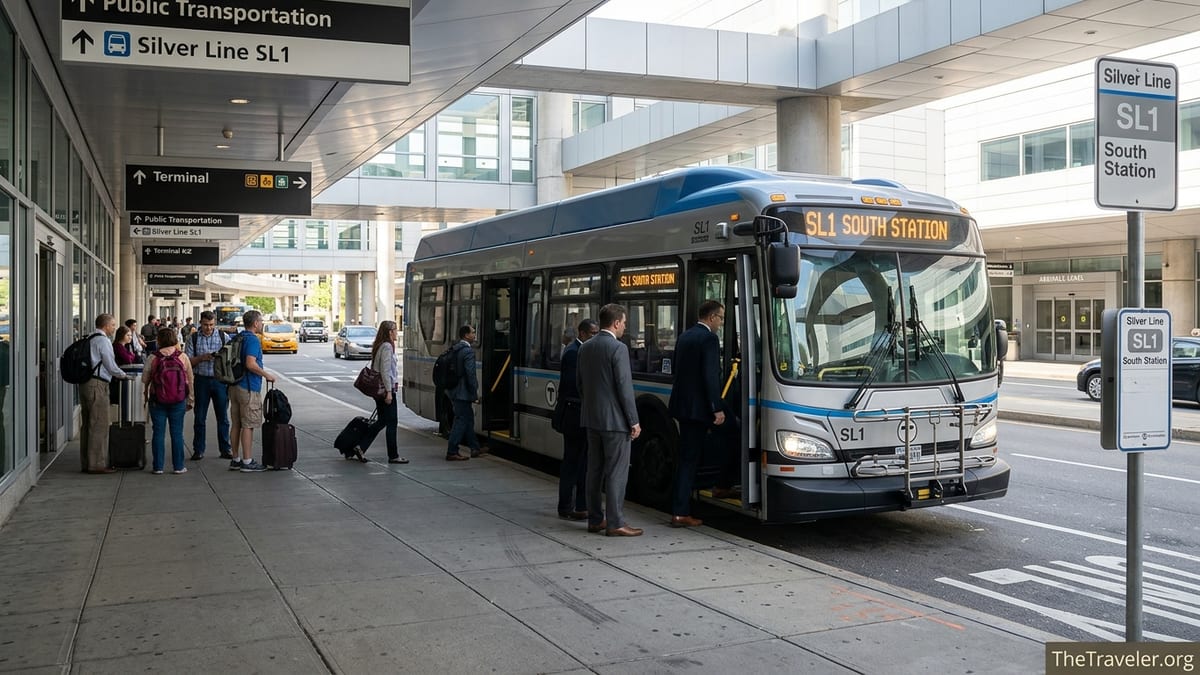
What Is the Silver Line SL1 and Why It Matters
The Silver Line SL1 is an MBTA bus rapid transit route that runs between all Logan Airport terminals and South Station in downtown Boston, with stops in the Seaport district along the way. In the Seaport and Financial District it uses a dedicated transit tunnel, then continues on normal streets within the airport. To you as a traveler, it functions like a subway line with buses instead of trains: you board at marked Silver Line stops, the vehicle has multiple doors and luggage space, and it connects you directly to the Red Line and commuter rail at South Station.
The most important feature for visitors is that inbound trips on SL1 from Logan Airport into the city are free. You can board at any terminal in the direction of South Station without paying a fare when you get on the bus. When you arrive at South Station you are already inside the paid area and can transfer to the Red Line subway toward Cambridge, the commuter rail, or stay in the Seaport and Financial District at no extra cost.
For many travelers, this makes SL1 the smartest default choice for getting into Boston. A typical taxi from Logan to downtown can cost in the range of 30 to 40 dollars plus tip depending on traffic, and app-based rides are often similar. By comparison, the Silver Line costs nothing inbound from the airport and usually takes around 20 to 35 minutes to South Station in normal traffic. For solo travelers or couples staying near a subway stop, that is a strong value.
SL1 also runs from very early morning into late night, with service roughly every 10 to 15 minutes in busy daytime periods and less frequently in the late evening and overnight. This makes it reliable not just for business travelers landing at peak hours but also for vacationers on late arrivals who want to avoid the cost of a cab.
Terminal Stops: Finding the Silver Line at Logan
Every passenger terminal at Logan has clearly signed Silver Line stops on the lower arrivals level. The route loops around the airport, generally serving Terminal A first and then continuing through the other terminals before heading into the city. The exact boarding point varies by building, but you will always be looking for the MBTA Silver Line signs and the “SL1 South Station” destination display on the front of the bus.
As a real-world example, if you arrive on Delta or WestJet into Terminal A, you will collect your bags on the arrivals level, exit the sliding doors to the curb, and follow the overhead signs for “Public Transportation” and “Silver Line / SL1.” The stop is usually just a short walk from the baggage claim doors, with a sheltered waiting area and an electronic display showing the next SL1 departure time. At Terminal B, which is large and split between different airlines, there are two Silver Line stops on the arrivals level, so follow the terminal’s own signage rather than guessing.
One frequent point of confusion is the difference between Massport shuttle buses and the Silver Line. Massport shuttles are free airport circulator buses that connect terminals, parking, the rental car center, and the Blue Line’s Airport Station. They are labeled with numbers like 22, 33, or 66 and do not go into downtown Boston. The Silver Line SL1, by contrast, is an MBTA service that goes directly to South Station and is signed clearly as “Silver Line SL1 Logan Airport – South Station.” At the curb, check the electronic sign above the windshield; do not board a random shuttle assuming it will take you downtown.
Another useful detail is that Silver Line stops are on the arrivals level, not the departures level used for check-in. If you accidentally go upstairs following crowds, just take the elevator or escalator back down and look for the public transit signage. Travelers with mobility concerns will find that every terminal has elevators between levels, and SL1 buses are low-floor and wheelchair accessible.
How the Free Airport Rides Actually Work
The free fare policy on SL1 is simple in practice but often misunderstood. From Logan Airport into Boston, the Silver Line SL1 is free to board at all terminal stops. There are no fare boxes or validators at the curb, and you do not need a ticket or pass to get on. You can use any door to board, and staff do not ask to see proof of payment for that inbound leg. When the bus arrives at South Station, the stop is inside the fare-controlled area of the Silver Line / Red Line station, so you are effectively already “paid in” to the subway system even though you did not tap.
This arrangement means that if you ride SL1 from Logan to South Station, you can walk directly from the bus platform up to the Red Line trains toward Cambridge or Ashmont/Braintree without passing through fare gates. For example, a visitor staying in Harvard Square could land at Terminal C, ride the free SL1 to South Station, then immediately transfer to a Red Line train to Harvard without paying any fare at all for the entire airport-to-hotel journey. The same is true if you transfer to another subway line further along the Red Line, such as changing at Downtown Crossing for the Orange Line.
In the opposite direction, from South Station to Logan Airport, the trip is not free. At South Station you access the Silver Line platform through the same turnstiles used for the Red Line. If you tap a contactless credit card, phone wallet, CharlieCard, or CharlieTicket at the gate, you will be charged the regular subway or Silver Line fare for that trip. As of mid-2026, that base fare is a few dollars per ride, similar to other major U.S. transit systems, but riders should check current MBTA fare information for precise amounts. If you are already riding the subway to South Station, your transfer to SL1 is included as part of the same trip within the MBTA’s transfer rules.
Travelers sometimes try to save money by riding a free Massport shuttle to the Blue Line’s Airport Station instead of paying for SL1 outbound from South Station, but this usually does not make sense if you are already near South Station or the Seaport. The extra time and transfers rarely justify the small fare difference. A more practical way to manage costs is to use the free inbound SL1 from Logan and then decide case by case for your return trip, depending on where you are staying and whether you have luggage.
Route, Seaport Stops, and Connections at South Station
The SL1 route runs from South Station through the Silver Line tunnel to Boston’s Seaport district before crossing the harbor channel and continuing around the Logan terminals. On the city side, it shares much of its path with the SL2 and SL3 routes. Typical intermediate stops between South Station and the airport include Courthouse Station and World Trade Center Station, both in the Seaport, and Silver Line Way. These stops put you within walking distance of major hotels, including many popular with convention and cruise passengers.
For example, a traveler staying at a Seaport hotel near the Boston Convention and Exhibition Center may find it easiest to ride SL1 from Terminal E to World Trade Center Station and walk the short distance rather than staying on the bus all the way to South Station. Conversely, a visitor whose final destination is a business address near South Station or in the Financial District will usually stay on the bus until the South Station stop, then exit at street level or transfer to the Red Line.
South Station itself is one of Boston’s main transportation hubs. From the Silver Line platform you have direct access to the Red Line subway, Amtrak services like the Acela and Northeast Regional, several MBTA commuter rail lines, and numerous intercity buses operated by companies such as Greyhound and others. This makes SL1 a particularly good choice for anyone connecting between Logan Airport and regional destinations like Providence, Worcester, or Portland, Maine, via train or coach. In a typical scenario, a traveler landing at Logan around 5 p.m. might take the 5:20 p.m. SL1 from Terminal B, arrive at South Station before 6 p.m., and comfortably catch a 6:15 p.m. Amtrak or commuter rail departure.
Because SL1 drops you inside the station’s paid area, it is also convenient for short errands or meetings near South Station. If, for instance, you are flying into Logan for a same-day meeting at an office near South Station and back out in the evening, you can ride SL1 both ways, paying only once from the city to the airport while enjoying a free inbound ride in the morning.
Travel Time, Frequency, and When SL1 Makes Sense
Travel time on SL1 between Logan Airport and South Station varies with traffic, especially on the airport roadways and the Ted Williams Tunnel. In typical off-peak conditions, the trip from Terminal A to South Station is around 20 to 25 minutes. During weekday rush hours or in bad weather, it can stretch into the 30 to 40 minute range. In late-night or early-morning hours when the roads are quiet, it can be faster than a taxi that has to queue, particularly if multiple flights arrive at once.
Service frequency is usually every 10 to 15 minutes during most of the day, with more frequent departures during heavy demand periods and less frequent service late at night and in the early morning. After midnight, intervals can widen, so travelers arriving on very late flights should expect potential waits of 20 minutes or more. Real-time information screens at airport stops generally show expected arrival times, and the MBTA’s trip planning tools and mobile apps can provide live updates.
In practice, SL1 is an excellent option if you have light to moderate luggage, are staying near a subway station, or are heading to South Station, the Seaport, or central locations like Downtown Crossing or Back Bay via an easy transfer. For example, a couple with two rolling carry-ons staying near Kendall/MIT can comfortably ride SL1 for free to South Station and transfer to the Red Line, reaching their hotel in under an hour total for zero transit fare.
On the other hand, if you are traveling with very young children, multiple large suitcases, or mobility challenges, the door-to-door convenience of a taxi or ride-hail vehicle may outweigh the cost savings, especially if your destination is far from a subway station or involves several transfers. Similarly, if you arrive during an active winter storm when roads are heavily congested, you may want to compare the projected SL1 travel time with other options such as water taxi or private shuttle services that serve nearby docks and hotels.
Luggage, Accessibility, and Onboard Experience
Silver Line SL1 buses are designed with airport passengers in mind. Vehicles are low-floor, so you board at curb level without steps, and there is open standing space in the middle section where travelers naturally place suitcases. There are no dedicated luggage racks, but wheeled carry-ons and medium suitcases fit comfortably in the open areas if you keep them close to you. Drivers generally expect airport passengers to bring bags and are accustomed to people taking a few extra seconds to board or alight carefully.
If you are traveling with several large checked bags, try to board through a door near the center of the bus where the floor area is widest. A solo traveler with one checked suitcase and a backpack, for instance, can stand near the articulation joint or over the rear wheels, keeping the bag close to their legs and out of the main aisle. Families with strollers are allowed to bring them on board; you may be asked to fold the stroller if the bus is crowded, but drivers often allow unfolded strollers in off-peak times if they do not block the aisle or doors.
Accessibility is a strong point of SL1. All buses are wheelchair accessible, with ramps and designated spaces. The stops at the airport and in the Silver Line tunnel have level boarding and elevators linking platforms to street level. For a traveler using a mobility device, the combination of free inbound fares and step-free access makes SL1 one of the most straightforward ways to reach downtown from Logan. Audio and visual announcements on board call out each stop, which is especially helpful in the tunnel where you cannot see external landmarks.
The onboard experience is what you would expect from a busy urban transit route. At peak times the bus can be crowded, particularly between South Station and Logan when many people with luggage are boarding. Seats may not always be available, so plan on standing if you are traveling during weekday rush hours or Sunday evening peak arrival times. In quieter periods you will likely find a seat easily and have more room for bags. Standard urban transit etiquette applies: keep luggage out of the aisle, avoid blocking doors, and move toward the center of the bus to make space for others.
Common Mistakes and How to Avoid Them
Several predictable mistakes catch first-time riders of the Silver Line SL1. The most common is boarding the wrong Silver Line route at South Station. At street level around South Station you may see Silver Line buses signed as SL4 or SL5; these go down Washington Street to neighborhoods like the South End and Roxbury and do not serve the airport. To reach Logan, you must enter the underground Silver Line station inside South Station and look specifically for buses labeled SL1 Logan Airport. Following the overhead signs for “Silver Line / Red Line” inside the station is the simplest way to avoid confusion.
Another frequent error is paying when you do not have to. At Logan terminals, the inbound SL1 is free. Some passengers unfamiliar with the system look for a fare box or attempt to tap a card on the on-board equipment; in practice, airport stops on inbound SL1 do not require payment at boarding. You can simply enter through any door and ride to South Station. If you are asked for payment, which is uncommon on inbound airport journeys, you can politely confirm that you are boarding at Logan and heading inbound to South Station.
A third mistake involves getting off at the wrong stop in the Seaport. For example, travelers heading to a hotel near Courthouse Station sometimes remain on the bus until South Station, then backtrack on foot or by subway. If your hotel confirmation mentions addresses on Seaport Boulevard, Congress Street, or D Street, it is worth checking a map before your trip to see whether Courthouse, World Trade Center, or Silver Line Way might be your closest stop. Getting off in the right place can save you a 15-minute walk with luggage.
Finally, some visitors underestimate late-night service patterns. While SL1 runs deep into the night and even into the early morning hours, the connecting Red Line subway operates on a different schedule and generally shuts down shortly after midnight. A traveler landing on a 1 a.m. flight may find that SL1 gets them to South Station with no problem, but the Red Line is no longer running. In that case, you may need to continue your journey by late-night rideshare or taxi from South Station rather than expecting a seamless subway transfer.
The Takeaway
The Silver Line SL1 is one of Boston’s best travel bargains: a direct, often free connection between Logan Airport and key parts of the city, including South Station and the Seaport. For many visitors, especially those comfortable using public transit and traveling with manageable luggage, it turns what could be an expensive airport transfer into a simple, predictable ride that plugs directly into the rest of the MBTA network.
By understanding where to find the terminal stops, how the free inbound fare works, and how to navigate South Station and the Seaport, you can use SL1 confidently instead of defaulting to a taxi or rideshare. Pay attention to route signs so you do not mix up SL1 with other Silver Line services, allow a bit of buffer time during rush hour or bad weather, and check which Seaport stop is closest to your hotel or meeting.
With those basics covered, the SL1 becomes more than just an airport bus. It is a reliable link into Boston’s broader rail network and neighborhoods, whether you are catching an early morning Acela, meeting friends in the Seaport, or heading to a conference in Cambridge. Used well, it can be the backbone of a low-cost, low-stress arrival and departure strategy in Boston.
FAQ
Q1. Is the Silver Line SL1 really free from Logan Airport to South Station?
The inbound SL1 from Logan Airport terminals into Boston is free to board, and you do not pay when you transfer to the Red Line at South Station.
Q2. Do I have to pay to take SL1 from South Station to Logan Airport?
Yes. From South Station to Logan you must enter through fare gates and pay the normal subway or Silver Line fare using a contactless card, CharlieCard, or ticket.
Q3. How long does the SL1 ride from Logan to South Station usually take?
Travel time is typically around 20 to 25 minutes in light traffic and can extend to 30 to 40 minutes during peak rush hours or bad weather.
Q4. Where exactly do I catch the Silver Line at South Station?
Follow signs inside South Station for “Silver Line / Red Line.” The SL1 airport buses depart from the underground Silver Line platform, not from the street-level bus bays.
Q5. Can I bring large suitcases or a stroller on the SL1?
Yes. SL1 buses are designed with airport passengers in mind and can accommodate suitcases and strollers, though you should keep them out of aisles and doorways.
Q6. Is the Silver Line SL1 accessible for wheelchairs and mobility devices?
Yes. SL1 buses are low-floor with ramps and designated spaces, and stations at Logan and in the tunnel have elevators and level boarding.
Q7. How late does the Silver Line SL1 run at night?
SL1 operates from early morning into late night, with less frequent service overnight. Exact times vary by day, so checking a current schedule before travel is wise.
Q8. What is the difference between SL1 and the other Silver Line routes?
SL1 serves Logan Airport, while SL2 and SL3 go to other destinations like the Design Center and Chelsea and do not stop at the airport terminals.
Q9. Is it better to use the Blue Line instead of the Silver Line from Logan?
The Blue Line requires a free Massport shuttle to Airport Station and then a paid subway ride. For most travelers heading to South Station or the Seaport, SL1 is simpler and free inbound.
Q10. Can I use the free SL1 ride from Logan to reach other subway lines besides the Red Line?
Yes. Because SL1 drops you inside fare control at South Station, you can transfer free to the Red Line and then connect onward to other subway lines as part of the same trip.