


Boston Logan International Airport can be confusing for first time and even frequent visitors using Uber or Lyft. Pickups have largely moved away from the curb to centralized areas, signage is not always intuitive, and surge pricing can turn a routine trip into a surprisingly expensive one. This guide walks you step by step through where to go at each terminal, how the system works in practice, and what alternatives make sense if prices spike.
Get the latest updates straight to your inbox!
How Uber and Lyft Work at Boston Logan Today
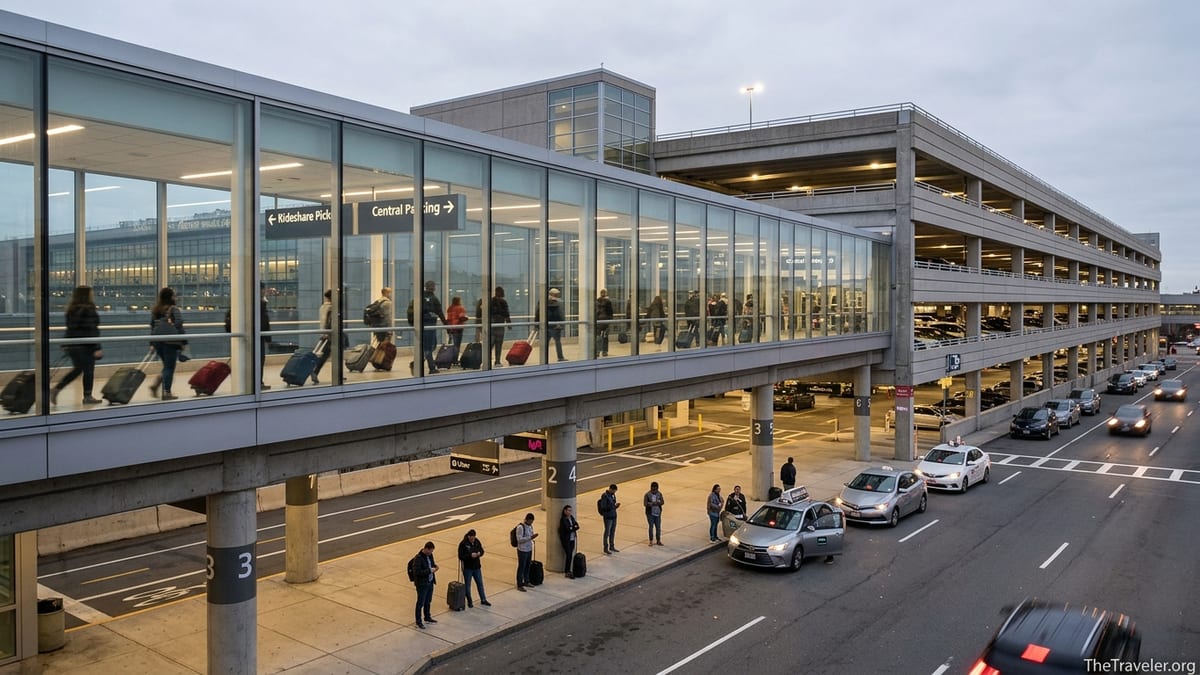
Logan is one of the US airports that pushes most ride app pickups away from the curb to dedicated areas in the parking garages. For most travelers, that means your Uber or Lyft pickup happens in or next to the Central Parking Garage, not right outside baggage claim. Signage uses phrases like “Ride App,” “App Ride,” or “Rideshare Pickup” rather than company names, so looking for those words is more reliable than hunting for the Uber or Lyft logos.
In practical terms, this setup means you will almost always need to walk a few minutes and go up at least one level via escalator, elevator, or pedestrian bridge. Many first time visitors step outside baggage claim, open the app, and are surprised when the pickup pin shows a spot that is clearly inside a garage. That is by design. The airport authority directs drivers into specific lanes inside those garages, where they queue and meet riders away from the already congested terminal curbs.
The arrangement also affects price and timing. Because the pickup area is centralized, your driver pays tunnel or bridge tolls and airport fees to reach the airport, and they may have waited in a special holding lot before being dispatched to the garage. Those costs are baked into what you see in the app. During busy periods, it is common for a 15 to 20 minute ride from Logan into downtown Boston to be quoted at two or three times its usual off peak price.
One other key point: riders with mobility limitations or accessibility needs can still request pickup at clearly marked accessible pickup locations near the terminal curbs. In both Uber and Lyft, these are sometimes labeled as “Accessible Ride App Pick Up” with options for each terminal, and they are closer to baggage claim than the main garage locations.
Terminal A: Delta, WestJet and Other Airlines
Terminal A primarily serves Delta and a few partner and seasonal carriers. If you are arriving here and calling an Uber or Lyft, your goal is to get from baggage claim up to the elevated walkway that leads into Central Parking. Inside the terminal, follow signs for “Central Parking,” “Walkway to Central Garage,” or “Ride App Pickup.” These will typically direct you to an escalator or elevator one level up from Arrivals.
Once you are on the elevated enclosed bridge, continue straight, following overhead signs for “Ride App / App Ride.” The walk is roughly 4 to 7 minutes for most travelers depending on your pace and how busy the corridor is. At the end of the walkway you enter the Central Parking Garage, where colored signs and column markings indicate the rideshare pickup zone for Terminal A. This is where you should confirm your pickup in the app so the pin matches your exact location inside the garage, rather than outside the terminal.
For example, if you land from a mid afternoon Delta flight from Atlanta and plan to go to a hotel near Faneuil Hall, you might see UberX quotes around a moderate fare in non peak times, but during a rainy weekday rush hour those same rides can easily jump to two or three times that amount. If the app shows an unusually high price, you could instead walk the same elevated bridge one level down toward the terminal bus stops and catch the free Silver Line bus to South Station, then grab a much cheaper short rideshare from there.
When being dropped off at Terminal A, most ride app trips are routed to the departures level or a designated ride app area next to it. The driver will follow airport signs that separate “App Ride” and “Departures.” From a traveler’s perspective, this is straightforward: you are dropped relatively close to the doors of Terminal A, often under cover, and only have a short walk to check in.
Terminal B: American, United, Southwest and More
Terminal B is the most confusing area at Logan for rideshare users because the terminal is split into two sides and has its own parking garage. Airlines like American, United, Southwest, Alaska, Air Canada, Spirit and others operate from different “B East” and “B West” sections. The airport has adjusted pickup rules several times in recent years, and even locals are often unsure whether they should walk to Central Parking or to the Terminal B Garage.
As a general rule for arriving passengers, plan to follow the in terminal signs rather than relying only on what the app map shows. From baggage claim, look up for “Ride App,” “App Ride,” or “Central Parking” signage. At Terminal B, those signs may direct you either into the Terminal B Parking Garage or across a pedestrian connector toward Central Parking, depending on exactly where in the building you are and how the airport is operating that day. The walk is typically 5 to 10 minutes, including time for elevators or escalators.
A common real world scenario: you arrive on an evening American Airlines flight from Chicago and walk out to the arrivals curb expecting to see your Uber. Instead, the app shows pickup on a different level labeled with “Zones 1 to 4” inside Terminal B Garage. In this case, you should go back inside, take the nearest elevator up following “Parking / App Ride” signs, and then walk toward the numbered pickup bays. It is better to move toward those signed areas first, then confirm the pickup in the app so your driver and GPS pin line up.
Drop offs at Terminal B are usually easier. Many ride app drivers are allowed to drop passengers near departures at certain hours, especially for early morning flights. If you are leaving from Logan and your flight is out of Terminal B at 6:30 am, it is realistic to request an Uber or Lyft from downtown around 4:30 to 5:00 am and expect to be dropped near the regular airline drop off zones. Outside those peak early morning windows, drivers may still be instructed to use ride app lanes that are slightly offset from the main departures curb but still within a short walk to the entrance doors.
Terminal C and E: JetBlue, International Flights and Central Garage
Terminal C handles most JetBlue flights along with some other carriers, while Terminal E is the main international terminal. For both, the rideshare pickup process is strongly linked to the Central Parking Garage rather than the individual terminal garages. Arriving passengers should expect to walk via elevated walkways from their terminal into Central Parking and then to the marked ride app pickup floor.
From Terminal C baggage claim, follow signs for “Central Parking” and “Ride App Pickup.” That usually means taking an escalator or elevator up from the arrivals level, then crossing an enclosed bridge above the roadway. Plan on 5 to 8 minutes of walking if you are coming from the far gates or during crowded times. Once inside Central Parking, overhead signs and staff in reflective vests typically direct you to the side where rideshare vehicles queue in marked lanes. Columns and zones are labeled so you can give your driver a simple landmark like “Zone C, next to column 5” if needed.
Terminal E is similar, but you may be more tired after a long overnight flight from Europe or a daytime flight from South America or Asia. After clearing customs and collecting your luggage, you will exit into the public arrivals hall. From there, look for overhead signage pointing you to “Central Parking / App Ride.” Escalators or elevators bring you up to the pedestrian bridge, and then you walk into the same Central Garage pickup area used by other terminals. If you are traveling with family and several large suitcases, factor this walk into your decision. Some larger parties choose an official taxi from the nearby curb instead of rideshare simply to avoid the extra time and effort when everyone is exhausted.
For drop offs at Terminal C and E, many rideshare trips will still bring you close to the departures level at the terminal itself, especially in normal traffic conditions. However, during major congestion or if airport rules temporarily change, your driver may instead be routed to a ride app lane connected to the garage. Either way, you will usually be within a short, covered walk of the terminal doors. If you have an early morning international departure, budgeting a few extra minutes in case of rerouting is wise.
Understanding Surge Pricing and When to Try Alternatives
Logan is a textbook case of how dynamic pricing works for ride apps. Fares jump significantly whenever a wave of flights lands into poor weather or rush hour traffic, or when there is a big event in Boston. For instance, travelers arriving on a Friday evening in October during a rainstorm often report UberX quotes in the range of a three figure fare for what would normally be a 20 minute ride to neighborhoods like Beacon Hill, Back Bay, or the Seaport. Even short trips to nearby hotels in East Boston can feel disproportionately expensive at these times.
In practical terms, you will see this in the Uber or Lyft app as a high price with a note that demand is elevated. The underlying system is adjusting prices to balance the limited number of drivers willing to navigate airport traffic and pay tolls with the large number of arriving passengers who want a ride at the same time. Because drivers often sit in a separate holding lot and then queue through the garage, they are reluctant to serve the airport if prices are low during peak congestion, so the apps raise prices to lure more cars.
If you open the app and see that a typical ride into downtown is quoting an unusually high price, one of the best strategies is to pair free or low cost public transport with a shorter rideshare. For example, the MBTA Silver Line SL1 bus is free from Logan to South Station. That leg may take 20 to 30 minutes depending on traffic, but from South Station a short Uber or Lyft ride to a downtown hotel often costs dramatically less than a direct airport pickup in surge conditions. Similarly, the Back Bay Logan Express bus is free from Logan to Back Bay and runs regularly through the day, after which a short rideshare within the neighborhood may be just a fraction of the airport fare.
Another practical alternative if surge pricing is extreme is to compare regular Boston taxis at the terminal curb. While taxi fares are meter based and can also be significant in traffic, they do not spike as dramatically with demand as ride apps do. For a mid distance trip, such as Logan to Kendall Square in Cambridge, it is common for a metered taxi to be in the same rough price range as a normal, non surged UberX. During intense surges, that taxi can be considerably cheaper while still offering a door to door ride with no app required.
Drop Off Rules, Tunnels and Timing for Departing Flights
For travelers heading from the city to Logan, ride app trips are usually more straightforward than pickups but still shaped by the airport’s layout and traffic patterns. Drivers reach the airport mostly via the Ted Williams Tunnel from the Seaport side or the Sumner Tunnel from downtown and the North End, and they must follow dedicated signage for “Departures,” “Arrivals,” and “App Ride.” These tunnels can back up during morning and evening rush hours, particularly when combined with construction or bad weather.
In practical terms, a ride from Back Bay to Logan in light traffic can take as little as 15 minutes, while the same trip at 8:00 am on a weekday might stretch toward 30 minutes even before you factor in security lines. If your flight is domestic and leaves around 7:00 am, calling an Uber or Lyft around 4:30 to 5:00 am from central Boston neighborhoods is usually comfortable. For later morning or late afternoon departures, leaving an extra 15 to 20 minutes earlier than you think you need is a conservative approach.
Most of the time, ride app drivers will be able to drop you reasonably close to your airline’s departures area. Signs will sometimes direct them into slightly separate ride app lanes or into areas adjacent to the main departure curb. You may notice airport staff in reflective jackets moving traffic along quickly and preventing drivers from lingering. It helps to have your airline and terminal ready to tell the driver as soon as they pick you up, so they can follow the correct lane to “Terminal A,” “Terminal B,” “Terminal C,” or “Terminal E” without hesitation.
One detail that surprises some visitors is that the same route into the airport can generate different ride prices at different hours. This is due not only to surge pricing but also to tolls and airport fees that are sometimes folded into the upfront price the app shows you. If you depart from a hotel in the Seaport District on a weekday morning, the app might show a modest fare to Terminal C. Taking that same trip late on a Sunday night could cost very slightly more because of changes in driver supply, but the variation is usually far less dramatic than what you see for pickups from Logan into the city.
Taxi, Logan Express and Silver Line: Smart Alternatives
Boston offers several credible alternatives to Uber and Lyft that are worth considering, especially when ride app prices spike or when you want to minimize walking with luggage. Traditional taxis queue at each terminal, usually close to the arrivals area. The taxi stands are staffed, and vehicles are checked regularly to meet the airport authority’s standards. For typical trips like Logan to downtown Boston, Cambridge, or the Seaport, a taxi is often competitive in price with a non surged UberX and can be cheaper when ride app surge pricing is aggressive.
The Logan Express network is another strong option. Buses operate from suburban locations such as Braintree, Framingham, Woburn, and Peabody, as well as from Boston’s Back Bay. As of recent schedules, a one way fare from the suburbs to Logan is in the range of a modest per person amount, while the Back Bay route is free from the airport to Back Bay and charges a small fee in the other direction. If you are staying in or near Copley Square or Back Bay Station, taking the free Logan Express from the airport and then walking or using a short local rideshare can significantly undercut the cost of a full Uber or Lyft trip originating at Logan.
For straight airport to downtown journeys, the MBTA Silver Line SL1 is one of the best value options in the United States. The bus is free when boarding at any of the Logan terminals and runs to South Station, connecting directly with the Red Line subway. In normal conditions, the ride takes around 20 to 30 minutes. From South Station, many hotels in the Financial District, Downtown Crossing, and Seaport are walkable in 10 to 15 minutes, or you can take a short, inexpensive rideshare if you have heavy luggage or are arriving late at night.
Another MBTA option involves the free airport shuttle bus to the Airport stop on the Blue Line. From there, a subway ride into downtown or toward the North Shore is straightforward and budget friendly. This is particularly useful if you are staying in neighborhoods such as Government Center, the North End, or East Boston. Many local residents combine the Blue Line or Silver Line with a short Uber or Lyft ride on the city side, where prices tend to be lower than direct pickups from Logan’s garages.
Practical Tips for a Smooth Rideshare Experience
To make your Logan rideshare experience less stressful, start by waiting to request your ride until you are physically close to the designated pickup area. Calling the car while you are still at the gate or standing at baggage claim can backfire, because drivers are required to follow set routes into the garage and may arrive before you do. Instead, collect your luggage, follow the “Ride App” and “Central Parking” signs into the garage, and then confirm your ride once you see the numbered pickup zones.
Pay close attention to terminal designations in the apps. In Uber, the airport pickup menu may list options like “Central Garage Terminal A,” “Central Garage Terminal C,” or “Terminal B Garage.” Choosing the precise option that matches the signs around you helps drivers locate you faster. The same applies if you are requesting an accessible pickup at the curb. Selecting a generic location like “Logan Airport” without specifying the terminal and pickup type may cause confusion and extra time on the phone with your driver.
It also helps to have a plan B if prices are high. Before you commit to an expensive surge priced ride, open your maps app and estimate the walking time to South Station, the Seaport, or Back Bay from the Silver Line or Logan Express stops. Many visitors find that a combination of a free airport to city bus and a short rideshare from there can save a substantial amount of money, especially for solo travelers or couples without too much luggage. Families or larger groups might still prefer a single ride app or taxi for simplicity, but even then, comparing estimated total costs can be worthwhile.
Finally, remember that Logan’s rules can evolve. The broad pattern of moving pickups into the garages and using centralized ride app areas has been in place for several years, but the exact lanes, levels, and curb access windows can shift in response to construction or changing traffic conditions. When in doubt, trust the physical signage and any instructions from airport staff in high visibility jackets over the sometimes outdated pickup pins inside the apps.
FAQ
Q1. Where do I meet my Uber or Lyft at Boston Logan?
Most passengers walk from their terminal into the Central Parking Garage or Terminal B Garage and follow signs for Ride App or App Ride pickup zones, rather than meeting drivers at the curb.
Q2. How long does it take to walk from the terminal to the rideshare pickup area?
Expect about 4 to 10 minutes of walking, depending on your terminal, the location of your gate, and how crowded the walkways and elevators are.
Q3. Can I get picked up curbside at baggage claim?
Regular rideshare pickups are usually in the garages, but clearly marked accessible pickup spots near the terminal curbs are available for travelers with mobility or accessibility needs.
Q4. Why is my Uber or Lyft from Logan so expensive compared with going to the airport?
Pickups include airport fees, tolls, and often heavy demand when many flights land at once, which leads to dynamic surge pricing that can push fares much higher than normal.
Q5. What is the cheapest way to get from Logan to downtown Boston?
The free MBTA Silver Line SL1 bus from all terminals to South Station is typically the lowest cost option, and from there you can walk or use a short, inexpensive rideshare.
Q6. Is a taxi ever cheaper than Uber or Lyft at Logan?
Yes. When surge pricing is high, a metered Boston taxi from the airport to central neighborhoods can be similar in cost or noticeably cheaper than a surge priced UberX.
Q7. How early should I call an Uber or Lyft for a departing flight?
For domestic flights, ordering your ride 2 to 2.5 hours before departure usually works, adding extra time during weekday rush hours or bad weather to account for tunnel traffic.
Q8. Can I use Logan Express and then take rideshare the rest of the way?
Yes. Many travelers ride the free Logan Express bus to Back Bay or other stops and then complete their trip with a short Uber or Lyft, especially when airport surge pricing is high.
Q9. What should I do if my driver and I cannot find each other?
Stay near the clearly marked Ride App pickup signs, confirm the exact zone or column number you are standing by, and use the in app call or chat feature to describe landmarks.
Q10. Are Uber and Lyft available at Logan late at night or very early in the morning?
Yes, both services operate around the clock, although wait times can be longer overnight and prices may fluctuate depending on how many drivers are logged in nearby.