


Landing at Boston Logan International Airport can feel intense, especially after a long flight, but the airport is compact and fairly straightforward once you know what to expect. This guide walks you step by step from the aircraft door to downtown Boston, covering baggage claim, immigration and customs, SIM cards and ATMs, plus clear, real-world options for taxis, rideshares, rental cars, buses, and other city transfers.
Get the latest updates straight to your inbox!
Understanding Boston Logan’s Terminals and Arrivals Layout
Boston Logan International Airport serves most domestic flights through Terminals A, B, and C, while Terminal E is the primary international terminal. All four terminals have their own baggage claim and ground transportation areas, so in most cases you will complete your arrival procedures and exit the airport from the same terminal where you land. If you are connecting between airlines, you may need to change terminals using the free Massport shuttles that loop around the airport.
Terminal A handles Delta and WestJet, Terminal B includes American, United, and several smaller carriers, Terminal C is home to JetBlue and some regional airlines, and Terminal E hosts most international airlines along with some transborder flights. On your approach to Boston, the cabin crew will announce your terminal, and it will also appear on the airport monitors once you step into the arrivals corridor. This matters because each terminal has slightly different ground-transport signage and pickup spots, even though the options are broadly the same.
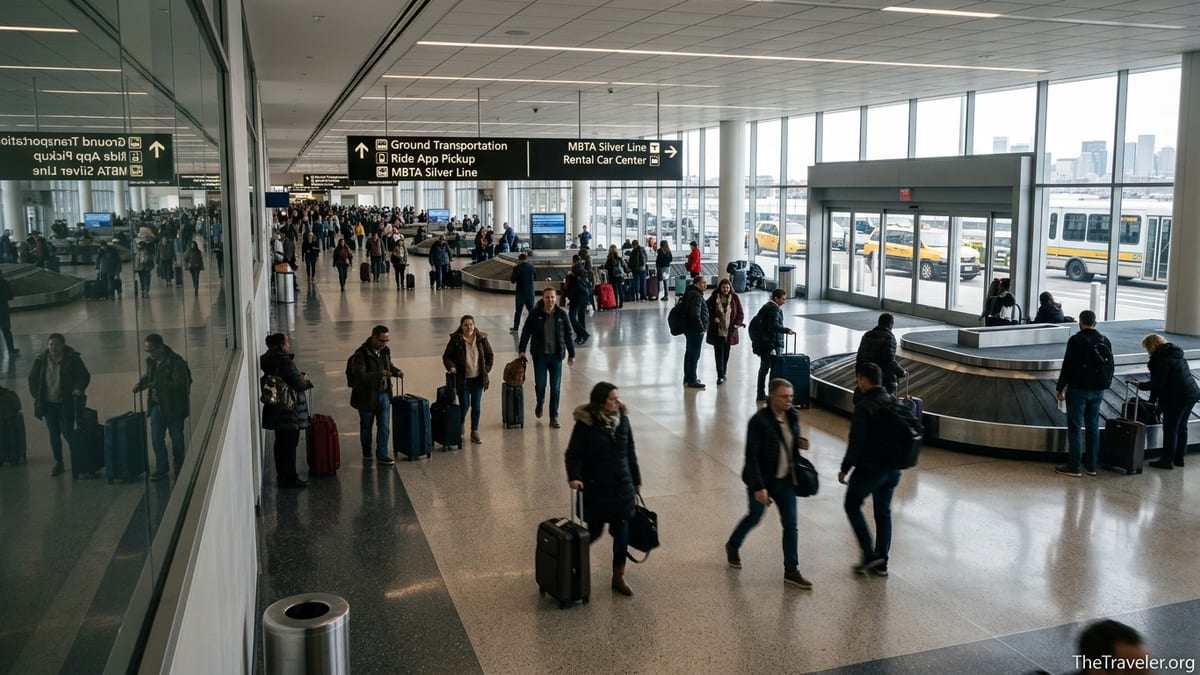
Arriving passengers generally come in on the upper level and then follow signs down to the arrivals and baggage claim level. The lower level is where you will find baggage carousels, restrooms, water fountains, ATMs, information desks, and doors leading to taxis, hotel shuttles, and the free airport buses. If someone is meeting you, this arrivals level near the baggage carousels or just outside the sliding doors is usually the most convenient place to agree on a meeting point.
The airport is relatively close to downtown Boston, about 3 to 5 miles depending on your destination. In normal traffic, taxis or rideshares to central areas like Back Bay or the Financial District often take only 15 to 25 minutes. At peak commuter hours or in bad weather, that same trip can stretch beyond 40 minutes, so factor that into your post-arrival plans, especially if you are catching a train at South Station or North Station.
Clearing Immigration, Baggage Claim, and Customs
If you are arriving from outside the United States, you will enter through Terminal E. After leaving the aircraft, follow the “Arrivals” and “Passport Control” signs to U.S. Customs and Border Protection. U.S. citizens and many visitors will see Global Entry and Automated Passport Control kiosks as well as staffed booths. Typical wait times vary widely: at off-peak times, you may clear in under 20 minutes; during busy evening waves from Europe, lines can exceed 45 minutes. Having your completed customs declaration (if required), passport, and any visas ready helps keep the process moving.
Once you pass immigration, you proceed to the baggage claim hall. Baggage carousels are clearly numbered, and the screens list flights and carousel assignments. If your checked bag does not appear, approach your airline’s baggage service desk, usually located along the wall near the carousels. For strollers and oversize items like skis, look for an oversize baggage door or belt, which may be separate from the standard carousel. Carts are available for a fee in the baggage hall, useful if you have multiple heavy suitcases and plan to continue by public transport.
After collecting your luggage, you walk through customs. There are typically two channels: “Nothing to Declare” and “Goods to Declare.” Most leisure travelers with personal belongings use the “Nothing to Declare” lane. Officers may still select passengers for random inspection, so keep receipts and medications in original packaging. If you are connecting to another U.S. flight, you may need to re-check your luggage with your airline just beyond customs before continuing to a different terminal.
For domestic arrivals into Terminals A, B, or C, you simply disembark, follow signs to “Baggage Claim,” and arrive directly at the carousels. There is no immigration or customs step, and you can be outside and looking for transport within 10 to 20 minutes of landing if you have only carry-on luggage. Families traveling with children often appreciate that restrooms and changing tables are located just off the baggage halls, making it easy to pause before heading into the city.
Money, ATMs, SIM Cards, and Connectivity on Arrival
Once you reach the arrivals and baggage claim level, you will find several banking and currency services. Most travelers rely on ATMs to withdraw U.S. dollars at standard bank rates instead of using currency exchange kiosks, which often have less favorable rates and additional commissions. ATMs from major U.S. banks are located in or near baggage claim areas in multiple terminals and accept international cards from Visa, Mastercard, and other global networks. If your home bank charges foreign transaction fees, consider withdrawing a slightly larger amount in one go to minimize charges.
For mobile service, Logan does not have the same variety of dedicated SIM card stalls as some larger international hubs, but visitors have a few realistic options. Many international travelers now arrive with an eSIM already installed on their phone from providers that sell short-term U.S. data packages. Those who prefer a physical SIM can usually find prepaid options from well-known carriers such as AT&T or T-Mobile at convenience stores or electronics shops in Boston rather than directly in the airport. If you only need data for navigation and messaging, airport Wi‑Fi is free and widely available in all terminals, which is enough to request a rideshare or check your hotel reservations.
Using a major credit card is straightforward in Boston. Visa, Mastercard, and American Express are widely accepted for taxis, rideshares, MBTA tickets, and most shops and restaurants. Many transit gates and vending machines also accept contactless payments, allowing you to tap a bank card or phone wallet instead of buying a separate transit card immediately. If you do carry significant cash, keep it secure and avoid counting large bills in open public areas like the curbside pickup lanes.
For business travelers, arrivals levels often include basic services such as small cafés and newsstands where you can pick up coffee or a snack while waiting for colleagues. Charging points are scattered around the baggage claim halls, though they can be busy at peak times, so having a portable battery pack can be useful. Once you are through customs or out of baggage claim, you can typically find a quieter corner to organize your onward transport, download offline maps, or message your hotel before stepping outside.
Ground Transportation Basics: Shuttles, Buses, and the MBTA
After baggage claim, look for signs marked “Ground Transportation.” Here you will see options including the free Massport shuttles, the MBTA Silver Line buses, connections to the Blue Line subway, taxis, rideshares, and hotel shuttles. One of the most useful services for new arrivals is the free airport shuttle network. These buses link all terminals with the MBTA Airport subway station on the Blue Line, the Rental Car Center, and various airport facilities. They run frequently, and the stops are directly outside the terminal exits on the arrivals level.
For many visitors heading to downtown Boston, the MBTA Silver Line SL1 from the airport to South Station is a particularly attractive choice. The Silver Line buses stop outside each terminal and run through a dedicated busway into central Boston. At the time of writing, rides from Logan Airport to South Station on the SL1 are free, allowing budget-conscious travelers to reach the city center without spending anything on transport. From South Station, you can easily transfer to the Red Line subway and other MBTA services within the same fare-controlled area.
Another option is to take a free Massport shuttle to the Airport station on the Blue Line. From there, you can ride the Blue Line toward downtown, changing at Government Center for the Green Line or at State for the Orange Line. This is a good route if you are staying in neighborhoods like the North End or near Faneuil Hall. The Blue Line does require a regular MBTA fare, typically paid by tapping a contactless bank card, phone wallet, or MBTA ticket at the gates.
Buses and the subway are especially compelling during rush hours when Boston traffic can be heavy. A Silver Line bus from Terminal E to South Station often takes 20 to 30 minutes, even when the highway is congested. Travelers arriving late at night should check the approximate operating hours of the subway; services generally taper off around midnight. If your flight lands in the early hours of the morning, you may find that only taxis and rideshares are available for direct transfers into the city.
Taxis, Rideshare Pickup, and Car Services
Traditional taxis are easy to find at Boston Logan. After collecting your luggage, follow signs for “Taxis” from each terminal’s arrivals level. Uniformed ground staff typically manage the lines, directing you to a cab. Fares to central Boston vary depending on traffic and exact destination, but a metered taxi to areas such as Downtown Crossing or Back Bay commonly lands in a moderate range before tip. Taxis are a good option for travelers with heavy luggage who prefer door-to-door service and do not want to navigate the Silver Line with bags.
Rideshare pickups for Uber and Lyft are more regulated and slightly less intuitive. You cannot simply walk out to the curb and expect your driver to collect you at the arrivals door. Instead, Logan uses designated “Ride App” pickup areas, often located in or near the central parking garages. After leaving baggage claim, follow the green-and-white “Ride App” or “App Ride” signs, which guide you via elevators, bridges, or short walks to the correct pickup zone for your terminal. Only once you reach that area should you request your ride in the app, choosing the exact pickup zone letter or number shown on the signage around you.
Realistically, riders can expect a standard rideshare trip from Logan to central Boston to cost in the same broad range as a taxi, although surge pricing at peak times can push that higher. As an example, a mid-afternoon UberX to a hotel near Boston Common might be reasonably priced, while a late-night ride in heavy demand could cost significantly more. Plan for variation and check the app estimates before committing. If prices are high and you are comfortable with transit, the free Silver Line to South Station and then a short walk or subway ride can save a meaningful amount for solo travelers.
Private car services and pre-booked black cars meet passengers in clearly designated areas, often similar to taxis or a specific section of the garage. If you have arranged a sedan or SUV with a corporate car service, your driver will typically text or call you as you exit baggage claim and may hold a sign in a prearranged meeting point. This can be worthwhile for groups with large amounts of luggage or for business travelers who value a guaranteed, fixed-rate transfer regardless of flight delays or late-night arrivals.
Rental Cars, Driving, and Reaching the City by Road
If you plan to drive yourself, all major rental car companies at Boston Logan operate from a centralized Rental Car Center rather than from individual terminal counters. After leaving baggage claim, follow the purple “Rental Cars” signs to the curbside area where Rental Car Center shuttles stop. These shuttles are free, frequent, and typically take around 5 to 10 minutes to reach the facility, depending on traffic and the terminal you are coming from.
At the Rental Car Center, you will find large multi-level garages and counters for brands such as Enterprise, Hertz, Avis, Budget, National, and Alamo, among others. Queues can be significant during peak evening arrivals, especially on Sundays and holiday periods, so having your reservation details readily available and joining the correct loyalty line (if applicable) can save time. Inspect your vehicle before leaving, noting any existing scratches or dents on the rental agreement. If you plan to drive into central Boston, you may also want to add a toll transponder option, since many regional highways use electronic tolling.
Driving from Logan into Boston usually involves a short hop through one of the harbor tunnels or across nearby bridges. For example, a typical route to Back Bay might take you through the Ted Williams Tunnel and onto the Massachusetts Turnpike toward downtown. Traffic can be smooth in the middle of the day but heavy during weekday mornings and evenings. Parking in downtown Boston is comparatively expensive and limited, so a rental car makes more sense if you are heading to suburban areas, planning day trips to places like Cape Cod or New Hampshire, or traveling with a family that needs flexibility.
For travelers who only plan to stay in Boston proper, a rental car is often not necessary. Between the MBTA subway, buses, commuter rail, taxis, and rideshares, most central neighborhoods are easy to reach without driving. In fact, many visitors choose to rely entirely on transit and rideshares for their stay and only rent a car on a specific day for an excursion, picking it up from a city location rather than at the airport to avoid overnight parking costs.
Connections, Inter-Terminal Transfers, and Special Situations
Some passengers land at Logan only to connect to another flight. If your itinerary is on a single ticket and you are connecting domestically, your baggage is usually checked through, and you simply follow “Connections” or “Gates” signage rather than exiting to the public arrivals area. When changing terminals, the airside path may not be available for all airline combinations, so you may need to exit, take the free Massport shuttle between terminals, and re-clear security. Allow plenty of time if this applies to you, especially when connecting from an international arrival in Terminal E to an early evening domestic departure in Terminals A, B, or C.
For passengers needing accessibility assistance, wheelchairs and electric carts can be requested through your airline and are usually available right at the aircraft door or gate. The arrivals and baggage claim levels are equipped with elevators and ramps, and both taxis and rideshares offer options for vehicles that can accommodate mobility devices. If you require curbside pickup instead of walking to a rideshare garage, indicate your accessibility needs within the app or coordinate with your driver by message so they can use the appropriate zone.
Travelers with long layovers sometimes want to venture into the city between flights. Given Logan’s proximity to downtown, this can be realistic with a layover of at least six hours, especially if you are already holding the necessary U.S. entry permissions. Many choose to ride the Silver Line to South Station and walk to the Seaport District or downtown landmarks like the Greenway and Faneuil Hall. Always leave generous time to return through security, since afternoon security lines can stretch considerably during busy travel days.
Families and groups may find it helpful to designate one person to handle transport arrangements while others watch the bags. For example, one adult can step aside to request an Uber from the rideshare zone while another stays with children in the waiting area. Clear communication about landmarks in the pickup zone, such as the lettered columns or color-coded sections in the garage, helps avoid missed rides and confusion once your car arrives.
The Takeaway
Arriving at Boston Logan International Airport does not have to be stressful. Once you know which terminal you are landing in, what to expect at immigration and baggage claim, and where to go for ground transport, the process becomes much smoother. International travelers focus first on clearing passport control in Terminal E and then following customs signs, while domestic passengers move directly toward baggage claim before choosing their onward option.
For getting into Boston itself, the free MBTA Silver Line from Logan to South Station stands out as a cost-effective and straightforward choice, especially if you are staying near downtown or along the Red Line. Taxis and rideshares provide door-to-door convenience for a moderate fare, with designated “Ride App” pickup areas that require a short but clearly signed walk from arrivals. Rental cars are there for those who plan to explore beyond the city or head to the suburbs, accessed via the free shuttle to the centralized Rental Car Center.
Most importantly, take a moment in the arrivals hall to get oriented, use the free Wi‑Fi, check prices, and choose the option that best fits your budget, schedule, and comfort level. With a bit of planning and realistic expectations, your first steps out of Boston Logan can set the tone for an efficient and enjoyable visit to one of the United States’ most historic and walkable cities.
FAQ
Q1. How long does it usually take to get from landing at Boston Logan to downtown Boston?
In light traffic and with only carry-on luggage, many travelers are in downtown Boston within 45 to 60 minutes of landing, including taxiing, deplaning, and ground transport. During peak immigration times at Terminal E or in heavy rush-hour traffic, the process can stretch beyond 90 minutes, so allow extra time if you have onward connections or dinner reservations.
Q2. Is the Silver Line bus from Boston Logan Airport to South Station really free?
At the time of writing, rides on the MBTA Silver Line SL1 from Logan Airport terminals to South Station are free when boarding at the airport stops. The policy can change, so it is wise to confirm posted notices at the bus stop or on the MBTA website, but many recent travelers report paying no fare when traveling from the airport into the city.
Q3. Where exactly do I meet my Uber or Lyft at Boston Logan?
After picking up your luggage, follow the “Ride App” or “App Ride” signs from your terminal’s arrivals level. These will lead you to a designated rideshare pickup area, often in a nearby parking garage or marked zone. Only once you reach this area should you request your ride, selecting the correct zone or letter indicated on the signage so your driver can find you easily.
Q4. Are taxis from Boston Logan Airport metered or flat rate?
Standard taxis at Boston Logan use meters rather than a fixed airport flat rate. The final fare depends on traffic, route, and any waiting time. For reference, a typical ride to central Boston neighborhoods often falls in a moderate range before tip, but you should ask the driver for an approximate cost if you want a better idea before departing.
Q5. Can I buy a local SIM card inside Boston Logan Airport?
Compared with some major international hubs, Logan has fewer dedicated SIM card kiosks. Many visitors either arrive with an eSIM already activated or wait to buy a prepaid SIM from major U.S. carriers at shops in the city. Free airport Wi‑Fi is usually enough to request a ride, check email, and message your hotel immediately after arrival.
Q6. How do I get to the rental car center from my arrivals terminal?
After leaving baggage claim, follow the purple “Rental Cars” signs to the curb. There you will find free shuttles marked for the Rental Car Center. These buses run regularly, and the ride usually takes 5 to 10 minutes from most terminals. Once at the facility, follow signs for your rental company’s counter or car pickup level.
Q7. What is the best way to reach the North End or Faneuil Hall from Logan?
To reach the North End or Faneuil Hall on public transport, many travelers take a free Massport shuttle from their terminal to Airport station on the Blue Line, then ride the Blue Line toward downtown and walk from Aquarium or Government Center stations. Alternatively, a taxi or rideshare offers a direct, door-to-door ride, which can be especially convenient with heavy luggage or in bad weather.
Q8. Do I need cash for transport from Boston Logan, or are cards accepted?
Most transport options accept credit and debit cards, including taxis, rideshares, and MBTA fare machines. Many MBTA gates and bus readers accept contactless tap-to-pay from bank cards and mobile wallets. It is useful to carry a small amount of cash for tips or small purchases, but you can generally travel from the airport to central Boston using only cards.
Q9. Is it safe to arrive late at night and take public transport from Logan?
Many travelers safely use the Silver Line or taxis late at night, but services are more limited as the evening wears on. The Silver Line typically runs later than the subway lines it connects to, so if you are arriving after midnight, a taxi or rideshare is often the most straightforward choice into the city. As in any large city, keep an eye on your belongings and stay in well-lit, populated areas while waiting.
Q10. How much layover time do I need if I land internationally at Terminal E and connect to a U.S. domestic flight?
It is prudent to allow at least two and a half to three hours between an international arrival at Terminal E and a subsequent domestic flight, especially if you have to collect and re-check luggage and possibly change terminals. This buffer accounts for potential queues at immigration, baggage claim, customs, and security in the departing terminal, as well as the time required to ride a shuttle between terminals if needed.