


More news on this day
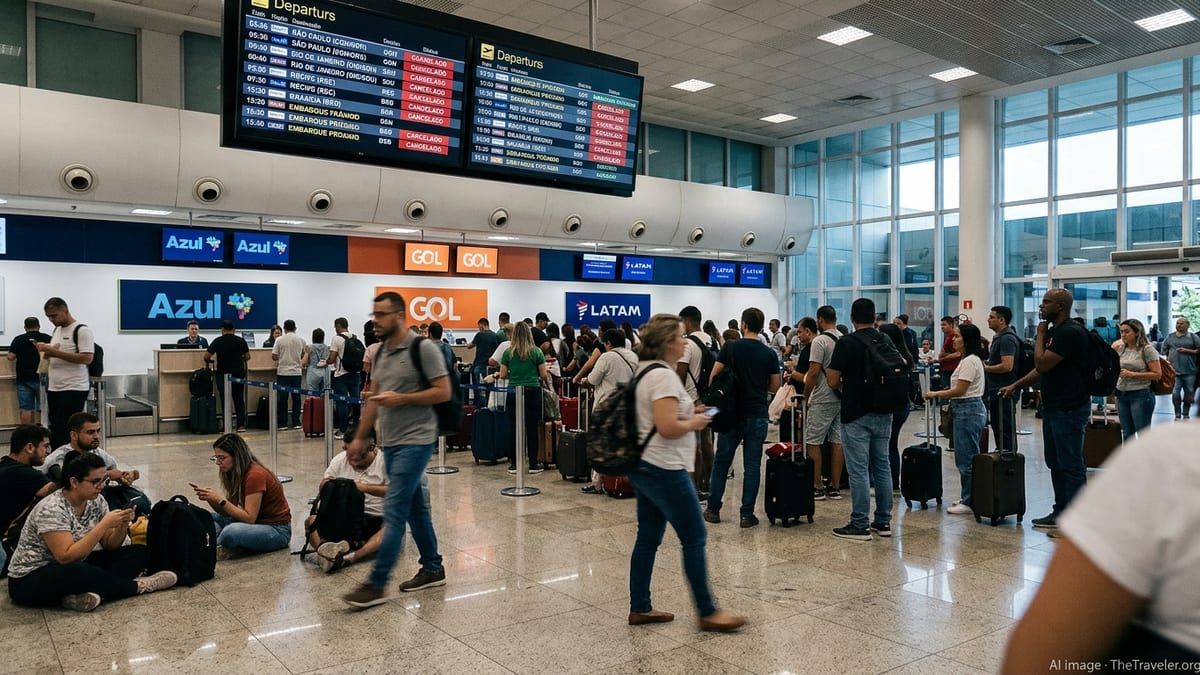
Severe disruption at Brazil’s two main São Paulo hubs, Guarulhos and Campinas, has triggered widespread delays and cancellations, leaving LATAM and GOL passengers facing missed connections, overnight airport stays and mounting frustration as operations struggle to normalize.
Get the latest news straight to your inbox!
Guarulhos and Campinas Hit by Wave of Disruptions
Brazil’s busiest international gateway, São Paulo/Guarulhos, and the major regional hub of Campinas/Viracopos experienced a sharp spike in operational problems, with 149 delays and 26 cancellations reported across the two airports. Publicly available tracking data and local coverage indicate that the disruption has cascaded through domestic and international networks, affecting connections from North America, Europe and across South America.
At Guarulhos, where LATAM and GOL both maintain extensive operations, delays have rippled through key trunk routes linking São Paulo with major Brazilian capitals such as Rio de Janeiro, Recife, Fortaleza and Porto Alegre. International services to hubs like Buenos Aires, Santiago, Lima and European gateways have also reported knock-on schedule changes as aircraft and crews fell out of position.
Campinas, a strategic base for domestic and regional services, has similarly seen a concentration of late departures and short-notice cancellations. The combination of two stressed hubs in the same metropolitan region has reduced the flexibility airlines typically use to re-route passengers via alternate airports, deepening the impact on travelers.
Recent Brazilian air-traffic performance reports already highlighted punctuality pressures at both Guarulhos and Campinas, and the latest disruption further underscores how quickly operational resilience can be stretched when weather, technical constraints or airspace limitations converge on the same day.
LATAM and GOL Passengers Face Long Queues and Missed Connections
The brunt of the disruption has fallen on passengers flying with LATAM and GOL, Brazil’s two largest carriers. Both airlines rely heavily on the São Paulo area for their connecting banks, meaning even modest interruptions can rapidly strand travelers far from their final destinations. Social media posts and recent passenger accounts describe lengthy lines at check-in counters and customer service desks at Guarulhos as travelers sought rebooking options after missed connections.
Domestic itineraries have been particularly vulnerable when short connection times are involved. Reports from Brazilian travel forums show that travelers with tight layovers at Guarulhos have been left scrambling to protect onward flights after initial legs departed late or were retimed. In several cases, passengers described spending the night in terminals while waiting for space on later flights, especially on already busy weekend and holiday services.
International journeys have also been affected. Recent online testimonies reference travelers who were rebooked multiple times after cancellations involving LATAM-operated legs within Brazil, resulting in substantial delays to long-haul trips and, in some cases, extended unintended stays in the country. These experiences echo broader concerns voiced in recent months about schedule reliability and communication during irregular operations.
While airlines typically provide meal vouchers, hotel stays or alternative flights during major disruptions, passenger reports suggest that support has been uneven, with some travelers receiving assistance promptly and others reporting difficulty reaching airline contact centers or securing clear information at airport counters.
Underlying Strains in Brazil’s Air Traffic and Airport Infrastructure
Industry data from Brazil’s air-navigation authorities show that Guarulhos and Campinas consistently rank among the country’s most heavily used airports by movements and passenger volumes. Recent comparative punctuality reports for 2026 already pointed to variability in on-time performance at both hubs, with peak-hour congestion, ground-handling bottlenecks and meteorological restrictions cited as recurring challenges.
Earlier this year, a technical issue at a regional airspace control center led to partial closures and delays across several São Paulo airports, highlighting the sensitivity of the system to upstream constraints. Although the latest wave of 149 delays and 26 cancellations reflects a different operational context, analysts note that similar structural factors can amplify the impact of any local disturbance at these high-density hubs.
Guarulhos in particular handles a dense mix of widebody intercontinental flights, regional services and short-haul domestic hops, many of them tightly banked. When a single bank is disrupted, aircraft are often out of position for the next wave of departures, forcing airlines into difficult choices about which routes to prioritize with limited spare capacity.
Campinas, though smaller, plays a critical role in distributing traffic across Brazil’s interior and neighboring countries. Any significant volume of cancellations there can quickly reduce connectivity for secondary cities that depend on São Paulo-area hubs for access to the broader network, compounding the inconvenience felt by passengers in more remote regions.
What Travelers Can Expect in the Coming Days
Published flight-status boards and airline advisories suggest that schedules at Guarulhos and Campinas are gradually stabilizing, but operational hangover effects are likely to persist. Aircraft rotations that were disrupted by the latest wave of delays and cancellations may take several days to fully realign, particularly for carriers like LATAM and GOL that operate tight utilization patterns on their fleets.
Travel experts advise that passengers booked through the São Paulo area in the near term should monitor their reservations frequently, use airline apps for real-time alerts and allow extra connection time where possible. Given the recent pattern of disruptions, those with nonessential trips or flexible dates may consider voluntarily shifting travel to less congested periods of the day or to alternative airports when viable.
Consumer-rights organizations in Brazil regularly remind travelers that local regulations provide for assistance and, in some circumstances, compensation when delays or cancellations cause significant inconvenience, depending on the cause and duration of the disruption. Publicly available guidance encourages passengers to keep documentation of boarding passes, receipts and written confirmation of schedule changes when seeking reimbursement or asserting their rights.
For now, the latest bout of travel chaos at Guarulhos and Campinas serves as a stark reminder of how dependent Brazil’s aviation system is on the stability of its main hubs, and how quickly operational turbulence can strand thousands of travelers when multiple pressure points collide.