


More news on this day
Etihad Airways has extended the cancellation of its Abu Dhabi to Kuwait City services until 22 June, as Kuwait International Airport continues to face a prolonged and only partially lifted closure following recent regional security incidents.
Get the latest news straight to your inbox!
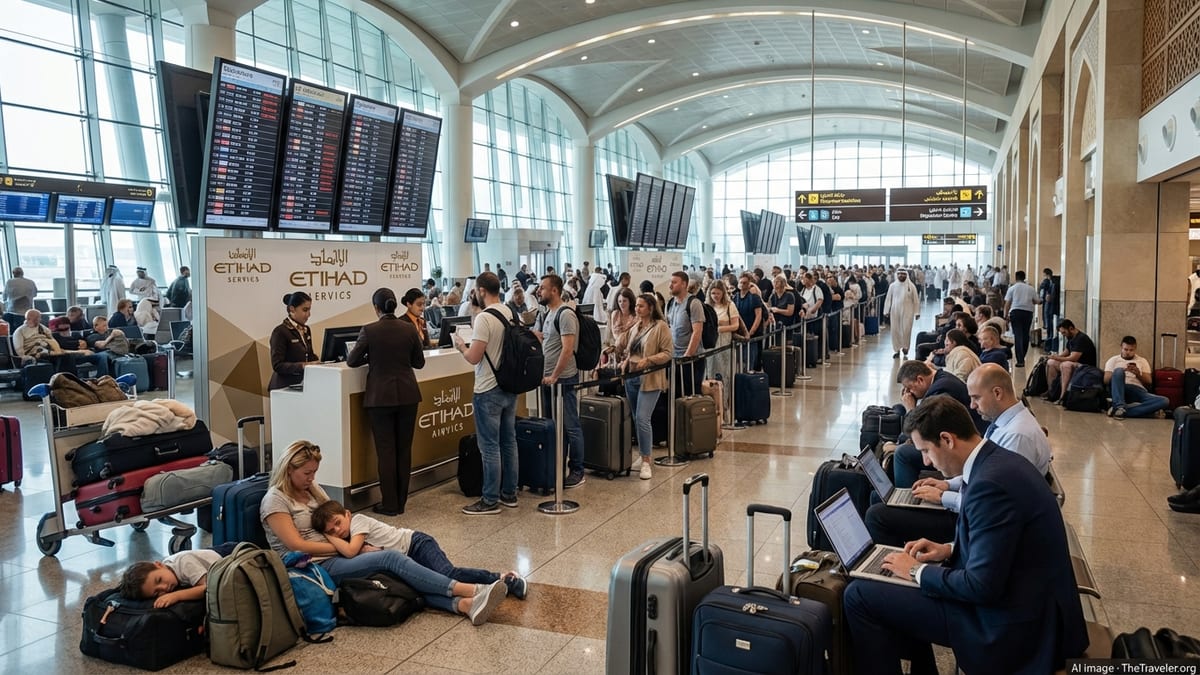
Partial reopening in Kuwait slows full flight restoration
Publicly available information indicates that Kuwait International Airport has only recently begun a limited restart of operations after an extended shutdown triggered by drone and missile strikes earlier this year. While select Gulf and regional carriers are gradually returning under restricted schedules, overall capacity at Kuwait’s main gateway remains sharply reduced compared with pre-closure activity.
Recent updates from Kuwait’s civil aviation authorities and local media describe a phased reopening that initially concentrates flights in specific terminals, including Terminal 4, with tight coordination on timetables and aircraft movements. This controlled approach is intended to restore connectivity while maintaining heightened safety and security procedures across the airport complex.
Despite these steps, a substantial portion of foreign carrier services has not yet resumed. Airlines continue to weigh operational risks, aircraft availability and network priorities as they determine when and how to reintroduce Kuwait into their schedules.
The constrained operating environment has left many point to point routes, including the busy Abu Dhabi to Kuwait sector, effectively on hold as airlines adjust day by day to infrastructure and regulatory changes on the ground.
Etihad keeps Abu Dhabi–Kuwait route offline through June 22
Against this backdrop, Etihad Airways has decided to keep its Abu Dhabi–Kuwait flights suspended until at least 22 June, extending an earlier block of cancellations that initially ran to mid June. Travel notices and timetable data show the carrier maintaining zero scheduled frequencies on the route during this period, with services listed as cancelled rather than merely retimed.
The extended blackout reflects both the lingering disruption at Kuwait International Airport and ongoing network recalibration at Etihad’s hub at Zayed International Airport in Abu Dhabi. The airline has already been operating a trimmed schedule across parts of its network following months of regional airspace restrictions and operational challenges.
By pushing the restart date for the Kuwait route further into June, Etihad is signalling that it does not yet see the conditions for a reliable, commercially viable operation on this short haul segment. The decision also aligns with broader industry caution as carriers avoid committing aircraft and crews to airports that remain under partial closure or subject to rapid regulatory changes.
Industry tracking sites and booking platforms continue to show no bookable Etihad inventory between Abu Dhabi and Kuwait City up to 22 June, underscoring the ongoing interruption to this once frequent service pair.
Passengers face rebooking, rerouting and refund options
For travellers, the extended suspension of Etihad’s Abu Dhabi–Kuwait flights means more weeks of disrupted plans at the start of the busy summer travel period. Passengers holding tickets on cancelled departures are being channelled toward standard remedies, including rebooking on alternative dates, rerouting via other regional hubs where possible, or seeking refunds in line with each fare’s conditions.
Travel forums and social media posts suggest that some Kuwait bound customers have already been re-accommodated on itineraries connecting through cities such as Doha, Riyadh or Dubai on other carriers, particularly where urgent business or family commitments are involved. In other cases, travellers appear to be postponing trips entirely, waiting for clearer visibility on when Kuwait’s airport will return to more normal operations.
Published advice from aviation and travel bodies continues to emphasize that passengers should monitor their bookings closely and check flight status in the days leading up to departure, as schedules across the region remain subject to short notice changes. Travellers are also being encouraged to build in longer connection times and consider flexible or changeable tickets where available.
The prolonged closure has already affected many thousands of passengers into and out of Kuwait since late February, with ripple effects across regional networks as airlines swap aircraft between routes and adjust fleet plans to reflect evolving demand and operational constraints.
Regional aviation still adjusting after security related shutdowns
The difficulties at Kuwait International Airport are part of a wider pattern of disruption for air travel in the Gulf and wider Middle East in 2026. A series of security related events earlier in the year led to temporary airspace closures, route suspensions and sharply reduced flight schedules for multiple carriers based in the region.
Etihad, Emirates, Qatar Airways and other major airlines all scaled back operations at various points, either due to direct restrictions on their home airspace or as a precaution in response to evolving risk assessments. While many routes have since come back online, the path to full normalization has been uneven, with certain destinations, such as Kuwait, lagging behind.
Aviation analysts note that the combination of infrastructure damage, heightened security screening and the need for close coordination between airlines and regulators can prolong recovery even after immediate threats subside. Airports must validate new procedures, carriers need to secure aircraft and crew resources, and insurers and corporate travel buyers reassess exposure to affected destinations.
For Abu Dhabi’s hub carrier, the continued suspension of the Kuwait route removes one short haul spoke from its regional network, limiting options for passengers seeking to connect between Kuwait and Etihad’s long haul services to Europe, Asia and Australia.
What travelers should do if booked on Abu Dhabi–Kuwait
With Etihad’s cancellations now extended to 22 June, travelers holding tickets on the Abu Dhabi–Kuwait route are being advised by publicly available guidance to take a proactive approach. This typically means checking their booking reference on the airline’s website or app to confirm whether their flight is marked as cancelled, then reviewing the rebooking or refund options presented.
Travel experts generally recommend that affected passengers keep records of any notifications received, such as email or app messages, and that they avoid travelling to the airport unless they have confirmed that their flight is operating as scheduled. For those needing to maintain travel dates, exploring alternative routings via other Gulf hubs or considering departures from nearby cities can provide additional flexibility.
In addition, passengers are encouraged to monitor updates from Kuwait’s aviation authorities and local media, as the pace of reopening at Kuwait International Airport will be a key factor shaping when airlines like Etihad are able to resume regular services. Any acceleration in terminal openings or operating hours could bring forward route restarts, while further operational constraints might prolong suspensions beyond the current 22 June target.
Until the situation stabilizes, the Abu Dhabi–Kuwait connection will remain one of several routes in the region where travellers are advised to remain particularly vigilant about schedule changes and to plan for potential last minute adjustments to their journeys.