


Brisbane Airport is one of Australia’s easier hubs to navigate, but transferring from a domestic flight at the Domestic Terminal to an international departure still takes planning. The terminals sit around 4 kilometres apart, and you will need to choose between the free terminal transfer bus, the paid Airtrain, a taxi or rideshare, and allow realistic time to recheck bags and clear formalities. This guide walks through each option, explains how connection times really work in practice, and clears up common myths about simply walking between terminals.
Get the latest updates straight to your inbox!
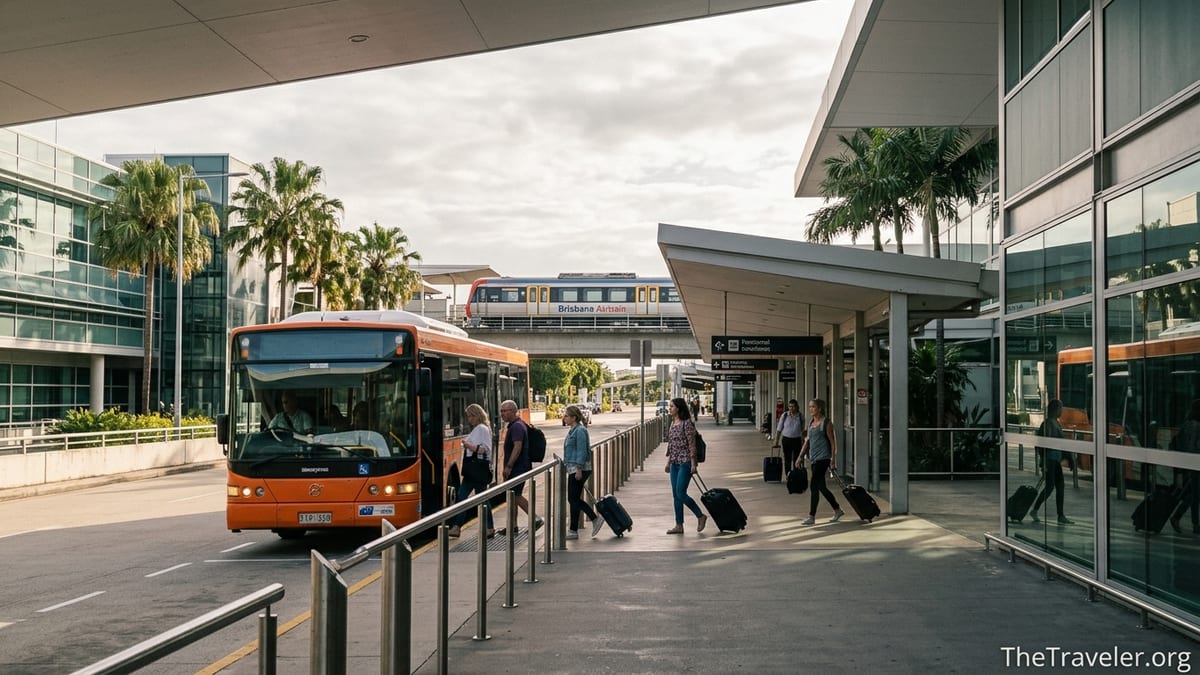
How Brisbane Airport’s Two Terminals Work
Brisbane Airport has two separate passenger terminals: Domestic and International. They are not joined by a walkway or shuttle inside the secure area. Instead, the buildings sit several kilometres apart on Airport Drive, connected by roads and the Airtrain rail line. If you arrive on a domestic flight and depart internationally, you must leave the secure area and transfer overland by bus, train, taxi, rideshare or a pre-booked transfer.
For most travellers, this means collecting checked luggage at the Domestic Terminal, exiting into the public arrivals hall, and then using one of the transfer options to reach the International Terminal departures level. Some through-ticketed passengers on airlines such as Qantas and Virgin Australia may be able to use a transfer desk and have baggage moved behind the scenes, but you should always confirm this on your booking rather than relying on it.
The terminals each have their own separate check in, security and border control points. When you arrive at the International Terminal from the Domestic side, you will be entering as a departing international passenger, so you need time to check bags, clear outbound immigration and security, and then walk to your gate. At busy times of day this can easily add 45 minutes or more.
Because of the distance between the terminals and the need to reclear processes, you cannot treat a domestic to international connection at Brisbane the same way you would a simple domestic-to-domestic change of gate. Building a realistic buffer into your plans is one of the most important decisions you will make when booking flights.
The Free Terminal Transfer Bus (T-Bus)
Brisbane Airport operates a complimentary Terminal Transfer Bus, often called the T-Bus, that links the Domestic and International Terminals. The shuttle also serves the Skygate and DFO shopping precincts, but for most connecting passengers its main role is moving people between the two terminals at no charge. The stops are signposted outside both terminals, typically near the Qantas and Virgin ends of the Domestic Terminal and at the arrivals level at International.
The free bus runs frequently through most of the day. Official information indicates it operates roughly every 10 minutes at peak, with slightly longer gaps late at night and in the very early morning. In practice, many passengers report waiting about 5 to 15 minutes for a bus, then a journey time of around 10 minutes between terminals, depending on traffic and how many intermediate stops are included on that run.
To use the bus from the Domestic Terminal, follow signs for “Terminal Transfer Bus” or “T-Bus” as you exit baggage claim. You do not need a ticket or boarding pass; simply queue at the stop and board when it arrives. The bus is standard, low-floor public transport style, with space for luggage but not dedicated luggage racks like some long-distance coaches. At busy times, expect it to be crowded with both airport workers and fellow passengers.
For many travellers on a budget, the T-Bus is the default choice. If your connection is comfortable, for example landing at 9:00 and departing internationally at 12:30 on separate tickets, the free bus gives you more flexibility to spend on food or a coffee rather than transport. However, if you are very tight on time or arriving in the middle of the night when frequencies thin out, the added certainty of a taxi or Airtrain may be worth paying for.
Using Brisbane Airtrain Between Terminals
Airtrain is the dedicated rail service linking Brisbane Airport with the city and the wider suburban rail network. Importantly for connecting passengers, it also runs between the Domestic and International Terminal stations, which sit directly outside each terminal building. Trains usually operate every 15 minutes in peak daytime periods and every 30 minutes at quieter times, from early morning to late evening.
Travel time between the Domestic and International stations is only a few minutes. However, you need to factor in walking from the arrivals hall to the station and waiting for the next train. At the Domestic Terminal, the station is accessed via a covered walkway from the terminal forecourt. At the International Terminal, the station sits on the same side of the building, with a covered connection up to the departures levels. A typical door-to-door transfer, including walks and waiting, is around 15 to 25 minutes.
Airtrain is a paid service. Fares change periodically, but as a rough guide you can expect to pay a modest single-figure amount in Australian dollars for a one-way trip between the Domestic and International stops, with discounts often available when buying online or using smartcards. Children under a certain age may travel free when accompanied by a paying adult, subject to Airtrain’s current conditions. Many travellers, especially families with several bags, appreciate the guaranteed space, level boarding and protection from weather that the train provides.
Airtrain can be a smart choice when you are landing in the peak morning rush and want a reliable, predictable transfer that is not affected by road congestion. For instance, if your domestic flight touches down at 7:30 and you have an international departure at 10:30 on separate tickets, stepping straight onto Airtrain can save you from waiting for a busy bus and give you a calmer experience. You simply follow the station signs, tap on or buy a ticket at the machines or staff counter, and ride one stop to the opposite terminal.
Taxi, Rideshare and Private Transfers
If you value door-to-door simplicity, a taxi or rideshare is the most straightforward way to move between Brisbane’s Domestic and International Terminals. Taxi ranks and rideshare pick up areas are located immediately outside each terminal. Drivers are very familiar with passengers making terminal hops, and the trip is short, typically around 10 minutes depending on traffic and roadworks.
Fares vary with time of day and traffic, but for such a short distance many travellers report paying roughly the cost of a minimum flag-fall ride, usually in the low tens of Australian dollars. Because the journey runs entirely within the airport precinct, you avoid toll roads, and there are no complex directions to explain to the driver. This can be especially appealing if you are jet-lagged, travelling with children, or dealing with several heavy suitcases.
Rideshare services such as Uber and others also operate at Brisbane Airport. Prices fluctuate with demand, but off peak they often sit in a similar range to taxis for an intra-airport trip. The main difference is that you will need mobile data and the relevant app, plus a few extra minutes to locate the correct pick up zone by following terminal signage. Some travellers prefer the predictable app-based estimate and cashless payment for a quick transfer between terminals, particularly late at night when bus frequencies are lower.
Pre-booked private transfers are generally more common for trips into Brisbane city or the Gold Coast, but if you have arranged a chauffeur or hotel shuttle, they can almost always drive you from one terminal to the other. Given the short distance, it is rarely economical to book a dedicated terminal transfer alone, but it can make sense if you are already using a private car for a longer journey and have a multi-hour gap.
Baggage Recheck, Transfer Desks and Security
One of the most confusing aspects of Brisbane domestic to international connections is what happens to checked baggage. On a single ticket, especially when flying with one airline or alliance, your bags are often tagged all the way through to your final destination. In that case, you may be able to use a transfer desk at the International Terminal to drop your bags again after customs, without personally wheeling them to the Domestic side or vice versa.
If your flights are on separate tickets, it is safer to assume you will need to collect your luggage at the Domestic Terminal carousel, clear into the public area, and then take it with you to the International Terminal to check in again from scratch. For example, if you arrive from Cairns on a low-cost carrier and connect to a full-service airline’s long haul flight booked separately, those airlines will usually not interline bags. You must build in extra time for baggage delivery, walking, check in and potential queues.
At the International Terminal, outbound passengers must clear security screening and passport control even if they have just arrived on a domestic flight. Security can peak in the early morning and evening when several widebody departures are scheduled. On a smooth day, checking in, dropping bags and passing through security and immigration might take 30 to 40 minutes. On busier days, or when inspections are tightened, it can take longer.
The key practical point is to treat baggage and border processes as the longest and least predictable part of the connection. Walking from transport stop to check in is relatively quick. Waiting for a bus or training it one stop usually adds 15 to 20 minutes. But waiting at the domestic carousel for bags, and later standing in lines at international check in and security, can sometimes chew through half of your available time, especially if the arriving flight is late.
Can You Walk Between Brisbane’s Terminals?
A persistent myth suggests that you can simply walk between Brisbane’s Domestic and International Terminals in a few minutes along a footpath. In reality, while the terminals are only around 4 kilometres apart in a straight line, they are separated by highways, service roads and secure airport areas. There is no convenient, dedicated pedestrian walkway for passengers. Attempting to walk would involve navigating busy roads with limited footpaths and is not recommended from either a safety or time perspective.
Official airport guidance directs passengers to use motorised options such as the Terminal Transfer Bus, Airtrain, taxis or rideshare. In practice, even fit local workers familiar with the precinct tend to drive or ride rather than walk between terminals. The time you would spend finding a passable route on foot far exceeds the 10 to 20 minutes required for the bus or train, and you may end up on uncomfortable roadside verges or dead-end service roads.
Another related misconception is that there might be an internal airside shuttle that keeps you within the secure zone. Brisbane does not currently operate such a system for regular passengers between its Domestic and International Terminals. Every transfer requires you to be in the public landside area at some point and to reclear security when you reenter the departure zone.
For planning purposes, it is best to completely rule out walking as an option and decide in advance which of the realistic choices best fits your budget, luggage situation and connection time. This avoids last-minute stress in the arrivals hall when you realise the terminals are not physically connected.
How Much Time to Allow for a Domestic to International Connection
Minimum connection times advertised by airlines can be as low as around 90 minutes for a protected domestic to international transfer in Brisbane when both flights are on the same ticket. This assumes typical operating conditions, bags checked through, and streamlined use of transfer desks. However, these official figures are designed for airline scheduling and do not guarantee a stress-free experience, particularly when flights are on separate bookings.
For separate tickets where you must collect and recheck baggage, a buffer of at least 3 hours between scheduled domestic arrival and international departure is a cautious benchmark. This allows for a moderate delay on the incoming flight, 20 to 30 minutes waiting for bags, about 20 minutes to reach the International Terminal using the free bus or Airtrain, and up to an hour or more for international check in and security. For example, arriving from Sydney at 8:30 and booking an international departure at 11:30 gives you some room to absorb queues and minor disruptions.
If you are checking no bags and can check in online for your international flight, you may be comfortable with a shorter gap, perhaps around 2 hours, especially outside peak times. In that scenario, you could land domestically at 10:00, walk straight off the aircraft with cabin baggage only, catch the next Airtrain or shuttle bus, and aim to be at international security around 10:40 or 10:50. This still leaves roughly an hour for security, immigration and a walk to the gate, which is workable but leaves little margin for unexpected hold-ups.
Passengers arriving in the early morning, when immigration queues for arriving long-haul flights can be longest, or late evening, when transport frequencies may be reduced, should err on the side of more time. Families with small children, elderly travellers, or anyone unfamiliar with the airport will almost always find that an extra hour of buffer is cheap insurance compared with the cost and stress of missing a long-haul departure and trying to rebook at the last minute.
Real-World Connection Scenarios
Consider a traveller flying from Melbourne to Brisbane on a morning service with a full-service airline, connecting to a late-morning international flight to Singapore on the same carrier, booked as a single itinerary. Their bags are tagged through to Singapore in Melbourne. When they land in Brisbane, they follow the signs to the transfer desk, recheck any bags if required, take the free terminal transfer bus across, and proceed straight to international security. With a sold connection time of about 1 hour 45 minutes, this is tight but achievable under normal conditions. If the first flight is delayed, the airline has a responsibility to rebook them on the next available service.
Now compare that with a couple who have found a cheap deal by booking a low-cost domestic flight from Cairns to Brisbane and a separate full-service international ticket from Brisbane to Tokyo. They arrive domestically at 10:35 and plan to depart internationally at 12:30, a gap of just under 2 hours. They must wait for checked bags in the Domestic Terminal, find the T-Bus stop, transfer across, join the international check in queue, and clear security and immigration. If baggage delivery or check in queues are slow, they risk missing the international flight. Because the tickets are separate, the second airline is under no obligation to rebook them for free if they arrive late at the counter.
A third scenario involves a solo traveller with cabin baggage only, flying from Sydney to Brisbane on an early afternoon flight and then on a separate ticket to New Zealand in the evening. They deliberately book a 4 hour layover. After landing, they walk directly from the gate to the Domestic Terminal Airtrain station, ride one stop to the International Terminal, and use the extra time to shower, eat, and relax before heading through security. Even if their domestic flight is delayed by an hour, they still have a substantial margin and a much lower stress level.
These examples highlight a central principle: the tighter and more fragmented your booking, the more you should consider paid, predictable transfer options and larger time buffers. When a long-haul or rare international service is at stake, a slightly longer layover is usually vastly preferable to gambling on a tight turnaround.
The Takeaway
Transferring from Brisbane Airport’s Domestic Terminal to the International Terminal is straightforward once you understand that the buildings are separate and connected only by surface transport. You cannot walk between them in a practical way, and there is no airside shuttle that keeps you within the secure zone. Every connection requires you to plan for baggage, movement between terminals, and international departure formalities.
The free Terminal Transfer Bus, or T-Bus, is the budget-friendly workhorse option, while Airtrain offers a fast, frequent ride between the two dedicated airport stations. Taxis, rideshare services and private vehicles provide a simple door-to-door alternative, especially when time is tight or you are managing multiple bags or young children. Choosing between these depends largely on how much time and money you are willing to trade for comfort and predictability.
The most important decision remains how much time to allow. On a single ticket with bags checked through, airline minimum connection times around the 90-minute mark are technically possible, though often stressful. On separate tickets or when you must collect and recheck bags, a window of 3 hours or more dramatically improves your odds of a smooth transfer, particularly at peak times or when flying long haul. Building that buffer into your plans is one of the simplest ways to protect your trip.
By combining a realistic connection window, a clear choice of transfer mode, and an understanding of baggage and security steps, you can turn Brisbane’s domestic to international transfer from a source of anxiety into a routine part of your journey. Planning ahead with real-world timing rather than best-case assumptions is the key to walking onto your international flight relaxed, rather than sprinting to the gate at the last minute.
FAQ
Q1. How long does it take to transfer from Brisbane Domestic to International?
In typical conditions, allow around 10 minutes for the bus or train ride, plus walking and waiting time. Door-to-door, most travellers take about 20 to 30 minutes between terminals.
Q2. What is the minimum safe connection time on separate tickets?
For separate bookings where you need to collect and recheck bags, a minimum of 3 hours between scheduled domestic arrival and international departure is a cautious guideline.
Q3. Is the terminal transfer bus at Brisbane Airport free?
Yes. The Terminal Transfer Bus, often called the T-Bus, is complimentary for passengers moving between the Domestic and International Terminals and Skygate.
Q4. Should I use Airtrain or the free bus between terminals?
If you value predictability and comfort, Airtrain is a good paid option. If your schedule is relaxed and budget is a priority, the free bus is usually sufficient.
Q5. Can I walk between Brisbane’s Domestic and International Terminals?
No. There is no practical pedestrian route between the terminals, and the roads and distances involved make walking unsafe and time consuming. Use transport instead.
Q6. Do I need to collect my bags for a domestic to international transfer?
If your flights are on the same ticket and your bags are tagged through, you may not. On separate tickets, assume you must collect and recheck baggage unless your airline confirms otherwise.
Q7. How much does Airtrain cost between the terminals?
Airtrain pricing changes from time to time, but expect a modest single-figure Australian dollar fare for the short trip, with discounts often available for online or smartcard purchases.
Q8. Are taxis and rideshares expensive for a terminal transfer?
Because the distance is short, the fare is usually similar to a minimum urban trip, typically in the low tens of Australian dollars, varying by time and demand.
Q9. What if my domestic flight is late and I miss my international flight?
If both flights are on one ticket, the airline generally rebooks you on the next available service. On separate tickets, you may have to buy a new international ticket at your own expense.
Q10. Is 90 minutes enough to connect domestically to an international flight at Brisbane?
On a single ticket with bags checked through, 90 minutes can work but is tight. For separate tickets or baggage recheck, it is generally too risky for long-haul departures.