


Cairo International Airport can feel overwhelming the moment you exit customs. Dozens of drivers call out "Taxi, my friend" and it can be difficult to know who is official, what a fair price is and how to avoid starting your Egypt trip by overpaying. This guide focuses specifically on taxis and car transfers at Cairo International Airport, with practical examples, current price ranges and step by step advice for finding the right pickup area and keeping your fare under control.
Get the latest updates straight to your inbox!
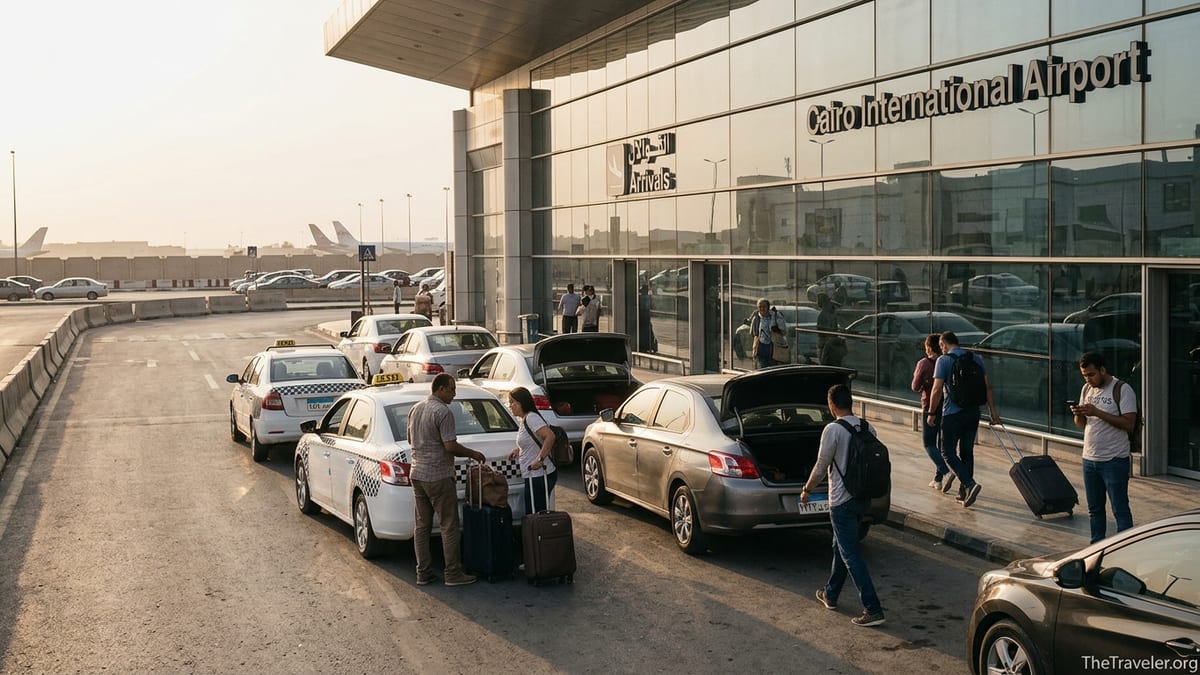
Understanding Your Taxi Options at Cairo International Airport
Cairo International Airport (CAI) lies in Heliopolis, roughly 15 to 20 kilometers from central neighborhoods like Downtown, Zamalek and Garden City, depending on the route and traffic. Most international travelers arrive into Terminal 2 or the newer Terminal 3. As you leave the arrivals hall, you will usually have three broad options for getting into the city by car: official airport limousines, regular Cairo white taxis and app based ride hailing such as Uber and Careem.
The airport’s own limousine services are often branded as "limousine" or "Misr Limousine" at desks inside or just outside arrivals. They operate with fixed prices by destination and car category rather than meters. These cars are typically newer sedans or minivans with air conditioning. Prices are higher than a regular taxi but more predictable, so they appeal to first time visitors and business travelers who want to avoid bargaining immediately after landing.
Outside the terminal, Cairo’s regular taxis serve the airport in two main forms. The older black and white taxis remain in circulation, usually without meters and with heavily negotiated fares. More common are the newer white taxis with a black checkered stripe, which by regulation have meters and air conditioning for rides into the city. In reality, some drivers will still try to avoid using the meter with tourists, so you will need to be firm.
On top of that, ride hailing apps such as Uber and Careem are widely used by locals and visitors to and from Cairo Airport. These services calculate fares in advance based on demand and distance, and many travelers now find them the easiest option when they have data on their phone. You will not see an official Uber or Careem desk inside the terminal, but drivers can pick up in designated parking areas in front of Terminals 2 and 3.
Typical Fares from Cairo Airport and What Is Reasonable
Because of inflation and fuel price changes, taxi fares in Cairo move frequently. As of mid 2026, an app based UberX or comparable Careem Go ride from Cairo Airport to central areas such as Downtown, Tahrir Square or Zamalek typically falls somewhere around 150 to 300 Egyptian pounds, depending on traffic, time of day and surge pricing. For example, travelers arriving on a weekday afternoon often report Uber quotes around 200 to 230 pounds for a 40 to 60 minute ride into Downtown in normal traffic.
Official airport taxis and limousines charge more. For a standard sedan in the airport limousine category, many recent visitors describe paying roughly 200 to 400 Egyptian pounds to central Cairo hotels for up to three passengers with luggage. If you are quoted something in that band from a clearly identified airport limousine counter, it is on the higher side compared with ride hailing, but not necessarily a scam. If someone quotes 800 or 1,000 Egyptian pounds for the same journey without a good reason, you are almost certainly being overcharged.
White metered taxis from the official taxi rank outside the terminal should, in theory, cost somewhat less than limousines, often roughly similar to an Uber when the meter is used properly. The meter in Cairo white taxis starts at a fixed "opening" amount, then adds increments per kilometer and per waiting time. Local authorities have periodically adjusted the opening charge; by 2026, it is roughly in the mid teens in Egyptian pounds to start, then climbs gently as distance and time add up. In practice, a correctly metered ride from the airport to central Cairo might land in the 180 to 280 pound range, similar to a non surged Uber.
The older black and white taxis almost always work by negotiation, not meter. Drivers may open with very high starting prices, such as 600 or 700 Egyptian pounds to Downtown. Many Cairo residents would consider 250 to 350 Egyptian pounds a more realistic cash negotiation for this distance at the moment, but the key is that you agree the price before getting in. If a driver refuses to state a clear figure or says "pay what you want" and then argues later, it is best to walk away.
Where to Find Taxis and Pickup Areas at Terminals 2 and 3
At Cairo Airport Terminal 2, after clearing immigration and customs, you will exit into the public arrivals hall. The first offers you see will usually be currency exchange, mobile SIM card counters and hotel or tour representatives. For taxis and cars, ignore individuals inside who whisper "Taxi" and instead follow overhead signs towards "Taxis" or "Ground Transportation". These will lead you through the sliding doors to the curbside area. Official airport limousine desks are sometimes located just inside the doors or immediately outside on the sidewalk.
Once outside Terminal 2, you will see several lanes of traffic. Immediate curbside tends to be reserved for quick drop offs and pickups, and this is where unlicensed touts often hover. For official white taxis, look further along the curb where you see an organized line of cars and sometimes a uniformed dispatcher. If you are using ride hailing, you may need to cross a lane or two following the app instructions to reach a designated parking zone slightly away from the main terminal doors, where Uber and Careem drivers can wait without being moved on by security.
Terminal 3, which handles many EgyptAir and Star Alliance arrivals, has a broadly similar layout but on a larger scale. After customs, you enter a long arrivals hall with services on both sides. Taxi touts will approach here as well. If you have pre booked a hotel or tour transfer, your driver will typically wait just beyond the sliding doors with a sign. For taxis and ride hail, keep moving until you exit to the curb. You will again find airport limousine desks near the exit and taxi queues a bit further along. Ride hailing pick up points for Terminal 3 are usually across the first roadway in the parking area, following the instructions in your app.
Because pickup arrangements can change, it is smart to check the latest in app map for Uber or Careem as you land. Some recent passengers describe needing to take a short elevator ride or pedestrian bridge to a lower level or outer car park, particularly at busy times when the airport directs ride hail cars away from the closest curb. If you are unsure, send your driver a message through the app with your exact location reference, such as "outside Door 3, arrivals level, near orange café." That simple clarification can save a lot of wandering with luggage.
How to Use White Taxis Safely and Avoid Overpaying
The modern white taxis of Cairo are generally the safest bet among street taxis. They are easy to recognize by their white body and the black and white checker stripe, and by law they are equipped with digital meters. At the airport, these taxis often wait in an official rank just beyond the busiest curb, sometimes with a clearly marked sign and a person organizing the queue. Choosing a car from this rank is usually more straightforward than accepting a random offer from a man inside the terminal.
When you get to the front of the queue, approach the driver with the name of your destination written down in both English and Arabic if possible. You can ask "meter, please" and watch to ensure that the driver resets and starts the meter before the car moves. If the driver says the meter is broken or insists on a high flat price, you can politely step back and let the next car take you. Do not worry about offending the driver; this is common practice and it is your money at stake.
A useful tactic is to know roughly what the ride should cost before you leave the terminal. For example, if Uber is quoting 220 Egyptian pounds from Terminal 3 to a well known hotel in Garden City at that moment, then a metered white taxi that reaches roughly the same amount by the end of the ride is reasonable. If, instead, a non metered driver insists on at least 500 pounds for the same trip, you can confidently walk away. Keeping the Uber app open even if you do not plan to use it gives you a valuable real time benchmark.
At the end of the journey, check the meter and your change. Small rounding up is normal. For example, if the meter shows 205 pounds, most visitors would offer 220 or 230 and consider that a modest tip. Travelers who want to avoid awkward change issues often carry a mix of 10, 20 and 50 pound notes in addition to a few larger bills. This makes it harder for a driver to claim he has no change and effectively force an oversized tip.
Airport Limousines, Hotel Cars and Prebooked Transfers
If you prefer not to deal with haggling after a long flight, the official airport limousine services can be a worthwhile compromise. These services, which often operate under names such as "Misr Limousine" or generic "Limousine Service," are authorized by the airport and have fixed price lists by destination and by vehicle category. Categories usually range from a standard sedan up to minivans and small buses. The desks are located in each terminal, and payment may be taken in cash in Egyptian pounds, and sometimes by card.
For example, in 2026, a standard airport limousine from Terminal 3 to a mid range hotel near Tahrir Square might be quoted around 350 to 400 Egyptian pounds for up to three passengers, with a higher price for a minivan if you are carrying bulky luggage. While this is more than a typical Uber fare, you gain the reassurance of a fixed price and an official receipt. For many solo travelers arriving around midnight, that premium feels acceptable for a smoother experience.
Many mid and high end hotels in Cairo also offer their own airport transfer services, often using branded vans or sedans. Prices are usually in the same or slightly higher band than airport limousines. It is not uncommon for a central Cairo hotel to charge the equivalent of 25 to 40 US dollars per car each way, which, at current exchange rates, is significantly more than a local taxi but may be folded into a package rate or corporate booking. If you are arriving with children, large suitcases or valuable equipment, the peace of mind and clear meeting point can be worth the cost.
For travelers who like to have everything arranged in advance, several reputable local operators and taxi companies allow online or email booking of private transfers. In this case, you will usually be met in the arrivals hall by a driver holding a sign with your name, then walked directly to the car. The main rule is to confirm the full price in writing beforehand and to clarify whether tolls, parking and waiting time are included so there are no surprises when you arrive.
Late Night Arrivals, Luggage and Safety Considerations
Many long haul flights from Europe and North America land in Cairo late at night or very early in the morning. At 2 or 3 a.m., the arrivals hall can actually feel more chaotic, not less, because there are fewer official staff around, yet the independent drivers know tired travelers are more vulnerable to overpaying. In these hours, you might see drivers proposing flat fares of 800 or even 1,000 Egyptian pounds to central Cairo, claiming that "night price" or "airport tax" makes this normal. It is not. While a modest night premium is reasonable, most locals would still not expect to pay more than roughly double the daytime Uber quote for the same ride.
If you are arriving very late and are concerned about navigation or safety, the simplest approach is to prebook a hotel car or reputable transfer. That way, you can walk past all offers until you see your name on a sign and know that the driver has your flight number and destination. Alternatively, using Uber or Careem with in app navigation gives you a traceable route and driver details. Many solo travelers report feeling safer in app based rides because there is a digital record of the trip.
Luggage is another practical factor. A typical UberX or white taxi sedan in Cairo can comfortably handle two medium suitcases plus small backpacks. If you are carrying three or four large cases, a stroller or bulky sports gear, look for a larger category in the app or ask the limousine desk for a minivan. In practice, a family of four with three big checked suitcases and two cabin bags may find that two separate UberX cars, each around 200 pounds, are easier than trying to squeeze everything into one small sedan.
Basic safety rules apply as they would in any large city. Always keep your valuables on your person rather than in the trunk. Take a quick photo of the license plate and, if using an app, make sure the car model and plate match what appears on your screen before getting in. If anything feels off, such as a driver insisting you cancel the app ride and pay cash at a higher price, it is fine to step back, decline and request another car.
Common Overcharging Tricks and How to Avoid Them
Most Cairo taxi drivers work hard for modest income, but a subset around the airport has become adept at squeezing as much as possible from short term visitors. Understanding the most common tricks will help you avoid them. One typical scam happens inside the terminal when a friendly looking man in plain clothes offers "official taxi" service. He may show a lanyard or laminated card, but he is not at a real desk. After walking you to a car, he quotes an inflated flat price, sometimes in foreign currency, such as 50 or 60 US dollars for a standard ride into town. By that point, with luggage loaded, many travelers hesitate to back out.
Another frequent tactic involves switching between currencies and exploiting confusion over exchange rates. You might initially agree to "300" assuming Egyptian pounds, but at the end of the ride, the driver claims you agreed to 300 dollars or euros. While this is extreme, some travelers have reported drivers insisting on the equivalent of 300 to 400 US dollars for a simple airport to hotel ride. To protect yourself, always state the currency clearly when agreeing a fare. For example, say "three hundred Egyptian pounds, only" and, if possible, type the amount on your phone and show it to the driver before you get in.
A more subtle trick is meter manipulation. A few drivers may start the meter at a higher base amount than normal or take unnecessarily long routes through congested side streets to increase the time and distance. While visitors cannot be expected to know every correct route, having your hotel location pinned in a maps app helps. You can watch the general direction and, if the driver seems to circle without reason, politely ask, "Is this the fastest way?" Knowing in advance that a typical airport to Downtown journey should take around 40 to 60 minutes in moderate traffic gives you a baseline.
Ride hailing is not entirely free from issues either. Some Uber and Careem drivers around Cairo Airport have been known to ask passengers to cancel the ride once they meet, arguing that they will give a "better cash price" if paid off the app. Often, the cash price turns out higher and you lose the safety of in app support. A good rule is to never cancel at the driver’s suggestion unless you truly want to renegotiate from zero. Keep the ride in the app so the fare is recorded and you can raise any concerns later if needed.
The Takeaway
Navigating taxis at Cairo International Airport can be confusing on your first visit, but it becomes manageable once you know the main options and rough price ranges. For stress free arrivals, many travelers now rely on Uber or Careem, which usually quote 150 to 300 Egyptian pounds to central Cairo and provide clear pickup guidance outside Terminals 2 and 3. Those who prefer speaking to a person and paying a fixed fee can head to the official airport limousine desks, expecting to pay somewhat more, especially for larger vehicles.
Regular Cairo white taxis remain a practical choice as long as you insist on using the meter or agree a clear price in Egyptian pounds before departure. Avoid accepting rides from unlicensed touts inside the terminal, be cautious about big night time "special" prices and use simple safeguards such as checking plates against your app and keeping valuables with you. With a bit of preparation and a realistic idea of what locals pay, you can leave Cairo Airport confident that your first ride in Egypt is fairly priced, safe and a smooth start to your trip.
FAQ
Q1. How much should a taxi from Cairo Airport to Downtown usually cost?
A metered white taxi or an Uber type ride from Cairo Airport to areas like Downtown or Tahrir Square typically falls around 150 to 300 Egyptian pounds, depending on traffic and time of day. If someone is asking for 600 pounds or more for a standard sedan to central Cairo without a very good reason, you are likely being overcharged.
Q2. Are taxis at Cairo Airport metered?
The newer white taxis with a black and white checkered stripe are supposed to use digital meters, including for trips starting at the airport. However, some drivers may claim the meter is broken or try to negotiate a high flat fare instead, especially with tourists. You can insist on the meter or walk away and choose another car from the rank.
Q3. Is it safer to use Uber or Careem than a regular taxi at Cairo Airport?
Many visitors feel more comfortable using Uber or Careem because the fare is calculated by the app, the route is tracked and driver details are stored. This does not mean every app ride is perfect, but it reduces the chance of major overcharging. For extra security, keep the ride active in the app and avoid cancelling to pay cash at a driver’s suggestion.
Q4. Where exactly do I meet my Uber or Careem driver at Cairo Airport?
Pickup spots can vary, but generally you will meet your Uber or Careem driver in the parking or curbside areas just outside Terminals 2 and 3. Follow the instructions shown in the app after you request the ride, which may direct you to cross one or two lanes or to a specific numbered door or parking zone. If you are unsure, send the driver a message describing the nearest door number or landmark.
Q5. What should I do if a taxi driver at the airport demands a much higher fare at the end of the trip?
Stay calm and refer back to whatever you originally agreed. If you had a meter running, point to the meter total and offer that amount plus a modest tip. If you feel pressured or unsafe, go into the hotel lobby or a staffed area rather than arguing at the curb. For app based rides, you can also report the situation through Uber or Careem support after the trip.
Q6. Are late night taxi rides from Cairo Airport more expensive?
There can be a slight premium at night due to lower supply and higher demand, and drivers may mention night rates. However, the price should not suddenly double or triple without reason. As a benchmark, check what Uber or Careem is quoting when you land, and use that as a reference to judge whether a taxi’s night fare is reasonable.
Q7. How can I avoid scams from unofficial drivers inside the terminal?
The simplest way is to decline all unsolicited offers in the arrivals hall and walk straight to official desks or the marked taxi rank outside. Unofficial drivers often approach with "Hello my friend, official taxi" and show informal ID cards. Instead, use an airport limousine counter, the organized white taxi rank, or book Uber or Careem on your phone and follow the app to the pickup point.
Q8. Do I need cash, or can I pay taxis by card at Cairo Airport?
Most regular taxis in Cairo expect to be paid in cash in Egyptian pounds, and many drivers do not accept cards. Airport limousine counters and some hotel transfer services sometimes accept card payments, but you should not rely on it. For a smooth arrival, withdraw or exchange enough Egyptian pounds at the airport to cover your first taxi ride and a small tip.
Q9. What if I have a lot of luggage or am traveling with a family?
For more than two large suitcases or when traveling with children, consider booking a larger car category in Uber or Careem if available, or asking the airport limousine desk for a minivan. Trying to cram four big bags into a small sedan can be uncomfortable and may lead a driver to argue for an extra fee. Families often find that a prebooked hotel or private transfer with a minivan is worth the slightly higher cost for space and predictability.
Q10. Is tipping expected for taxi drivers from Cairo Airport?
Yes, small tips are customary but not mandatory. Many visitors round up the fare or add roughly 10 percent if the service was straightforward and the driver was honest. For example, if the agreed or metered fare comes to 220 Egyptian pounds, handing over 240 or 250 pounds is polite. There is no need to tip excessively just because you are coming from the airport.