


More news on this day
Canada has tightened its travel advisory for the United Arab Emirates, now urging residents to avoid non-essential trips as regional tensions, missile attacks and a volatile security environment reshape perceptions of risk in one of the Middle East’s busiest transit hubs.
Get the latest news straight to your inbox!
Advisory Raised to Avoid Non-Essential Travel
Publicly available information from the Government of Canada’s travel portal shows that the United Arab Emirates is now listed under an “avoid non-essential travel” warning, replacing the previous guidance that asked Canadians to exercise a high degree of caution. The change, posted in mid-July, reflects what officials describe in published material as a deterioration in the regional security climate and a heightened risk of further attacks.
The advisory highlights the potential for renewed missile and drone strikes linked to ongoing hostilities between Iran and a United States–Israel coalition, as well as broader instability across the Gulf. While the UAE continues to function as a commercial and aviation hub, Canadian authorities indicate that the conflict has introduced new layers of uncertainty, particularly around civilian infrastructure and air traffic corridors.
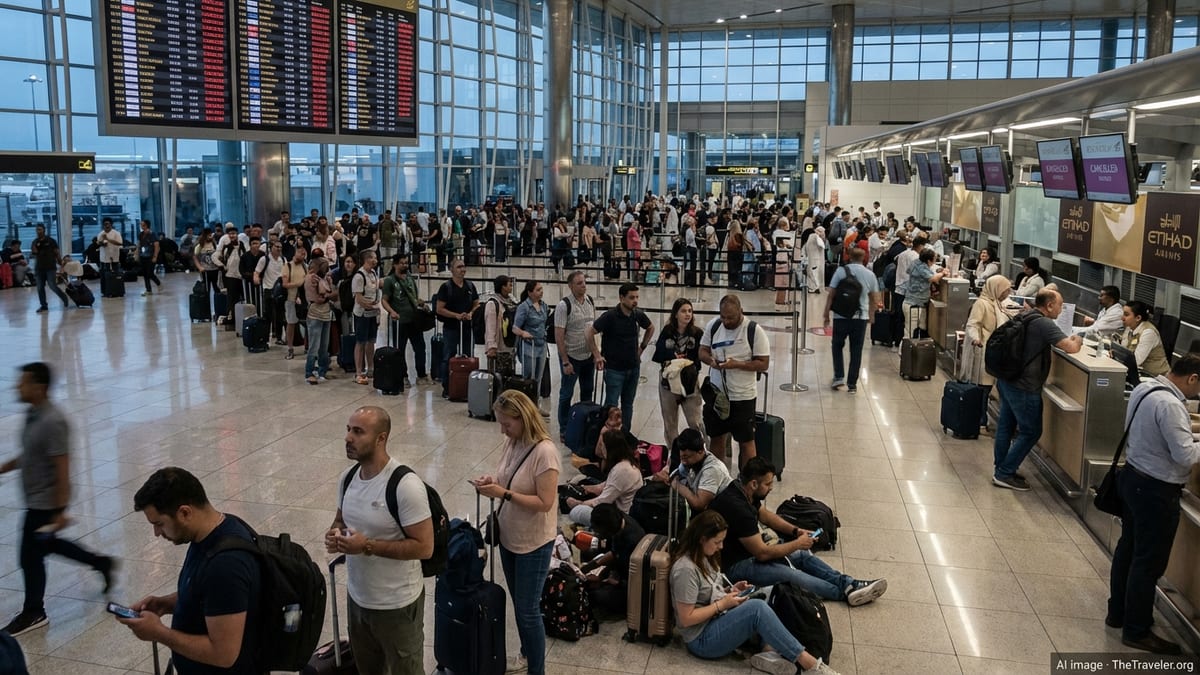
The updated notice stresses that travel plans may be disrupted at short notice by changes to airspace access, flight schedules and security measures at airports. Travellers are urged, in the government’s publicly available guidance, to ensure they have flexible tickets and comprehensive travel insurance that addresses war or conflict-related disruptions, which are often excluded from standard policies.
Regional Conflict Brings Risks Closer to Home
The tightening of Canada’s advisory comes after a series of Iranian missile and drone attacks earlier in 2026 that struck targets in and around Dubai and other parts of the UAE. Open-source reporting details incidents in which projectiles and intercepted debris damaged a hotel complex and port facilities, underscoring the capacity of the conflict to spill over into areas previously viewed as safe transit points.
Analysts cited in international coverage of the crisis note that the strikes represented a turning point for Gulf security, demonstrating that high-profile economic and aviation hubs are not insulated from regional confrontation. For Canada, which has thousands of citizens living, working and transiting through the UAE at any given time, such developments have prompted a reassessment of how to balance travel freedom with evolving security realities.
Global travel advisories issued by other governments, including the United States and several European and Asia-Pacific states, similarly reference a risk of further hostilities and attacks on infrastructure across the wider Middle East. Canada’s tighter stance aligns its travel warning with this broader international trend, even as it continues to emphasize that each traveller must make individual risk calculations.
Impact on Flights, Layovers and Tourism Plans
The UAE’s role as a major international aviation hub means that Canada’s revised guidance is likely to resonate well beyond travellers whose final destination is Dubai or Abu Dhabi. Many Canadians connect through the UAE on long-haul routes to Africa, Asia and Oceania, often spending only a few hours in transit. Under the updated advisory, those itineraries technically fall within the scope of “non-essential” travel, although the decision to reroute remains at the discretion of individual travellers and airlines.
Industry analyses circulating within the travel and hospitality sector indicate that airlines have already been adjusting their operations in response to the regional unrest. Some carriers have reduced frequencies, re-routed flights to avoid certain airspace or introduced flexible rebooking policies for passengers affected by cancellations and schedule changes. The European Union’s aviation safety body has also issued precautionary guidance asking companies to limit exposure to Gulf airspace during periods of heightened tension.
For Canadian holidaymakers, the combination of security concerns and operational uncertainty may prompt a pivot away from the Gulf and toward alternative winter-sun destinations in Southern Europe, the Caribbean or Southeast Asia. Travel trade publications suggest that tour operators are closely monitoring booking patterns and may shift marketing focus and capacity if the current advisory level persists into the peak travel seasons.
Government Messaging to Canadians Abroad
Alongside the updated advisory, Canadian authorities are amplifying generic preparedness messages aimed at citizens already in the UAE or planning to go despite the recommendation. Public guidance encourages travellers to register their presence abroad, monitor local and international news, and maintain contingency plans in case of sudden deterioration, including knowing the location of shelters and alternative routes to airports.
Canadians are also being reminded through official communications that consular assistance can be limited in a fast-moving security crisis, particularly if access to certain areas is restricted. The advisory language emphasizes that travellers should not assume evacuation flights or government-organized transport will be available, and that they may need to rely on commercial options or personal resources to leave the country if conditions worsen.
Global Affairs Canada material further advises travellers to verify that their insurance covers medical evacuation and conflict-related incidents, and to consider how sanctions, flight bans or fuel shortages could affect their ability to move within the region. The focus, according to publicly posted notices, is on empowering individuals to make informed decisions rather than imposing legal barriers to travel.
Balancing Bilateral Ties With Heightened Caution
The decision to tighten travel advice for the UAE comes at a time when Canada continues to cultivate political and economic ties with Gulf partners. Recent official readouts describe high-level meetings between Canadian and Emirati leaders on the margins of international gatherings, where topics have included regional security, trade and cooperation on energy transition and climate policy.
Observers note that travel advisories are framed as technical risk assessments rather than political statements, but their impact on public perceptions and commercial links can be significant. The UAE has been an important destination and transit point for Canadian business travellers, tourists and expatriate workers, with multiple direct flights connecting major Canadian cities to Dubai and Abu Dhabi.
Policy specialists writing in think-tank and industry reports suggest that if the regional conflict stabilizes and missile threats recede, governments may gradually recalibrate their warnings. For now, Canada’s latest move places the UAE in the same broad risk category as several other Gulf states, signalling to travellers and the aviation industry that the security environment remains fragile and that further adjustments to travel advice cannot be ruled out.