


Calling at Castries on a cruise and eyeing the fishing village of Anse La Raye for the day, or its famous Friday night Fish Fry? With limited hours ashore and a winding west-coast road to navigate, timing and transport choices matter. This guide walks you through real-world taxi prices, driving times, private tour options, and safe return buffers so you can enjoy Anse La Raye, and even nearby Marigot Bay, without worrying about becoming the dreaded pier runner.
Get the latest updates straight to your inbox!
Understanding the Route from Castries Cruise Port to Anse La Raye
Anse La Raye sits on Saint Lucia’s west coast, south of Castries, along the same coastal highway that continues to Marigot Bay, Canaries and Soufriere. Depending on the map you check, the distance between Castries and Anse La Raye is quoted at roughly 14 to 20 kilometers, or about 9 to 12 miles, which aligns with what local drivers describe as a 25 to 35 minute run in normal traffic. In practice, this is a curving, hilly coastal road, not a straight freeway, so average speeds are low and journey time can stretch if a truck or bus sets the pace.
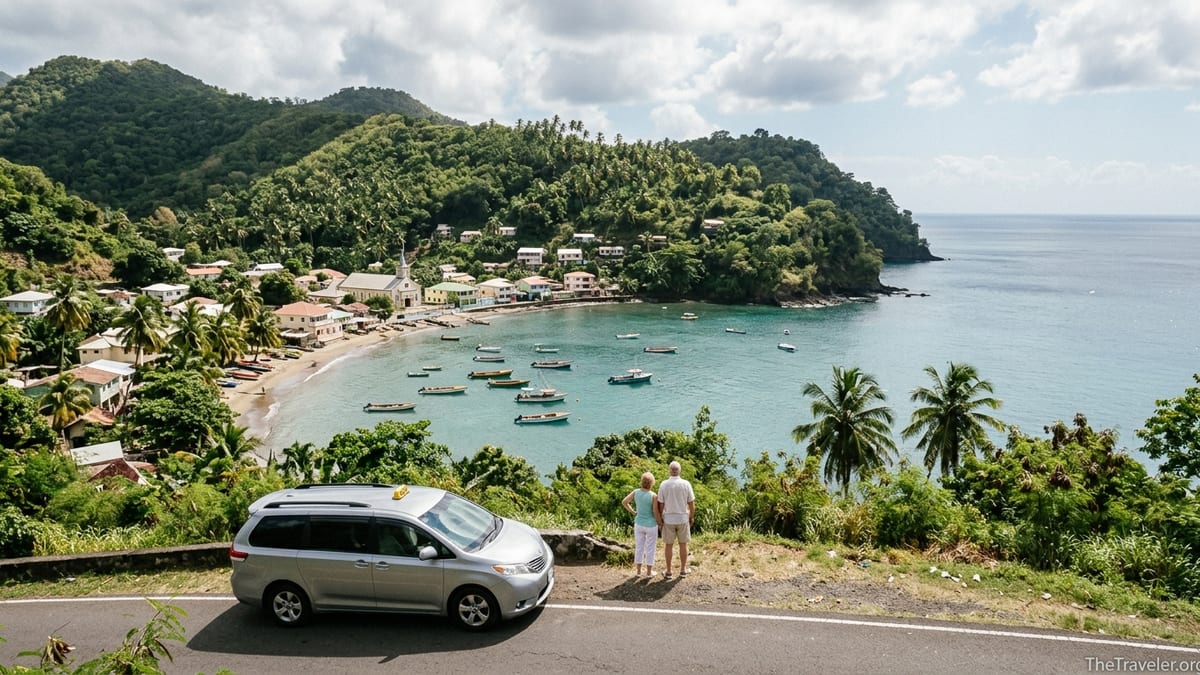
From the cruise berths at Pointe Seraphine or La Place Carenage, taxis use the same main road that runs south out of Castries. You will climb briefly out of the city, then wind through lush hills with sea views before descending into Anse La Raye itself. The village is compact: Front Street runs parallel to the small beach and is the center of activity, especially on Friday nights when the Fish Fry takes over the waterfront. For daytime visits, your driver can usually drop you directly on the main street or near the small church and fishing boats.
Because Castries can clog with traffic when several ships are in port, you should factor in extra time just to clear the downtown area. On quiet days, some visitors report making the trip in around 25 minutes from the pier to the village. On busier days, or when school dismisses in the afternoon, it can be closer to 40 minutes. For cruise passengers, the smart approach is to treat 35 minutes each way as a realistic planning baseline rather than betting on the fastest possible time.
Taxi Options, Typical Costs and How to Negotiate
Taxi ranks are stationed at both Castries cruise terminals, and on cruise days there are usually more drivers than passengers. Official taxi fares around Saint Lucia are guided by government schedules, but in reality you will encounter a mix of posted rates and negotiated prices, especially for custom itineraries that combine several stops. For a simple return transfer from Castries cruise port to Anse La Raye, recent visitor reports and local driver quotes suggest a ballpark of 60 to 80 US dollars per taxi for up to 3 or 4 passengers, depending on season and demand. Larger vans seating 6 to 10 people may cost more in total but less per person.
As a concrete example, a couple disembarking at Pointe Seraphine might agree a round-trip fare of 70 US dollars with a driver, including one or two hours of waiting time in the village while they explore and have lunch. If you want the driver to stay on call for three or four hours, or to continue to Marigot Bay after Anse La Raye, the price is likely to increase into the 90 to 130 US dollar range for the taxi. Always confirm whether the quoted price is per taxi or per person, and whether it includes waiting time or just the transfers.
When you walk out of the cruise terminal, expect drivers to approach you with offers for island tours or specific destinations. If your only goal is Anse La Raye, be clear from the start: tell them you want a private return transfer to Anse La Raye, state roughly how long you plan to stay, and ask for a total price including the return to the ship. It is reasonable to politely negotiate, especially if you have a small group. For example, if one driver suggests 90 US dollars for two people for a simple there-and-back visit, you might counter with 70 or 75, citing that you will not need more than two hours on site.
Payment is usually in cash, and US dollars are widely accepted, with change sometimes returned in Eastern Caribbean dollars. Some established tour companies may accept cards if booked online in advance, but casual dockside taxis tend to be cash only. If your ship is in port on a busy day with several large vessels, taxis can command higher prices. Booking in advance with a local operator, or joining a shared taxi arranged by fellow cruisers, can help keep costs predictable.
Private Tours, Water Taxis and Independent Visits
Beyond a simple taxi, many cruise passengers choose a private west-coast tour that includes Anse La Raye as one of several scenic stops. Typical circuits from Castries head south through Marigot Bay, Anse La Raye, Canaries and on toward Soufriere and the Pitons. Local operators based in Soufriere or Castries often quote around 150 to 200 US dollars per taxi for a half-day road tour, including photo breaks in villages like Anse La Raye, visits to viewpoints, and sometimes a short beach or snorkeling stop. For a ship in port from 8 a.m. to 5 p.m., this style of tour can offer a fuller taste of the island without cutting return margins too fine.
Water taxis add a different dimension. Several small-boat operators on the west coast run private transfers linking Castries, Marigot Bay, Anse La Raye, Anse Cochon and Soufriere. While published price lists focus more on resort transfers, example quotes show round-trip water taxi runs such as Castries to Marigot Bay around 200 US dollars and Marigot Bay to Anse La Raye around 100 US dollars for small groups. That implies that, if you arranged it directly with a boat captain, a customized route that picks you up near Castries, stops at Marigot Bay for a brief look, continues to Anse La Raye, then returns to Castries or Marigot could come in somewhere in the mid to high hundreds of US dollars for a private boat, depending on the number of hours and fuel costs.
For independent-minded visitors, a hybrid approach can work well: take a standard taxi from the cruise port to Marigot Bay, then arrange a short water taxi hop from Marigot to Anse La Raye and back, returning to Castries by road. This leverages the scenic boat ride for the most attractive part of the coast while keeping total cost below a full-day private boat charter. As an example, a family of four might pay 40 to 50 US dollars for a taxi return between Castries and Marigot Bay, then 80 to 120 US dollars for a private water taxi from Marigot to Anse La Raye and back, splitting the boating cost between them.
Independent visits, whether on land or sea, do come with responsibilities. No one will track the time for you the way a ship’s excursion does. You need to set alarms for your planned departure from Anse La Raye, keep your driver’s phone number handy, and build in buffers for traffic and weather. Nonetheless, many cruise passengers successfully visit Anse La Raye on their own, particularly during the day, often combining it with lunch in the village or at a small seaside bar between Castries and Marigot Bay.
Driving Time, Traffic Patterns and Safe Return Buffers
From a scheduling standpoint, the key fact is that the west-coast road between Castries and Anse La Raye is two-lane, hilly and shared with local commuters, school buses and delivery trucks. While the pure driving time may be about 25 to 30 minutes in light traffic, you should not count on that when you are trying to make a fixed all-aboard time. A more conservative planning window is 35 to 45 minutes each way, especially during morning or late-afternoon peaks.
If your ship departs at 5 p.m. with a typical all-aboard time of 4:30 p.m., it is wise to be back at the cruise terminal by 3:30 p.m. at the latest. Working backwards, that suggests leaving Anse La Raye no later than around 2:45 p.m. for a taxi back to port, giving you a 15 to 45 minute buffer in case a slow vehicle holds up traffic on the hills or there are delays getting into Castries. For a ship departing at 6 p.m., you might push the departure from the village closer to 3:15 p.m., but still plan to be in the city center an hour before all-aboard.
Concrete examples illustrate how these buffers play out. Imagine an 8 a.m. to 5 p.m. call in Castries. A couple might meet a taxi at 9 a.m., arrive in Anse La Raye by around 9:40 a.m., walk the village, chat with fishermen, and enjoy an early seafood lunch on the waterfront. If they depart the village at 1:45 p.m., a 40 minute ride returns them to the pier around 2:25 p.m., leaving more than two hours of safety margin. Even if an accident temporarily slows traffic, they still have time to spare.
Weather can also influence timing. Heavy tropical rain does not usually close the road, but it can reduce visibility and slow overall speed. If there are reports of landslides or construction along the west coast, which can happen during the wet season, be extra cautious about your timing and listen to your driver’s advice. In those scenarios, choosing the shorter Castries to Marigot Bay segment rather than going all the way to Anse La Raye or beyond could be the safer call for tight port times.
Combining Anse La Raye with Marigot Bay in One Port Day
Many cruise passengers are tempted to see both Anse La Raye and Marigot Bay on the same day, and with a full-day call that is entirely feasible if you plan carefully. Marigot Bay lies closer to Castries than Anse La Raye, roughly 15 to 20 minutes by road in normal conditions. It is a deep, sheltered inlet known for moored yachts, a small beach and a cluster of waterfront bars and cafes. A typical combined itinerary might start with Marigot Bay for mid-morning coffee and a short stroll, then continue south to Anse La Raye for lunch and a walk through the village.
In practice, a straightforward way to structure the day is to book a private driver for four to five hours. You could leave the port at 9 a.m., arrive at Marigot Bay by around 9:20 a.m., spend an hour exploring the marina side and perhaps taking the short ferry hop across the inner bay, then depart at 10:30 a.m. for Anse La Raye. That gets you into the village around 11 a.m., giving two to three hours for lunch, beach time and photography before starting the return journey toward Castries around 2 p.m.
Expect to pay more for a combined tour than for a simple out-and-back transfer. A realistic range for a private taxi or small van covering Castries, Marigot Bay and Anse La Raye, with multiple stops and several hours of waiting time, might fall between 120 and 180 US dollars per vehicle depending on group size and negotiations. Split between four people, that can be comparable to or cheaper than a ship-sold shore excursion, with the advantage of tailoring stops to your preferences.
If you are interested in a water perspective, ask your driver or a local tour desk about including a short boat segment between Marigot Bay and Anse La Raye. For instance, you might drive from Castries to Marigot, then board a small boat for the scenic run south past coves and headlands to Anse La Raye, where your taxi meets you again for the road journey back north. This kind of mixed overland-and-sea routing can showcase more of Saint Lucia’s coastline without significantly increasing total travel time, provided you keep a close eye on the clock.
Friday Night Fish Fry: Timing, Transport and Limitations for Cruisers
Anse La Raye’s Friday night Fish Fry, also described locally as Seafood Friday, is one of the island’s marquee community events. On Friday evenings, stalls line the waterfront as vendors grill fish, lobster when in season, and other seafood, with sides of breadfruit, plantains and salads. Music, rum punches and local beers add to the atmosphere, drawing both residents and visitors. For land-based travelers staying on the island, it is a strong candidate for a Friday-night outing. For cruise passengers, the key constraint is simple: ships very rarely stay late enough in Castries to allow a full Fish Fry experience.
Most cruise calls in Castries are daytime stops, often with departures in the late afternoon. Since the Anse La Raye Fish Fry really gathers momentum after dark, and at minimum early in the evening, a ship leaving at 5 or 6 p.m. effectively rules it out. Even if stalls begin setting up in the late afternoon, you would only catch the quietest early phase of the event and would need to depart long before the liveliest atmosphere, which tends to build later in the evening when islanders finish work and arrive from other districts.
Visitors staying at resorts in the north or south, by contrast, often plan a taxi transfer to Anse La Raye for the evening and return late at night. A hotel in Rodney Bay or near Castries might quote a return evening taxi to Anse La Raye at 80 to 120 US dollars depending on distance and waiting time, while resorts farther south near Soufriere might offer shorter and sometimes cheaper runs. Drivers usually wait in or near the village until their clients are ready to leave, often heading back between 10 p.m. and midnight.
For cruise passengers hoping to sample local nightlife, the more realistic options in the limited time ashore are a leisurely lunch in Anse La Raye on a non-Fish-Fry day, a daytime visit to a local rum shop or bar, or an early-evening drink in Castries if your ship departs later. Unless your itinerary specifically lists a late-night or overnight call in Saint Lucia, you should assume that attending the full Friday night Fish Fry is not compatible with cruise timings, and plan your village visit in the morning or early afternoon instead.
Practical Safety Tips, Comfort and Local Etiquette
Independently visiting Anse La Raye from Castries cruise port is generally straightforward, but a few practical steps can make the day smoother. First, treat the coastal road with respect. If you are prone to motion sickness, the combination of hills and curves can be challenging. Taking motion sickness tablets before leaving the ship, sitting up front in the taxi where possible, and asking the driver not to rush the bends can all help. Having a bottle of water and a light snack on hand is also wise, particularly if you are traveling with children.
Once in the village, normal urban common sense applies. Keep valuables like passports and large amounts of cash locked in your cabin safe, carrying only what you need for the day. Use a crossbody bag that zips, avoid leaving phones on tables unattended, and be cautious when photographing locals. Many fishermen and vendors are friendly and used to cameras, but it is courteous to ask permission before taking close-up portraits. If you are visiting on a weekday morning, expect a slower, more residential feel, with children going to school and locals running errands.
Beach and waterfront conditions can vary with weather and recent rainfall. While Anse La Raye’s bay is picturesque with its small fishing boats, water clarity near the shore may be affected by runoff after heavy rain, and infrastructure is more basic than at large resort beaches. Wear sturdy sandals for walking the village streets, which can be uneven, and consider bringing a small towel if you plan to sit on the low seawall or on the sand. From a health perspective, sun protection is critical: the sun in Saint Lucia is strong year-round, so apply high-SPF sunscreen, wear a hat and carry a light cover-up.
Finally, remember that you are visiting a real community, not a theme park. Buying a plate of fish from a local vendor, a cold drink from a small bar, or a souvenir from a roadside stall directly supports residents. Keeping your tone respectful, greeting people with a simple “good morning” or “good afternoon,” and being patient if service is relaxed by big-city standards all go a long way toward a positive experience for both visitors and locals.
The Takeaway
Planning a visit from Castries cruise port to Anse La Raye is largely a matter of realistic timing and clear communication with your driver or tour operator. Allow 35 to 45 minutes each way for the drive along the west-coast road, build a generous buffer ahead of your ship’s all-aboard time, and agree on total taxi costs before you set off. With those basics in place, both simple round-trips and more elaborate combinations that include Marigot Bay or a short water taxi segment can fit comfortably within a typical full-day call.
For cruise passengers, the celebrated Friday night Fish Fry is more of a tease than a practical option, since most ships depart before the event truly comes to life. Instead, focus on Anse La Raye as a daytime window into Saint Lucian village life: fishing boats bobbing in the bay, pastel houses along narrow streets, and the chance to share a plate of fresh seafood for lunch. If you want the full evening street-party atmosphere, consider a future land-based stay, when you can linger in the village under the stars without glancing at your watch.
FAQ
Q1. How long does it take to get from Castries cruise port to Anse La Raye by taxi?
The drive typically takes about 25 to 35 minutes in light traffic, but cruise passengers should plan on 35 to 45 minutes each way to allow for hills, curves and occasional congestion near Castries.
Q2. How much should I expect to pay for a taxi from the cruise port to Anse La Raye and back?
For a private taxi round-trip with waiting time in the village, a realistic range is around 60 to 80 US dollars per vehicle for up to 3 or 4 passengers, with larger vans costing more in total but less per person.
Q3. Is it safe to visit Anse La Raye independently instead of taking a ship excursion?
Yes, many visitors go independently using licensed taxis from the port. As with any destination, use common sense, keep valuables to a minimum and agree all prices in advance.
Q4. Can I combine Anse La Raye and Marigot Bay in a single port day?
Yes, if you have a full-day call it is quite feasible. Hiring a private driver for four to five hours allows time for a short stop in Marigot Bay plus a longer visit in Anse La Raye and a comfortable buffer for your return.
Q5. Are there water taxis between Castries, Marigot Bay and Anse La Raye?
Several operators run private water taxis along the west coast linking Castries, Marigot Bay and nearby villages like Anse La Raye, though they often price trips as customized charters rather than fixed shuttles, so you should request a quote for your specific route.
Q6. Can cruise passengers realistically experience the full Friday night Fish Fry in Anse La Raye?
In most cases no, because the event is an evening street party and cruise ships almost always depart Castries in the late afternoon. You might see early setup if in port on a Friday, but not the peak nightlife.
Q7. What is a sensible return time to aim for if my ship departs at 5 p.m.?
For a 5 p.m. departure with a likely all-aboard at 4:30 p.m., aim to be back at the cruise terminal by 3:30 p.m. at the latest, which usually means leaving Anse La Raye no later than about 2:45 p.m.
Q8. Is the road between Castries and Anse La Raye very winding?
Yes, the west-coast road is two-lane, hilly and has many curves. If you are prone to motion sickness, consider medication beforehand and ask to sit near the front of the vehicle.
Q9. Can I pay for taxis with a credit card?
Some pre-booked tour companies may accept cards, but most casual taxis at the cruise pier expect cash. US dollars are widely accepted, often with change given in Eastern Caribbean dollars.
Q10. What should I wear and bring for a daytime visit to Anse La Raye?
Light, breathable clothing, sturdy sandals, sun hat, sunglasses and high-SPF sunscreen are recommended, plus a bit of cash for food and drinks, a small towel if you plan to sit by the water and a fully charged phone with your driver’s number saved.