


Catching a ferry from Cebu to Bohol is straightforward, but the critical link is getting from Mactan Cebu International Airport to Cebu Pier 1 on time. Traffic, ticketing queues, luggage rules and limited ferry seats mean you cannot treat this as a casual airport-to-city hop. This guide focuses on real-world options, timing and tactics so you can connect smoothly to OceanJet and other Bohol ferries from Pier 1.
Get the latest updates straight to your inbox!
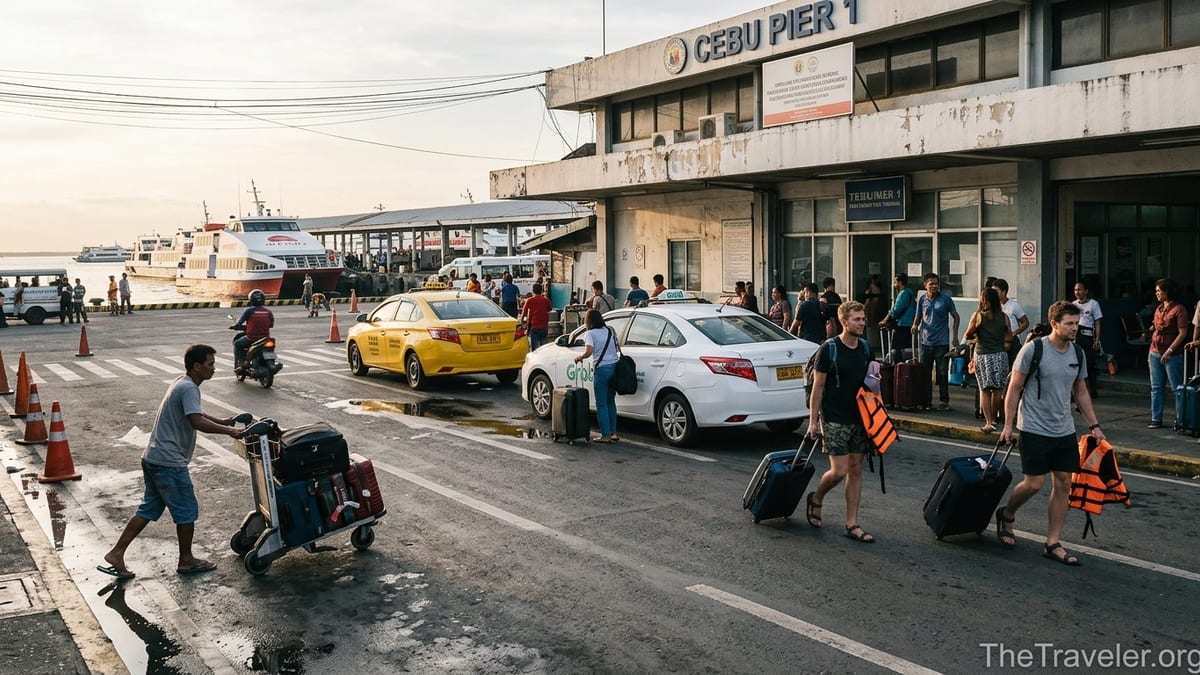
Understanding the Route: Airport to Cebu Pier 1
Mactan Cebu International Airport sits on Mactan Island, while Cebu Pier 1 is across the channel on Cebu Island, close to downtown Cebu City. By road, the distance is roughly 14 to 18 kilometers depending on the route your driver uses. In light traffic very early in the morning or late at night, the drive can take around 25 to 30 minutes. In typical daytime conditions, 40 to 60 minutes is more realistic, and in heavy rush-hour traffic the journey can stretch to 75 minutes or more.
From the airport you will first cross either the old Mactan-Mandaue Bridge or the newer Marcelo Fernan Bridge, then continue along congested urban roads toward downtown Cebu and the port area. Pier 1 itself is the main departure point for fast ferries to Tagbilaran and other Bohol ports. For example, OceanJet uses Pier 1 for its Cebu to Tagbilaran and Cebu to Getafe services. The pier area gets very busy around peak departure times, especially in the morning when multiple ferries and buses are loading passengers at once.
Pier 1 has a basic terminal with security checks, ticket counters, a waiting area and porters for luggage. Outside, a steady flow of taxis and private cars jostle for space along a narrow access road. It is not an area where you want to arrive at the last minute, still hunting for tickets or trying to figure out baggage rules. Treat the airport-to-pier segment as a key leg of your Bohol journey that demands time padding and a clear plan.
For most travelers heading directly from the airport to a Bohol ferry, the most sensible options are a metered taxi, a Grab car booked via app, or a pre-arranged hotel or transfer service. Public transport combinations using MyBus and jeepneys are possible and cheap, but they are slower, involve more walking with bags and are risky if you have a same-day ferry connection.
Taxi and Grab From the Airport: What to Expect
As you exit Cebu airport arrivals, you will find several taxi options: yellow airport taxis, regular white city taxis and coupon taxis with fixed fares. Grab, the main ride-hailing app in the Philippines, also operates at Mactan Cebu International Airport, allowing you to book a GrabCar or GrabTaxi directly to Pier 1. All of these options deliver you door-to-door to the pier gates.
Yellow airport taxis cost more than regular white taxis but are usually well regulated and easier to find right at the terminal. White taxis use the standard Metro Cebu taxi fare structure, with a base flagdown and a per-kilometer rate plus a small charge for waiting time in traffic. In practice, travelers commonly report paying roughly 250 to 400 pesos from the airport to the downtown or port area in normal conditions, while yellow airport taxis can be somewhat higher. A GrabCar fare into the city often lands in a similar band, though surge pricing can push it up during peak demand or bad weather.
A concrete example: a mid-morning weekday arrival in Terminal 2 might see a couple traveling with two checked-size suitcases queue for a yellow taxi, then pay around 350 pesos for a 45-minute ride to Pier 1 in moderate traffic. On another day, a solo traveler arriving late at night might open the Grab app and book a GrabCar from the curb, paying about 280 pesos for a 30-minute ride when the city is quieter. Occasionally, heavy rain or a Friday rush hour can push both taxi meter totals and Grab fares higher, so keep some buffer in your budget.
For reliability, many visitors prefer Grab because the route and fare estimate are recorded in the app, and payment can be cash or card depending on your settings. However, during peak times or very late at night, Grab cars may be limited and you might find yourself waiting while regular taxis remain available in the airport queue. If you are racing to catch a certain ferry, it can be smarter to join the taxi line instead of waiting for an elusive ride-hailing match.
Travel Time, Traffic Patterns and When to Leave the Airport
Traffic between Mactan Island and downtown Cebu is the single biggest variable in making your ferry on time. Rush hours in Metro Cebu are particularly intense on weekdays. Expect heavier traffic inbound toward the city between roughly 7:00 and 9:30 in the morning, and again late afternoon from around 4:00 to 7:00 in the evening. During these windows, the airport-to-pier trip can easily extend beyond one hour, especially if there are accidents or roadworks on either of the bridges.
If you have a specific OceanJet sailing in mind, work backwards from the scheduled departure. Ferry operators generally advise passengers to be at the pier about one hour before departure to allow time for check-in, baggage processing and security screening. In practice, it is more comfortable to arrive 60 to 90 minutes ahead, particularly for busy mid-morning and early afternoon departures when groups and tours feed into the same sailings.
For example, if you are aiming for a 1:00 pm OceanJet from Cebu to Tagbilaran, plan to be at Pier 1 by 11:30 am. On a weekday, that means leaving the airport between 10:15 and 10:30 am at the latest, giving you roughly an hour on the road plus a modest buffer. If your flight lands at 9:00 am, this is workable: you have time to clear immigration or baggage claim, grab some cash from an ATM, then head straight to the taxi lane.
On the other hand, trying to connect from a 10:30 am scheduled flight arrival to an 11:40 am ferry is risky, particularly if you are checking luggage and must still buy ferry tickets at the pier. A realistic rule of thumb is to allow at least three hours between your flight’s scheduled landing and your desired ferry departure, especially if you are unfamiliar with the city or traveling with children or bulky baggage. If your buffer is shorter, treat the next ferry as your real target and only use an earlier departure as a bonus if everything runs perfectly.
OceanJet and Other Ferries to Bohol From Pier 1
OceanJet is the dominant fast ferry operator between Cebu and Bohol, running multiple daily trips from Pier 1 to Tagbilaran and additional services to Getafe in northern Bohol. Schedules change over time, but in recent timetables typical Cebu to Tagbilaran departures span from early morning around 5:10 or 6:00 am through late afternoon, roughly every one to two hours. On the Tagbilaran to Cebu side, the pattern is similar, providing flexibility for same-day round trips.
Base fares for Cebu to Tagbilaran on OceanJet are usually tiered by class. As of mid-2026, open-air or tourist class commonly costs around 800 pesos one way, while business class, with more spacious seating, comes in near 1,200 pesos. Promotional pricing or slight adjustments are possible, so treat these numbers as a working ballpark rather than fixed rates. Ticket prices generally already include fuel surcharges and standard terminal fees, though separate port fees may occasionally be collected by the terminal operator.
OceanJet tickets can be purchased at authorized ticketing offices in Cebu City, at the Pier 1 terminal counters, through local travel agencies or via the company’s official online booking system. Several online travel platforms and third-party agents also resell OceanJet tickets, sometimes adding service fees. Online booking is handy in peak seasons such as Christmas, Holy Week and major festivals, but note that advance booking windows are often limited, and you may not be able to purchase tickets many months in advance.
Aside from OceanJet, other companies occasionally run ferries between Cebu and Bohol, including Lite Shipping and other RORO-style vessels. These typically depart from different piers or terminals and may have longer sailing times but more relaxed baggage policies. For travelers who prioritize speed and convenience directly from Pier 1 to central Bohol via Tagbilaran, OceanJet remains the standard choice, with sailing times of roughly two hours depending on conditions.
Luggage Rules, Porters and Managing Bags at Pier 1
Baggage handling is one of the most confusing aspects of taking the ferry from Cebu to Bohol, especially on OceanJet. The company has updated its baggage policy several times and emphasizes a hand-carry allowance plus paid check-in for larger items. In recent advisories, OceanJet has highlighted that Cebu port operations now follow a simplified baggage allowance, but implementation can still vary on the ground. As a traveler, assume that small backpacks and personal items will be allowed on board free, while trolley suitcases and heavier bags may need to be checked and potentially incur additional fees.
Real-world experiences vary widely. Some passengers report walking on board with a medium roller suitcase without being charged, while others describe being directed to check in a similar bag and paying a luggage fee that can reach a few hundred pesos per piece, depending on weight. There are also reports of inconsistent enforcement and limited or informal receipts, which makes reimbursement difficult. To reduce stress, keep your essential valuables, electronics and documents in a smaller bag that you can confidently carry with you, and be mentally prepared to pay a modest amount to check larger luggage if asked.
Porters at Cebu Pier 1 are organized under local associations and offer to carry your luggage from the curbside to the check-in counters or directly into the boarding area. Recent posted tariffs indicate a typical base porter fee around 50 pesos per piece in Cebu, regardless of size, though some passengers voluntarily tip more for heavy loads or long pushes through crowds. A practical example: a family of four arriving in a taxi with two large suitcases and two backpacks may pay a porter about 100 pesos to move the big bags through security and to the OceanJet counter, freeing them to focus on tickets and passports.
If you are comfortable handling your own bags, you are not obliged to use a porter. However, during hot, humid midday sailings, with crowds and multiple security checks, their services can be genuinely helpful, especially for older travelers or those wrangling children. Always agree on the fee before they start moving your luggage, pay in small bills and keep your hand luggage with passports, cash and electronics on your person rather than on the trolley.
How Early to Arrive at Pier 1 and Ferry Check-in Tips
Unlike airports, Cebu’s ferry terminals rarely publish detailed cut-off times, but queues at ticket counters and security can build quickly, particularly before popular OceanJet departures around mid-morning and early afternoon. Aim to be at Pier 1 at least 60 minutes before your scheduled ferry, and 90 minutes ahead is safer if you need to buy tickets on site or if you are traveling during school holidays or local festivals.
Check-in typically involves several steps. First, you may need to pass through an initial security or baggage screening at the terminal entrance. Next, if you do not yet have a boarding pass, you will queue at the relevant ferry company’s ticket counter to purchase or confirm your ticket and sometimes pay any outstanding fees. After that, you proceed to a waiting area where final boarding is announced by staff, and passengers file out to the fast craft through a series of gates or walkways. Each step adds a few minutes, and small delays multiply when multiple ferries are departing close together.
If you booked OceanJet tickets online, bring a printed copy of the confirmation or have the digital voucher easily accessible on your phone. Staff at the counter may need to verify your booking and issue a physical boarding pass. Some travelers report that online bookings still require revalidation at the pier, so do not assume you can bypass the counter entirely. Build in time for this, especially if your online booking was made through a third-party agent rather than directly with the ferry company.
A useful scenario to aim for: for a 10:40 am OceanJet sailing, arrive at Pier 1 by 9:10 am. By 9:20 am you are through the initial security check, by 9:30 am you have approached the OceanJet counter, and by 9:45 am your tickets and any baggage tagging are complete. This leaves you half an hour to find seats in the waiting area, buy water or snacks from a kiosk and use the restroom before boarding begins around 10:10 or 10:20 am.
Public Transport Alternatives: MyBus, Jeepneys and Why They Are Risky
Travelers on tight budgets sometimes consider using public transport from the airport to Pier 1. The most common backbone is MyBus, a modern city bus that links Mactan Cebu International Airport to SM City Cebu, a major mall on the Cebu mainland. From there, it is theoretically possible to transfer to jeepneys or taxis that continue toward the downtown port area and Pier 1.
In practice, this option is only advisable if you are not in a hurry and are carrying light luggage. A typical journey might look like this: after landing, you buy a MyBus ticket for a modest fare, often around 60 pesos, and ride about 30 to 40 minutes to SM City. With a backpack this is manageable, but dragging a large suitcase on and off the bus in tropical heat can be exhausting. Once at the mall, you either hail a taxi, which may cost another 120 to 180 pesos to Pier 1 depending on traffic, or you locate a jeepney heading toward the port, pay a small fare in coins and follow local passengers’ guidance on where to jump off.
Jeepneys are the colorful shared minibuses that crisscross Cebu. They are cheap and authentic, but they are not designed for big wheeled suitcases or travelers who need clear signage or real-time navigation. Routes are marked in small letters on the side of the vehicle, and you will often have to ask drivers or fellow passengers to confirm that the jeepney passes near Pier 1. In crowded conditions, you may find yourself standing or squeezed in, balancing your backpack on your knees.
Because of the multiple steps and unpredictability, public transport from the airport to Pier 1 is not recommended if you have a same-day OceanJet ticket to Bohol. Delays waiting for the next bus, confusion over jeepney routes or difficulty finding a taxi at SM City can all eat into your buffer. A realistic use case for MyBus and jeepneys would be a traveler who arrives in Cebu the day before, plans to spend the night in the city and only needs to reach the pier the following morning without time pressure.
Practical Scenarios: Matching Ferry Times to Arriving Flights
To make planning easier, it helps to map out a few common scenarios combining actual flight arrival times with typical OceanJet departures. Imagine a traveler landing on a morning domestic flight that is scheduled to arrive at 8:00 am. After taxiing, disembarking and collecting a checked suitcase, they walk out of the arrivals hall around 8:40 am. They join the taxi queue and depart the airport at 8:50 am, reaching Pier 1 by roughly 9:30 or 9:40 am in moderate traffic. In this case, they would comfortably make a 10:40 am ferry and might even have a chance at a 10:00 am sailing if ticket queues are short and they move quickly.
Contrast that with a traveler whose flight is scheduled to arrive at 10:00 am but lands slightly late at 10:20 am. By the time they collect bags and clear the terminal, it is 11:00 am. They manage to book a Grab that departs at 11:10 am, but encounter congestion on the bridge and only reach Pier 1 at 12:05 pm. With an OceanJet departure at 11:40 am already gone or about to leave, they are forced to rebook onto a later ferry, such as a 1:00 pm or 1:40 pm departure, and spend extra time in the terminal.
Many long-haul travelers arrive on evening international flights and face the decision of whether to overnight in Cebu or push straight to Bohol. If your flight is scheduled after about 4:00 pm, it is usually safer to assume you will miss the last practical fast ferry to Tagbilaran that day. In that case, you might book a hotel either near the airport or in Cebu City and aim for an early morning sailing the next day. This plan reduces stress, gives you time to rest and keeps you out of Cebu’s worst evening traffic.
Families traveling with young children or elderly relatives should lean toward conservative timing. Consider building in four hours between your scheduled flight arrival and target ferry, factoring in the possibility of airline delays and baggage handling problems. The cost of spending a bit more downtime at Pier 1’s waiting area is minor compared to the cost and inconvenience of missing your boat and rearranging accommodation in Bohol.
The Takeaway
Connecting from Mactan Cebu International Airport to Cebu Pier 1 for a Bohol ferry is entirely manageable with a bit of planning. The key is respecting Cebu’s traffic, giving generous time for check-in and baggage handling, and choosing the transfer option that best matches your budget and risk tolerance. For most visitors, a straightforward taxi or Grab ride from the airport to Pier 1, combined with a target arrival at the pier at least an hour before departure, creates a smooth and predictable link.
OceanJet and other fast ferries provide frequent, relatively fast crossings from Pier 1 to Tagbilaran and other Bohol ports, but their schedules, fares and baggage policies can shift over time. Check the latest information close to your travel date, expect some on-the-ground variability in luggage enforcement, and carry a small amount of extra cash for porters and incidental fees. With realistic expectations and a buffer built into your schedule, the airport-to-pier leg becomes a simple transition rather than a source of stress on your journey to Bohol.
FAQ
Q1. How long does it take to get from Cebu airport to Pier 1 by taxi?
In light traffic the drive can be as quick as 25 to 30 minutes, but in typical daytime conditions you should expect 40 to 60 minutes. During weekday rush hours or heavy rain, it can stretch to around 75 minutes, so always allow extra time if you have a same-day ferry connection.
Q2. Is Grab available at Mactan Cebu International Airport for rides to Pier 1?
Yes, Grab operates at Mactan Cebu International Airport and you can book a GrabCar or GrabTaxi directly to Pier 1. Availability can tighten during peak times or late at night, so if the app shows long wait times, joining the regular airport taxi queue may be faster.
Q3. How much should I budget for a taxi or Grab from the airport to Pier 1?
Most travelers pay roughly 250 to 400 pesos for a regular white taxi or comparable GrabCar ride in normal traffic. Yellow airport taxis and periods of high demand can push the cost higher, so carrying at least 500 pesos in small bills for the transfer is sensible.
Q4. How early should I be at Pier 1 before my OceanJet ferry to Bohol?
Plan to arrive at Pier 1 at least 60 minutes before your scheduled OceanJet departure, and 90 minutes ahead is safer if you still need to buy tickets or check luggage. During holidays or peak travel seasons, adding even more buffer reduces the risk of missing your sailing.
Q5. Can I go from Cebu airport to Pier 1 using MyBus and jeepneys?
It is possible but not ideal if you have a same-day ferry. You can take MyBus from the airport to SM City Cebu, then transfer to a jeepney or taxi for the final leg to Pier 1. This option is cheaper but slower, involves more walking and is awkward with large luggage.
Q6. What are typical OceanJet fares from Cebu to Tagbilaran?
As a rough guide, recent fares have been around 800 pesos for open-air or tourist class and about 1,200 pesos for business class one way. Exact prices can change, so check close to your travel date and be prepared for small adjustments or promotions.
Q7. How strict is OceanJet about luggage on the Cebu to Bohol route?
OceanJet emphasizes a limited hand-carry allowance and may require trolley suitcases or heavier items to be checked, sometimes with additional fees. Enforcement on the ground can be inconsistent, so keep essential items in a small carry-on and expect that larger bags might need to be checked and charged.
Q8. Are porters at Pier 1 necessary, and how much do they cost?
Porters are optional but helpful if you have heavy luggage or children in tow. Typical posted tariffs in Cebu are around 50 pesos per bag, though some travelers tip extra for large loads. Always agree on the fee before they move your bags and pay in small denominations.
Q9. Is it realistic to land in Cebu and go straight to Bohol the same day?
Yes, as long as your flight arrives early enough and you build in a generous buffer. Aim for at least three hours between your scheduled flight landing and your target ferry departure, and choose a later sailing if your arrival time is close to midday or in the middle of rush hour.
Q10. Should I stay overnight in Cebu if my flight arrives late afternoon or evening?
If your flight is scheduled to land after about 4:00 pm, it is usually safer to stay overnight in Cebu and catch a morning ferry to Bohol. This avoids relying on the last sailings of the day, gives you time to rest and keeps you from battling the city’s heaviest evening traffic with a tight connection.