


Chicago O’Hare International Airport is one of the busiest hubs in the world, and departures here can feel intense if you are not prepared. With four terminals, multiple security checkpoints, and more than 20 airline lounges, a little planning goes a long way. This guide focuses on what matters most on departure day: when to arrive, how check in works by airline and terminal, what to expect at security, where to find food and shops near your gate, and which lounges are worth planning extra time for.
Get the latest updates straight to your inbox!
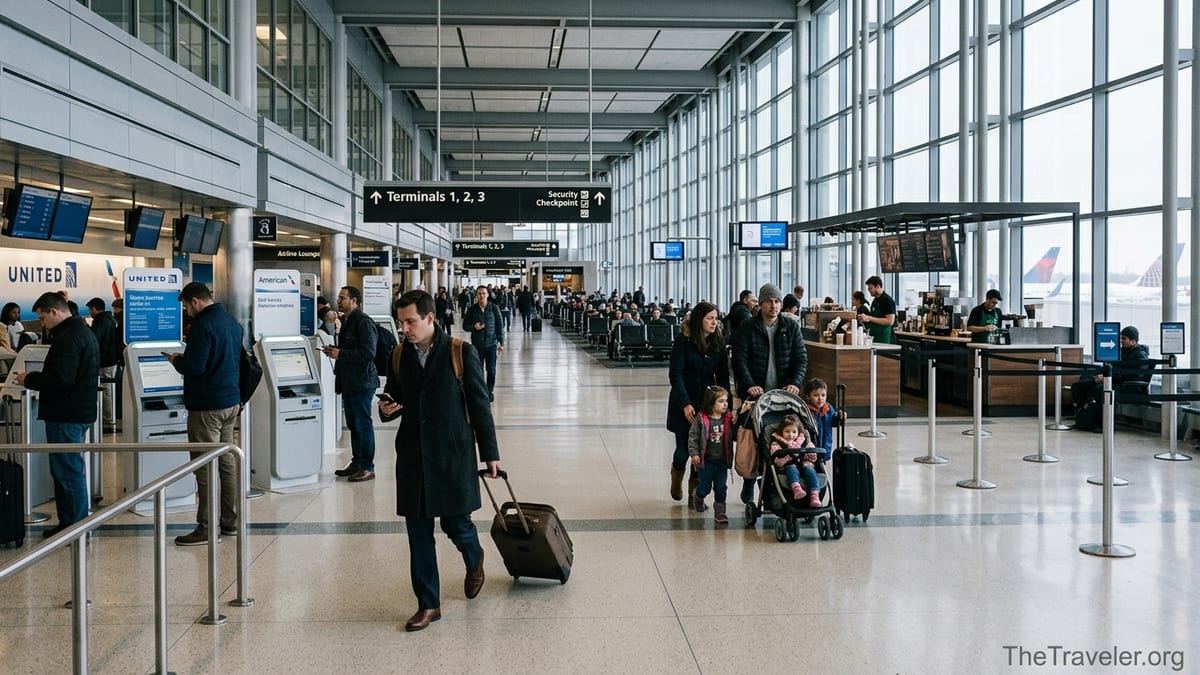
Understanding O’Hare’s Terminals and Departures Layout
O’Hare is organized into four passenger terminals: 1, 2, 3 and 5. Terminals 1, 2 and 3 sit in one connected horseshoe, while Terminal 5 is separate across the airfield, linked by the Airport Transit System train. For departing passengers, this matters because you can walk airside between Terminals 1, 2 and 3 after security, but Terminal 5 has its own security and you cannot walk from 5 to the others once screened. If your boarding pass shows a gate starting with B or C, you are in Terminal 1, E or F in Terminal 2, G, H, K, L in Terminal 3, and M in Terminal 5.
Terminal 1 is the primary hub for United Airlines and its regional partners, and also handles Star Alliance carriers such as Lufthansa and All Nippon Airways on many flights. Terminal 2 is a mix of United regional services and several other domestic carriers. Terminal 3 is the main base for American Airlines as well as oneworld partners like British Airways, Iberia and Japan Airlines on certain departures. Most long haul international flights on non alliance carriers, plus many leisure and low cost airlines, depart from Terminal 5, although some international flights do still leave from Terminals 1 and 3.
Knowing your terminal early helps you plan transportation and timing. For example, a passenger on an early morning United flight to Denver will usually depart from Terminal 1, while a traveler heading to London on American Airlines will almost always use Terminal 3, and someone flying to Istanbul on Turkish Airlines will depart from Terminal 5. Always confirm on your airline app the day before travel, as O’Hare occasionally shifts airlines or individual flights between terminals.
Signage curbside is clear, but curb traffic can back up at peak times. If you arrive by rideshare or taxi and find your airline door area clogged, ask the driver to drop you one door earlier or later within the same terminal and walk inside. For example, United passengers can be dropped at any Terminal 1 door, then follow overhead signs to check in and security for their concourse.
Check-In Timing and Airline Cutoffs
At O’Hare, the safest general rule is to arrive at the airport 2 hours before a domestic departure and 3 hours before an international departure, in line with TSA guidance. That said, specific airline check in and bag drop cutoffs are stricter. United and American typically require checked bags to be dropped 45 minutes before most domestic flights and at least 60 minutes before international flights, with some long haul routes requiring 75 minutes or more. If you show up with luggage 30 minutes before a full morning departure to New York, you may be denied checked baggage even if you can still clear security with only a carry on.
Concrete examples help. A 9:00 a.m. United flight from O’Hare to Orlando will likely close bag drop around 8:15 a.m., and boarding can begin by 8:20 or 8:30. To avoid stress, aim to reach the terminal doors by 7:00 a.m., giving you time for any queue at the United kiosks, potential re tagging of bags, and the security line. For a 5:15 p.m. American Airlines departure to Phoenix from Terminal 3, arriving curbside by 3:15 p.m. gives a similar cushion.
Early morning is a special case. Several airlines do not open all counters overnight. Regular United check in kiosks in Terminal 1, for instance, may not fully open until around 3:15 a.m., with bag drop counters opening closer to 3:30 a.m. and TSA PreCheck at 4:00 a.m. If you show up at 2:45 a.m. for a 6:00 a.m. flight, you will simply be waiting with other passengers for the counters and security lanes to open. In practical terms, for the first wave of flights around 5:30 to 7:00 a.m., arriving 2 to 2.5 hours early is usually ideal.
If you have already checked in on your airline’s app and are traveling with carry on only, your timing can be tighter. A seasoned traveler with TSA PreCheck, flying American to Dallas at midday on a non holiday weekday, might comfortably arrive 75 to 90 minutes before departure. Families, travelers unfamiliar with O’Hare’s layout, or those prone to delays in traffic should still stick with the full 2 or 3 hour suggestion.
Security, TSA PreCheck, CLEAR and Passport Control
Security wait times at O’Hare fluctuate significantly by terminal, day of week and time of day. The airport and TSA still publicly recommend arriving 2 hours before domestic flights and 3 to 4 hours before international flights. In practice, recent traveler reports in 2026 show that off peak waits in Terminals 2 and 3 can be as short as 5 to 15 minutes, while early morning surges in Terminal 1 sometimes push regular security lines close to an hour. Afternoon and late evening periods tend to be calmer, though holiday peaks and summer weekends are naturally busier.
All terminals have standard TSA lanes and dedicated TSA PreCheck lanes. CLEAR biometric lanes are present at Terminal 1 and some other checkpoints, typically feeding into either the standard or PreCheck lanes. Real world experiences diverge: one traveler might breeze through Terminal 1 with CLEAR and PreCheck in under 5 minutes, while another at 6:00 a.m. faces a long regular line stretching toward the end of the terminal but can divert to Terminal 2 security, clear more quickly, then walk back airside to their United gate. This airside connection between Terminals 1, 2 and 3 is a useful backup strategy when one checkpoint is severely backed up.
For international departures from Terminal 5, security is separate and lines are often moderate rather than extreme, though this changes during banked departures to Europe or Asia in the late afternoon and evening. Keep in mind that passport control for outbound passengers is handled at the gate country, not at O’Hare, but U.S. exit checks and document verification can still take time at the gate for some destinations. Incoming international passengers use federal passport control and customs facilities in Terminal 5, which is more relevant for connections than for pure departures.
If you do not have TSA PreCheck, consider practical preparation to move quickly through security: wear slip on shoes, avoid belts and heavy jewelry, and place liquids and large electronics in an easily accessible part of your bag. Families should coach children beforehand about the process to avoid last minute delays at the conveyor belt. Travelers with PreCheck can keep laptops and small liquids in their bags and may keep shoes on, but still need to follow officer instructions carefully as procedures occasionally shift or vary by lane.
Lounges, Rest Areas and Where to Relax Before Departure
O’Hare has one of the largest collections of airline lounges in the United States, with more than 20 facilities across its terminals. United operates multiple United Club locations in Terminal 1 and elsewhere, plus the premium United Polaris Lounge near Gate C18 in Terminal 1 for eligible long haul business class passengers. American Airlines runs several Admirals Club lounges in Terminal 3, including spaces near the H and K concourses and in Concourse L for regional flights. Many of these lounges offer quiet zones, workspaces with power outlets, hot and cold snacks, bar service, and showers in select premium facilities.
In Terminal 5, the lounge landscape has grown rapidly, now including carrier lounges and independent options that may be accessible with Priority Pass or various premium credit cards. A striking recent addition on the O’Hare lounge scene is the large Delta Sky Club in Terminal 5, a spacious, modern lounge that serves Delta passengers with eligible access and is designed to accommodate several hundred guests comfortably. Travelers connecting internationally on SkyTeam partners or flying Delta domestically out of Terminal 5 often find this lounge a major step up from older facilities.
If you do not have elite status or a premium cabin ticket, several lounges at O’Hare sell day passes. American Admirals Club locations, certain United Clubs, and some third party lounges in Terminal 5 may allow entry for a fee when capacity permits. As a concrete example, a day pass might cost in the range typical for major U.S. airports, giving you a quieter place to work compared to the busy gate areas. Check in with the lounge desk staff about availability, especially during peak travel periods.
For travelers who prefer public spaces, O’Hare offers a number of comfortable seating areas away from the gates. In Terminal 1, the tunnel connecting the B and C concourses is worth walking for its unique design and leads to quieter corners near the C gates. Terminal 3’s H and K concourses have high ceiling rotunda areas with natural light and more spread out seating. Power outlets, however, can still be scarce in older sections, so a small power strip or battery pack is useful if you plan to work for an extended time before boarding.
Food, Coffee and Shops Near the Gates
Because O’Hare’s terminals are extensive, it pays to think about food and shopping while you are still reasonably close to your gate. Terminals 1, 2 and 3 share a wide range of options after security, and you can walk between them without re screening. This means a United passenger in Terminal 1 can, in principle, go to a well known coffee chain in Terminal 2 or a popular Chicago style food outlet in Terminal 3, then walk back to their B or C gate, assuming they leave enough time.
Real world examples include classic Chicago flavors like deep dish pizza slices and local hot dog stands, as well as national chains for burgers, salads and sandwiches. Several sit down restaurants in the H and K concourses of Terminal 3 provide table service if you have more than an hour before boarding. For a quick breakfast before a 7:30 a.m. flight, passengers often gravitate toward pastry counters and espresso bars near the security exits of each terminal, which can build lines during the early rush.
Retail options are concentrated around the central concourses. You will find newsstands and convenience stores selling snacks, travel size toiletries and last minute phone chargers at almost every pier. Specialty shops sell Chicago sports merchandise, souvenirs and regional food gifts, making them a good stop if you want to pick up a small present before leaving the city. In Terminal 5, a growing mix of international duty free shops and branded boutiques caters to long haul travelers, especially near the M gates that handle flights to Europe, the Middle East and Asia.
Time management is essential. If your flight begins boarding 30 to 40 minutes before departure, you should aim to finish any sit down meal at least 45 minutes before that, particularly if your gate is at the far end of a concourse. It can easily take 10 to 15 minutes to walk from a central food court in Terminal 3 to a distant L gate or from the head of the B concourse in Terminal 1 out to a late C gate, particularly when the terminal is crowded.
How Early to Arrive at O’Hare: Realistic Scenarios
Travelers often ask how early they truly need to arrive at O’Hare, especially given variable security wait times. While the official line remains 2 hours for domestic and 3 hours for international flights, recent on the ground experiences suggest a more nuanced approach based on time of day, terminal and your risk tolerance. For most routine domestic departures between mid morning and early evening, arriving 90 to 120 minutes before scheduled departure is adequate if you are checked in on your phone and traveling with carry on only.
Consider these scenarios. A solo traveler with TSA PreCheck on a 1:00 p.m. United flight to Houston from Terminal 1 on a Wednesday might comfortably arrive at 11:30 a.m., clear PreCheck within 10 to 20 minutes based on typical midday conditions, grab a quick lunch in the B concourse and still be at the gate before boarding begins. By contrast, a family of four without PreCheck flying American to Orlando on a Saturday morning at 9:00 a.m. from Terminal 3 should keep the full 2 hour cushion, arriving curbside by 7:00 a.m. to allow for bathroom breaks, stroller tagging, and the greater chance of a longer standard security queue.
International departures deserve more padding. For a 5:15 p.m. flight to London from Terminal 3, arriving around 2:15 p.m. gives ample time for check in, potential document checks at the counter, and any additional screening. At Terminal 5, where many long haul flights to Europe and Asia depart in banks between late afternoon and late evening, aim for 3 hours before departure, particularly on Fridays, Sundays, and around U.S. holidays. While some recent travelers have reported clearing check in, security and reaching their gate in under 20 minutes off peak, you cannot count on this in busy periods.
Always factor in ground transport to the airport itself. From downtown Chicago on the Blue Line, allow at least 45 to 60 minutes station to terminal, plus walking time to your airline area. In a rideshare from the Loop during rush hour, the drive can stretch toward an hour or more. Build these variables into your backward counting from scheduled departure, and remember that airlines will not hold planes for passengers delayed by traffic.
Connections, Terminal Transfers and Special Situations
Many travelers at O’Hare are not starting or ending their journey in Chicago but connecting between flights. If you are departing O’Hare as the second leg of a trip, your timing will largely be set by your inbound flight’s arrival. Within Terminals 1, 2 and 3, airside connections are straightforward: you can walk between concourses without exiting security. A 50 minute domestic to domestic connection on United that keeps you within Terminals 1 and 2 is tight but manageable if your first flight is on time.
Connections involving Terminal 5 are more complex. If you arrive on an international flight into Terminal 5, you must clear passport control, collect any checked bags for customs, then re check and clear security again before your onward domestic departure from Terminals 1, 2 or 3. Airlines usually enforce a minimum connecting time that may range around 90 minutes or more for such transfers. On the flip side, if you start your trip in Chicago and connect internationally through another hub, your experience at O’Hare will be like any regular departure from your domestic terminal, with passport control only at your overseas arrival.
Travelers with special needs, such as limited mobility or traveling with infants, should request assistance from their airline in advance. O’Hare’s terminals involve long walks, especially in concourses like C in Terminal 1 and L in Terminal 3. Wheelchair escorts, pre boarding options and gate checked strollers can make a substantial difference. For unaccompanied minors departing from O’Hare, airlines require guardians to stay at the gate until the flight departs, so build extra time into your drop off planning for both check in and escort badges.
Finally, weather is a wildcard, particularly in winter. Snow and low visibility can slow everything from curbside traffic to deicing at the gates. If you are departing on a storm day from O’Hare, monitor your airline notifications closely, consider arriving earlier than usual, and pack patience along with snacks and a charged phone. Lounges and terminal restaurants can fill up quickly when delays ripple across the schedule, so securing a comfortable spot early is wise.
FAQ
Q1. How early should I arrive at O’Hare for a domestic flight?
Plan to arrive at least 2 hours before departure, especially in the early morning, on weekends, or if you need to check bags or do not have TSA PreCheck.
Q2. How early should I arrive at O’Hare for an international flight?
Aim for 3 hours before international departures, particularly from Terminal 5 or during late afternoon and evening long haul banks when multiple flights leave close together.
Q3. Which terminal does United Airlines use at O’Hare?
United primarily uses Terminal 1 for most mainline and many regional flights, with some operations in Terminal 2 and certain international flights also using Terminal 5.
Q4. Which terminal does American Airlines use at O’Hare?
American Airlines mainly departs from Terminal 3, including most domestic flights and several international oneworld partner routes such as flights to London and Tokyo.
Q5. Can I walk between terminals after security at O’Hare?
Yes, you can walk airside between Terminals 1, 2 and 3 once through security. Terminal 5 is separate, so transfers there require a train or shuttle and re screening.
Q6. Are there lounges I can pay to enter at O’Hare?
Yes, several lounges including some United Clubs, American Admirals Clubs and independent lounges in Terminal 5 offer paid day passes when space is available.
Q7. Does O’Hare have TSA PreCheck and CLEAR?
Yes, all major terminals have TSA PreCheck lanes, and CLEAR operates at key checkpoints, particularly in Terminal 1, often speeding up identity verification and queueing.
Q8. Where can I find the United Polaris Lounge at O’Hare?
The United Polaris Lounge is located in Terminal 1 near the C concourse gates and is reserved for eligible long haul international business class passengers.
Q9. What are the best food options before departure at O’Hare?
Terminals 1, 2 and 3 offer a mix of local Chicago style eateries, major national chains, coffee bars and sit down restaurants clustered near the main concourses.
Q10. What should I do if security lines look very long at my terminal?
If you are departing from Terminals 1, 2 or 3, you can sometimes use security at another of these terminals and walk back airside to your gate, saving time when one checkpoint is overloaded.