


For frequent travelers, a good banking app can be as important as a valid passport. Chime and Monzo are two of the most popular app-based banking options for people who want to avoid surprise fees, track spending in real time, and manage money on the move. Both promise low-cost travel, but they do it in different ways and for slightly different types of travelers. This guide compares how Chime and Monzo actually perform when you are abroad, with practical examples to help you decide which one fits your style of travel.
Get the latest updates straight to your inbox!
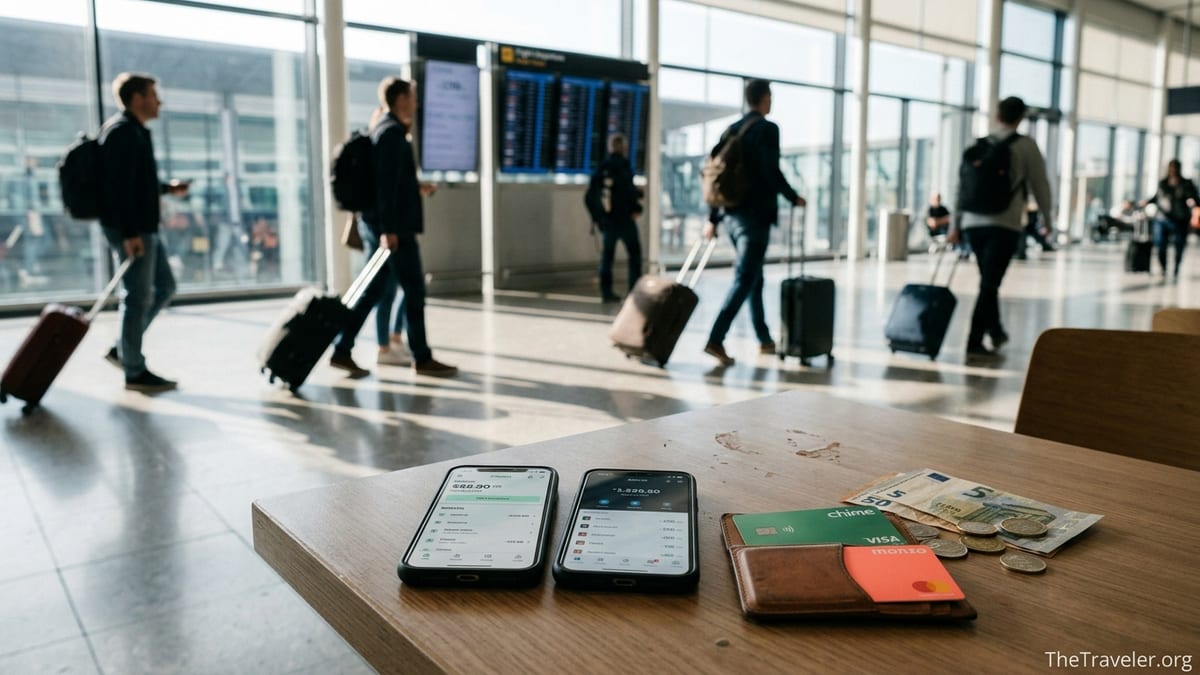
Overview: Chime vs Monzo at a Glance
Chime and Monzo are both app-first financial services built around debit cards, instant notifications, and low fees. Chime primarily serves US-based customers through partner banks. Monzo is a UK bank that also offers accounts to residents of several European countries and, through Monzo US, to a limited pool of American users. From a traveler’s perspective, the core questions are simple: Will my card work abroad, how much will it cost to use, and how easy is it to manage my money from my phone?
With Chime, a typical US traveler might use the Chime Visa debit card as their main travel card. Purchases abroad do not incur foreign transaction fees from Chime, and you see transactions in real time in US dollars. For example, if you pay for a 12 euro tapas bill in Barcelona, Chime converts the amount at the Visa exchange rate and shows the final US dollar charge in the app without adding its own percentage fee on top.
Monzo’s strength is its multi-currency friendliness and budgeting tools. A UK-based traveler can swipe their Monzo card in Japan, pay for a 1,200 yen ramen lunch, and immediately see both the yen amount and the converted pound amount in the app. The card itself generally does not add a foreign purchase fee for card payments, which is a significant improvement over many traditional UK banks that still add a percentage to every overseas transaction.
Before choosing one, it is crucial to understand that Chime is most easily accessible to US residents, while Monzo is still primarily a UK and European product. If you live in the United States and mainly travel abroad a few times a year, Chime may be simpler to open and maintain. If you are based in the UK or Europe and frequently bounce between countries, Monzo’s account structure and fee model can be more compelling.
Foreign Card Purchases and Exchange Rates
The first major test of a travel banking app is how it handles card purchases in foreign currencies. Chime does not charge its own foreign transaction fee on international card purchases. When you tap your Chime card at a Paris café to pay 5 euros for an espresso and croissant, Chime relies on the card network’s exchange rate, and the final US dollar amount simply appears in your app without an extra 1 to 3 percent markup from Chime itself. This can save a US traveler a few dollars per day in busy destinations where every coffee and metro ticket adds up.
Monzo takes a similar approach for card payments. When you book a hotel in Thailand and your card is charged in Thai baht, Monzo converts the charge to your home currency (such as pounds) using the network or wholesale rate and typically does not add its own foreign transaction surcharge for card spending. The Monzo app shows the charge in both currencies, which helps you follow your travel budget in familiar numbers even if prices on the ground are listed in baht, pesos, or kroner.
In practice, this makes both cards well suited for contactless and chip-and-PIN payments at restaurants, public transport kiosks, and shops. Imagine a week in Lisbon: you tap your card for a 1.80 euro tram ride, a 3 euro pastel de nata snack, and a 30 euro dinner. With either Chime or Monzo, you avoid the extra foreign transaction percentage that older bank debit cards often impose, and you can see your running tally in the app.
One detail both sets of users should watch is dynamic currency conversion, which happens when a merchant abroad offers to charge your card in your home currency rather than the local one. Whether you use Chime or Monzo, it is generally better to decline that offer and pay in the local currency so you benefit from the bank card network’s exchange rate instead of the merchant’s often inflated rate.
ATM Withdrawals and Cash Access Abroad
Cash access is where differences between Chime and Monzo become more noticeable. Chime users enjoy free withdrawals at a large in-network ATM network inside the United States, but when you are traveling internationally you are usually using out-of-network ATMs. In those cases, Chime typically charges a flat out-of-network withdrawal fee per transaction, and the foreign ATM operator may add its own fee on top. For example, a Chime user in Cancun who withdraws the equivalent of 100 US dollars from an airport ATM might see Chime’s out-of-network fee plus a local operator fee, which together can add several dollars to the cost of getting cash.
Monzo structures ATM fees differently and ties them to how often you rely on cash and where you are. For many standard Monzo customers, withdrawing cash in the UK or certain regions can be free up to a limit within a rolling 30-day period. Beyond that, Monzo can apply a percentage-based fee to further ATM withdrawals. Abroad, fee-free limits or charges can vary depending on whether you are in the European Economic Area or in another region. For example, a traveler using Monzo in Spain for a weekend may be able to take out a few hundred euros in total without Monzo’s own ATM fee, but a long backpacking trip in Southeast Asia with frequent cash withdrawals might eventually trigger Monzo’s extra percentage charge after crossing a monthly threshold.
To see the difference in practice, consider two travelers in Istanbul. The Chime user might choose to withdraw 2,000 Turkish lira once for the whole weekend to minimize per-withdrawal fees from both Chime and the Turkish ATM provider. The Monzo user, depending on their allowance and account level, might feel more comfortable withdrawing smaller amounts more often, as some of those withdrawals may fall within Monzo’s fee-free limits until the rolling cap is reached.
For both services, it is wise to check within the app before you travel to understand your current ATM terms, especially if you are planning cash-heavy trips where card acceptance is limited, such as rural areas, local markets, or small guesthouses that only accept cash payments.
Budgeting, Notifications, and Card Security on the Road
Both Chime and Monzo were built with smartphone-era money management in mind, which is a major advantage for travelers who need to track expenses day by day. Each app sends instant notifications when your card is used, which can make spotting fraudulent transactions far easier when you are on a busy trip and swiping your card in unfamiliar places.
Chime focuses on straightforward balance tracking and alerts. A solo traveler in Mexico City, for instance, can see each restaurant bill and Uber ride appear immediately in the app, which helps them keep an eye on the overall daily spend in US dollars. If the card is lost in a crowded market, they can open the Chime app, lock the card to prevent new transactions, and then contact support from their phone without needing to call a traditional bank hotline from abroad.
Monzo is more feature-rich when it comes to budgeting. Many travelers use Monzo’s built-in budgeting tools to create monthly or trip-based spending targets. A digital nomad based in Berlin might set a 600 euro monthly “eating out” budget in Monzo before a month-long work trip that includes stops in Prague and Vienna. Each time they pay a restaurant bill in Czech koruna or euros, Monzo automatically categorizes the spend and updates the budget tracker. This can be especially useful on long trips where it is easy to lose track of small everyday expenses in multiple currencies.
Card security controls are strong in both apps. Chime users can disable international transactions if they are not traveling and then re-enable them right before a trip abroad. Monzo lets you freeze and unfreeze your card with a tap and offers controls for contactless, magnetic stripe, and online payments. These features are invaluable if you misplace your card at an airport, forget it in a café, or suspect it was skimmed at an ATM while you were in a rush catching a train.
Overdrafts, SpotMe, and Travel Emergencies
Unexpected costs are part of travel. A sudden train strike might force you into a more expensive last-minute flight, or a lost bag could mean buying replacement clothes on the spot. Here, Chime’s SpotMe feature is particularly useful for eligible customers. SpotMe allows qualifying members to overdraw their Chime account up to a preset limit without paying overdraft fees, with the negative balance automatically repaid from future deposits. For a traveler, this might mean that if your hostel bill or train ticket pushes you slightly past your available balance, the card will not be declined up to your SpotMe limit.
Imagine a Chime user in Lima with 50 US dollars left in their account and a 100 dollar SpotMe limit. They arrive at the bus station to find that the last ticket to Cusco that day costs the equivalent of 80 dollars. Instead of having the card declined, SpotMe could allow the purchase, leaving the account temporarily negative but avoiding the stress of being stranded. When their paycheck or transfer arrives a few days later, the negative balance is automatically covered.
Monzo generally operates more strictly around overdrafts for day-to-day customers, with formal overdraft products rather than fee-free overdrawing tied to certain usage criteria. Many travelers using Monzo simply avoid running a negative balance by relying on instant notifications and the ability to move money from savings pots. If a Monzo user in Rome suddenly needs extra funds to book a hotel after a missed train connection, they can quickly move money from a savings pot to their main account inside the app before paying, rather than relying on an informal overdraft buffer.
In both cases, it is not wise to see overdraft-style features as funding for big travel purchases. They are better understood as safety nets for small shortfalls, such as a slightly larger restaurant bill or an unexpected taxi ride to the airport, rather than a way to finance expensive tours or flights.
Availability, Account Opening, and Who Each App Suits Best
Where you live strongly influences whether Chime or Monzo is the better travel banking app for you. Chime is designed primarily for US residents, and its direct deposit features are most useful if you are paid in US dollars and use Chime as a core checking account. In practical terms, a US-based teacher taking summer trips to Europe or a remote worker visiting Mexico and Canada several times a year might find it easy to set up Chime, route part of their paycheck into it, and then use the card abroad thanks to the lack of Chime-imposed foreign purchase fees.
Monzo has grown as a full-service bank for UK and some European customers. A London-based traveler who often takes weekend trips to Spain, Portugal, or France benefits from having their salary paid into Monzo, automatically building a travel pot in pounds, and then freely spending on the card across the European Union with no extra charge for card purchases. When they head further afield to destinations like the United States or Japan, they still enjoy the clarity of seeing every foreign purchase converted back into pounds inside the app.
For American travelers, access to Monzo remains more limited, as the company’s US operations have been developing more slowly than its UK presence. Many US residents who want a Monzo-style experience end up pairing a domestic no-foreign-fee credit card with a Chime debit card to cover ATM withdrawals and day-to-day cash needs. In contrast, a UK-based traveler might build their whole banking life around Monzo and simply rely on it everywhere they go.
When deciding between the two, think about your “home base” and typical travel pattern. If you are a US resident who travels abroad once or twice a year, Chime’s combination of zero foreign transaction fees on card purchases and straightforward account management can be more than enough. If you are a UK or European resident who crosses borders frequently, uses multiple currencies often, and wants granular control over budgeting, Monzo’s features will likely feel more tailored to your needs.
Real-World Itineraries: Which App Wins Where?
To see how Chime and Monzo stack up in real-world scenarios, imagine three different trips. First, a two-week vacation in Japan for a US-based couple. They book most hotels in advance on a separate no-foreign-fee credit card but plan to use a debit card for trains, meals, and occasional cash withdrawals. In this case, Chime works well for everyday card purchases without foreign transaction fees from Chime itself. They might withdraw cash at major bank ATMs in Tokyo and Osaka, accepting that each withdrawal will incur a flat out-of-network fee and possibly a local ATM fee, so they plan two or three larger withdrawals instead of many small ones.
Next, picture a London-based freelancer heading on a three-month rail trip across Europe, from Amsterdam to Budapest. They receive their income in pounds, which flows into their Monzo account. They set monthly budgets for accommodation, food, and entertainment. As they pay for hostels in euros, coffee in Prague in Czech koruna, and museum tickets in Budapest in Hungarian forints, Monzo’s budgeting tools keep every transaction visible in pounds. They seldom need cash within the European Union due to widespread card acceptance, and when they do withdraw cash at an ATM, much of it falls within Monzo’s fee-free allowance.
A third scenario: a digital nomad based in the United States but spending six months in Latin America, splitting time between Mexico, Colombia, and Peru. This traveler might use Chime as a primary debit card because of its lack of foreign transaction fees on purchases. They learn which local ATMs have the lowest operator fees, minimize withdrawals, and rely on card payments where possible. If they occasionally return to the UK or Europe or spend long periods there, they might also open a Monzo account once they have a UK address, then use Monzo locally and keep Chime as a backup or for US-based income.
In each itinerary, neither app is universally superior. Chime shines for US residents wanting a simple, low-fee way to pay abroad without complicated budgeting tools. Monzo is strongest for UK and European travelers who live in a world of constant border crossings and appreciate detailed analytics and pots for saving toward future trips.
The Takeaway
Chime and Monzo both offer significant advantages over traditional banks for travel, particularly when it comes to avoiding foreign transaction fees on card purchases and enjoying instant insight into your spending. Chime is generally a better fit for US-based travelers who want a straightforward, low-fee debit card to use abroad, combined with features like SpotMe that cushion small shortfalls without overdraft fees. Monzo is usually the stronger choice for UK and European travelers who want a full-featured bank with robust budgeting tools, multi-currency transparency, and thoughtful controls for daily life at home and on the road.
Rather than asking which app is absolutely better, it is more accurate to ask which is better for your home base, your income currency, and your style of travel. If you are a US traveler heading overseas occasionally, Chime can serve as a reliable travel companion alongside a good no-foreign-fee credit card. If you are a UK or European traveler hopping between countries throughout the year, Monzo’s account and budgeting ecosystem may give you more control and clarity.
Whichever you choose, the key is to understand your specific fees and limits before you board the plane, practice good card security, and use the app’s tools to keep your travel budget on track. In a world where you can pay for a street taco in Mexico City or a metro ride in Paris with a tap of your phone, an app that keeps your money transparent and fees predictable can make travel feel smoother and more enjoyable.
FAQ
Q1. Does Chime charge foreign transaction fees when I travel?
Chime does not charge its own foreign transaction fee on card purchases abroad, though you may still pay ATM operator fees when withdrawing cash.
Q2. Does Monzo charge fees for using my card in another country?
Monzo generally does not add an extra foreign transaction fee for card purchases in another currency, but separate limits and rules can apply to ATM withdrawals.
Q3. Which is better for a US-based traveler, Chime or Monzo?
For most US residents, Chime is easier to open and use as a primary travel debit card, while Monzo remains more naturally suited to UK and European residents.
Q4. How do ATM fees compare between Chime and Monzo?
Chime often charges a flat out-of-network fee plus any local ATM fees abroad, while Monzo may offer fee-free ATM limits and then charge a percentage on further withdrawals.
Q5. Can I use Chime or Monzo as my only card while traveling?
You can, but it is safer to carry at least one backup card. Many travelers pair Chime or Monzo with a separate no-foreign-fee credit card for added security.
Q6. How do budgeting tools differ between Chime and Monzo?
Chime focuses on simple balance tracking and alerts, while Monzo offers more advanced budgeting features, such as spending categories and savings pots for specific goals.
Q7. What happens if I lose my Chime or Monzo card abroad?
Both apps allow you to freeze your card instantly inside the app, reducing the risk of fraud, and then contact support to arrange a replacement or alternative access.
Q8. Is Chime’s SpotMe useful for travelers?
SpotMe can help eligible Chime users cover small shortfalls without overdraft fees during a trip, such as a slightly higher-than-expected restaurant bill or transport fare.
Q9. Can US residents easily open a Monzo account for travel?
Monzo’s primary customer base is in the UK and parts of Europe, and access for US residents is more limited, so many Americans find Chime easier to obtain and use.
Q10. Which app is better for long-term travel or digital nomad life?
For US-based digital nomads, Chime pairs well with US income streams, while UK or European nomads often prefer Monzo for its deeper budgeting features and multi-country flexibility.