


For many US travelers, Chime has become a go-to option for simple, app-based banking on the road. Whether you are flying to Paris, road tripping through the Southwest, or hopping between hostels in Southeast Asia, understanding exactly how Chime works for travel spending can save you money and keep your trip running smoothly. This guide breaks down how Chime handles cards, fees, ATM withdrawals, security, and common real-world scenarios so you can decide how to fit it into your travel money plan.
Get the latest updates straight to your inbox!
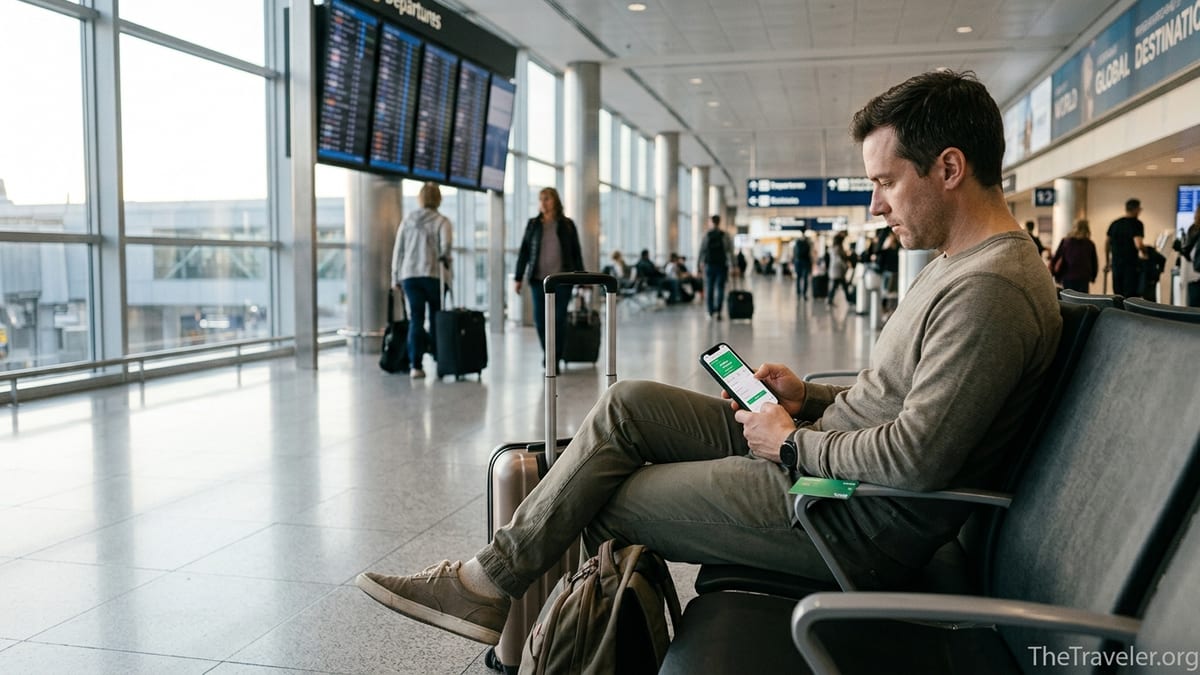
Chime in a Nutshell for Travelers
Chime is a US-based financial technology company that offers app-centered banking through partner banks, along with a Visa debit card and a secured credit card product. For travelers, what matters most is that you manage nearly everything inside the mobile app: checking your balance before boarding a flight, freezing your card if a wallet goes missing in Barcelona, or spotting a suspicious charge after paying at a beach bar in Mexico.
A Chime Checking Account is typically where your travel funds sit. Your physical Chime Visa debit card draws from that balance when you pay in shops, restaurants, or online. If you use Chime’s Credit Builder card, you can also run purchases through a secured credit line that you fund from your checking balance. Both products show up in the app in real time, which can be comforting when you are far from home and relying on a single card.
Because Chime is app-driven, it suits travelers who live on their phones and prefer tapping to calling a traditional bank. You will not find a Chime branch to walk into overseas, but you can open the app from a hostel bunk in Lisbon at midnight, track every transaction in US dollars, and contact support through chat if something looks off.
Using Chime Cards Abroad: Where and How They Work
Chime issues Visa cards, which means you can generally use them anywhere in the world that accepts Visa, from metro ticket machines in London to hotels in Bangkok and supermarkets in Berlin. For most US travelers, that covers the majority of places you are likely to swipe or tap. The main exceptions tend to be very small businesses that are cash only or local-only card networks in some countries.
Many travelers report that Chime does not charge a separate foreign transaction fee on purchases, so when you tap your Chime Visa at a cafe in Rome, you typically pay close to the Visa exchange rate, rather than an inflated tourist rate from your bank. You might still encounter fees imposed by a foreign ATM operator or dynamic currency conversion offers at terminals that try to charge you in US dollars at a poor rate, but Chime itself tends to avoid adding a percentage fee on top.
In practice, this means you could use Chime as your main card for purchases in many popular destinations: paying for a 50 euro dinner in Paris, 3000 baht worth of street food and taxis in Bangkok, or 500 Mexican pesos for snorkeling in Cozumel. The key is to always choose to be charged in local currency at the point of sale and let Visa handle the conversion in the background. If a terminal prompts you to pay in US dollars, decline that option and pick the local currency instead.
Before any international trip, it is wise to open the Chime app, confirm your card is activated, and make a small online purchase to ensure everything runs smoothly. While Chime does not require traditional travel notices in the same way as some legacy banks, confirming that your phone number and email are up to date in the app will make any security verification easier if an overseas transaction gets flagged.
Fees, Exchange Rates, and Real Trip Cost Examples
One of the main reasons travelers consider Chime is to avoid the layered fees that can eat into travel budgets. Traditional US banks often charge a foreign transaction fee of around 3 percent on each non-US purchase. If you spend the equivalent of 2,000 dollars on a two-week trip to Japan, that alone can add about 60 dollars in fees. With Chime, many travelers see that those percentage-based foreign transaction fees are not added, leaving only the underlying Visa rate and any local merchant or ATM fees.
Imagine you arrive in Lisbon and pay 120 euros for a guesthouse using your Chime debit card. If the underlying exchange rate that day is roughly 1.10 US dollars per euro, the base cost converts to around 132 dollars. With many big banks, a 3 percent foreign fee would raise that to roughly 136 dollars. With Chime, you would usually see a charge close to 132 dollars, plus or minus minor exchange rate timing differences, effectively saving a few dollars on that single transaction.
ATM access is where fees become more visible. In the United States, Chime offers access to a network of more than forty thousand fee-free ATMs through partners such as Allpoint and machines inside certain 7-Eleven or Speedway locations. Outside that network, Chime charges 2.50 dollars per withdrawal, and the foreign ATM owner may add its own fee on top. For international ATM withdrawals, that same 2.50 dollar fee from Chime usually applies, plus whatever the local machine charges.
In practice, if you withdraw the equivalent of 200 dollars from an ATM in Tokyo, you might see the local ATM add a fee of, for example, 3 to 5 dollars in yen, and Chime apply its 2.50 dollar international ATM fee. Spreading about 7 to 10 dollars of total fees over a 200 dollar withdrawal is still cheaper than paying a foreign card fee on every card purchase, but it is a cost you can reduce slightly by withdrawing fewer, larger amounts instead of many small ones, while still considering personal safety and how comfortable you are carrying cash.
Withdrawing Cash on the Road: Limits and Workarounds
Cash is still unavoidable in many destinations, whether it is tipping a guide in Guatemala, paying for rural taxis in Morocco, or buying market snacks in Vietnam. With Chime, you can withdraw cash from in-network ATMs in the United States with no Chime fee, and from other ATMs for a 2.50 dollar fee per transaction, plus any fee the ATM operator adds. Internationally, nearly every withdrawal will count as out of network, so budgeting for that 2.50 dollar charge per withdrawal is sensible.
Chime publishes typical cash withdrawal limits around a few hundred dollars per day at ATMs for most members, with higher total limits if you factor in cash back at registers or over-the-counter withdrawals at banks that accept Visa debit cards. For example, many US members see ATM withdrawal limits in the range of about 515 dollars per day with their debit card, and may be able to obtain additional cash at a bank counter using the same card, subject to local bank policies and any fees listed in the Chime app for over-the-counter withdrawals.
When you are traveling in the United States, a common cash strategy with Chime is to use grocery stores like Safeway or Kroger or pharmacies like Walgreens and CVS to request cash back when you make a purchase. Many large grocery chains allow around 100 dollars in cash back in a single transaction and some drugstores allow around 40 dollars. If you buy a bottle of water for 2 dollars at Walgreens and ask for 40 dollars cash back, the purchase and cash appear as one debit card transaction, typically with no additional fee from Chime, though store policies can vary.
Because cash back at registers often counts toward your overall daily cash withdrawal limit, it can be a flexible way to top up cash without paying an ATM operator fee. On a US road trip, for example, you might plan to buy fuel and snacks at a supermarket instead of a gas station, use your Chime card to pay, and add 80 or 100 dollars cash back to avoid an out-of-network ATM fee in a small town.
SpotMe and Travel: Covering Small Shortfalls
Chime’s SpotMe feature is a form of fee-free overdraft coverage available to eligible members who receive qualifying direct deposits. Instead of charging a traditional overdraft fee when you go a bit negative on your checking account or Chime Card, Chime can cover certain debit card purchases, ATM withdrawals, or cash back transactions up to a preset limit, often somewhere between 20 and 200 dollars for many users, though individual limits vary.
On the road, SpotMe can act as a backup if you miscalculate your remaining balance. Suppose you are in New Orleans on a weekend trip, and your account balance is 15 dollars but your SpotMe limit is 60 dollars. If you use an in-network ATM to withdraw 40 dollars for a jazz club cover charge and tips, Chime may allow the withdrawal and take your account to negative 25 dollars, rather than declining the transaction or charging a standard overdraft fee. Your next paycheck or transfer into Chime then automatically repays the negative balance.
SpotMe is not designed to finance a trip or cover major emergencies, but it can smooth over small gaps in timing when you are between deposits. Travelers should remember that ATM fees and foreign ATM operator charges still apply, and those can count toward the covered amount. For instance, if you try to withdraw 60 dollars equivalent in cash abroad and the ATM adds a 5 dollar fee plus Chime’s 2.50 dollar fee, your total transaction becomes 67.50 dollars. If your SpotMe headroom is only 50 dollars, the transaction may be declined.
Because SpotMe limits adjust over time based on your account history, it is worth checking your exact limit in the app before you travel and not relying on it as your only safety net. It works best as a cushion while you keep a reasonable travel budget in your account and maintain another backup method, such as a second bank account or a low-fee credit card you can use for hotels and car rentals.
Security, Card Controls, and Handling Problems on the Road
Travel always increases the chances of card issues, from a card being skimmed at an ATM in an unfamiliar city to a wallet getting lost on a crowded tram. Chime’s app-first design gives you some useful tools to manage risk, especially when you are abroad and cannot easily visit a branch or spend a long time on an international call.
If your card goes missing in a busy night market in Mexico City, you can open the Chime app within seconds and toggle your physical card off. This instantly blocks new purchases and ATM withdrawals on that card number. You can keep using your virtual card for some online purchases if needed, and once you are in a secure place, you can request a replacement card through the app. While waiting, you may still move money out of Chime to another account or digital wallet for access.
Real-time transaction alerts are another key security feature. Each time you use your Chime card, a push notification typically appears on your phone. If you are sitting in a cafe in Prague and see an alert for a purchase at a gas station two towns away, you can immediately freeze your card and contact Chime support through in-app chat or by phone. That fast reaction can limit potential losses and help you resolve fraud claims more quickly.
To prepare for problems, it is wise to save Chime’s support contact details in a note on your phone and to ensure the app can send notifications over cellular or Wi-Fi. Before traveling, consider adding your Chime card to a mobile wallet such as Apple Pay or Google Pay, so if the physical card strip is damaged or a chip reader fails, you may still be able to tap to pay at many terminals without exposing your physical card repeatedly.
Practical Travel Strategies: When Chime Works Best
Chime is particularly strong for travelers who value fee transparency and mobile control. For domestic trips in the United States, you can rely on the large fee-free ATM network for cash, set up direct deposit so paychecks land even while you are away, and use features like early paycheck access to fund last-minute flights. A traveler flying from Chicago to Denver for a long weekend might plan to withdraw cash from a fee-free ATM at a 7-Eleven upon arrival, use the debit card for restaurants and ride shares, and lean on cash back at supermarkets when passing through mountain towns with few ATMs.
Internationally, Chime can work well as a primary spending card in many card-friendly destinations, especially in Europe, parts of Asia, and major cities in Latin America. A digital nomad spending a month in Lisbon could pay rent to a local landlord via bank transfer from Chime to another service, use the Chime Visa card for daily expenses, and visit international ATMs just once every week or two for a small stash of euros, accepting the flat 2.50 dollar fee each time.
Chime is less ideal as your only banking option if you expect to spend long stretches in places where cards are rarely accepted or where local ATMs are unreliable. In rural parts of some countries, cash is still king, and relying on a single US-based app with daily cash withdrawal limits can feel restrictive. In those cases, pairing Chime with a second bank account, a no-fee travel credit card, or even a prepaid local card can give you more resilience.
Whatever your itinerary, the smartest approach is to treat Chime as one pillar of a broader travel money plan. Keep some funds in Chime for its low fees and easy controls, maintain a small emergency cushion in another account, and carry a backup card from a different issuer stored separately from your main wallet. That way, if a Chime card is eaten by an ATM in Rome or blocked by a fraud algorithm at an inopportune time, you are not stranded.
The Takeaway
For many US-based travelers, Chime offers a flexible, relatively low-fee way to manage travel spending, both at home and abroad. Its Visa cards are widely accepted, the app makes it simple to track transactions in real time, and features like SpotMe add a cushion against small mistakes without the sting of traditional overdraft fees.
Still, like any single banking solution, Chime has limitations that matter when you are far from home. Cash withdrawal limits, international ATM fees, and reliance on app-based support mean it works best when paired with a second card or account, especially in cash-heavy or infrastructure-poor destinations. Thinking through those constraints before you go is as important as shopping for the right luggage or travel insurance.
If you understand how Chime handles fees, ATMs, and security, you can lean on it confidently for everyday purchases, budget-friendly trips across the United States, and many international adventures. Used thoughtfully, it can simplify your money life on the road so you can focus less on banking and more on the actual journey.
FAQ
Q1. Can I use my Chime card in other countries?
Yes, you can use your Chime Visa card in most countries where Visa is accepted. Card acceptance is widest in major cities and tourist areas; in very rural regions or cash-only businesses you may still need local currency.
Q2. Does Chime charge foreign transaction fees on purchases?
Chime typically does not add a separate percentage-based foreign transaction fee on card purchases, though normal currency conversion through Visa still applies and local merchants or ATM operators may charge their own fees.
Q3. What are the typical daily ATM withdrawal limits with Chime?
Many Chime members see a standard daily ATM withdrawal limit of around a few hundred dollars, often reported near 500 dollars, though exact limits can vary by account and are visible inside the app under account settings.
Q4. How much does Chime charge for international ATM withdrawals?
Chime generally charges a 2.50 dollar fee per withdrawal at out-of-network and international ATMs, and the machine’s owner may add its own fee, so the total cost per withdrawal is the combination of both.
Q5. Can I rely on Chime SpotMe while traveling?
SpotMe can help cover small shortfalls on eligible accounts, usually up to a limit between about 20 and 200 dollars for many users, but it should be treated as a backup cushion, not a primary source of travel funds.
Q6. How do I find fee-free ATMs for Chime in the United States?
In the Chime app, you can use the ATM or cash map feature to locate in-network ATMs, such as many Allpoint machines or those inside some 7-Eleven and Speedway locations, where Chime does not charge its own withdrawal fee.
Q7. Is Chime safe to use as my main card on a long trip?
Chime provides standard security features like instant card-freeze, real-time alerts, and in-app support, which make it safe for many travelers. However, it is still wise to carry at least one backup card from another bank.
Q8. Can I get cash back at stores with my Chime card?
Yes, many US grocery stores and drugstores let you request cash back when making a purchase with your Chime debit card, often up to around 40 to 100 dollars per transaction, subject to individual store limits.
Q9. Do I need to tell Chime I am traveling abroad?
Chime does not typically require traditional travel notices, but it is smart to ensure your contact information is updated in the app and to monitor real-time alerts so you can respond quickly if a transaction is flagged.
Q10. What should I do if my Chime card is lost or stolen while traveling?
Open the Chime app immediately and disable your card to block new transactions, review recent activity for suspicious charges, and then contact Chime support through the app or by phone to report the loss and request a replacement card.