


For many travelers planning a first trip to western China, the choice quickly narrows to two giants: high-rise, river-straddling Chongqing and relaxed, food-obsessed Chengdu. They sit just 300 kilometers apart and are linked by dense high-speed rail, yet the experience on the ground is strikingly different. Understanding how they compare on food, sightseeing, urban atmosphere, transport, nature excursions and onward travel can help you decide where to base yourself or whether it is worth visiting both.
Get the latest updates straight to your inbox!
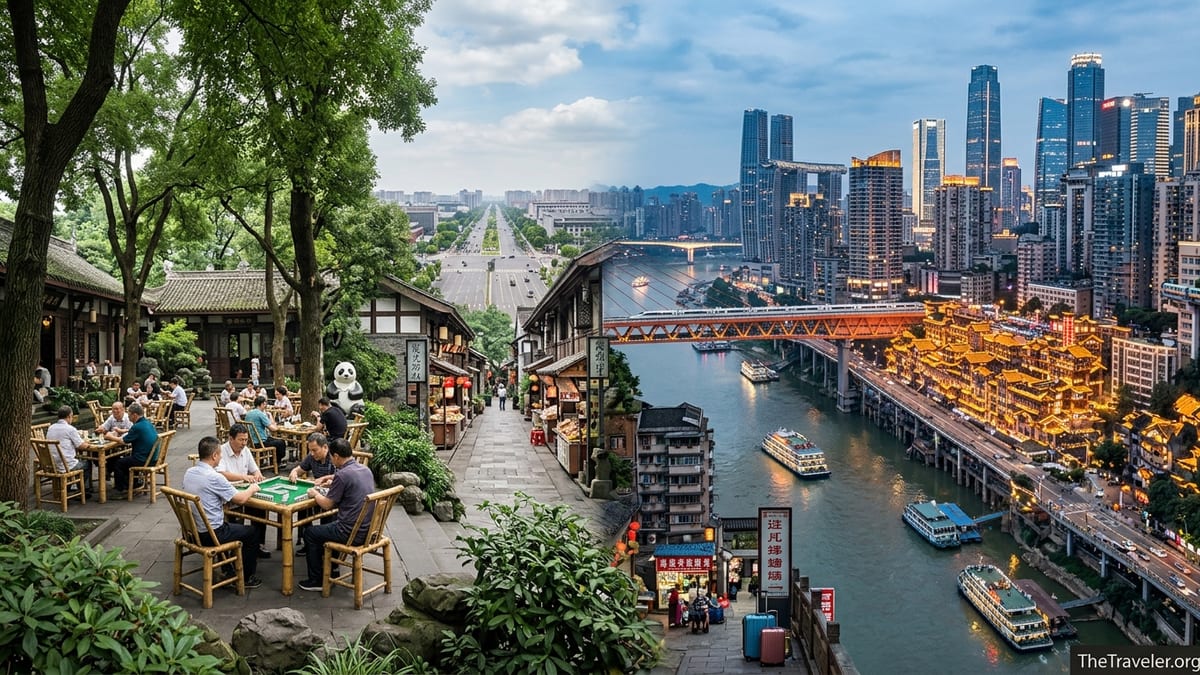
Two very different Sichuan Basin capitals
Chongqing hits you first with geography. The central districts perch on steep hills between the Yangtze and Jialing rivers, stacked with layered flyovers, cliffside apartment blocks and vertiginous viewpoints. Jiefangbei’s canyons of glass and steel, the cliff-hugging wood façades of Hongyadong and the view across to Chaotianmen at night create one of China’s most dramatic cityscapes. Visitors often spend their first evening simply walking between river lookouts and rooftop terraces to watch ferries and cruise ships sliding through the illuminated gorges of apartments.
Chengdu feels almost like the opposite. The city spreads out on a largely flat plain, with broad boulevards, quieter side streets and a slower, more residential rhythm. Instead of vertical spectacle, Chengdu sells atmosphere: teahouses in People’s Park where retirees play mahjong, renovated alleys such as Jinli and Kuanzhai lined with snack stalls and courtyards, and tree-lined streets filled with hotpot restaurants and noodle shops. The city is also the most accessible jumping-off point for visiting the region’s famous panda bases.
For first-timers to China, Chengdu usually offers a gentler landing, with more English on menus around the main tourist areas, an easier street layout and a food culture already familiar from “Sichuan cuisine” abroad. Chongqing tends to appeal to travelers who are comfortable navigating big Asian cities and want an urban experience that feels less polished, more vertical and visually intense. The good news is that fast trains run between the two in about an hour, making it realistic to sample both on the same trip.
In practice, many visitors now fly into Chengdu, spend several days enjoying the food scene and panda visits, then connect to Chongqing by high-speed rail to experience its cliffs, cableways and riverfront skyline before heading down the Yangtze or continuing elsewhere in China.
Air access, high-speed rail and getting between the two cities
Chengdu is the stronger international hub. The newer Chengdu Tianfu International Airport handles the bulk of long-haul and regional services, with non-stop flights to dozens of international destinations in Asia, Europe and North America. Current schedules include direct routes to cities such as Los Angeles and a broad network of Southeast and Northeast Asian capitals from carriers including Air China, Sichuan Airlines, Spring Airlines and others. Shuangliu Airport, closer to the old city, still handles many domestic and some regional flights, so first-time visitors should double-check which airport their flight uses when booking.
Chongqing Jiangbei International Airport has grown rapidly but remains a secondary international gateway compared with Chengdu. As of late 2026 it offers direct flights on roughly three dozen international routes, concentrated on Northeast and Southeast Asia. Examples include services to Bangkok, Seoul, Osaka and resuming connections to Taiwan and popular Thai beach destinations. For travelers from Europe or North America, reaching Chongqing often involves a transfer through Beijing, Shanghai, Guangzhou, Shenzhen or increasingly through Chengdu itself.
The real link between the two cities is high-speed rail. Multiple services on the Chengdu–Chongqing high-speed corridor depart roughly every 15 to 20 minutes during the day, with typical journey times of about 1 to 1.5 hours depending on stopping patterns. Recent fare searches for late 2026 show second-class tickets around 80 to 110 yuan and first class from about 130 to 180 yuan for the fastest services. Trains use large, modern stations such as Chengdu East or Chengdu Tianfu and Chongqing West or Chongqing North, all reachable by metro. For a first-time visitor, buying tickets in-app through official railway apps or via hotel assistance is usually straightforward with passport details.
Given these connections, a popular strategy is to enter China via Chengdu, spend several nights there, then ride high-speed rail to Chongqing for a two or three night stay before continuing onward by train to destinations such as Guiyang, Xi’an or Kunming, or by air from either city’s airport. The rail link is fast enough that some travelers even base in one city and day-trip to the other, although an overnight stay in each gives a much better feel.
Core sights: river drama versus teahouses and pandas
Most first-time visitors to Chongqing start around Jiefangbei, a dense commercial core of skyscrapers, malls and neon. Walking downhill from here towards the river reveals much of what makes Chongqing unique: steep staircases, overpasses floating at mid-building level and glimpses of trains and ferries threading through the concrete. Jiefangbei itself is free to wander, and spending an evening simply people-watching around the central monument costs nothing aside from any snacks or drinks you pick up along the way.
Close by, Hongyadong is one of Chongqing’s most photographed spots. The complex’s tiered, traditional-style façades cling to the cliff above the river, with multiple internal levels linking modern shops, bars and viewing decks. Entry to the complex is free, though individual restaurants and bars set their own prices. Arriving just before sunset lets you see the transition from daytime river views to full illumination, when the entire structure and surrounding bridges light up.
Another signature Chongqing experience is the Liziba monorail station, where trains pass directly through a residential tower between the sixth and eighth floors. There is no separate admission fee; you pay only the small metro fare, then watch or photograph as trains emerge from the building against a backdrop of high-rises and river bends. For a wider panorama, many visitors ride the Yangtze River Cableway between Yuzhong and Nan’an districts. Tickets are modestly priced per one-way journey, and queues build up near sunset, when the view of the skyline, bridges and layered expressways is at its most dramatic.
By contrast, Chengdu’s first-time essentials are more horizontal and more about lingering than chasing viewpoints. People’s Park in central Chengdu is free to enter and offers one of the best introductions to everyday Sichuan life. Teahouses line the lakeside; for roughly 20 to 40 yuan you can sit for hours with a pot of jasmine or green tea while watching ear-cleaners ply their trade and dance or opera rehearsals unfold nearby. A short walk away, Jinli Street and the Kuanzhai Alleys form restored pedestrian districts where entry is free but food, souvenirs and small exhibitions are ticketed or pay-per-item. These areas can be crowded, yet they remain convenient places to graze on skewers, stuffed pancakes and sweets while admiring the courtyard architecture.
Two of Chengdu’s major paid attractions are Wuhou Shrine and the Chengdu Research Base of Giant Panda Breeding. Wuhou Shrine, which commemorates the heroes of the Three Kingdoms period, charges an entrance fee that in recent years has been in the low tens of yuan. The panda base on the city’s northern outskirts uses timed tickets and dynamic pricing, with advance online purchases often around the 50 to 80 yuan range for adults. For many visitors, this panda visit is the single must-do in Chengdu, especially for families.
Transport inside the city: monorails and slopes versus a wide metro
Chongqing’s geography shapes its transport. The Chongqing Rail Transit network mixes conventional metro lines with elevated monorails that swoop in and out of hillsides. Stations like Liziba or those serving the cableway can be attractions in themselves. However, first-time visitors should be prepared for complex, multi-level station layouts and significant vertical movement. Leaving a station may mean riding several escalators, crossing elevated walkways and then descending long flights of steps to reach riverside streets. For travelers with luggage or limited mobility this can be tiring, although newer stations greatly expand escalator and elevator coverage.
Walking around central Chongqing is equally shaped by topography. Distances that look short on a map can involve steep climbs or labyrinthine staircases. In older quarters near the rivers, pedestrian paths move between building rooftops and lower road levels, which is part of the city’s appeal but can be confusing. Taxis and ride-hailing apps are widely available and inexpensive by international standards, and they can be a good option at night or when moving between districts separated by long bridges or tunnels.
Chengdu, by comparison, is much easier to read and navigate. Its metro system has grown into an extensive, mostly underground network that covers central areas and reaches both airports as well as suburban attractions. Station exits usually emerge directly onto broad, flat streets, and the grid-like layout makes it relatively simple to orient yourself. For visitors who prefer cycling or walking, the flat terrain and an increasing number of bike lanes and shared-bicycle schemes make short inner-city journeys comfortable.
In daily practical terms, Chengdu tends to be the less demanding city for newcomers: metro signage is clear, platforms are level with trains and interchange stations are well marked. Chongqing’s system is just as modern, but its stacked platforms, long vertical transfers and occasional crowds around scenic stations mean that moving around can feel more like an adventure. Those who enjoy unusual transport perspectives often love Chongqing for exactly that reason.
Food culture: hotpot capitals, street snacks and teahouses
Both Chongqing and Chengdu sit in the heart of China’s spicy food belt, but each has its own culinary emphasis. Chongqing is strongly associated with its fiercely numbing, chili-laden hotpot, typically built around a partitioned metal pot full of red broth on one side and a mild or herbal broth on the other. Diners order skewers or plates of offal, tripe, thin-sliced beef, vegetables and tofu to cook at the table. Chain restaurants around Jiefangbei, Guanyinqiao and Shapingba offer clear menus with per-plate prices, and a filling hotpot meal with beer for two can easily be kept within a few hundred yuan depending on ingredients.
Street snacks in Chongqing skew towards bold flavors: small noodle shops selling hot-and-sour xiaomian, grilled skewers dusted with peppercorn and cumin, and late-night stalls near universities and riverfronts. Prices remain low compared with coastal megacities, and a simple breakfast of xiaomian or rice noodles with soy milk often costs less than a single metro ride in many Western cities. Visitors interested in everyday local food might consider staying near an older residential district or university area to explore these backstreet options.
Chengdu’s food scene is broader and more developed for visitors. In addition to Sichuan hotpot, which in Chengdu often emphasizes complex broths and dipping sauces, the city is known for dishes like mapo tofu, twice-cooked pork, dan dan noodles and rabbit or chicken in rich chili oil. Traditional restaurants and newer bistros cluster around the city center, Yulin and Tai Koo Li areas, with options ranging from humble noodle stands to high-end tasting menus that reinterpret classic Sichuan flavors. Prices span a huge range: a bowl of dan dan noodles can cost under 20 yuan in a neighborhood shop, while elaborate multi-course dinners at well-known establishments reach international levels.
Tea culture is noticeably stronger in Chengdu’s public life. Spending half a day at a teahouse in People’s Park or near Wenshu Monastery is not just acceptable but expected, and staff rarely rush tables. Teahouse menus typically list dozens of loose-leaf options, with refills included in the per-person tea price. In Chongqing, teahouses do exist, but the overall feel of the city’s leisure spaces tilts more towards nighttime river walks, bars, hotpot joints and skewers than hours-long tea sessions. For visitors primarily interested in food and drink, Chengdu usually offers more variety and depth, while Chongqing excels in intense hotpot, humble noodles and the experience of eating with plunging river views.
Day trips and nature: Dazu carvings versus Leshan, Qingcheng and Dujiangyan
From Chongqing, the standout cultural day trip is the Dazu Rock Carvings, a UNESCO World Heritage site of intricate cliff sculptures scattered across Dazu District. Recent transport information shows that high-speed trains from Chongqing West or Chongqing North to Dazu South station can take as little as around 30 to 40 minutes, followed by local buses or taxis to the main Baodingshan area. Organized day tours from central Chongqing bundle transport and tickets, and many travelers report that a long but manageable day allows for a morning departure, several hours at the carvings and return to the city by evening.
Nature-oriented excursions from Chongqing include Wulong Karst National Geology Park, known for sinkholes, natural bridges and “Avatar” style limestone formations, reachable by longer high-speed rail or bus journeys that suit an overnight stay. River cruises from Chaotianmen towards the Three Gorges are also possible, though modern dam projects have altered the classic scenery and most multi-day cruises now target a broader domestic market, with limited English-language guiding.
Chengdu offers a denser cluster of classic day trips. South of the city, high-speed rail and buses make it possible to visit the Leshan Giant Buddha in a long day, combining train or coach to Leshan with local buses or taxis to the riverside scenic area. To the west, Mount Qingcheng’s forested slopes and Daoist temples pair well with Dujiangyan’s ancient irrigation system. Fast trains from Chengdu to stations near Dujiangyan and Qingchengshan generally take under an hour, then local buses or taxis connect to the scenic gates. Many visitors base in Chengdu and schedule one or two such day trips without changing hotels.
In terms of realistic return times, a Dazu day trip from Chongqing and a Leshan or Dujiangyan plus Mount Qingcheng day trip from Chengdu all require early starts and some careful connection planning, but they are widely offered by local agencies and frequently attempted independently. For first-time visitors who want world-famous religious sculptures and mountain or river settings, Chengdu’s combination of Leshan and Qingcheng often edges ahead, while Chongqing’s Dazu remains less crowded and feels more off the main international circuit.
Budgets, accommodation and seasonal considerations
Both cities are relatively good value compared with Beijing or Shanghai, but costs vary by neighborhood. In Chengdu, mid-range international or quality domestic hotels around Tianfu Square, Chunxi Road or near People’s Park often list nightly rates in the 400 to 800 yuan range for advance bookings in late 2026, with simple local hotels and guesthouses available for considerably less. In Chongqing, hotels around Jiefangbei and Guanyinqiao show comparable or slightly lower prices, although river-view rooms and newer boutique properties command premiums during weekends and holidays.
As a rough planning example for a central stay in either city, a two-night mid-range hotel bill might run 800 to 1,600 yuan. Add airport metro or shuttle transfers and a handful of taxi rides for approximately 100 to 300 yuan altogether, daily meals ranging from budget noodles and snacks to a single more elaborate dinner for roughly 150 to 300 yuan per day per person, and entry tickets for one or two major attractions in the 50 to 100 yuan bracket. A solo traveler comfortable with public transport could realistically enjoy two full days in either city on a total budget of around 1,200 to 2,000 yuan, excluding flights, while couples and families should scale this estimate accordingly.
Seasonal climate plays a big role in comfort. Chongqing’s reputation as one of China’s “three furnaces” is well earned: summers are long, hot and extremely humid, with hazy air that softens skyline views. Winters tend to be cold and damp rather than deeply freezing, with frequent fog and low cloud that can obscure distant hills yet lend river views a moody atmosphere. Chengdu is also humid, but summer heat in the city core generally feels slightly less oppressive, and parks and teahouses offer shade. Both cities can experience air quality issues, particularly in winter, though conditions fluctuate day by day and have improved over the longer term compared with a decade ago.
Accessibility is improving in both cities but remains uneven. Newer metro stations in Chongqing and Chengdu usually provide elevators and tactile paving, but older areas, especially in Chongqing’s stepped hillside neighborhoods and riverside stairways, are challenging for travelers with mobility limitations. Chengdu’s flatter layout and large, modern pavements around central sights, malls and parks give it a clear edge for wheelchair users and anyone who prefers to avoid steep climbs. When booking hotels in Chongqing, it is sensible to confirm elevator access, distance to the nearest flat main road and proximity to a metro station with barrier-free facilities.
Practical two-day itineraries and a combined plan
For a first-time visitor focusing on Chongqing, a two-day outline might look like this. On day one, check into a hotel near Jiefangbei and spend the afternoon exploring the surrounding shopping streets, snack alleys and viewpoints, then walk or ride the short distance to Hongyadong for sunset and night photography before taking an evening riverfront stroll near Chaotianmen. On day two, ride the Liziba monorail section in the morning, then continue to the Yangtze River Cableway for panoramic views. In the afternoon, dive into a classic Chongqing hotpot feast and, if time and energy allow, visit a museum or explore another slope-side neighborhood before a final evening walk among the skyscrapers.
In Chengdu, a two-day visit can balance food, pandas and city life. On day one, start early at the Chengdu Research Base of Giant Panda Breeding, aiming to arrive close to opening time when pandas are generally more active and crowds somewhat lighter. Return to the city for a late lunch of noodles or mapo tofu, then spend the afternoon and evening around People’s Park, its teahouses and nearby Kuanzhai Alleys or Jinli, grazing on snacks and watching local life. On day two, consider Wuhou Shrine followed by a long, relaxed lunch and an evening hotpot in a well-regarded local restaurant, wrapping up with a stroll through a lively commercial district such as Chunxi Road.
For travelers with three to five days to allocate to both cities, a straightforward combined plan works well. For example, arrive in Chengdu on day one, focus on central food and teahouse culture, then visit the panda base on day two. On day three, take a high-speed train to Chongqing around midday; the journey of roughly 1 to 1.5 hours leaves time to check into a hotel near Jiefangbei and enjoy Hongyadong and the riverside in the evening. Day four can cover Liziba, the cableway and further exploration of Chongqing’s urban canyons. If you have a fifth day, either take an organized day trip from Chengdu to Leshan or from Chongqing to Dazu before catching an evening train or flight onward.
Because of the dense rail schedules, it is easy to fine-tune the order. Some travelers prefer to start in Chongqing, tackling steeper walks and more intense heat or humidity first, then unwind in Chengdu’s parks and teahouses. Others choose Chengdu first in order to adjust gently to China, then step into Chongqing’s more demanding yet visually spectacular terrain.
Which city suits you: tailored recommendations
Food lovers usually find Chengdu the better single base. The range of Sichuan dishes, from casual noodles to refined multi-course meals, is wider and much of it is accessible on foot or via short metro rides from central hotels. Hours in teahouses, snack-hopping through Jinli and Kuanzhai, and evening hotpot sessions give a full picture of local dining culture. Chongqing is still essential for those who want to taste intensely spicy hotpot and street noodles in their “home” environment, so passionate eaters with enough time should strongly consider visiting both.
Photographers and fans of dramatic cityscapes will almost certainly prefer Chongqing. The multilevel bridges, riverside skylines, cableway panoramas and constant interactions between rail lines, towers and hillsides furnish a huge variety of compositions, especially at dusk and after dark. Chengdu has its visual charms, particularly in traditional courtyards, parks and around the panda base, but it lacks Chongqing’s immediate skyline drama. For urban night photography on a short trip, Chongqing is hard to beat.
Families and first-time visitors to China often find Chengdu the easier place to start, especially with children. The panda base is a clear highlight for younger travelers, central parks provide space to run around, and the metro and flat streets simplify logistics with strollers. Many restaurants are accustomed to families and can moderate spice levels. Chongqing can certainly be rewarding for families, but the steep streets, dense traffic flows and hot, humid summers require more stamina, and some viewpoints are crowded with stairs.
Travelers with mobility limitations will almost always be better served basing in Chengdu. The flat urban core, wide pavements, clear metro layouts and accessible public parks make it much more manageable. Chongqing’s most iconic walks often involve stairs, slopes and multi-level station exits that are difficult to avoid, and while both cities are investing in accessibility, geography is not on Chongqing’s side. If time and mobility allow, a short, carefully planned visit to Chongqing focused on viewpoints reachable by metro plus cableway or taxi can still be worthwhile.
For many visitors with five days or more in the region, combining both cities is ideal. Chengdu provides the food, pandas and day trips to Leshan or Mount Qingcheng, while Chongqing delivers unforgettable night views, monorails threading through buildings and access to the Dazu carvings or longer Yangtze journeys. In the end, Chengdu is the better all-round base and first stop for most, but Chongqing offers a uniquely vertical, cinematic city experience that justifies the short high-speed rail hop for anyone curious about how extreme an Asian river city can feel.