


More news on this day
Crews are working to clear derailed coal cars and contain spilled cargo near Eureka after a freight train left the tracks, disrupting rail traffic and raising fresh questions about heavy-haul safety in the region.
Get the latest news straight to your inbox!
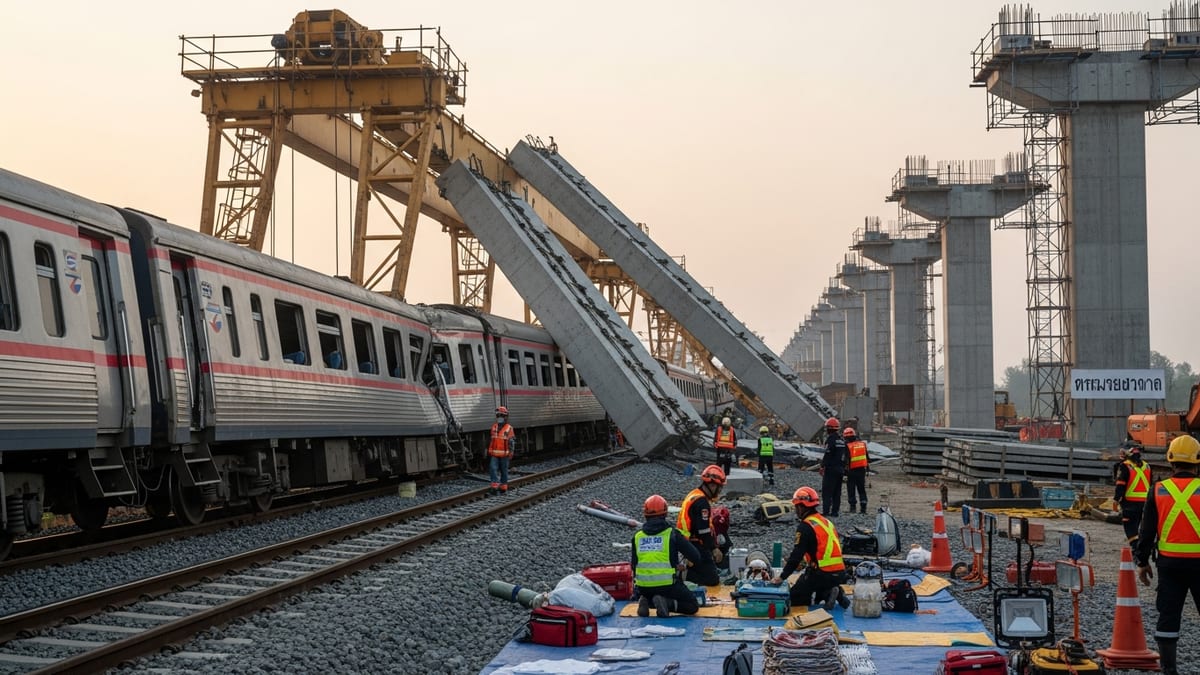
Coal train leaves the tracks near Eureka
Initial reports from local and regional outlets indicate that several loaded coal cars derailed on a freight line in the Eureka area, leaving a tangle of railcars and damaged track. The incident, which occurred along a corridor commonly used for bulk commodities, has temporarily halted service while responders assess damage and begin recovery work.
Images and early descriptions show coal hoppers off the rails, with some cars tipped at sharp angles and others resting on their sides. Nearby residents reported unusual rail noise and the sound of metal striking ballast shortly before the line went quiet. There were no immediate reports of serious injuries, but rail traffic through the corridor has been significantly disrupted.
Publicly available information suggests the train was part of a unit coal service, a configuration in which an entire consist is loaded with a single commodity. Such trains are a common sight on western North American main lines, where long consists of coal cars move between mines, power stations, and export terminals.
Rail incident records and previous investigations show that derailments involving heavy bulk trains can stem from a range of factors, including track conditions, equipment failures, and operational issues. In this case, the precise cause has not yet been detailed in open reports, and the focus remains on stabilizing the scene and restoring service.
Emergency response and environmental assessment
In the hours after the derailment, emergency crews, railroad response teams, and contractors converged on the site to secure the area. Standard procedures in similar coal derailments include isolating the affected track, checking for fuel leaks from locomotives, and confirming that no hazardous materials are involved beyond diesel and lubricants carried by the train itself.
Coal is generally classified as a bulk solid rather than a hazardous chemical, but spill response still requires careful handling. Publicly available guidance shows that cleanup crews typically work to prevent coal from entering nearby waterways, culverts, or drainage systems, where sediment and fine dust can affect water quality and aquatic habitat.
Reports from recent coal train incidents in other regions describe a pattern of earthmoving equipment being brought in to scoop spilled coal away from the right of way, followed by screening, loading into trucks or railcars, and removal to designated storage or disposal sites. The same approach is expected near Eureka, with crews balancing the need for rapid rail reopening against erosion control and dust suppression.
Weather conditions can also shape the response. Dry, breezy conditions raise concerns about coal dust and trackside fire risk, while heavy rain can mobilize spilled material into ditches and streams. Forecasts for the broader Eureka region are being watched closely as the cleanup proceeds.
Rail traffic disruptions for freight and passengers
The derailment has added another complication to an already busy summer on North American rail networks, where freight congestion and several high profile incidents have drawn attention to line capacity and resilience. In the Eureka area, the affected subdivision serves as a key link for bulk commodities, and taking even a short section out of service can ripple across timetables.
Published coverage of similar derailments shows that railroads often respond by rerouting freight trains over parallel lines where possible, lengthening transit times and increasing pressure on neighboring corridors. Where no convenient alternate route exists, coal customers may face delivery delays while track repairs are completed and equipment is inspected.
If passenger services share the line, schedules can be reduced or temporarily replaced with buses until at least one track is cleared and inspected. In other recent North American derailments, limited operations have sometimes resumed within 24 to 48 hours on an adjacent track, while full restoration of normal speeds can take days or weeks depending on the extent of damage.
For travelers and shippers, the immediate effect is uncertainty. Railroads typically publish customer notifications and service advisories after major incidents, advising coal shippers, intermodal customers, and connecting carriers of anticipated delays and adjusted operating plans.
Ongoing investigation and safety context
While cleanup progresses near Eureka, attention is turning to what the derailment may reveal about the condition of the route and the broader safety picture for heavy-haul coal trains. Public databases maintained by transportation regulators and safety boards show that unit coal trains feature prominently in past derailment statistics, largely because of their length, weight, and the demanding territory they often traverse.
Academic research into freight rail risk notes that unit trains carrying heavy bulk commodities exert sustained high axle loads on track and structures, making rigorous inspection regimes and timely maintenance essential. Studies comparing unit trains with mixed manifest trains describe different risk profiles, with unit trains tending to have fewer coupling and switching movements but higher potential energy and momentum once in motion.
Investigations into earlier derailments in mountain and river canyon territories highlight the role of track geometry, rail wear, ballast condition, and extreme weather in destabilizing trains that might otherwise be operating well within their speed limits. Even minor defects, such as a developing rail crack or a compromised tie, can become critical under the passing weight of hundreds of loaded coal cars.
In Eureka, publicly available information indicates that technical teams will review data from locomotive event recorders, track inspection logs, and recent maintenance activities to determine what went wrong. The findings are expected to feed into ongoing discussions about inspection technology, including ground-based sensors, detailed imaging, and predictive models designed to flag potential derailment points before an accident occurs.
Community impact and longer term questions
For communities along the corridor near Eureka, the derailment is another reminder of the close relationship between rail lines and daily life. Tracks often run behind neighborhoods, along rivers, and near local roads, making any major incident both a logistical challenge and a visual shock to residents accustomed to routine train movements.
Coal dust and noise have long been subjects of debate in rail towns where unit trains move through at all hours. A derailment that spills coal outside the railbed can intensify those concerns, even when official assessments describe the overall environmental risk as manageable. Residents typically watch for information about air quality, water protection measures, and the timeline for returning the landscape to something close to its pre-incident state.
From a travel and tourism perspective, the incident also raises practical questions. Rail corridors are often shared with scenic passenger routes, access roads to trailheads, and gateways to outdoor destinations. Any prolonged closure or speed restriction can affect visitor flows, especially during peak vacation periods when travelers are relying on tight connections between trains, buses, and flights.
As crews continue to lift derailed cars, repair track, and move spilled coal away from sensitive areas, attention will remain on how quickly normal operations can resume and what lessons this episode might hold for rail corridors serving both heavy industry and gateway communities like Eureka.