


More news on this day
Emergency crews in South Carolina are responding to a freight train derailment involving 17 rail cars near the boundary between Laurens and Greenwood counties, prompting road closures and an extended cleanup but with no immediate reports of injuries.
Get the latest news straight to your inbox!
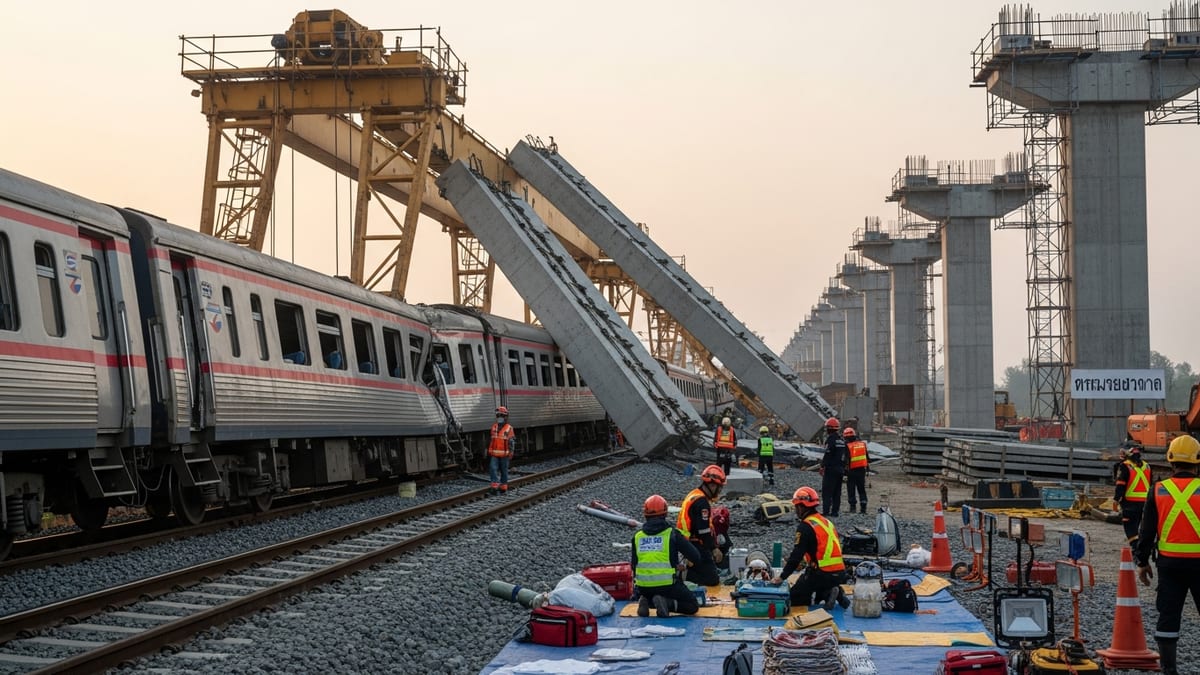
Derailment reported near county line
Initial local coverage indicates that the derailment occurred near rail lines running close to the Laurens and Greenwood county boundary in the South Carolina Upstate. Early information describes a freight consist with 17 cars leaving the tracks, with several cars coming to rest at angles along the rail bed.
Reports suggest the incident took place in a semi-rural area where rail infrastructure threads between residential pockets, farmland and access roads. That geography has helped limit direct impact to homes and businesses, although road closures are affecting local travel while crews establish a perimeter around the site.
Publicly available information so far indicates that the derailed consist was a freight train rather than a passenger service. Details on the exact railroad operating the train and its origin and destination have not yet been fully disclosed in open reports.
Images shared through local outlets appear to show multiple rail cars off the main line, with some tipped at sharp angles but remaining largely intact. There is no widely reported evidence of a significant fire, explosion or large visible plume at the scene.
Emergency response and safety measures
Regional news coverage notes that local fire services and county emergency agencies were among the first to respond, with additional support requested from neighboring jurisdictions. Responders established staging areas near the scene to coordinate traffic control, site assessment and any potential evacuations if needed.
Standard protocol in rail incidents involving freight cars includes rapid checks for hazardous materials, leaks and ignition risks. Based on information currently available, there have been no prominent public advisories about large-scale hazardous releases or widespread shelter-in-place orders related to this derailment.
Nevertheless, responders are treating the area as an active incident site. Access roads close to the tracks have been restricted, and the public has been urged, through local reporting, to avoid the immediate corridor so heavy equipment and personnel can move freely. Rail traffic through the area is expected to be halted or severely limited until tracks and signaling equipment can be inspected and, if necessary, rebuilt.
Neighboring counties are monitoring conditions, particularly around waterways, drainage channels and low-lying terrain where runoff from firefighting efforts or minor leaks could concentrate. To date, there is no broad indication from published information of major downstream environmental impacts.
Environmental and infrastructure concerns
Any multi-car derailment raises questions about potential effects on soil, water and nearby communities. In this case, the location near the Laurens-Greenwood line brings added attention because the broader area links to regional watersheds that feed lakes and rivers used for recreation, irrigation and in some cases drinking water.
According to publicly available rail safety data and recent coverage of other derailments across North America, most incidents of this scale do not result in large hazardous-materials releases, but they can still scatter debris, fuel and cargo. Cleanup typically involves methodical inspection of each car, removal of damaged equipment and, where necessary, excavation of contaminated ballast or soil.
Crews working near the South Carolina site are expected to focus first on stabilizing any rail cars that pose a rollover or collapse risk, then on clearing the right-of-way so track repairs can begin. Heavy cranes, specialized rail equipment and truckloads of replacement ties and ballast are commonly brought in for this phase of work.
Local transportation corridors are also affected. Even if the derailment occurred away from major highways, nearby secondary roads often serve as crucial connectors for residents and freight traffic. Drivers can expect detours and slowdowns in the vicinity until rail cars are removed and any damaged crossings or signals can be evaluated.
Broader context of recent derailments
The South Carolina derailment comes amid a series of freight train incidents reported in 2026 across the United States and Canada, drawing renewed public attention to rail safety in both urban and rural settings. National rail safety databases show that minor derailments occur far more frequently than high-profile events, often involving a small number of cars in yards or at low speeds.
Recent published coverage from other regions has highlighted concerns about aging infrastructure, track conditions, and the increase in long, heavy freight trains that can place additional stress on rails and equipment. These broader trends inform how observers interpret new incidents such as the derailment near the Laurens-Greenwood line, even when early indications suggest limited damage beyond the immediate right-of-way.
For communities along busy freight corridors, each derailment reinforces questions about inspection regimes, investment in track maintenance and the routing of hazardous materials. While there is no confirmed public indication that this particular South Carolina train was carrying significant dangerous cargo, the very possibility often drives calls for transparency about consist details and risk assessments.
Transportation analysts note that rail remains one of the most efficient ways to move large volumes of freight, but incidents like this underline the importance of predictive maintenance, better monitoring of track conditions and rapid response planning.
Next steps for investigation and recovery
Once the immediate response stabilizes the scene, attention is expected to shift toward identifying what caused the 17 cars to leave the tracks. Investigations of derailments typically assess a combination of track integrity, mechanical condition of rail cars and locomotives, train handling and external factors such as weather or obstructions on the line.
Railroad companies generally conduct their own internal reviews, while federal and state agencies collect data through standardized reporting forms and site documentation. Findings can take weeks or months to emerge publicly, especially if more detailed metallurgical or mechanical analyses are required.
In the short term, residents near the Laurens-Greenwood line are likely to see elevated rail and construction activity as crews clear wreckage, restore track and resume freight operations. Experience from other recent derailments suggests that once tracks are rebuilt and service resumes, attention often shifts to longer-term policy discussions about infrastructure investment and regulatory oversight.
For now, publicly available information indicates that the key priorities near the South Carolina site remain protecting public safety, supporting cleanup work and restoring rail service, while formal investigations begin the slower process of determining how and why 17 cars derailed along this Upstate freight corridor.