


Oulanka National Park, straddling the border between Finland and Russia in northeastern Lapland, is one of the country’s most rewarding hiking destinations. Famous for its roaring rapids, hanging bridges and the classic Karhunkierros long-distance route, it offers everything from one-hour boardwalk strolls to multi-day wilderness treks. This guide gathers the key information visitors need right now: where to find reliable trail maps, how to choose a route that matches your fitness, what to expect in each season, and how to navigate the park’s huts, campfire sites and visitor services with confidence.
Get the latest updates straight to your inbox!
Getting Oriented: Where Oulanka Is and Why It Matters
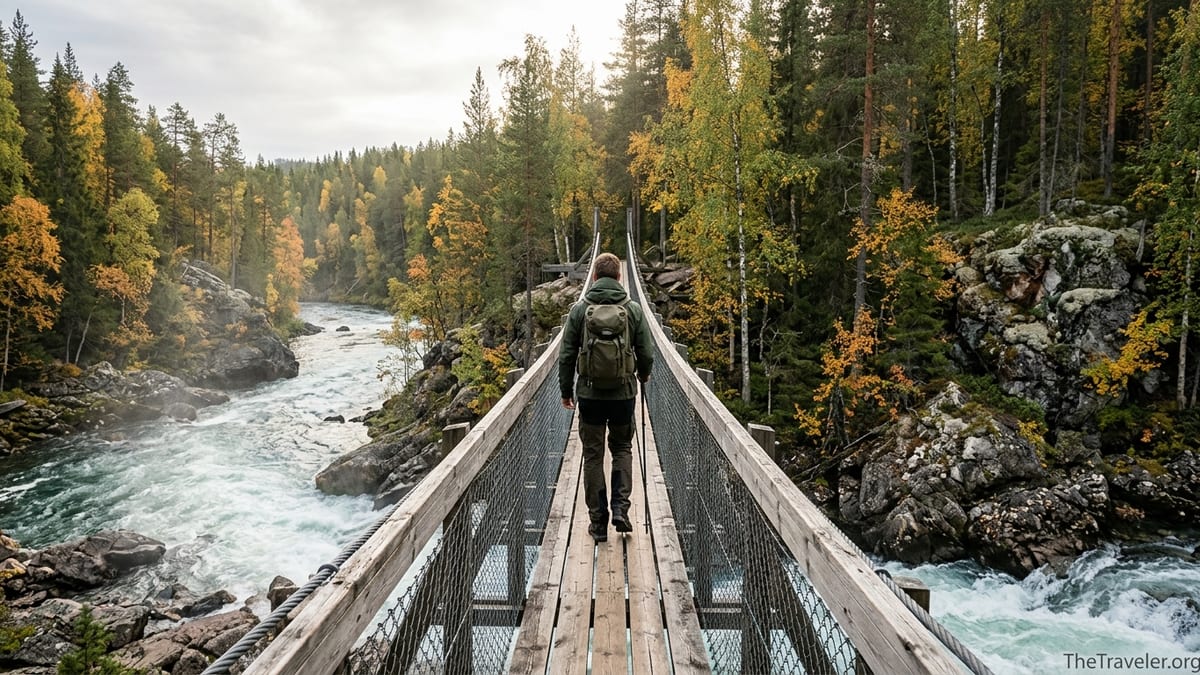
Oulanka National Park lies in northeast Finland, mainly within the municipality of Kuusamo, about 800 kilometers north of Helsinki. For most visitors, the access gateways are the Ruka ski resort area and the small village of Juuma, with Kuusamo Airport serving as the nearest air hub. The park follows the valleys of the Oulankajoki and Kitkajoki rivers, where suspension bridges cross turquoise rapids and steep wooden stairs climb in and out of gorges.
The park covers more than 270 square kilometers, but hikers experience it as a network of well-marked trails, campfire spots, lean-to shelters and wilderness huts. Oulanka is especially famous because much of Finland’s best-known hiking route, the 80-plus kilometer Karhunkierros or Bear’s Trail, runs through it. Day visitors typically sample a small section of this route, while long-distance hikers can spend four to six days crossing the region from hut to hut.
Geographically, Oulanka sits at the meeting point of northern boreal forest and more continental influences from Russia. In practice this means long snow seasons, cool summers that are excellent for hiking, and striking seasonal contrasts. In May you may still find lingering snowdrifts and swollen rivers; in September the birch forests blaze with autumn color; in January only marked winter trails and snowmobile routes are safely passable.
Although the park feels wild, it is not trackless wilderness. Waymarking is generally very clear, with color-coded route markers on trees and posts, frequent signboards at junctions, and maintained structures at rest spots. For most first-time visitors, the challenge is not finding the path, but choosing which of the many options fits their time, experience and gear.
Finding Reliable Maps & Trail Information
The most important planning resource for Oulanka is the official map produced by Finland’s parks authority Metsähallitus. In practice, visitors tend to use two complementary sources: the online Excursion Map, which shows current trail lines and facilities, and printed topographic-style hiking maps sold in outdoor shops around Kuusamo, Ruka and Juuma as well as at Oulanka Visitor Centre. The paper map is convenient if your phone battery drops in cold weather or coverage flickers in deep valleys.
At the Oulanka Visitor Centre, located roughly in the middle of the park, staff can provide up-to-date information on trail conditions, closures and detours. For instance, after heavy spring floods or autumn storms, certain suspension bridges or steep stair sections may be temporarily closed. Staff usually post a noticeboard just inside the entrance describing which segments of Karhunkierros or Pieni Karhunkierros are affected, and they can mark alternatives for you on a paper map in a matter of minutes.
Digital mapping apps popular among hikers, such as Outdooractive, AllTrails and Wikiloc, also host GPS tracks for the main routes. These are useful for visualizing elevation changes and checking distance, but they should be seen as supplements rather than replacements for official information. For example, user-uploaded tracks might still show an older alignment of the Karhunkierros, while the maintained trail has been rerouted away from erosion-prone riverbanks. The safest approach is to cross-check any GPX file with the current park map or the Excursion Map before your trip.
If you plan to hike the full Karhunkierros, it is worth purchasing a dedicated Karhunkierros guide map printed at a relatively detailed scale. Many Finnish hikers carry both this and a smartphone map. In summer, when daytime highs are usually around 15 to 20 degrees Celsius and the sun sets late, it is easy to underestimate how long distances feel when you stop often for photos and river viewpoints. Having clear distance markers on your map helps you decide when to camp and how aggressively to schedule each day.
Key Trails: From Short Walks to the Iconic Karhunkierros
Most visitors start with the park’s flagship day hike, Pieni Karhunkierros, or Little Bear’s Trail. This 12 kilometer loop begins near Juuma village and packs a disproportionate amount of scenery into a relatively short distance: narrow canyons, thundering rapids at places like Myllykoski, multiple hanging bridges and traditional wooden structures that photograph beautifully in any season. Fit walkers typically complete the loop in three to five hours, but many take longer because they stop to shoot the classic view of an old mill house perched above the foaming river.
The full-length Karhunkierros, often translated as Bear’s Trail or Bear’s Ring even though it is not a loop, stretches roughly 80 to 82 kilometers between Hautajärvi in the north and Ruka in the south. Most hikers walk it north to south in four to six days, staying in a mix of free wilderness huts, reservable huts and nearby campfire sites. The route is well signed and not technically difficult, but constant small ups and downs on staircases and roots mean that even experienced hikers usually limit their daily distance to 15 to 22 kilometers. Many combine one rest day in the middle, perhaps spending extra time around Oulanka Canyon or the Kiutaköngäs rapids.
For a shorter overnight outing, a common real-world itinerary is to walk from Hautajärvi to Oulanka Visitor Centre over two days, spending the night at one of the huts or lean-to shelters near the halfway point, then use local transport or a pre-booked shuttle to return. Families with children often opt for a simple out-and-back to Kiutaköngäs from the visitor centre, a route that gives a strong sense of the park’s character without committing to difficult terrain.
In winter, only specific snowshoe and ski routes are maintained. A good example is the Rytisuo snowshoe trail of about 7.5 kilometers, which leads into open aapa mires where visitors can experience the silence of midwinter without having to break their own trail through deep snow. Because daylight is limited and temperatures can fall well below freezing, winter trails are best reserved for those comfortable navigating in snow conditions, ideally with a GPS track in addition to the physical markers.
Visitor Centres, Huts, Campfires and Practical Services
Oulanka Visitor Centre is the park’s main information hub. Here you can pick up free trail leaflets, browse detailed maps, ask about conditions and, in season, enjoy a simple café or restaurant service. Staff can explain how the Finnish hut system works, what is permitted regarding camping, and which rest spots are currently stocked with firewood. In summer and early autumn, they may be able to tell you, for example, that a popular wilderness hut on the Karhunkierros has been particularly busy on recent weekends, in which case carrying a tent becomes especially sensible.
Along the trails you will encounter several types of structure maintained by Metsähallitus. Open wilderness huts are simple log cabins with bunk platforms, a wood-burning stove and an outhouse nearby. They are free to use on a first-come, first-served basis and intended for one-night stays. Reservable huts, which usually require a paid booking in advance through national park services or partner accommodation operators, offer slightly more privacy and predictability. In addition, there are numerous lean-to shelters, campfire sites with picnic tables, and dry toilets positioned at intervals along the main routes.
Fire rules are specific and should be taken seriously. In general, open fires are allowed only at designated campfire sites marked on the official maps, and they are always prohibited when a regional forest fire warning is in force. The person who lights the fire is responsible for ensuring it is fully extinguished before leaving. In practice, this means that in dry summers you may arrive at a picturesque fire ring beside the river but find a notice explaining that no fires are currently permitted. In that situation, a gas camp stove is usually allowed, but campers should verify current guidance from visitor centre staff before relying on it.
Food, fuel and other supplies are not sold inside the hiking area itself, apart from limited snacks or simple meals at the visitor centre or nearby private lodges like Basecamp Oulanka. Most hikers buy groceries in Kuusamo or at a supermarket near Ruka before starting their trek. At current prices, a typical resupply for a four-day hike for two people, including pasta, oats, coffee and basic trail snacks, can easily reach the equivalent of a modest hotel night. Budget-conscious hikers often buy in larger towns such as Oulu or even in southern Finland before traveling north, then top up only fresh items locally.
Seasonal Conditions, Safety and What to Pack
Weather in Oulanka varies dramatically with the seasons, and packing correctly is crucial. From late June to August, daytime temperatures usually sit between about 15 and 20 degrees Celsius, though cold snaps and rain are always possible. Trails are generally dry by July, but boardwalk sections can remain slippery, and rapid snowmelt in May or early June may leave certain low-lying sections muddy or temporarily flooded. During that shoulder season, official updates sometimes mention closed bridges or recommended detours around particularly wet bogs.
In autumn, from late August into September, nights grow colder and frosts become more frequent. This is one of the most beautiful times to hike Karhunkierros, as birch forests shift into yellow and orange and the air becomes clearer. However, evenings are darker, so carrying a reliable headlamp and spare batteries is important. By October, snow is increasingly likely, and in November transitional conditions can be challenging: not enough snow for skis, but enough ice to make roots and rocks treacherous.
Winter usually brings deep snow and temperatures that can plunge well below freezing. Only marked winter trails should be used, and daylight can be as short as a few hours in midwinter. For example, a snowshoe outing that feels leisurely in March, with stronger sunlight and warmer afternoons, could be dangerous in January if you underestimate how quickly temperatures drop and how slowly you move through powder. Winter visitors should pack insulated boots, layered clothing including a windproof shell, spare gloves, and an emergency bivvy bag at minimum.
Regardless of season, several safety basics apply. Good footwear with grippy soles is essential, as much of Pieni Karhunkierros and Karhunkierros involves steep wooden steps that become slick when wet. Trekking poles are highly recommended, especially when descending long staircases near rapids. Because mobile reception can be patchy in river valleys, travelers should not rely solely on a smartphone; a physical map and basic navigation skills remain important. Finally, mosquitoes can be intense in early summer, especially in the more boggy northern sections of the park, so insect repellent and a head net can make the experience far more pleasant.
Access, Transport and Accommodation Around the Park
Most international visitors reach Oulanka via Kuusamo Airport, which has regular flights from Helsinki. From Kuusamo, it is roughly a 40 to 60 minute drive to the main access points near the park, depending on whether you head toward Ruka or Juuma. Many hikers rent a car, finding that it offers the most flexibility for shuttling between trailheads and picking up supplies in town before and after the hike.
Public transport solutions exist but require more planning. In recent seasons, local bus companies and seasonal shuttle services have run routes linking Kuusamo, Ruka, Juuma and the Karhunkierros trailheads, particularly at the beginning and end points in Hautajärvi and Ruka. Schedules can change each year, so hikers should confirm departure times close to their trip dates and build in a buffer day in case a bus runs only once daily. Some visitors choose to start or end their hike at intermediate points where transport is more straightforward, such as near the village of Juuma.
In terms of accommodation, there is a spectrum from full-service hotels to rustic cabins. Ruka offers ski-resort style hotels, serviced apartments and cabins with saunas, which can be very welcome at the end of a long trek. Juuma and the vicinity of Basecamp Oulanka feature smaller guesthouses and nature lodges positioned directly on or near Pieni Karhunkierros, making them ideal bases for day hikes. Prices vary, but in high summer and during autumn foliage season it is wise to book ahead, as both Finnish families and international hikers converge on the region.
For those hiking the full Karhunkierros and relying on huts, it is crucial to understand that open wilderness huts cannot be reserved and may fill up, particularly in July and early August. Sensible practice is to always carry a tent or lightweight shelter so you are not dependent on finding a space indoors. Even in good weather, hut etiquette expects visitors to make room for later arrivals who may be colder, older or less well-equipped, which can mean sharing tight quarters or choosing to pitch a tent outside if the hut feels crowded.
Respecting Nature: Rules, Etiquette and Local Culture
Oulanka National Park is protected both for its landscapes and for its biodiversity, which includes rare orchids, sensitive river ecosystems and old-growth forest communities. Visitors are expected to follow standard Finnish national park rules, which broadly allow hiking and temporary camping in designated areas but restrict activities that would damage nature, such as picking protected plant species, disturbing wildlife or leaving marked trails in certain sensitive zones. Information boards at trailheads and on the park’s official information pages lay out what is and is not allowed in plain language.
Campfire etiquette is especially important. Fires should be lit only at marked sites using the firewood provided, and visitors are expected to conserve wood, splitting only what they need and keeping fires modest. It is good practice to restock kindling and ensure that the next group arriving late has dry small pieces ready to go. During dry periods when an official forest fire warning is issued, all open fires are forbidden, even at established rings, and hikers must rely on camping stoves for cooking.
Hut etiquette follows long-standing Finnish traditions. Space inside open wilderness huts is shared; the first to arrive does not have the right to exclude later arrivals, and beds or bunks are not reserved for friends who are still on the trail. Quiet hours are informally observed, with most people cooking, chatting quietly and then turning in early. Everyone is expected to leave the hut cleaner than they found it: sweeping floors, bringing in additional firewood if possible, and carrying out all rubbish rather than leaving it behind.
Finally, a word on local culture and language: Finnish and Swedish are the official languages in Finland, but in the Kuusamo region most information at visitor centres and on major trail signage is also provided in English. Learning a few simple Finnish words such as “kiitos” for thank you and “mökki” for cottage can be a pleasant icebreaker with local hosts. In remote areas you may also encounter reindeer herding activity; if you meet reindeer on the trail or road, give them space and avoid loud noises or sudden movements.
The Takeaway
Oulanka National Park offers a rare combination of accessibility and wild atmosphere. With clearly marked routes, a dense network of huts and shelters, and famous trails like Pieni Karhunkierros and the Karhunkierros long-distance route, it is an ideal introduction to Finnish hiking for first-time visitors, yet still engaging for experienced backpackers. The key to a successful trip is thorough preparation: obtain current maps and trail updates, match your route to your fitness and experience, and pack for variable weather.
Whether you stand on a suspension bridge above the roaring Myllykoski rapids, watch the midnight sun gild the tops of birch trees in July, or break trail through fresh March snow on a winter route, Oulanka leaves strong sensory memories. By respecting local rules, treating huts and campfire sites with care, and traveling with realistic expectations about distances and conditions, you help ensure that this landscape remains as unspoiled for future hikers as it feels today.
FAQ
Q1. Do I need a permit to hike in Oulanka National Park?
In most cases you do not need a permit to hike the marked trails or to walk the full Karhunkierros. However, organized commercial groups require separate agreements with the park authority, and specialized activities such as research or filming may need permits. Always check the latest official guidelines if your plans go beyond normal hiking.
Q2. How difficult is the Pieni Karhunkierros trail?
Pieni Karhunkierros is moderate rather than easy. The 12 kilometer loop includes several steep wooden staircases, uneven roots and a few exposed sections near cliffs and rapids. Most reasonably fit hikers can complete it in three to five hours, but anyone with knee issues or very young children should allow extra time and use trekking poles for stability.
Q3. How many days should I plan for the full Karhunkierros route?
The approximately 80 to 82 kilometer Karhunkierros typically takes four to six days to walk, depending on fitness and daily distances. Many hikers aim for roughly 15 to 20 kilometers per day, with one shorter day in the middle to enjoy viewpoints and rest. Fast, experienced hikers may complete it in fewer days, but most visitors find a slower pace more enjoyable.
Q4. Can I camp anywhere in the park?
Camping is generally allowed only at designated camping areas, lean-to shelters and near huts indicated on official maps. In some parts of the park, such as sensitive riverbanks and strictly protected zones, camping is not permitted. Because regulations and recommended sites can change, it is wise to confirm current rules and suggested camping spots at the Oulanka Visitor Centre before starting your hike.
Q5. Are there bears or dangerous animals in Oulanka?
Large carnivores like bears and wolves exist in the broader region, but sightings on the main hiking routes are uncommon and true incidents involving hikers are very rare. More typical wildlife concerns are mosquitoes in early summer and, in some areas, ticks. Standard precautions such as wearing long sleeves and checking your body after hiking in tall grass are usually sufficient.
Q6. What is the best time of year to visit Oulanka for hiking?
The main hiking season runs from late June to September, when most trails are snow-free and all services are operating. July and early August are the warmest and busiest months. Many experienced hikers consider late August and early September ideal, as temperatures are cooler, bugs are fewer and autumn colors begin to appear, though nights are darker and cooler.
Q7. Is Oulanka suitable for families with children?
Yes, with careful trail selection. Shorter routes from the Oulanka Visitor Centre, as well as limited sections of Pieni Karhunkierros near Myllykoski, can be excellent day outings with school-age children. Parents should pay close attention near rivers and cliffs, as there are steep drops, and be prepared to turn around if weather or fatigue make the route feel too demanding.
Q8. Can I hike in Oulanka during winter?
Winter hiking is possible but conditions are challenging and best suited to those with experience in cold environments. Only marked winter routes should be used, typically on snowshoes or skis, and proper winter gear is essential. Daylight is short in midwinter, and temperatures can drop far below freezing, so many visitors prefer late winter or early spring, when days are longer and temperatures milder.
Q9. What navigation tools should I bring?
At minimum, bring a current paper hiking map of Oulanka or Karhunkierros and a compass, even if you rely mainly on a smartphone. Download offline maps from your preferred app before arriving, and carry a power bank, as cold temperatures drain batteries faster. Trail markings are generally excellent, but fog, snowfall or fatigue can make junctions confusing, so having backup tools is prudent.
Q10. Where can I buy food and supplies before entering the park?
Most visitors stock up in Kuusamo, which has supermarkets, outdoor shops and fuel stations, or at smaller stores in the Ruka area. Around Juuma and near the park edges there are only limited services, such as small cafés, guesthouses or lodges. Plan to purchase the bulk of your food and gas canisters in Kuusamo or another larger town before traveling to the trailheads.