


I grew up tracing the Arctic Circle as a thin blue band on classroom globes, a faraway line that separated the familiar world from a mysterious one of midnight sun and polar night. Years later, when I finally stepped across that invisible boundary for the first time, it felt surprisingly concrete. Crossing the Arctic Circle was not just a change in latitude. It was a travel milestone that rearranged my sense of distance, light and scale, and it is one I will never forget.
Get the latest updates straight to your inbox!
Meeting the Arctic Circle in Real Life
The Arctic Circle is not a mythic border drawn by storytellers. It is a line of latitude, currently sitting at about 66 degrees 33 minutes north, that encircles the top of the planet. North of it, there are at least some days each year when the sun never sets in summer and never rises in the depths of winter. That simple fact is what turns a cartographer’s curve into a life goal for many travelers.
What I did not appreciate until I went north myself is that the Arctic Circle is also a living place. It cuts across forests, fishing villages and highways. It runs through Rovaniemi in Finnish Lapland, where a white stripe painted across the central square of Santa Claus Village marks the spot where you officially “enter” the Arctic. It slices through northern Sweden, where the night train rolls past a sign on the trackside in the spruce forest. It even passes over a tiny Icelandic island called Grímsey, where a concrete sphere on a windswept headland marks the circle’s current position.
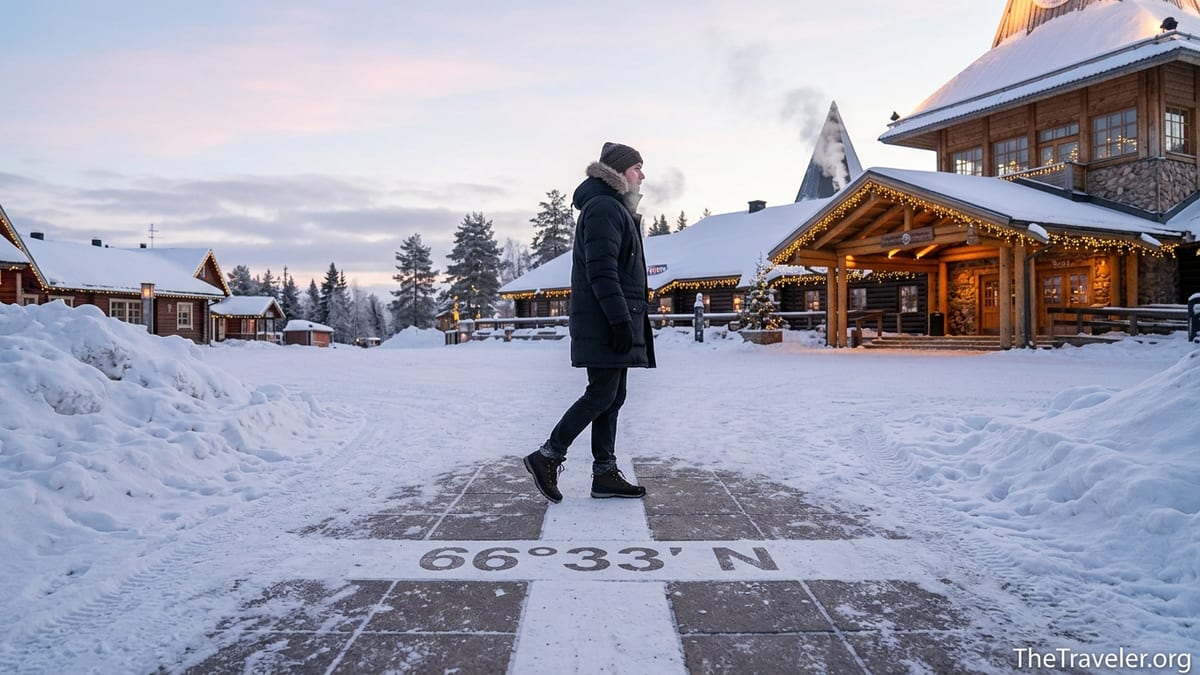
My first crossing happened on the outskirts of Rovaniemi on a cold November morning. Snowflakes hung in the air like static and the daylight felt pewter and thin. The Arctic Circle line at Santa Claus Village looked almost comically simple: just a wide band of white tiles in the snow, latitude 66°33′ printed in bold black letters. Yet walking over it felt momentous, like stepping through an unmarked doorway into another chapter of the planet.
That moment crystallized what the Arctic Circle really is for travelers. It is not an attraction in itself so much as a threshold. On one side, the rhythms of daylight and darkness behave more or less as expected. On the other, time and light twist into new patterns that change how you plan your days, how you sleep, even how you feel the passing of time.
First Crossing: A Snowy Line Outside Rovaniemi
Rovaniemi markets itself as the Official Hometown of Santa Claus, and Santa Claus Village, about eight kilometers north of the city, is built right on top of the Arctic Circle line. The village can feel unapologetically commercial, with souvenir shops selling reindeer hides and Christmas ornaments twelve months a year, but it is also one of the most accessible places in the world to physically stand on that famous latitude.
I arrived on a local bus that runs between Rovaniemi’s compact center and the village, a journey of roughly 15 to 20 minutes depending on winter traffic. Families with children in bright snowsuits filled most of the seats, clutching plush reindeer they had already bought in town. As we pulled into the village, the Arctic Circle line cut through the snow like a runway marker, flanked by low timber buildings and strings of warm yellow lights.
There is something disarming about how everyday the line feels. It crosses the central square, runs past Santa’s Main Post Office, and continues right through a café terrace, so that you can theoretically sip a hot chocolate with your boots in two different climate zones. The official line here corresponds to the historical position of the Arctic Circle in the 19th century, while the true astronomical circle has shifted slightly north over time. The difference is a few hundred meters, hardly noticeable under fresh powder, but it is a good reminder that this boundary is tied to the slow wobble of the Earth, not to the foundations of the gift shops.
I joined a small crowd waiting their turn to take the classic photograph: one foot on each side of the painted line, a grin on your face, the words “Arctic Circle” at your feet. A staff member was quietly offering printed certificates nearby, the kind you can buy as proof that you have crossed. Many travelers leave with a stamped postcard from Santa’s post office, timed to arrive back home just before Christmas. It is unabashedly touristy, yet beneath the commercial layer I could feel the weight of the latitude itself. When I finally stepped across, the snow squeaking under my boots, I felt the same mix of disbelief and satisfaction I had felt touching the equator monument in Ecuador. The planet suddenly felt smaller and stranger, all at once.
Crossing by Sea: The Hurtigruten Ceremony
My second crossing of the Arctic Circle was far more theatrical. Months after Rovaniemi, I boarded a Hurtigruten coastal ship in Trondheim, Norway, for the classic voyage up the Norwegian coast. Sometime between the port towns of Nesna and Ørnes, the ship would pass 66°33′ north at sea, near a tiny islet called Vikingen crowned with a globe monument. The crew promised a traditional Arctic Circle ceremony on deck when we reached the line.
On the morning of the crossing, the sky above the Helgeland coast was a silver bowl, low and unbroken, and the sea was glassy. Loudspeakers crackled to life in three languages, announcing that we were about to enter the Arctic. Passengers surged to the open decks in down jackets and wool hats, breath steaming in the air, cameras ready. The captain slowed the ship as the Vikingen monument slid past, its metal globe stark against the slate water.
Then came the ritual. A crew member dressed as a kind of Arctic monarch appeared, flanked by sailors carrying a tub of shaved ice taken from the ship’s own fish hold. One by one, we were invited to kneel and have a ladleful of freezing seawater poured down the back of our necks “to earn the right” to sail this far north. The shrieks that followed were half shock, half delight. Someone handed around tiny paper cups of hot lingonberry juice, and the cold sting slowly turned into a pleasant burn.
Part of me knew this was a choreographed performance for visitors, a playful echo of older maritime traditions that marked important latitudinal crossings with elaborate ceremonies. Yet it was effective precisely because the crossing was real. At that moment the ship’s GPS showed the numbers ticking past 66°33′. The captain sounded the whistle and hurtling through the wind I felt the same sense of having stepped across a threshold, this time without setting foot on land.
Seeing the World Differently After the Line
Long after those first crossings, the Arctic Circle has lingered in my mind less as a dot on a map and more as a shift in how I think about distance and light. Before traveling north, the planet felt abstractly round. Afterward, it felt tangibly tilted. In winter in Rovaniemi, the sun barely skimmed the horizon even at noon, tinting the snow a kind of permanent twilight blue. In coastal Norway, I returned in June to find the opposite: a midnight sun that refused to sink, the sky hovering in perpetual golden hour around Tromsø and Bodø.
These experiences directly stem from that simple line. Maps explain that above the Arctic Circle you get at least one full day of winter darkness and one of summer light, but they do not convey how that actually feels in your body. The first time I walked back to my guesthouse in Rovaniemi at 3 p.m. and realized it was already full night, something shifted. The day seemed to evaporate, replaced by long hours indoors and the quiet hum of saunas and cafés. In summer, by contrast, I watched children kicking a football on a beach north of Lofoten at midnight in bright sunshine, as if time had let go of its usual rules.
Crossing the Arctic Circle also rearranged my personal map of the world. Distances I had once thought of as extreme suddenly felt navigable. Rovaniemi, with its regional airport and frequent flights to Helsinki, did not feel remote at all. Night trains from Stockholm to Swedish Lapland, rolling past the Arctic Circle marker just north of Jokkmokk, turned the idea of the far north into something reachable in a single continuous journey. It became clear that “far away” is often more about mindset than miles.
Perhaps the most lasting impact, though, has been psychological. Standing north of the line made the planet’s fragility impossible to ignore. The Arctic is warming faster than the global average, a fact you can feel even in small moments: rain falling instead of snow in early winter in Lapland, locals in Rovaniemi commenting on thinner lake ice, news reports about unusual heat waves reaching the Arctic coast. The line I had traveled so far to cross will not move because of climate change, but the world it encircles is changing rapidly, and that knowledge now travels with me.
Practical Ways to Reach the Arctic Circle
For travelers who want to turn the Arctic Circle from an idea into a memory, there are several practical, well established routes. In Finland, the easiest entry point is Rovaniemi. From Helsinki, regular direct flights take about one hour and fifteen minutes, and overnight trains operated by VR, Finland’s national rail company, run north with sleeper cabins that let you arrive at the edge of the Arctic well rested. Once in Rovaniemi, the Santa Claus Village lies a short bus or taxi ride away, and you can cross the painted Arctic Circle line in a single winter afternoon before returning to the city for dinner.
In Sweden, the legendary night train to the far north offers another way to cross. Services from Stockholm up to Kiruna and further into Swedish Lapland typically pass the Arctic Circle marker near Jokkmokk. On board, you can book a simple seat or upgrade to a sleeping compartment with bunks and shared or private facilities, turning the crossing into part of a seamless slow-travel experience. On clear winter nights, passengers sometimes spot the glow of the northern lights outside the window somewhere north of the line.
Norway offers perhaps the most dramatic approach by sea. The classic coastal voyage, operated by companies such as Hurtigruten and Havila Voyages, runs daily between Bergen and Kirkenes. Somewhere on the third day northbound, the ship crosses the Arctic Circle off the Helgeland coast, often marked with an announcement, a ceremonial splash of cold water, and drinks on deck. While these voyages are not inexpensive, they roll accommodation, transport and Arctic scenery into one moving platform that carries you well beyond the circle to ports like Svolvær, Tromsø and Honningsvåg.
More adventurous travelers can seek out lesser known crossings. In Iceland, domestic flights reach the small island of Grímsey from Akureyri, and ferries run seasonally, allowing visitors to walk along a path dotted with concrete spheres showing the approximate position of the Arctic Circle for different years. In North America, driving the Dalton Highway in Alaska or the Dempster Highway in Canada brings you to simple roadside signs where the circle intersects the road. In both cases, services are limited, distances are long and conditions can be harsh, so these routes require careful planning, appropriate vehicles and genuine respect for the environment.
Making the Most of Your Arctic Circle Moment
The moment you physically cross the Arctic Circle can pass in seconds. A train threads past a sign in the forest, a bus rolls over a line of paint, a ship glides past a metal globe on a rocky islet. What turns that instant into a lasting milestone is the context you build around it. Spending at least a couple of days on either side of the line, rather than rushing in and out for a single selfie, lets you feel the shift in light, temperature and daily life more deeply.
In Rovaniemi, that might mean combining a visit to Santa Claus Village with time at the Arktikum museum in the city center, where exhibitions delve into Arctic cultures, climate and history. You can stand on the line in the morning, then spend the afternoon learning about Sámi reindeer herding or the science behind the northern lights. In coastal Norway, it might mean planning the Hurtigruten crossing as part of a longer trip that includes a few nights in Tromsø or the Lofoten Islands, where you can hike under the midnight sun or chase auroras on crisp winter nights.
The practical details also matter. Winter crossings require serious respect for the cold, particularly if you are planning outdoor activities around the line. In November in Rovaniemi, I was grateful for thermal base layers, insulated boots and hand warmers just to stand outside on the square for half an hour. At sea, windchill on the open decks can make temperatures feel far lower than the forecast suggests. Booking flexible tickets and leaving buffer time is wise too, as winter conditions can affect trains, flights and buses more easily in the north.
Finally, it is worth thinking about your footprint. Many Arctic Circle experiences now incorporate sustainability measures, from coastal ships that use cleaner fuels to resorts that encourage guests to conserve energy and respect wildlife. As a visitor, choosing locally owned accommodations where possible, supporting responsible tour operators and following local guidelines on everything from snowmobile routes to reindeer encounters all help ensure that the milestone you are celebrating does not contribute to the erosion of the environment that makes it special.
The Takeaway
Crossing the Arctic Circle is not like arriving at a single, iconic monument. It is more subtle and, in many ways, more profound. You might mark it with a splash of icy seawater on the deck of a Norwegian ship, a family photograph on a painted line outside Rovaniemi, or the quiet blink of a GPS screen on a train cutting through Swedish forest. However you reach it, the moment lodges in your memory because it represents a tangible encounter with the shape and tilt of the Earth.
For me, the Arctic Circle transformed from an abstract classroom fact into a lived experience. It recalibrated my inner map, made the extremes of light and dark feel real in my bones, and sharpened my awareness of a region that is warming and changing before our eyes. Years later, I can still picture the white band of tiles in the Lapland snow and the steel globe on the Viking coast, and I can still feel the small, private jolt of stepping over them. If you are looking for a travel milestone that stays with you long after the photographs fade, crossing the Arctic Circle belongs near the top of your list.
FAQ
Q1. What exactly is the Arctic Circle and why does it matter for travelers?
The Arctic Circle is a line of latitude currently near 66°33′ north. North of it, there are days each year when the sun never sets in summer and never rises in winter. For travelers, crossing it means entering a region where daylight behaves in unusual ways and where polar environments and cultures are part of everyday life.
Q2. Where is the easiest place to cross the Arctic Circle for a first-time visitor?
One of the most convenient spots is Santa Claus Village just north of Rovaniemi in Finnish Lapland. It sits directly on the Arctic Circle line, is close to a regional airport and train station, and has clear signage, visitor facilities and year-round activities that make a short visit easy to plan.
Q3. Is visiting the Arctic Circle in winter too harsh for most travelers?
Winter conditions can be very cold, with short days and snow or ice, but many crossings are designed for visitors and are quite manageable with proper clothing and realistic expectations. Places like Rovaniemi, Tromsø and Kiruna have winter-ready infrastructure, heated indoor spaces and guided activities that help you experience the Arctic safely.
Q4. Can I see the northern lights as soon as I cross the Arctic Circle?
Crossing the line does not guarantee northern lights, which depend on solar activity, clear skies and darkness. However, many destinations just north of the Arctic Circle, such as coastal Norway, Finnish Lapland and Swedish Lapland, lie under favorable aurora belts, so spending several nights there in winter significantly improves your chances.
Q5. How expensive is it to travel to the Arctic Circle?
Costs vary widely. A simple day trip by bus from Rovaniemi to the Arctic Circle line can be relatively affordable, while multi day coastal cruises in Norway or remote overland drives in Alaska and Canada are more costly. Planning shoulder season travel, booking trains instead of short flights where possible, and choosing modest guesthouses can keep budgets under better control.
Q6. Do I need special permits or visas to cross the Arctic Circle?
There are no special permits required just to cross the Arctic Circle itself. You only need to meet the usual entry requirements for the country you are visiting, such as visas for Finland, Norway, Sweden, Iceland, Canada or the United States if they apply to your nationality.
Q7. Is the Arctic Circle line I see at visitor sites the exact scientific position?
Often the line marked at visitor centers corresponds to the position of the Arctic Circle at a certain date in the past. Because the Earth’s axial tilt shifts slightly over time, the theoretical circle moves gradually. The difference is usually only a few hundred meters, so for travel purposes the marked lines are close enough to the current position.
Q8. What should I pack for a trip to the Arctic Circle in winter?
Layers are essential. A moisture wicking base layer, warm mid layer such as fleece or wool, and a windproof, insulated outer layer work well. Add insulated boots, warm socks, gloves or mittens, a hat that covers your ears and a buff or scarf. Hand warmers and traction aids for icy sidewalks can also be helpful.
Q9. Can I cross the Arctic Circle on a budget without expensive tours?
Yes. Using regular trains or buses to reach towns near the line, staying in hostels or simple guesthouses, and focusing on free experiences like walking across the Arctic Circle marker, exploring local trails and visiting public viewpoints can keep costs down. Many museums charge modest entry fees compared with guided excursions.
Q10. Why do so many travelers describe crossing the Arctic Circle as a milestone?
For many people, the Arctic Circle represents the edge of the familiar world, a boundary associated with polar night, midnight sun and remote wilderness. Physically crossing it turns a concept from school atlases into a lived memory and often changes how travelers think about distance, climate and the planet as a whole, which is why it feels like a genuine milestone.