


More news on this day
Delta Air Lines says it has restored an automated system used to calculate aircraft weight and balance after a technical failure on November 22 caused widespread delays at its Atlanta hub and across the United States at the start of the busy Thanksgiving travel period, leaving many passengers facing long waits, missed connections and lingering knock-on disruptions into the following days.
Get the latest news straight to your inbox!
What happened to Delta’s system and how operations were affected
According to statements from Delta and the Federal Aviation Administration, the disruption on Sunday, November 22, centered on an automated system that calculates the weight and balance of departing aircraft. Airlines rely on this software to combine passenger, baggage, cargo and fuel information into a final load sheet that confirms a plane is within safe operating limits. When the system malfunctioned, Delta said it switched to manual workarounds while technicians worked to restore automation.
The outage primarily affected flights at Hartsfield-Jackson Atlanta International Airport, Delta’s largest hub and the world’s busiest airport by passenger numbers, but delays spread across the carrier’s domestic network as aircraft, crews and passengers missed scheduled connections. Data cited by multiple outlets showed that by Sunday afternoon roughly half of Delta’s flights were running late, with more than 1,000 departures and arrivals affected at Atlanta alone and total Delta delays exceeding 1,600 flights across the system.
To manage congestion while teams reverted to manual processes, Delta requested a temporary ground delay program for some flights into Atlanta. The FAA said this ground delay, which staggered inbound departures from other airports, lasted for about an hour before being lifted once the airline could process more departures and the backlog eased. Regulators stressed that the problem was confined to Delta’s systems and was not related to earlier FAA network issues that had caused a nationwide ground stop on November 13.
Timeline of the disruption and system restoration
Passengers and airport monitors began reporting mounting delays on Sunday morning as early departures from Atlanta and other Delta stations pushed back from the gate later than scheduled or held at the gate awaiting final load information. By late morning, the airline confirmed that an issue with its weight-and-balance automation was affecting its operation and that teams were using manual procedures while working to restore the system.
Midday Sunday, the FAA issued the Atlanta-specific ground delay program at Delta’s request. This meant some flights bound for the hub were held at origin airports for set periods before being cleared for departure, to prevent arriving traffic from overwhelming gate space and ground resources. While essential for safety and flow, these measures added secondary delays away from Atlanta as aircraft and crews remained out of position for subsequent flights.
By Sunday afternoon, Delta said the automated system had been restored and the ground delay program ended. Flight tracking data and subsequent airline updates indicated that operations gradually improved into Sunday evening. However, the scale of the disruption meant that residual delays and knock-on impacts carried into Monday and, on some routes with tight aircraft rotations, into Tuesday, November 24. Travel industry analyses noted that while Delta’s schedule returned largely to normal by midweek, some passengers continued to deal with rebooked connections and delayed baggage.
Impact on travelers at Atlanta and across the U.S.
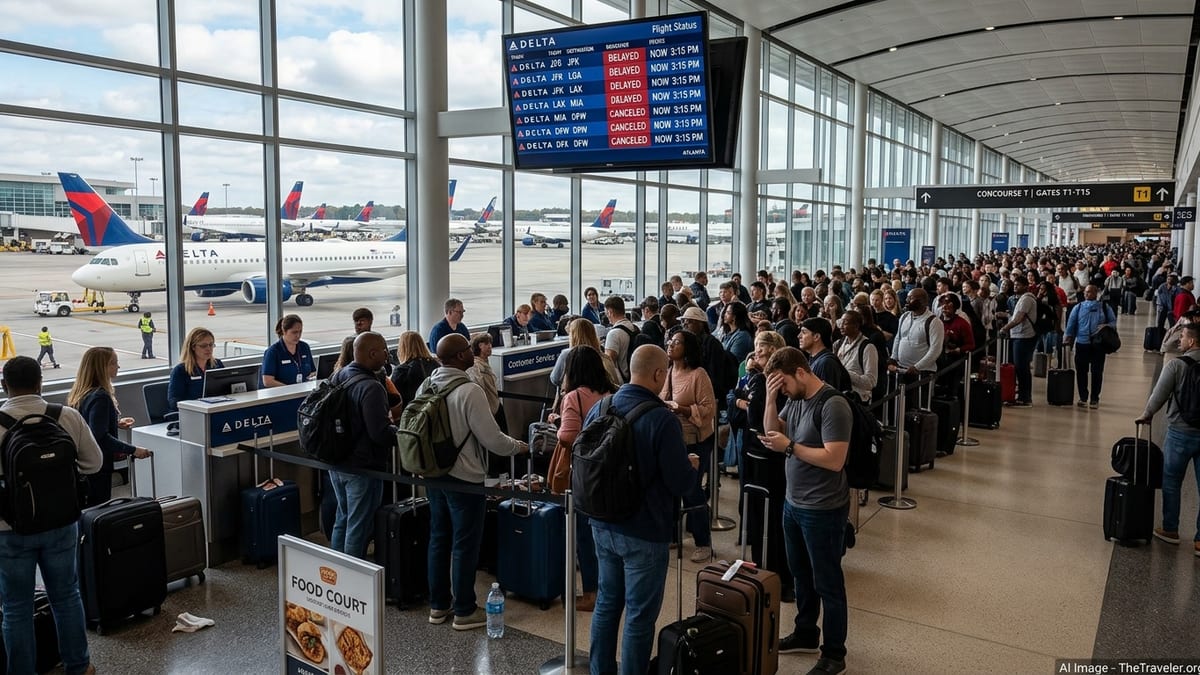
The timing of the outage, at the outset of the Thanksgiving travel period, magnified its effect on passengers. Atlanta is a central connecting hub for Delta, so even travelers whose journeys did not start or end there were often routed through the airport. As weight-and-balance calculations were processed manually and inbound flights were metered, customers reported long waits on the ground before takeoff, extended lines at customer service desks, and tighter or missed connections.
At the height of the disruption, many travelers arriving into Atlanta found that their onward flights were already delayed or had departed, prompting same-day rebookings where seats were available and, in some cases, overnight stays. Some passengers reported being rerouted through alternative hubs such as Detroit, Minneapolis–St. Paul or Salt Lake City to bypass Atlanta’s congestion once seats opened up on other routes. Others opted to cancel trips or switch to other airlines when that was a practical option.
While the problem originated with the automation used for weight-and-balance data, the impact extended to baggage handling and airport staffing because delayed departures and arrivals ripple through every part of an airline’s operation. Delta acknowledged that its baggage network faced added strain, and some customers experienced delayed or misrouted luggage as aircraft rotations changed. The disruption also hit crews, with pilots and flight attendants sometimes timing out under duty regulations if delays pushed them beyond allowable working hours, which in turn forced additional cancellations or substitutions.
How the Delta issue fits into a broader run of U.S. aviation glitches
Delta’s system failure came less than ten days after a nationwide ground stop on November 13 triggered by a technical problem in the FAA’s air traffic control network. That event, which affected multiple airlines, led to more than 17,000 canceled or delayed flights over several days as carriers worked to reposition planes and crews once the ground stop lifted. In the days that followed, United Airlines experienced its own technology outage affecting weight information for departing aircraft, causing delays on November 16 before service was restored.
Together, these incidents highlight the growing dependence of U.S. air travel on complex, interconnected digital systems. Airlines and the FAA rely on a patchwork of automation tools for flight planning, crew scheduling, weight-and-balance calculations and baggage routing. When one element fails, the ensuing disruption can quickly spread across a carrier’s network or, in the FAA’s case, the entire national airspace system. Industry groups and policymakers have pointed to these events as further evidence that both government and airlines need to accelerate investment in modernizing aging infrastructure and building more redundancy into critical systems.
For Delta, the November 22 event follows a series of technology-related issues in recent years, including substantial disruption linked to a global IT outage in July 2024 that hit multiple airlines. Public filings from the carrier have since flagged dependence on technology, vulnerabilities in information systems and the risk of third-party service failures as key business risks. While Sunday’s outage was shorter and more contained than the 2024 disruption, it underscored how even a single internal system failure can significantly affect passengers, especially during peak travel periods.
What travelers should do now and ahead of future peak periods
Delta’s automated weight-and-balance system is now back in service, and both the airline and independent tracking data indicate that its flight schedule has largely normalized in the days since the outage. Travelers flying in the aftermath, particularly on routes touching Atlanta, were advised to expect residual delays into at least Tuesday, November 24 as aircraft and crews returned to their intended positions. By late week, the carrier was operating close to its planned timetable, with weather once again becoming the main driver of day-of-travel disruptions during the Thanksgiving rush.
Customers who experienced significant delays or missed connections because of the November 22 outage can review Delta’s current customer service policies for options such as rebooking, travel credits or reimbursements for certain out-of-pocket expenses. In previous technology disruptions, Delta has provided waivers and compensation in specific circumstances, but eligibility depends on ticket type, route, and how the delay was handled, so travelers should consult the airline directly and retain receipts for any additional costs incurred.
Looking ahead to the rest of the holiday season, passengers across U.S. airlines may want to build more buffer time into their plans. Recent events at Delta, United and the FAA show that unplanned technology failures can coincide with busy travel days, amplifying the effect on individual trips. Travelers connecting through large hubs like Atlanta can reduce risk by allowing longer connection windows where possible, monitoring flight status early and often on airline apps, and considering early-morning departures, which tend to be less affected by same-day knock-on delays. While no traveler can fully avoid the impact of sudden system outages, these steps can make it easier to adapt quickly if schedules change with little warning.