


More news on this day
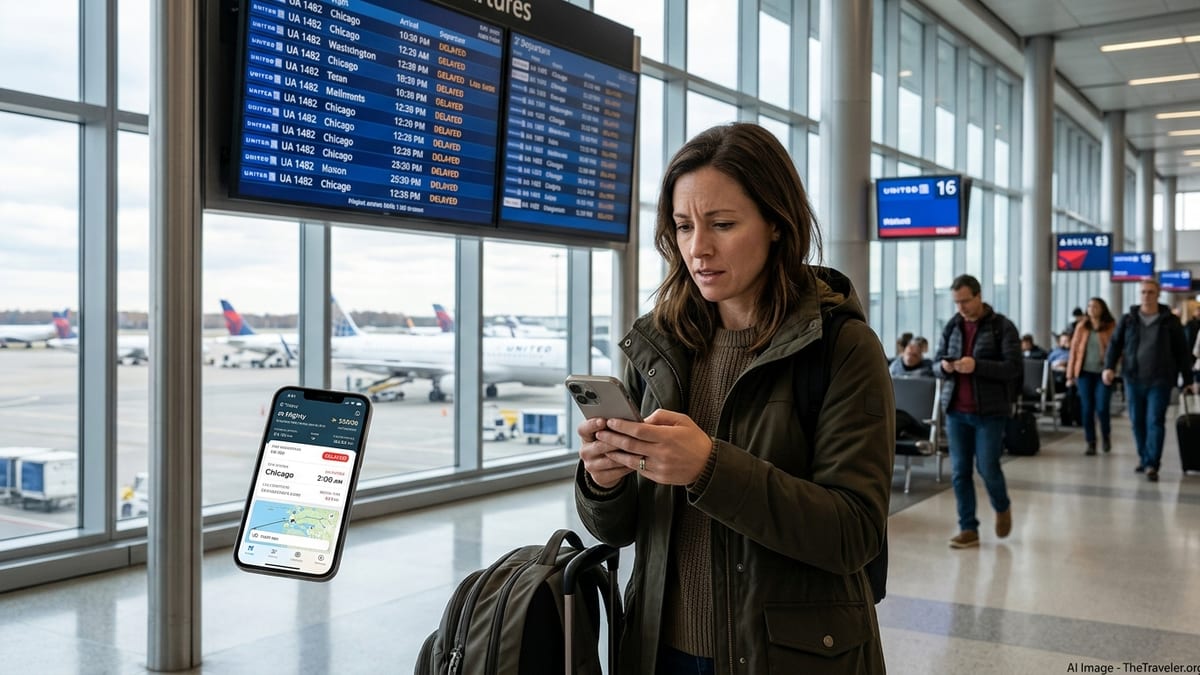
With U.S. airlines again bracing for heavy Thanksgiving traffic and a significant share of flights arriving late, travelers are increasingly turning to specialist apps and official data tools that can flag delays, bottlenecks and long security lines before they even leave home.
Get the latest news straight to your inbox!
Why early delay warnings matter more in 2026
Thanksgiving 2026 is set to be one of the busiest U.S. holiday travel periods in recent years, with industry data showing that roughly a quarter of flights during last year’s November and December holidays arrived at least 15 minutes late. Those delays did not always stem from bad weather at a passenger’s departure airport. Congestion and storms hundreds of miles away created knock-on effects across the network, meaning travelers could face disruption even when skies looked clear where they were departing.
The experience has underscored how quickly problems can spread through the national airspace system. A rare nationwide ground stop earlier this month and a separate outage that temporarily halted flights into Atlanta highlighted the risk of large-scale disruption triggered by technical issues, not just weather. For travelers, the practical question is how to see signs of trouble as early as possible, particularly when they are relying on tight connections or flying through major hubs at peak periods.
Airlines and airports provide basic status updates through their own apps and websites, but several independent tools now aggregate multiple data feeds or crowd reports to offer more granular, traveler-focused information. These services cannot prevent a delay, and their forecasts are not guarantees, but they can give passengers a clearer picture of what is happening beyond the departure board in the terminal.
Flighty: tracking inbound aircraft and predicting likely delays
One of the most widely used specialist tools among frequent flyers is Flighty, a flight tracking app for Apple devices that focuses on fast alerts and predictive information. According to its App Store listing and recent product updates, Flighty combines official air-traffic data, airline information and machine learning to detect potential trouble long before some carriers issue a formal delay or cancellation notice.
Travelers add an upcoming itinerary or flight number, and the app automatically tracks the specific aircraft scheduled to operate that service. If the inbound aircraft is running behind on an earlier leg, Flighty estimates the likely knock-on effect for the next departure, including a predicted delay and, when available, an explanation such as late inbound aircraft, air traffic control restrictions or weather-related constraints. Recent updates have also added an “Airport Intelligence” view summarizing delays and trends at a given airport and a “When to Leave” feature that factors in typical processing times and road traffic when suggesting when to head to the airport.
Flighty remains limited to Apple’s ecosystem. It is currently available on iPhone, iPad, Apple Watch and Mac, and there is no Android version. While the app offers basic tracking and some historical data for free, real-time delay predictions, detailed explanations and the fastest alerts are reserved for paying subscribers. The company continues to promote a free trial of those premium features on a traveler’s first tracked flight, which can be useful for passengers who only occasionally fly over the holidays but want more detailed monitoring for a single critical journey.
Flightradar24: real-time disruption picture at major airports
For a wider view of where problems are building up in the network, travelers often turn to Flightradar24. Best known for its global map of aircraft in near real time, accessible through both mobile apps and a web browser, the service also maintains a live “airport disruption” page that can be particularly useful around Thanksgiving.
The disruption map ranks major airports using a composite index based on the share of flights that are delayed or cancelled and the average delay length. For each airport, it reports recent departure performance, the proportion of flights running late, average delay times and the share of cancellations. Because the data are updated frequently, passengers connecting through a hub can see whether an airport is running relatively smoothly or facing significant congestion before they land or even before they leave home.
Flightradar24’s core map functions are available on both iOS and Android and through standard web browsers, while the disruption index remains a web-based feature. Travelers can tap on individual aircraft to see where a plane is coming from, its route and schedule, but for most Thanksgiving passengers the most practical use is checking the current status of departure or connection airports on the disruption map, then cross-checking that picture with airline alerts and official airport messages.
Checking security lines: crowd-sourced tools and official TSA data
Delays at the gate are not the only concern during peak holiday periods. Getting through the security checkpoint can be unpredictable, particularly in the early morning and late afternoon peaks when many Thanksgiving travelers depart. Several tools now attempt to give passengers at least a general sense of current conditions, but each has limitations that travelers should understand before relying on them.
The U.S. Transportation Security Administration’s own MyTSA app remains the primary federal source for both historical and crowd-sourced wait time information. The app shows recent and user-reported security checkpoint waits at selected airports in broad time bands, as well as TSA PreCheck lane availability at different terminals. Because the data depend on voluntary reports from travelers and are not a live measurement from TSA’s systems, coverage can be patchy at quieter airports or outside the busiest times of day, and estimates may lag actual conditions when lines build quickly.
Independent crowd-sourced tools have also appeared in recent years, following a similar model in which passengers who have just cleared security report how long they waited and share that information for free. One such service is DeLayze, a website set up during a previous period of extended TSA wait times that invites travelers to report the time it took them to pass security at airports around the United States. As with MyTSA, the usefulness of DeLayze depends on how many recent reports a given airport has. Some major hubs see regular input at peak seasons, but other airports may show no up-to-date submissions at all, which means the site should be treated as a supplementary guide rather than a definitive source.
FAA National Airspace System Status: official view of ground stops and delays
Behind the scenes, the Federal Aviation Administration’s Air Traffic Control System Command Center manages traffic flow across the country, issuing ground delay programs, ground stops and other restrictions during periods of heavy demand or bad weather. The agency publishes a near real-time view of these measures through its National Airspace System Status portal, which draws on the same Operational Information System used by dispatchers and pilots.
The site presents a dashboard of key constraints, including current ground stops, airports operating under ground delay programs, airspace flow programs and significant weather impacts. A tabular “list view” allows users to see which airports are affected, the average delay for arriving flights and, where applicable, the reasons for restrictions such as thunderstorms, low visibility or volume-related congestion. Because this is an operational tool created for aviation professionals, the terminology can be technical, but for travelers it provides a direct source for confirmed, system-wide measures that will almost certainly impact flight times.
For Thanksgiving travelers, the FAA portal is most useful when used alongside consumer-focused apps. If Flighty or a similar app signals a likely delay due to air traffic control restrictions, checking the FAA’s status page can confirm whether a ground delay program or ground stop has been formally put in place at the origin or destination airport. It also helps explain why a flight is being held even when local weather appears favorable, as the constraint may be in en route airspace or at a downstream hub that is necessary for connections or aircraft rotations.
How travelers can use these tools without missing their flight
While these services can offer earlier warnings and additional context, they are not a substitute for an airline’s own instructions. Schedules can change quickly, particularly during busy holiday periods, and aircraft or crew can be reassigned at short notice. Airlines may resolve an expected delay by switching aircraft, adjusting routings or revising crew pairings, which means a departure that looked significantly delayed an hour earlier can move back toward its original time.
For that reason, travelers are still advised to follow the official check-in and arrival guidance issued by their airline and airport, even when a third-party app predicts that a flight will depart late. The most practical use of Flighty and similar tools is to give passengers more time to consider contingency plans once a disruption becomes likely, not as a justification to arrive at the airport late. When a significant delay appears probable, traveler options can include monitoring alternative departures on the same day, identifying later connections that might be rebooked, or contacting the airline earlier than other passengers to discuss re-routing.
Looking ahead to the rest of the Thanksgiving period, travelers planning to fly should ensure that they have at least one reliable source of airline-issued alerts, such as the carrier’s own app, SMS notifications or email updates. Adding a specialist tool for delay predictions, checking Flightradar24’s disruption map for hub performance, consulting TSA or crowd-sourced wait time estimates before leaving for the airport, and reviewing the FAA’s national status page when major storms or technical issues hit can all help passengers make more informed decisions. None of these tools can guarantee an on-time departure, but taken together they provide a more complete, real-time picture of the pressures on the U.S. air travel system during one of its busiest weeks of the year.