


More news on this day
With nearly six million U.S. air passengers expected during the Thanksgiving 2026 travel period and a recent nationwide ground stop still fresh in memory, Raleigh-Durham International Airport travelers are being urged to prepare for possible flight changes, longer lines and weather disruptions in the days around the holiday.
Get the latest news straight to your inbox!
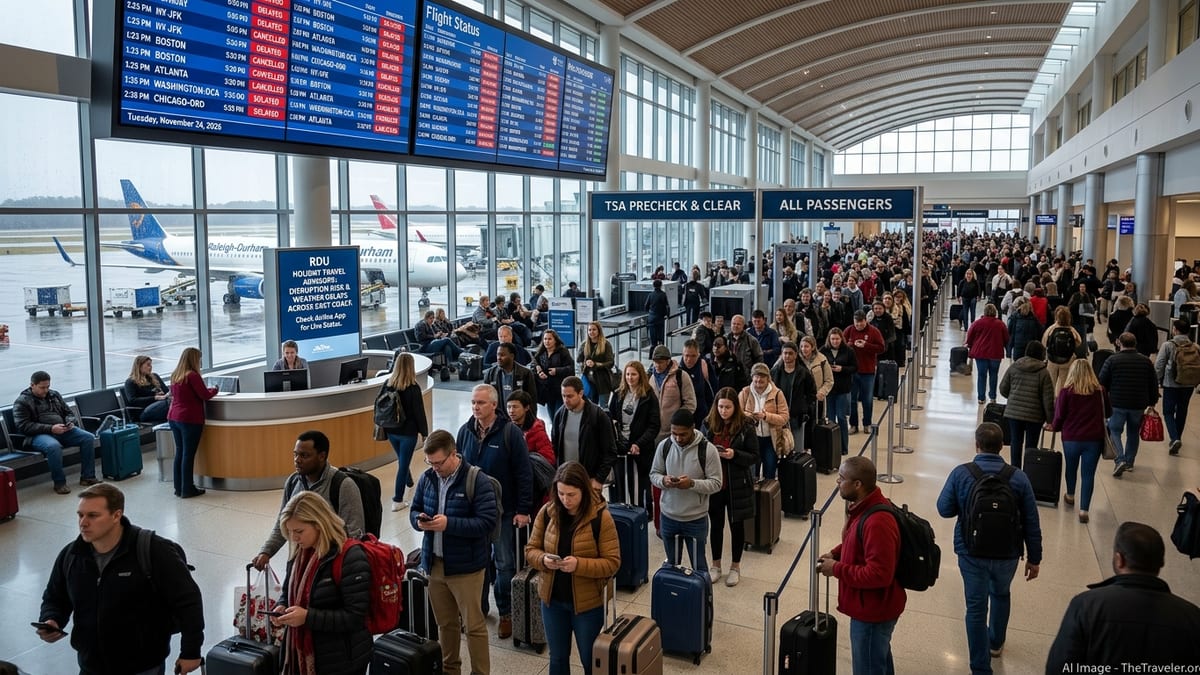
Holiday demand and disruption risk at RDU
Thanksgiving remains one of the busiest U.S. travel periods of the year, but 2026 volumes are forecast to ease slightly from last year. AAA projects about 81.5 million Americans will travel at least 50 miles from home between Tuesday 24 November and Monday 30 November 2026, with roughly 5.96 million of them expected to fly. Airlines for America, which represents major U.S. carriers, separately expects nearly 29 million passengers across an 11-day Thanksgiving air travel window from 20 to 30 November, a figure that includes domestic and international itineraries.
At Raleigh-Durham International Airport, traffic is concentrated on a small number of peak days. Airport officials and local media identify the Wednesday before Thanksgiving and the Sunday after as the busiest dates, with the heaviest crowds in early morning hours when banks of departures leave in close succession. In recent years, RDU has also handled increased passenger totals on similar numbers of flights as airlines have upgauged to larger aircraft, which means load factors are high and rebooking options can be limited when disruptions occur.
This year’s holiday travel comes directly after a rare nationwide ground stop and separate airline technology outage, both of which caused significant delays across multiple hubs. While neither event was specific to RDU, residual crew and aircraft positioning issues have persisted into the week of Thanksgiving. That backdrop, combined with the potential for a coastal nor’easter and associated ground delays in the Northeast, is prompting officials and consumer advocates to advise RDU passengers to plan for irregular operations even if local conditions appear normal.
What weather and national constraints mean for RDU flights
The broader East Coast forecast for the Thanksgiving period in 2026 includes a developing nor’easter that could bring strong winds, rain and coastal flooding to parts of the Mid-Atlantic and Northeast around Thanksgiving Day. That system is expected to affect major hubs such as New York and Boston more than North Carolina, but because RDU is closely tied to those airports through connecting traffic, delays and ground stops elsewhere can cascade into the Triangle’s schedules.
The Federal Aviation Administration has signalled that low clouds, rain and wind in dense airspace could trigger flow restrictions and temporary ground stops at some large East Coast and Midwest hubs if conditions deteriorate. When that happens, RDU-bound flights from affected airports may be held at the gate or in departure queues, and some turnarounds in Raleigh-Durham can be pushed back or cancelled while airlines recover their operations. Over the last several Thanksgiving periods from 2021 to 2025, roughly 6 percent of RDU departures were significantly disrupted, a lower rate than the national average but still enough to affect thousands of passengers.
Beyond weather, system constraints are contributing to a tighter operating environment. High load factors limit the number of open seats available for same-day reaccommodation, and airlines are operating dense schedules in the days immediately before and after Thanksgiving to meet demand. As a result, passengers traveling through RDU during the peak are more exposed to rolling delays, swapped aircraft and last-minute schedule changes than on a typical week in autumn, even if the airport itself avoids severe local storms.
How to track your RDU flight in real time
For this Thanksgiving period, the most reliable source of flight status at RDU remains the airline itself. Carriers update their own reservations and operations systems first, then push changes to third-party displays. Airport flight-status boards and airport websites can lag or occasionally display out-of-date information during disruption events, which means travelers should not rely on them as their only reference if conditions are deteriorating.
Airlines increasingly encourage passengers to use their mobile apps or websites to monitor gate assignments, departure times, aircraft changes and same-day rebooking options. These channels typically provide the earliest notifications of delays, cancellations and gate changes, and some carriers now allow customers to switch flights or confirm overnight hotel and meal vouchers directly in-app when irregular operations are formally recognized. For RDU travelers, enrolling in push alerts and ensuring contact details are current in the booking is particularly important in the 24 hours before departure.
Third-party flight tracking tools can supplement airline information. Services such as FlightAware provide real-time maps of an aircraft’s position, estimated arrival times based on current conditions and details of where the inbound aircraft is arriving from. This can be useful in assessing whether an on-time departure from RDU is realistic when the plane is still en route from a weather-affected hub. For passengers using iPhones, typing the airline and flight number into an iMessage and pressing to preview will surface Apple’s built-in live flight tracking, which displays status, departure and arrival times and, in many cases, a simple route map without needing to download an additional app.
Steps to take if your RDU flight is delayed or cancelled
When irregular operations occur, RDU passengers are advised to act quickly rather than wait passively for airline outreach. The U.S. Department of Transportation requires carriers to provide prompt refunds when a flight is cancelled or significantly changed and the passenger chooses not to travel, but the department does not mandate that airlines proactively book travelers on alternatives in all situations. In practice, rebooking inventory on popular routes from RDU, such as to major hubs or Florida, can disappear within minutes once a disruption is confirmed.
Travelers can often rebook faster through digital channels than by waiting in an airport queue. Airline apps and websites routinely display same-day or next-day options and sometimes allow free changes during weather waivers or system outages. If the app does not present an acceptable alternative, calling the airline’s reservation line or using chat functions can be effective while simultaneously queuing at the airport service desk. For those who booked through an online travel agency rather than directly with a carrier, the agency may need to modify the ticket, although travelers still benefit from checking the airline’s own waiver policies to understand their rights.
Passengers facing cancellations should also review their obligations and protections before accepting vouchers. A refund is generally available when the airline cancels a flight or makes a major schedule change and the passenger opts not to travel, even if the ticket was sold as nonrefundable. However, when delays are caused by weather or air-traffic-control constraints rather than factors within the airline’s control, there is no federal requirement to provide hotel or meal vouchers, and each carrier’s policy differs. Travelers flying from RDU are therefore encouraged to check the “customer service commitments” or “travel disruption” pages of their airline in advance to know what to expect if they become stranded overnight.
Timing, security and ground logistics at RDU
Raleigh-Durham International continues to advise passengers to arrive well ahead of departure during busy periods. The airport’s official guidance is to arrive at least two hours before domestic flights and at least three hours before international flights, to allow sufficient time for parking, check-in and security screening. For the specific Thanksgiving window, arriving even earlier can be prudent for early morning departures on Wednesday 25 November and Sunday 29 November, when parking lots and security checkpoints are expected to be busiest.
Parking has become a particular pinch point during major holiday periods. RDU encourages travelers who plan to park at the airport to reserve spaces in advance when possible, particularly in on-site decks and surface lots closest to the terminals. When demand outstrips capacity, drivers may be redirected to more distant overflow areas, adding time for shuttle transfers and increasing the risk of missing check-in cutoffs. Those using ride-hailing services or being dropped off should also account for heavier traffic volumes on airport access roads, especially around the terminal curbs in the early morning and early evening peaks.
Security screening times at RDU vary significantly throughout the day, but are generally longest before 9 a.m., when multiple banks of departures depart in quick succession. Travelers enrolled in TSA PreCheck or CLEAR usually benefit from shorter lines, although those queues can still lengthen during peak holiday mornings. To keep the process moving, passengers should verify luggage rules before leaving home, including limitations on liquids and the need to remove certain electronics or food items in standard lanes, which can otherwise trigger additional screening and slow progress for everyone in line.
What RDU travelers should watch in the days ahead
For the remainder of Thanksgiving week, the most important variables for RDU passengers will be evolving weather forecasts for major East Coast hubs, recovery progress from recent system disruptions and day-to-day passenger volumes. National forecasters will refine predictions of the nor’easter’s track and intensity as Thanksgiving Day approaches, which in turn will influence the FAA’s use of traffic management initiatives that ripple across the network. Travelers with tight connections through affected airports may wish to explore earlier itineraries or more generous layovers if their airline permits changes without penalty.
In parallel, airlines and the Transportation Security Administration are monitoring staffing and passenger throughput to adjust resources where possible. TSA will publish daily screening numbers, which can serve as a rough indicator of how busy particular days are relative to forecasts, and carriers may implement travel waivers if storms or operational issues appear likely to cause widespread disruption. RDU passengers who opt in to airline alerts and check their bookings regularly in the 72 hours before departure will be best positioned to respond quickly to schedule changes.
Once the Thanksgiving period ends on Monday 30 November 2026, air traffic is expected to normalize to typical late-autumn levels until the lead-up to the December holidays. For now, travelers flying through Raleigh-Durham can reduce the risk of serious inconvenience by confirming their itineraries before leaving home, allowing additional buffer time for parking and security, and preparing backup plans in case a tight national system, bad weather or lingering technology issues once again alter plans at short notice.