


More news on this day
Automatic cash refunds for major disruptions in the United States, a newly updated air passenger rights regulation in the European Union, and a Supreme Court backed regime in Canada are reshaping what travelers can claim when flights are delayed or canceled. Understanding which rules apply to your specific route now makes the difference between accepting a schedule change and securing a full refund, hotel and meals, or even standardized cash compensation on top.
Get the latest news straight to your inbox!
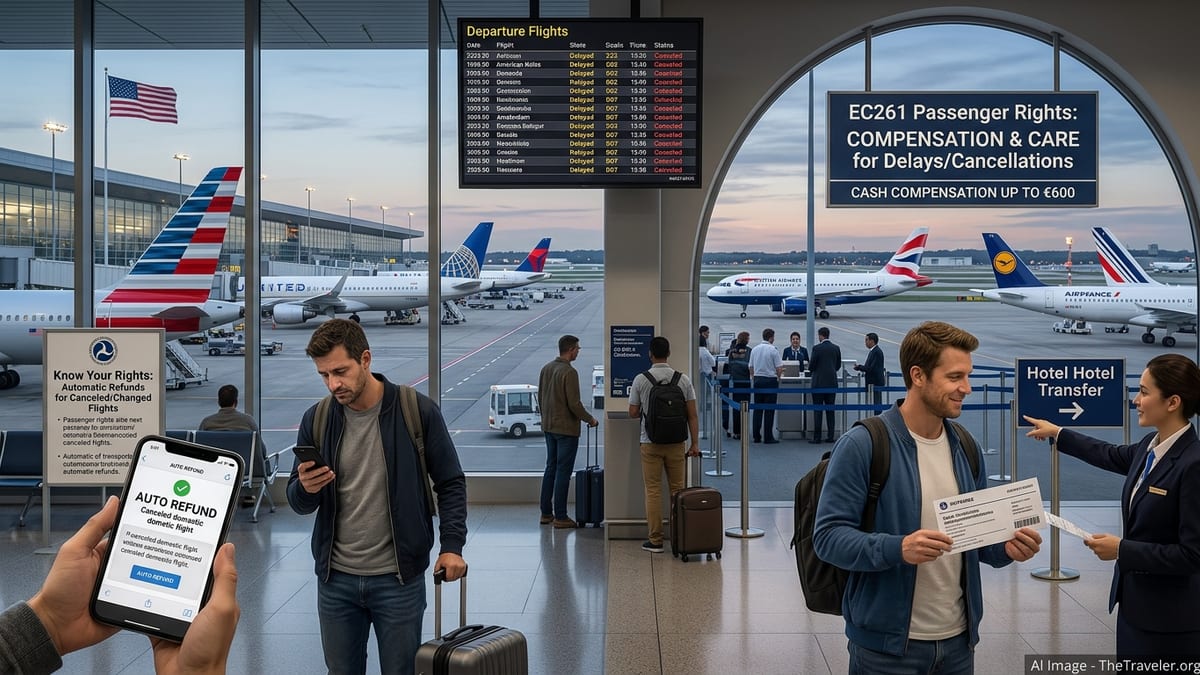
United States: automatic refunds take effect, but no federal cash payouts
For itineraries to, from or within the United States, the most significant recent change is the move to automatic refunds rather than vouchers when flights are canceled or significantly changed and the passenger does not travel. Under a final rule issued by the US Department of Transportation (DOT) in April 2024 and published in the Federal Register on 26 April 2024, airlines and ticket agents must provide prompt, automatic cash refunds in the original form of payment when a covered disruption occurs and the traveler rejects alternatives. The statutory trigger date for key refund duties tied to the FAA Reauthorization Act was 16 May 2024, with additional parts of the DOT rule coming into force on 28 October 2024.
The rule introduces, for the first time, a clear federal definition of a “significant change” to a flight itinerary. Under DOT regulations, a significant change includes a shift of at least three hours to departure or arrival time on domestic itineraries or six hours on international itineraries, as well as changes to the origin or destination airport, additional connections compared with the original booking, and certain involuntary downgrades. It also covers particular routing changes affecting passengers with disabilities, such as adding connections or removing needed accessibility features on substitute aircraft. When a carrier cancels a flight or imposes one of these significant changes, and the passenger either rejects or does not accept alternative transportation, the airline or the ticket agent responsible as merchant of record must refund the unused portion of the ticket including mandatory taxes and fees, even if the fare was sold as nonrefundable.
For cancellations and significant delays occurring on or after 16 May 2024, DOT has made clear that airlines are required to notify passengers of their refund rights and ensure refunds are issued automatically if eligibility is met and the traveler does not take up an alternative itinerary. Once a refund is due, carriers generally must transmit the refund to the credit card issuer within seven business days for tickets purchased by card, and within 20 business days for other payment methods. Ticket agents that fall under DOT definitions must pass through refunds promptly. Airlines are permitted to set reasonable deadlines for passengers to accept or reject alternatives, but their policies must be public and cannot deprive eligible travelers of the refund entitlement if no response is given by the deadline.
What the federal framework still does not offer is standardized cash compensation simply for the inconvenience of a cancellation or delay that is within the carrier’s control. The Biden administration pursued a separate rulemaking that would have required airlines to pay cash and provide minimum standards of care, such as hotels and meals, when disruptions stemmed from airline-controlled causes, but this proposal did not ultimately take effect before being withdrawn under the subsequent administration. As a result, US airline passenger rights remain focused on refunds rather than lump-sum compensation. Many US airlines continue to publish voluntary customer service plans that promise meal vouchers or hotel accommodation when delays are within their control, but these commitments are policies rather than federal legal rights and typically exclude weather, air traffic control restrictions and other external events.
European Union: updated EU261 keeps lump-sum compensation and clarifies disputes
Travelers departing from airports in the European Union, or arriving in the EU on an EU carrier, remain covered by a distinct model built around standardized cash compensation plus care and refunds. Regulation (EC) No 261/2004, widely known as EU261, has provided these protections since 2004. It grants lump-sum compensation when flights are canceled at short notice or when passengers reach their final destination with long delays that are attributable to the airline and not caused by extraordinary circumstances. Typical compensation levels remain 250, 400 or 600 euros per passenger depending on flight distance and whether a journey is intra-EU or intercontinental, while carriers must also offer a choice of refund, rerouting at the earliest opportunity or travel at a later date chosen by the traveler, subject to seat availability.
In parallel, EU261 imposes a duty of care that is independent of whether compensation is due. Airlines must provide assistance such as meals and refreshments appropriate to the waiting time, communication facilities and hotel accommodation with airport transfers where an overnight stay becomes necessary. This duty applies even when the underlying cause of disruption is outside the airline’s control, for example severe weather or certain security incidents. Long court-driven interpretation of EU261 has established that passengers who arrive at their final destination three hours or more after the scheduled arrival time, and where the delay is not due to qualifying extraordinary circumstances, are treated in much the same way as those whose flights were canceled at short notice.
After years of debate, the EU has now completed an update to its air passenger rights regime. Regulation (EU) 2026/2202, adopted on 16 September 2026 and published in the EU’s Official Journal, amends EU261 and the separate regulation on air carrier liability. The revised law maintains the core structure of the existing regime, including the standard compensation amounts and the principle that lengthy delays at final destination can trigger compensation, but aims to provide clearer definitions and more consistent application across member states. Among other changes, the new regulation strengthens requirements on airlines to justify in detail when they invoke extraordinary circumstances to deny compensation, and it clarifies aspects of how the rules apply to complex, multi-leg journeys and codeshare flights where several carriers are involved.
The updated EU regulation will take effect after a transition period set out in the legal text, so some changes may not yet apply to trips departing in late 2026. During this period, passengers’ rights continue to be determined by the original EU261 as interpreted by the Court of Justice of the European Union, combined with the transitional provisions in the amending regulation. As the new rules are phased in, travelers should check whether their journey date falls before or after the formal application date, but in practical terms they can still expect the same key protections: set levels of compensation for controllable cancellations and long delays, a requirement to offer refunds or rerouting options, and an ongoing duty of care for meals and accommodation irrespective of fault.
United Kingdom: UK261 preserves EU-style protections after Brexit
Following the United Kingdom’s departure from the EU, the substance of EU261 was retained in domestic law as what is now generally known as UK261. This regime applies to flights departing from UK airports regardless of carrier, and to flights arriving into the UK when operated by UK or other qualifying UK-registered airlines. The UK Civil Aviation Authority (CAA) is responsible for enforcement and continues to base its consumer guidance on the original EU regulation, including adoption of earlier EU interpretative guidelines where compatible with UK law.
Under UK261, passengers whose flights are canceled or who arrive at their final destination with a long delay may qualify for fixed-sum compensation in pounds sterling when the disruption is within the airline’s control and does not arise from extraordinary circumstances. The compensation bands mirror the EU’s structure, with amounts linked to flight distance and whether travel is within the UK and Europe or on longer-haul routes. In addition to compensation rights, airlines must give passengers a choice between reimbursement of the unused ticket, rebooking at the earliest available opportunity or rerouting at a later date convenient to the traveler, subject to seats being available.
UK law also maintains a robust duty of care. When long delays occur, airlines are expected to provide meals or meal vouchers proportionate to the waiting time, allow passengers to make phone calls or other communications, and arrange hotel accommodation with ground transport for overnight disruptions where necessary. This obligation applies even when the airline can rely on extraordinary circumstances to avoid paying compensation, such as severe weather or air traffic control strikes that are outside the carrier’s control. Where passengers consider that an airline has misclassified an event in order to avoid paying compensation, they can escalate complaints either to an approved alternative dispute resolution scheme, if the carrier is a member, or to the CAA’s Passenger Advice and Complaints Team.
Canada: APPR confirmed by Supreme Court and refund rules strengthened
Canada’s Air Passenger Protection Regulations (APPR), which came into force in stages starting in 2019, continue to function as a hybrid model with both compensation and refund rights, overseen by the Canadian Transportation Agency (CTA). The APPR apply to flights to, from and within Canada, including connecting flights, and distinguish between large and small carriers when establishing compensation amounts. For delays and cancellations within airline control that are not required for safety, large carriers must pay higher compensation than small ones once specific arrival delay thresholds are exceeded, with amounts increasing in parallel with the length of the delay.
Amendments that took effect on 8 September 2022 addressed earlier gaps related to disruptions outside airline control, such as major weather events or certain security situations. Under these changes, if a passenger’s flight is canceled or subject to a lengthy delay for reasons that fall outside the carrier’s control, and the airline cannot complete the itinerary within a reasonable amount of time, the traveler must be offered a choice between rebooking and a refund. This ensures that passengers are not left indefinitely holding tickets for trips the airline cannot reasonably operate. While the obligation to provide care such as food and accommodation continues to depend on the cause of the disruption and the classification of the carrier, the baseline right to either transportation or a refund is more clearly defined.
The long-term validity of the APPR was tested in a major legal challenge by airlines and their trade association. On 4 October 2024, in International Air Transport Association v. Canada (Transportation Agency), the Supreme Court of Canada upheld the core structure of the APPR as it applies to international flights. The Court confirmed that, subject to Canada’s international treaty obligations, Parliament had authority to mandate regulations requiring airlines to compensate passengers for certain delays and cancellations and to refund baggage fees when luggage is lost or damaged. The CTA’s subsequent annual reporting has treated the judgment as confirmation that the APPR remain the primary enforceable framework for air passenger rights in Canada, including for international routes touching Canadian airports.
Under the APPR, events within airline control that are not required for safety, such as some crew scheduling or maintenance decisions, can trigger both cash compensation and rerouting or refund rights when arrival delays surpass defined thresholds. Where disruptions occur for reasons outside airline control or for safety-related reasons, carriers are typically required to rebook passengers or, if that is not possible within a reasonable period, provide refunds, but in those categories they are not generally obliged to pay compensation for inconvenience. Travelers who believe their situation has been misclassified can bring complaints to the CTA, which continues to publish case summaries and guidance on how it applies the APPR’s categories.
How overlapping systems affect real itineraries and what travelers should check now
Because most modern air itineraries cross borders, several passenger rights regimes can apply to the same trip. The governing law usually depends on where a particular flight segment departs, where it arrives and the legal home of the operating carrier. For example, a journey from New York to Paris on an EU airline involves US rules for refunds on flights departing the United States and EU rules on compensation, care and rerouting because the operating carrier is established in the EU and the flight lands there. If such a flight is canceled at short notice for reasons within the airline’s control, a traveler who declines rebooking could rely on US regulations for an automatic cash refund of the unused ticket and on EU261 for lump-sum compensation and duty of care for meals and accommodation.
By contrast, a European resident flying solely between two US cities on a domestic ticket would be covered almost entirely by US federal and state rules. In that case, EU261 and UK261 do not generally apply, even if the passenger is a citizen of an EU member state or usually travels with European airlines. If the flight suffers a lengthy delay due to an airline-controlled problem, US federal law does not yet require standardized cash compensation. The traveler may still be entitled to a refund if the delay qualifies as a significant schedule change and they choose not to travel, and the carrier’s customer service plan may provide hotel or meal vouchers as a matter of policy, but the protection differs sharply from what they would receive on an intra-EU route of similar length.
Booking channels can also affect how entitlements are exercised, even though they do not change the underlying legal rights. Under the US refund rule, for instance, a passenger who purchased a nonrefundable ticket through an online travel agency remains entitled to an automatic refund when a covered cancellation or significant schedule change occurs and they reject alternatives. The airline that operates the flight is responsible for complying with DOT refund obligations, while the ticket agent is required to pass on those refunds within specified time limits. In the EU, UK and Canada, passengers offered rerouting at the earliest opportunity but who instead opt to abandon or substantially postpone their trip are usually entitled to reimbursement of unused segments, though treatment of ancillary services such as seat reservations or extra baggage fees may vary by jurisdiction and case.
As the EU’s revised regulation moves from adoption to practical application and as North American authorities continue to enforce and refine their frameworks, travelers planning trips for 2027 and later should verify several details close to departure. These include checking whether individual flights depart from or arrive in jurisdictions covered by EU261 or UK261, whether the operating carrier is an EU, UK, US or Canadian airline, and whether new EU provisions or transitional rules have taken effect for their travel dates. In the United States, passengers should confirm that airlines and agents are applying automatic refunds correctly and within required timeframes, particularly where significant schedule changes cross the three-hour domestic or six-hour international thresholds.
Across all four regions, keeping precise documentation remains essential when flights disrupt. Travelers should retain boarding passes, booking confirmations, notification messages from airlines and receipts for food, accommodation or ground transport purchased during disruptions, and should note actual departure and arrival times. If a carrier attributes a disruption to extraordinary circumstances or events outside its control and declines to pay compensation, passengers who suspect an internal operational cause may need to request a detailed explanation and, where appropriate, pursue complaints with regulators such as the US DOT, the CAA in the UK, relevant national enforcement bodies in the EU or the CTA in Canada. With rules still evolving, particularly in Europe, confirming the latest official guidance from these authorities shortly before travel remains the most reliable way to know what can realistically be claimed when flights do not go as planned.