


More news on this day
Delta Air Lines is launching a sweeping $1 billion cabin retrofit across 42 Airbus A330 jets, adding business-class suites with privacy doors, upgraded cabins throughout and self-serve snack stations aimed at reshaping the onboard experience on key long haul routes.
Get the latest news straight to your inbox!
Multi-Year Retrofit Targets 42 Workhorse A330s
According to recent fleet updates and industry coverage, Delta’s new investment centers on its Airbus A330-200 and A330-300 aircraft, which form a core part of the carrier’s transatlantic and select transpacific network. The airline plans to retrofit 42 of these jets, bringing them closer in look and feel to its newer A330-900neo and Airbus A350 widebodies.
Reports indicate the project will begin in late 2026 and run as a multi-year program, with aircraft cycled through modification lines in phases to avoid major schedule disruption. Aviation analysts note that a full tip to tail overhaul at this scale typically takes several weeks per aircraft, suggesting that passengers will see a gradual rollout rather than an overnight transformation across the fleet.
The retrofit focuses most visibly on Delta One, the airline’s flagship business cabin, but extends into Premium Select, Comfort Plus and Main Cabin. Publicly available information shows that Delta is positioning this as part of a broader effort to have the majority of its long haul premium seats configured as enclosed suites by the end of the decade.
Once complete, the A330 program is expected to give Delta a significantly more consistent product on routes where the older A330 layout has lagged behind newer aircraft in privacy, storage and technology.
Delta One Suites With Sliding Privacy Doors
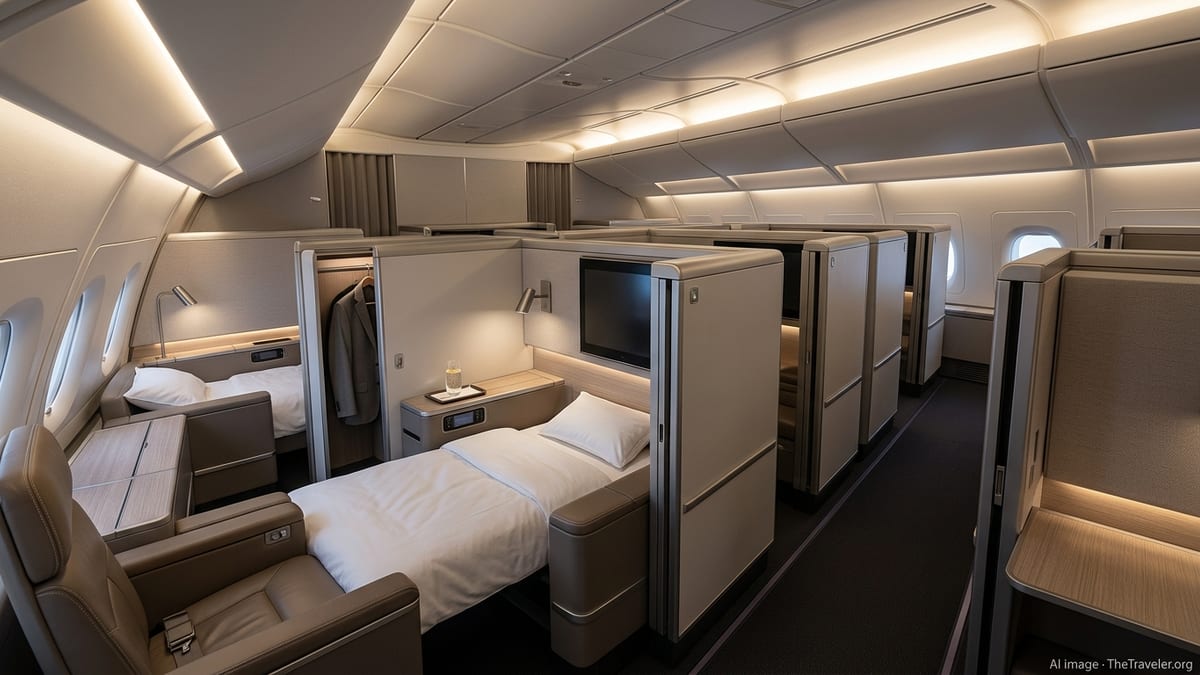
The headline change is the installation of new-generation Delta One suites on the retrofitted A330s, each featuring a sliding privacy door. Currently, privacy-door suites are standard on Delta’s Airbus A350-900 and A330-900neo, while older A330s retain a more open, angled-flat layout that has drawn criticism from frequent flyers seeking seclusion and direct aisle access.
According to published coverage of the announcement, the new A330 suites will echo the design language of Delta’s latest widebody cabins, with fully flat beds, increased personal storage, larger tray tables and high-resolution seatback screens measuring around 24 inches. Each suite is expected to offer direct aisle access, addressing one of the remaining inconsistencies in Delta’s long haul business class.
Industry observers note that introducing sliding doors to all Delta One seats on the A330s is central to the airline’s goal of having roughly nine in ten business-class seats fitted with doors by 2030. That strategy is intended to position Delta as a leader among U.S. carriers in the highly competitive transatlantic and transpacific premium markets, where privacy and personal space have become major selling points.
The retrofit will not change the basic role of Delta One as the airline’s top long haul cabin, but it is likely to reshape customer expectations on routes that until now have alternated between older and newer configurations, sometimes within the same season.
Self-Serve Snack Bars Come to Delta One Cabins
Beyond the suites themselves, one of the most eye-catching elements of the A330 program is the addition of dedicated snack stations in the Delta One cabin. Business travel publications report that these self-serve areas will be built into the galley-adjacent space, offering a selection of packaged snacks and light bites for passengers to help themselves between meal services.
Snack bars are already a familiar feature on several international carriers and on some of Delta’s newest aircraft, but this marks the first time they will be systematically incorporated across the older A330 fleet. The concept is aimed at long haul travelers who value flexibility over set meal times, especially on overnight sectors where passengers may sleep through the main service and still want something to eat later in the flight.
For Delta, the move also adds a visual statement to the refurbished cabin. The snack area is expected to be integrated into the overall design of Delta One, with lighting and finishes aligned to the rest of the premium cabin rather than appearing as a standard galley.
Travel industry analysis suggests the snack stations could help differentiate Delta’s product on routes where competitors still rely primarily on galley service and call buttons, particularly on eastbound overnight flights to Europe where timing and convenience of food service are closely scrutinized by frequent flyers.
Upgrades Across Premium Select, Comfort Plus and Main Cabin
While Delta One draws most of the attention, the $1 billion plan also includes substantial changes for the rest of the cabin. Reports indicate that Premium Select, the airline’s premium economy product, will receive refreshed seats, updated finishes and larger seatback screens aligned with Delta’s newest widebodies.
Comfort Plus and Main Cabin are also slated for updates. Industry coverage highlights plans for enhanced in-flight entertainment screens, USB power and Bluetooth audio connectivity throughout the aircraft, allowing customers to pair their own wireless headphones instead of relying on wired options. Some reporting notes that economy seating, including Comfort Plus, is expected to gain approximately an inch of extra legroom on retrofitted aircraft.
These changes are designed to narrow the experiential gap between new and older jets, a recurring concern for travelers who often discover the specific aircraft type only shortly before departure. By standardizing technology and seat hardware, Delta aims to make the onboard experience more predictable regardless of whether a flight is operated by a newest-generation A330-900neo or an updated A330-200.
The investment also reflects growing demand for intermediate cabins. Premium economy in particular has become a revenue driver on transatlantic routes, and analysts suggest that aligning the A330 Premium Select product with that on the A350 and A330-900neo will make it easier for Delta to market these seats consistently across its network.
Competitive Context and Passenger Impact
The A330 retrofit comes amid an arms race in long haul business class, as U.S. and European airlines compete with Middle Eastern and Asian carriers that have long offered enclosed suites, designer bedding and high-end onboard services. By committing more than $1 billion to cabins on existing aircraft, Delta is signaling that product consistency is as important as the introduction of new jets.
For corporate travel buyers and premium leisure passengers, the move reduces the risk of booking an ostensibly top-tier product only to find an older seat on the day of travel. With privacy doors, upgraded entertainment and snack bars increasingly standard across the fleet, the airline is seeking to simplify expectations: a Delta One ticket on an A330 will mean a similar level of privacy and comfort as on an A350.
At the same time, the emphasis on technology upgrades and modest increases in space in the rear cabins recognizes that most passengers will still travel in economy. Bluetooth audio, improved seatback screens and refined lighting are comparatively small changes individually, but together they shift the onboard environment closer to that of Delta’s newest aircraft.
As the first retrofitted A330s enter service in the second half of the decade, travelers on some of Delta’s busiest long haul routes will be watching closely to see how the refreshed cabins perform in real-world conditions, and whether the experience matches the ambition of one of the largest retrofit investments in the airline’s history.