


Denver International Airport is one of the busiest hubs in the United States, and its security checkpoints are famous among Colorado travelers for being either a breeze or a bottleneck depending on the day and time. With record passenger volumes in 2024 and 2025 and ongoing construction in the Jeppesen Terminal, knowing when to arrive at security and how to move through it efficiently has never mattered more. This practical guide uses current information about Denver International Airport to help you time your arrival, choose the right checkpoint, and use programs like TSA PreCheck and DEN Reserve so you do not miss your flight.
Get the latest updates straight to your inbox!
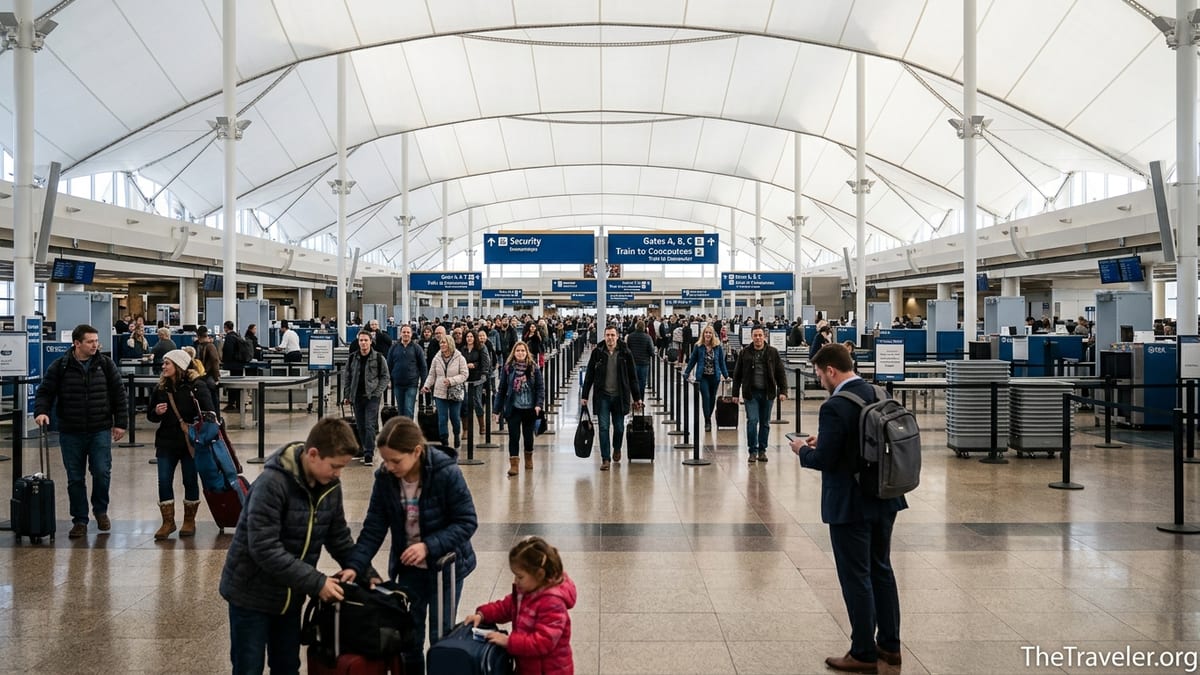
How Denver Airport Security Works Today
Denver International Airport funnels nearly all departing passengers through security in the Jeppesen Terminal before they board the underground train to Concourses B and C or walk the bridge to Concourse A. Recent terminal renovations moved the main checkpoints to the north end of Level 6, labeled East and West, which now handle the bulk of standard screening, TSA PreCheck and CLEAR traffic. The older Level 5 checkpoints and the separate A-Bridge checkpoint have been scaled back or reconfigured over several construction phases, so signage and online information matter more than old habits.
The airport publishes live wait-time estimates for each checkpoint, updated throughout the day. On a typical midweek morning, travelers might see standard screening at East posted at about 25 to 35 minutes while West shows 15 to 20 minutes, with TSA PreCheck listed closer to 5 to 15 minutes. These are averages, not guarantees, but they give you a practical baseline: at busy times, it is reasonable to expect that standard lines can stretch toward half an hour or more, while PreCheck usually moves significantly faster.
After security, the time to your gate at Denver is not trivial. The airport itself suggests planning roughly 10 to 20 minutes from security to most gates on Concourse A, 10 to 25 minutes to B, and up to about half an hour to the far end of C, depending on train crowds and walking speed. That means “clearing security” is not the end of the journey. If you are departing from a far C gate on a busy holiday morning, you should treat the train ride and concourse walk as a meaningful part of your timing, not an afterthought.
Because Denver has become a major connecting hub for United, Southwest and Frontier, waves of departures can cause sudden, sharp spikes at security even when average daily waits look moderate. Travelers who build in an extra 20 to 30 minutes beyond the bare minimum often find that they can absorb an unexpected traffic jam, check-in glitch or train delay without panic.
Typical Wait Times and Peak Periods
Security wait times at Denver vary widely by time of day, day of week and season. Third-party trackers that monitor Denver’s live feed frequently show average standard waits in the 10 to 30 minute range during normal periods. Early weekday mornings between roughly 5:00 and 8:30 a.m. are often the most intense, with standard lines sometimes swelling toward half an hour or more when large banks of business and commuter flights depart. Midday on Tuesday or Wednesday can look very different, with posted waits dropping to under 15 minutes and some travelers walking almost straight to the scanners.
Real-world reports from travelers in spring and summer 2026 show just how changeable things can be. One passenger in March arrived at around 8:15 a.m. to find Denver’s own website listing a 28 to 32 minute wait for standard screening, which matched closely with the half-hour they spent in line. Another traveler flying early on a Monday with TSA PreCheck reported clearing security at East in about 10 minutes even though the posted estimate was slightly lower, around 7 minutes. Others in peak holiday periods have seen standard waits stretch toward 40 to 45 minutes during surges, while PreCheck and CLEAR stayed closer to 10 to 20 minutes.
Holidays and long weekends are consistently the worst periods for surprise delays. Over Thanksgiving, Christmas, spring break and long summer weekends, Denver Airport has publicly warned travelers that daily passenger numbers can hit record highs. During these peaks, a line that usually moves in 20 minutes might take twice as long if several large flights depart within the same 30-minute window, if weather elsewhere disrupts schedules, or if TSA staffing is tight. The official wait-time tools are worth watching, but they can lag reality by a few minutes, especially when a fresh wave of passengers arrives all at once.
Because of this unpredictability, any fixed “average” for Denver should be taken as a rough guide, not a promise. Many frequent flyers who pass through the airport several times a month build their own mental rule of thumb: assume standard screening could be as quick as 10 minutes but plan emotionally and logistically for 30 to 45 minutes when traveling at peak times, then be pleasantly surprised if it is shorter.
How Early You Should Arrive at Denver
The conventional airline advice to arrive at the airport two hours before a domestic flight and three hours before an international flight is a starting point, not a hard rule, at Denver. For most domestic travelers with checked bags and standard security, a 2 to 2.5 hour cushion before departure is a realistic target on normal days. That means for a 9:00 a.m. departure to Chicago on a Tuesday, a Denver-based traveler might aim to be dropped off at the terminal between 6:30 and 7:00 a.m. This window allows for 15 to 20 minutes at check-in, 20 to 30 minutes at security, and still leaves time to take the train and walk to a mid-concourse B gate without sprinting.
Passengers with TSA PreCheck, CLEAR, no checked bags and mobile boarding passes can compress that timetable somewhat, especially outside of the early-morning peaks. For example, a frequent flyer heading to Phoenix on a 1:00 p.m. departure with only a carry-on might reasonably plan to arrive at Denver around 11:30 a.m., allowing roughly 60 to 90 minutes to clear security, ride the train and grab a quick snack before boarding. Even then, it is wise to build in an extra 15 minutes beyond what apps or the airport’s website show for security waits, in case actual lines are longer than the estimate.
International flights out of Concourse A, such as departures to London, Frankfurt or Mexico City, demand more caution. Airlines often begin boarding widebody or long-haul flights 45 minutes to an hour before departure, and additional documentation checks at the gate can slow boarding. For a 5:00 p.m. departure to Europe, arriving at Denver between 2:00 and 2:30 p.m. is prudent, particularly during peak summer and holiday travel. This gives time to manage passport checks at check-in, potentially longer security lines, and the walk or train ride to an international A gate where boarding may start well before the printed departure time.
Travelers connecting through Denver should remember that minimum connection times are not built around worst-case security delays, since connecting passengers usually do not have to clear security again. However, irregular operations such as weather diversions or aircraft swaps can push passengers back landside unexpectedly. If an airline rebooks you on a later flight and asks you to re-clear security, the same logic applies: do not assume that because you are already “at the airport” you can cut it close; treat the new departure as if you were starting from scratch and allow at least 90 minutes whenever possible.
Choosing the Right Checkpoint: East, West and the A-Bridge
Denver’s current main checkpoints are located on the north end of Level 6 in the Jeppesen Terminal, known as East Security and West Security. Both handle standard screening and typically have dedicated TSA PreCheck and CLEAR lanes integrated into their layouts. Airline check-in counters still follow an east-west split by carrier, which influences where most travelers naturally gravitate, but security itself is flexible: you can generally use either East or West regardless of airline as long as you have a valid boarding pass for that day.
In practice, that means it can pay to be strategic. Imagine you are flying to Houston with United from Concourse B. You are dropped off on the west side because United check-in is there, and the line at West Security appears long. Before committing, you open Denver’s security page on your phone and see West listing a 35-minute standard wait while East is showing around 15 minutes. Because East and West share the same train system once you are through security, walking an extra two or three minutes across the terminal to East could save you 20 minutes or more of standing in line.
The A-Bridge checkpoint, located at the entrance to the pedestrian bridge to Concourse A, has historically been a useful alternative for travelers who like to walk instead of taking the train. In recent years, as terminal construction has progressed and new checkpoints have opened on Level 6, the hours and role of the A-Bridge checkpoint have changed. For much of the day it focuses on standard screening and can be less crowded than the main banks during moderate periods, but hours can be limited, particularly in the evenings. Travelers who enjoy walking across the glass-walled bridge directly to A should confirm on the airport’s website whether the bridge checkpoint is open during their travel window.
Whatever checkpoint you choose, build in a minute to look for the latest signage or digital displays in the terminal. Denver occasionally rebalances queues, adjusts dedicated lanes or alters flows to accommodate construction. Following the crowd to the longest visible line is rarely the optimal strategy. A quick check of real-time wait estimates and signs pointing to alternate entrances can easily save you ten minutes, which might be the difference between a calm coffee at the gate and a frantic dash as boarding closes.
TSA PreCheck, CLEAR and Expedited Screening at Denver
TSA PreCheck is one of the most effective tools for reducing security stress at Denver, particularly for frequent travelers. Members with a Known Traveler Number and a qualifying boarding pass can typically use dedicated PreCheck lanes at both East and West Security. On most days, anecdotal reports in 2026 suggest that PreCheck lines at Denver run under 15 minutes, often closer to 5 to 10 minutes outside the absolute peaks. In March of this year, for example, a traveler reported that while standard lines were approaching half an hour, they cleared PreCheck in roughly 10 minutes at sunrise.
PreCheck’s practical benefits become especially clear in winter. Picture a busy Sunday during ski season with long lines of travelers lugging boot bags and gear cases bound for mountain towns. Standard lanes may be clogged with people repacking after removing laptops, liquids and belts. A PreCheck member in the same period can usually leave shoes on, leave laptops and small liquids in bags, and move through a streamlined lane, cutting total time from curb to concourse significantly. Over a year of multiple trips, that time savings can justify the enrollment fee, especially when combined with credit card rebates that cover the cost.
CLEAR, the private biometric identity service, also operates at Denver, integrating with TSA PreCheck where available. CLEAR members verify identity with iris or fingerprint scans and are escorted to the front of the physical screening lane, which can be particularly useful when PreCheck itself has backed up. However, Denver’s layout and lane allocation sometimes limit CLEAR’s advantage during the most pressured periods, and travelers have reported that if only a single bag-screening lane is available for CLEAR and PreCheck combined, the bottleneck can shift from the ID check to the x-ray machines.
For occasional travelers who do not want to commit to a paid program, closely monitoring Denver’s live security wait tool can partially replicate the planning advantage that frequent flyers get from PreCheck and CLEAR. Checking wait times the evening before your trip and again as you leave home lets you see patterns: if you notice that East Security has hovered around 30 minutes at your planned arrival time for several days running, you can assume your experience is likely to be similar and adjust when you leave home accordingly.
DEN Reserve: What It Is and What Changed
DEN Reserve, Denver’s virtual queuing system for security, was introduced as a free, optional way for standard-screening passengers to book a specific time window for entering a dedicated security lane. Travelers could reserve a slot from home or their hotel, receive a QR code and then show up at the checkpoint at the chosen time to join a much shorter line. For families with small children, occasional travelers nervous about airports, or anyone flying during peak holiday periods without PreCheck, DEN Reserve could dramatically reduce the uncertainty around security waits.
In practice, DEN Reserve worked best for travelers who were reasonably sure they could arrive at the airport during their chosen 15-minute window. For example, a family of four heading to Orlando for spring break might have booked a DEN Reserve slot at 8:15 a.m. for a 10:30 a.m. departure. They would plan to be dropped off by about 7:45 a.m., giving some buffer for traffic or baggage check-in, and then head directly to the Reserve entrance at East or West Security. Many who used the service reported that they bypassed long standard lines and reached the scanners in under 10 minutes.
By mid-2026, however, Denver announced that DEN Reserve would end in late June, after the airport completed a new contract cycle for its virtual queuing software. Local discussions among frequent travelers indicated that the program might return in another form or be replaced by similar tools, but for now, travelers should not assume that DEN Reserve will be available for upcoming trips. Anyone who relied on it in 2024 or early 2025 should double-check current information on the airport’s site for the latest status and not schedule their arrival on the assumption that a reserved slot will shorten their wait.
The end of DEN Reserve makes the standard tools and strategies more important. Without a guaranteed virtual time slot, travelers must fall back on generous arrival windows, live wait-time monitoring and, where possible, expedited programs like TSA PreCheck. Families and groups can mimic some of the benefits of DEN Reserve by assigning one person to track live waits on a phone and make quick decisions at the terminal, such as switching from East to West Security when one checkpoint suddenly becomes congested.
Concrete Strategies to Save Time and Avoid Missing Your Flight
The simplest way to avoid missing a flight at Denver is to work backward from your departure time with conservative assumptions. Start with your boarding time, which is often 30 to 45 minutes before scheduled departure for domestic flights and up to an hour for long-haul international flights. Add your estimated tram and walking time to the gate, typically 10 to 20 minutes for most gates but possibly 25 to 30 minutes for the far end of Concourse C. Then add your expected security wait, padding it by at least 10 minutes beyond the posted estimate. Finally, layer in 15 to 20 minutes for check-in or bag drop if you have luggage. The resulting sum is the latest time you should be entering the terminal doors, not pulling into the parking lot.
Consider a concrete example. You have a 7:30 a.m. winter flight from Denver to New York, departing from Concourse B, and you plan to check one bag. A week of watching live wait times shows that on weekdays between 5:45 and 6:30 a.m., standard screening hovers around 25 to 35 minutes. You decide to treat 35 minutes as the baseline, add 15 minutes for check-in, and 15 minutes to ride the train and walk to your gate. You also want to be at the gate 30 minutes before departure. Adding those pieces together, you get 95 minutes. That means you should be at the terminal doors by about 5:55 a.m. To absorb Denver’s occasional spikes or a slow baggage line, you might round that up to 5:40 a.m., even if it feels early.
Small practical habits can also shave precious minutes off your journey. Checking in online the day before, paying for bags through your airline’s app, and printing or downloading your boarding pass before you leave home reduces your dependence on potentially long check-in counter lines. Packing in a way that aligns with TSA rules, such as placing liquids and electronics where you can easily reach them in case you are routed into a non-PreCheck lane, minimizes repacking delays that sometimes clog the conveyor belts at Denver’s security lanes.
Finally, build your ground transportation plans around realistic timing. If you ride the A Line commuter train from downtown Denver, remember that the trip to the airport takes roughly 35 to 40 minutes. Missing a train and waiting another 15 minutes on the platform can easily erase any time you saved by cutting your airport arrival close. If you drive and use Denver’s economy parking lots, budget time for the shuttle ride to the terminal, especially in snow or heavy rain when buses may run slower. A good rule is to treat “arrive at the airport” as “step onto the curb outside the terminal,” not “turn onto Peña Boulevard.”
The Takeaway
Denver International Airport’s security experience in 2026 is manageable if you combine realistic expectations with smart planning. Average waits may often sit in the 10 to 30 minute range, but those numbers hide sharp peaks on busy mornings, holidays and stormy days when standard lines can approach or exceed 40 minutes. With concourses spread out and a train ride between the terminal and the majority of gates, it is essential to think of security as one link in a chain, not the only potential bottleneck.
Arriving two hours before a domestic flight and three hours before an international departure remains sound baseline advice at Denver, but the real key is paying attention to your specific situation: time of day, day of week, whether you have TSA PreCheck or CLEAR, whether DEN Reserve or similar tools are currently available, and which concourse you are using. Travelers who treat these factors with respect, monitor live wait information, and give themselves a modest buffer almost never end up running to the gate as boarding closes.
In practical terms, that means building a personal checklist: check live waits before you leave home, choose East or West Security based on current conditions rather than habit, pack with security rules in mind, and allow generous time for the train ride and concourse walk. With those steps in place, Denver’s size and popularity become less of a source of stress and more of a predictable part of the journey, letting you start or end your time in Colorado without an unnecessary security scare.
FAQ
Q1. How early should I arrive at Denver International Airport for a domestic flight?
For most domestic flights, plan to arrive at the terminal doors 2 to 2.5 hours before departure, especially in the early morning or during holidays. This typically covers check-in, a 20 to 30 minute security wait and the train ride to your gate with a small buffer.
Q2. How early should I arrive at Denver for an international flight?
For international departures from Concourse A, aim for 3 hours before scheduled departure. Long-haul flights often begin boarding 45 to 60 minutes early and may involve extra document checks, so the additional time helps you avoid rushing.
Q3. What are the busiest times for security at Denver Airport?
The heaviest security crowds usually occur on weekday mornings between about 5:00 and 8:30 a.m. and again in late afternoon before the evening departure banks. Holidays, long weekends and ski season Sundays can see elevated waits throughout the day.
Q4. Is TSA PreCheck worth it at Denver?
For travelers who fly several times a year, TSA PreCheck is often worth the cost at Denver. PreCheck lanes typically run significantly shorter than standard lines, often under 15 minutes, and allow you to keep shoes on and leave laptops in your bag, which speeds the process.
Q5. Does Denver Airport still offer DEN Reserve for security?
DEN Reserve, the free virtual queuing system for security, ended in late June 2026. Travelers should not count on DEN Reserve for upcoming trips and instead rely on early arrivals, live wait-time tools and expedited programs like TSA PreCheck.
Q6. Which security checkpoint is better, East or West?
Neither checkpoint is always better; it depends on current conditions. Check the airport’s live wait-time information and be willing to walk from one side of the terminal to the other if it means a noticeably shorter line at that moment.
Q7. How long does it take to get from security to the gate at Denver?
Most travelers should plan on 10 to 20 minutes from security to their gate on Concourse A or B and up to about 25 to 30 minutes for the far end of Concourse C, including the train ride and walking.
Q8. What if the posted security wait time at Denver seems wrong?
Posted wait times are estimates and can lag behind real conditions by a few minutes. If a line looks much longer than advertised, assume the real wait may be closer to what you see and consider switching checkpoints if possible.
Q9. Can I use any checkpoint regardless of my airline or concourse?
In most cases yes, as long as you have a valid same-day boarding pass. You can clear security at East, West or the A-Bridge and still reach any concourse via the train or, for Concourse A, the pedestrian bridge, unless specific temporary restrictions are in place.
Q10. What is the biggest mistake people make with Denver security timing?
The most common mistake is underestimating how long security plus the train ride and walk to the gate will take, especially at peak times. Cutting arrival too close to departure leaves no buffer for a sudden 40-minute line or a slow baggage drop, which is when people end up missing flights.