


Denver International Airport can feel overwhelming at first glance. Its white-tented Jeppesen Terminal, three long concourses, and underground train create a layout that is different from many other U.S. airports. With a little advance know-how, though, navigating Denver International Airport becomes straightforward, even on a tight connection. This guide walks you through the terminal map, explains how the train and concourses fit together, and offers concrete examples so first time travelers can move through DEN with confidence.
Get the latest updates straight to your inbox!
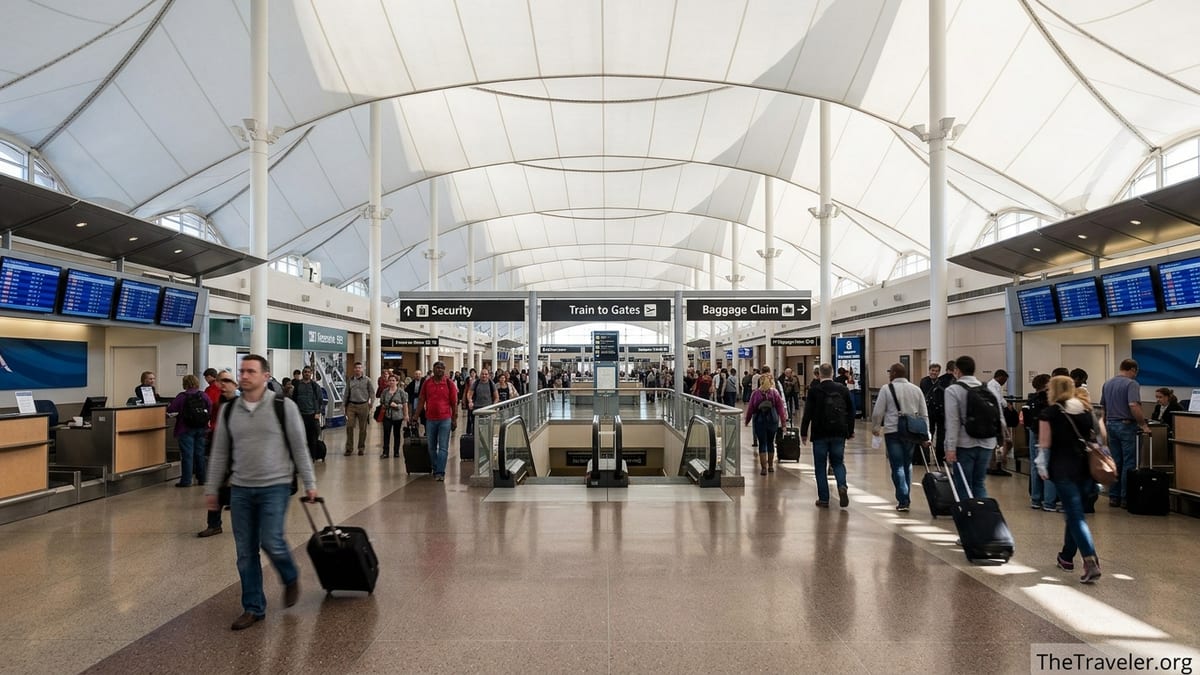
How Denver International Airport Is Laid Out
Denver International Airport uses a simple "one terminal, three concourses" design. The landside building is called the Jeppesen Terminal, and that is where you will find airline check in counters, TSA security checkpoints, baggage claim, ground transportation and the main public areas. Once you clear security, you move into the airside side of the airport, which is organized into three separate concourses labeled A, B and C, each with its own set of gates and amenities.
The easiest way to picture the map is to imagine a hub in the middle with three spokes. The hub is Jeppesen Terminal. Extending out from that hub are Concourses A, B and C, all in a line and all connected by the underground "Train to the Gates." Every departing passenger starts in Jeppesen Terminal, passes through security on Level 6, then rides the train or uses the pedestrian bridge to reach their concourse. Every arriving passenger does the reverse to reach baggage claim and transportation on Level 5.
Unlike airports with multiple separate terminals, you will not need to change terminals at Denver. Whether you are flying United, Southwest, Delta, Frontier, American or an international carrier, you still begin and end in the same Jeppesen Terminal building. The only thing that changes is which concourse your gate is on and how many train stops it takes to get there.
For a concrete example, a traveler flying United from Denver to Chicago will check in and clear security in Jeppesen Terminal, then head to Concourse B where most United gates are clustered. Someone flying Southwest to Phoenix will follow exactly the same initial steps, but ride the train two stops instead of one, because Southwest primarily uses Concourse C.
Understanding Jeppesen Terminal: Levels, Check In and Baggage Claim
Jeppesen Terminal is the white peaked structure you see in photos of Denver International Airport. Inside, the building is organized vertically. Level 6 is primarily airline check in and security. Level 5 is where baggage claim, arrivals, ground transportation, the RTD rail station access and some shops and services are located. Lower levels connect to parking and some back-of-house areas that most passengers will not use.
If you are departing Denver, you will most likely be dropped off on Level 6 outside the appropriate side of the terminal. United, for example, is dominant on the west side of Jeppesen Terminal, while Southwest, Frontier and several other carriers tend to use the east side. After your airline check in counter, you will follow signs to one of the main TSA checkpoints on Level 6. These checkpoints all lead to the same secure area, so it does not matter which one you use for reaching the concourses, but it can matter for how long you wait in line.
On arrival in Denver, your path reverses. From your gate, you take the train back toward the terminal, then ride the escalators or elevators up into the Level 5 baggage claim halls. Baggage carousels are split between east and west, generally matching the airline you flew. For example, a traveler arriving on United from Houston will follow signs to West Baggage Claim on Level 5, while a traveler arriving on Southwest from Las Vegas will follow signs to East Baggage Claim. From there, exits lead directly to ride share pick up points, taxis, hotel shuttles and private vehicles.
Information booths in Jeppesen Terminal are especially helpful for first time visitors. Staff can point you to the correct security checkpoint, confirm which side your airline uses, or explain the quickest route to the RTD train to downtown. A traveler landing late at night, unsure where to collect bags, can walk just a few steps from the escalator into baggage claim and find clearly marked information desks staffed throughout much of the day.
Concourses A, B and C: Who Flies Where
After security, every passenger at Denver travels to one of three concourses. Concourse A is the closest to the terminal. It handles a mix of domestic and international flights, with several major U.S. carriers and foreign airlines using its gates. Many international flights that arrive in Denver, including from Europe and Latin America, pull up to Concourse A, where passengers clear U.S. customs and immigration before rejoining the main terminal.
Concourse B is largely the home of United Airlines and its regional partners. If your boarding pass shows a gate number starting with "B," you will almost certainly be heading to a United-operated flight or a United Express regional jet parked on one of the concourse's many commuter gates. The length of Concourse B can surprise first time visitors. A traveler connecting from a United flight arriving at B4 to a regional flight departing from B80 should allow at least 20 to 25 minutes to walk comfortably down the concourse, especially during busy times when moving walkways are crowded.
Concourse C is where Southwest Airlines has its Denver hub presence, joined by several other carriers such as American, Alaska and a handful of smaller airlines. Just like Concourse B, Concourse C stretches out with gates running into the 60s and 70s, and walk times can add up. A traveler connecting from an American Airlines arrival at Gate C30 to a Southwest departure at C60 should expect close to a 10 to 15 minute walk, depending on crowd levels and personal pace.
An important detail for planning: you cannot walk between concourses without returning to the train platform. There is no public airside walkway from Concourse B to Concourse C, for example. If you land on B and need to catch a flight on C, you simply stay within the secure area, take the train one stop farther, and walk to your new gate. There is no need to reclear security as long as you do not exit into the main terminal.
Security Checkpoints and the Bridge to Concourse A
Security lines are often the most stressful part of any trip, and Denver is no exception. Fortunately, all three concourses are accessible from any of the main TSA checkpoints on Level 6 of Jeppesen Terminal, so your main decision is which checkpoint line looks shortest or is most convenient to your check in area. Travelers with TSA PreCheck or CLEAR will find dedicated lanes at certain checkpoints, which can significantly cut wait times during morning and evening peaks.
One unique feature of Denver is the pedestrian bridge that connects Jeppesen Terminal directly with Concourse A, bypassing the train for those willing to walk. After clearing security at the checkpoint that feeds the bridge, you can stroll across a glass walled walkway with views of aircraft taxiing below and the Rocky Mountains in the distance. The walk typically takes about 5 to 10 minutes for most travelers. This bridge is especially useful when the train area feels crowded or during periods of maintenance and delays on the train system.
Because the bridge leads straight into the center of Concourse A, it is often the fastest route for A gates located near the middle of the concourse. For example, a traveler departing from Gate A36 who clears security at the bridge checkpoint can be at the gate in less than 15 minutes in most situations, including walking and a brief stop to grab coffee en route. The bridge can also be valuable for nervous fliers who prefer extra movement and natural light before boarding.
If your flight leaves from Concourse B or C, you will still use the same general security checkpoints, but you will follow signs down escalators after security to reach the train platform instead of heading out to the bridge. First time visitors sometimes worry that they have chosen the "wrong" checkpoint for their gate. At Denver, that is rarely the case. Once you are through security, everything connects via the train system, so the most important factor is simply to allow enough time.
Riding the Train to the Gates
The "Train to the Gates" is Denver International Airport's underground automated people mover. It links Jeppesen Terminal with Concourses A, B and C, stopping in the center of each. Trains arrive every few minutes under normal operations, and the ride between each stop is only a couple of minutes. The system is designed so that passengers follow a simple order: from the terminal, the first stop is Concourse A, the second is Concourse B, and the third is Concourse C.
For departing passengers, the boarding platform is located below Jeppesen Terminal, accessible by escalators and elevators after security. Overhead signs clearly show which side of the platform is boarding for the concourses, and onboard announcements call out the next stop. For example, a traveler leaving Denver on Southwest will board in the terminal area, ride past the first stop at A, stay onboard for the second stop at B, and exit at the third stop, C. This sequence is easy to follow as long as you remember the alphabetical order of the concourses.
Arriving passengers follow the reverse pattern to reach baggage claim. After stepping off the plane, you walk to the center of your concourse and descend to the train platform. You then take the train toward "Terminal and Baggage Claim." If you are on Concourse C, the train will stop at B, then A, then the Terminal. Staying on until the final stop brings you back to Jeppesen Terminal, where you ride up to baggage claim on Level 5. A traveler arriving late at night, bleary from a long-haul flight, can simply follow the crowd down from the gate, board the first train marked for the terminal and stay on until everyone disembarks at the end of the line.
On rare occasions, scheduled maintenance temporarily changes the train pattern, especially overnight. When that happens, the airport adds large signs explaining alternate routes and may direct some passengers to use the pedestrian bridge to Concourse A. As a visiting traveler, your best strategy is to follow the current signage and listen to train announcements, which will clearly indicate if service is limited between certain stops. For most daytime travelers, especially during peak hours, the train operates normally and is the fastest route between the terminal and all concourses.
Step by Step: A First Time Traveler’s Journey Through DEN
To see how all of this fits together, imagine a first time traveler flying from New York to Denver on United, then connecting onward to Salt Lake City on the same airline. The traveler lands at a B gate, walks into the center of Concourse B and checks the overhead monitors to confirm their next gate, which might be B50. They realize they only have 45 minutes between flights, so they use the moving walkways along the concourse to speed up the journey, stopping quickly at a coffee shop in the center core to refuel before walking to the mid-concourse gates.
In another scenario, picture a family flying Southwest from Denver to Orlando. They arrive at Jeppesen Terminal by rideshare and are dropped at the east side check in area on Level 6. After printing bag tags at a kiosk and dropping off their suitcases, they follow overhead signs to a security checkpoint offering family lanes that accommodate strollers. Once cleared, they immediately see escalators leading down to the train. On the platform, screens show the next train arriving in under two minutes. They board, pass the first stop at Concourse A and the second at Concourse B, and then exit at Concourse C, where their gate C34 is less than a five minute walk from the central core.
Consider a third example involving an international arrival. A traveler flying in from Frankfurt on a foreign carrier lands at Concourse A. After disembarking, they follow signs to U.S. customs and immigration, clear passport control, collect and recheck any luggage as instructed, and then pass through security screening before reentering the main terminal system. From there, if they have a domestic connection on a U.S. airline, they will ride the train to the appropriate concourse, just as any other passenger would.
These examples highlight how consistent the flow is at Denver. No matter which airline you fly or where you come from, you always return to the same decision points: which concourse your next flight uses, whether you need the train or the bridge to reach it, and which level of Jeppesen Terminal you must go to for baggage or ground transport. Once you are familiar with these basic steps, even a tight 40 minute domestic connection is manageable for most able bodied travelers who walk with purpose.
Tips for Smooth Connections, Long Walks and Amenities
One of the most important practical tips for navigating Denver is to allow time for long walks inside the concourses. The airport's "dumbbell" design, with long linear concourses and gates extending far from the central core, means that a gate-to-gate transfer can involve 10 to 20 minutes of walking even without changing concourses. Travelers with reduced mobility, small children or heavy carry on bags should factor this into their connection planning or request wheelchair assistance through their airline in advance.
For those with longer layovers, each concourse offers a variety of restaurants, bars and shops clustered around the center core. A traveler with three hours to spare before an evening departure might choose to stay on their concourse, enjoy a sit down meal overlooking the tarmac and charge devices at gate area power outlets, instead of returning to the main terminal. Play areas and quiet seating zones, including kid focused spaces on Concourse C, give families a break during extended waits.
Wayfinding signs at Denver are generally clear and color coded, but first time visitors sometimes miss smaller directional signs when the concourses are crowded. If you feel uncertain, look for overhead boards labeled "All Gates" and "Train to Terminal" or ask at one of the information booths positioned at the center of each concourse. Staff there can help you estimate walk times to distant gates, explain whether a last minute gate change keeps you on the same concourse or forces a quick hop on the train, and point out the nearest restrooms or nursing rooms.
Finally, remember that all concourses stay airside, behind security. If you accidentally ride the train past your stop on arrival, you can remain on board and loop back to the correct concourse without passing through security again. Only when you exit into Jeppesen Terminal on Level 5, heading toward baggage claim or ground transportation, do you leave the secure area. That knowledge can be reassuring if you miss a train announcement or realize late that your gate is actually back on Concourse A rather than B.
The Takeaway
Denver International Airport's layout looks complex on a flat map, but in practice it follows a clear, repeatable pattern: one central terminal, three concourses in alphabetical order, and a train that connects everything. Once you understand that Jeppesen Terminal is for check in, security, baggage and transportation, while Concourses A, B and C are where flights actually depart and arrive, the pieces fall into place.
For first time travelers, the keys to a low stress experience at Denver are simple. Check your gate and concourse early, plan time for the train and the long concourse walks, choose any security checkpoint with a reasonable line, and follow the overhead signage. Use the pedestrian bridge to Concourse A when it is convenient, and do not hesitate to ask staff at information booths for directions if something is unclear.
With those basics in mind, you can treat Denver International Airport as an efficient connection point rather than an obstacle. Whether you are sprinting to make a 40 minute domestic connection on United, shepherding a family through a midday Southwest departure, or clearing customs after an overnight international flight, a working mental map of Jeppesen Terminal and the three concourses will help you navigate DEN with confidence.
FAQ
Q1. How early should I arrive at Denver International Airport before my flight?
For most domestic flights, plan to arrive at Jeppesen Terminal 2 hours before departure. For international flights, aim for 3 hours, especially during morning and evening peaks when security lines can be longest.
Q2. How do I know which concourse my flight uses at DEN?
Your boarding pass and booking confirmation will list a gate starting with A, B or C. A means Concourse A, B means Concourse B, and C means Concourse C. Airline apps also show this information and update it if the gate changes.
Q3. Do I have to take the train to reach every concourse?
You must use the train for Concourses B and C. Concourse A can be reached either by train or by the pedestrian bridge that connects directly from Jeppesen Terminal after security.
Q4. How long does the train ride take between the terminal and the concourses?
Under normal conditions, trains arrive every few minutes, and each segment between stops is only a couple of minutes. From Jeppesen Terminal to Concourse C, the farthest stop, the total ride is usually under 10 minutes, not counting waiting time.
Q5. If I am connecting flights, do I have to go through security again at DEN?
For most domestic to domestic or domestic to international connections, you stay inside the secure area and do not pass through security again. You simply ride the train to your next concourse and walk to your new gate.
Q6. Where is baggage claim at Denver International Airport?
Baggage claim is on Level 5 of Jeppesen Terminal, split between east and west sides. Follow signs from the train up to "Baggage Claim," then look for monitors listing your flight and carousel number.
Q7. How much time do I need for a connection between distant gates?
Walk times within a single concourse can reach 15 to 20 minutes for far apart gates, especially on long Concourses B and C. If you also need to change concourses using the train, having at least 45 minutes between flights is comfortable for most travelers.
Q8. Is the pedestrian bridge to Concourse A faster than the train?
For gates near the center of Concourse A, the bridge can be just as fast or faster, especially when train platforms are crowded. For gates far out on the concourse, overall time is often similar, so you can choose based on preference.
Q9. What should I do if the train is down for maintenance?
When scheduled maintenance affects the train, the airport posts large signs and may direct some passengers to use the bridge to Concourse A or temporary alternatives. Follow current signage and staff instructions, as patterns can change depending on the work being done.
Q10. Are there information desks if I get lost in DEN?
Yes. Information booths are located in Jeppesen Terminal on Level 5 and in the center core of each concourse. Staff can provide maps, estimate walk times and help with directions to gates, baggage claim or ground transportation.