


More news on this day
Dubai International Airport is edging back toward full capacity after months of airspace disruptions linked to the Iran conflict, with flight data and aviation reports showing the Middle East’s busiest international hub handling heavy passenger volumes despite lingering regional risks.
Get the latest news straight to your inbox!
Traffic Rebounds as Airspace Gradually Reopens
Publicly available information from aviation authorities and industry trackers indicates that United Arab Emirates airspace was fully restored in early May 2026, following extensive closures and reroutings triggered by the outbreak of the conflict in late February. Since then, Dubai International Airport has moved rapidly to rebuild schedules, adding frequencies and reopening routes as neighboring flight corridors become available.
Dubai Airports data cited in regional business coverage shows that the hub processed about 18.6 million passengers in the first quarter of 2026, even as airspace restrictions intensified in March. Operators report that by late spring the airport was once again handling more than a thousand flight movements per day, approaching its pre-crisis baseline of roughly 1,200 daily flights at peak.
Independent airline and cargo bulletins describe Dubai as a key stabilizing node in a reshaped regional network, with carriers using alternative routings over the Arabian Sea and Pakistan to avoid high-risk airspace. While these detours add time and complexity, they have enabled the airport to sustain a large share of its long-haul and regional connectivity and to steadily lift operations toward normal capacity.
Industry analyses circulated in May suggested that Dubai International was already operating at more than half of its theoretical annual capacity, with forecasts pointing to as many as 85 million to 90 million passengers this year if the current ceasefire holds and routing options continue to expand.
Resilient Hub Amid Conflict-Related Disruptions
The rebound comes after one of the most turbulent operational periods in the airport’s history. At the height of the conflict this spring, airspace closures across much of the Gulf forced sweeping cancellations and diversions. Published reporting shows that Dubai International experienced temporary suspensions of departures and arrivals following drone and missile incidents in the vicinity of key terminals, though the facility never entered a prolonged full shutdown.
Throughout March and April, Dubai’s main carriers Emirates and flydubai maintained reduced but extensive networks from their home base, shouldering the bulk of passenger flows as many foreign airlines suspended services to the United Arab Emirates and broader Middle East. Travel advisories from logistics and freight operators during that period repeatedly described Dubai and Abu Dhabi airports as operational but capacity constrained, with schedule changes and backlogs common.
Analytical digests covering the conflict’s economic impact note that Dubai International is central to global air traffic patterns, historically ranking as the world’s busiest airport for international passengers. Even during the worst weeks of the crisis, the hub continued to process millions of travelers and hundreds of thousands of tonnes of cargo, underscoring its strategic role in connecting Europe, Asia, and Africa.
By early summer, conflict monitoring reports were already documenting days when Dubai’s flight activity had climbed back to more than 95 percent of its pre-war level, reflecting an aggressive push by the airport operator and airlines to normalize operations whenever security conditions allowed.
Passengers See Busy Terminals but Patchy Airline Recovery
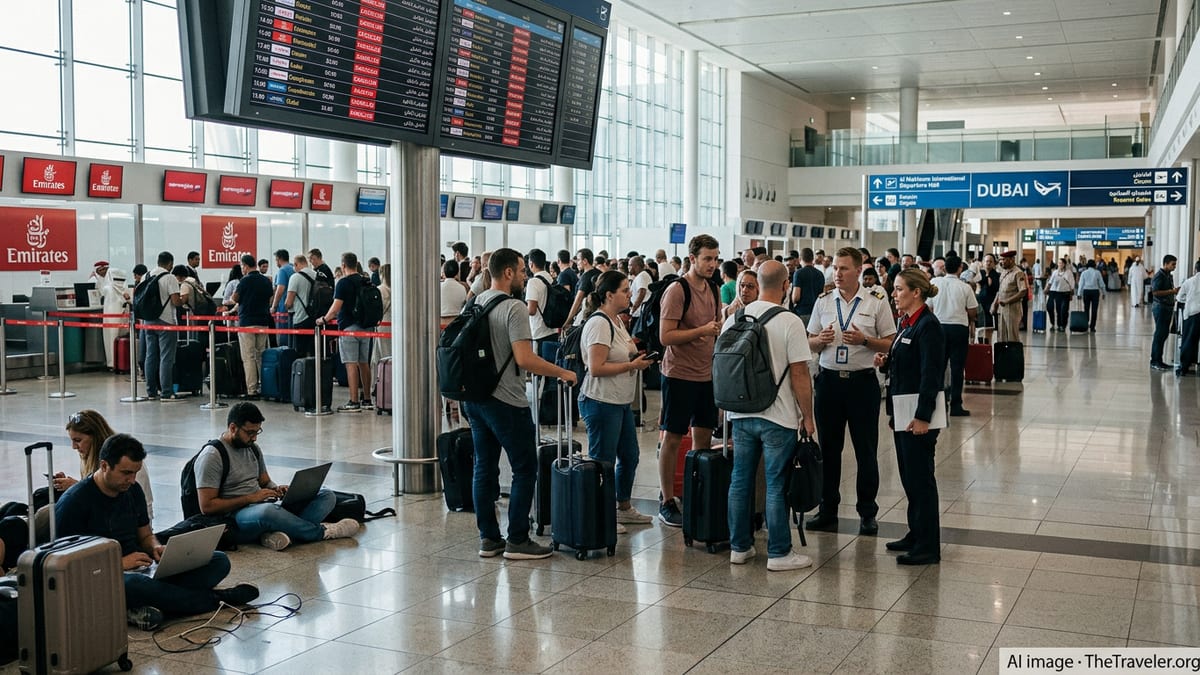
Recent traveler accounts and schedule data suggest that Dubai International today looks and feels busy, even if the mix of airlines and routes remains different from pre-conflict patterns. Social media posts from June and July describe crowded concourses, long-haul flights operating as usual on Gulf-based carriers, and a general sense that daily life in the terminals has stabilized, albeit with heightened security and occasional delays.
At the same time, several major foreign airlines have been slower to restore full programs into Dubai. International business and travel coverage highlights that some European carriers have returned with once-daily services rather than multiple daily frequencies, while certain North American airlines have left their Dubai routes suspended for now. This staggered return keeps overall seat capacity below what the airport’s infrastructure can handle, even as home carriers add back flights.
Travel forums and community channels focused on Gulf aviation still feature frequent questions about short-notice cancellations, altered routings, and the status of particular flights. Contributors regularly advise passengers to check airline apps and airport departure boards on the day of travel, reflecting a more fluid operating environment than before the conflict.
Despite this volatility, publicly accessible flight-tracking data and recent reporting from regional outlets show that Dubai International continues to welcome a broad spread of services, from European and Asian long-haul routes to high-frequency regional links across the Middle East, Indian subcontinent, and East Africa.
Cargo and Supply Chains Lean on Dubai’s Capacity
Supply chain advisories issued in June by global logistics firms point to Dubai and Abu Dhabi as critical gateways for keeping trade moving during the crisis. With several regional airports operating under tighter restrictions or limited hours, forwarders have increasingly funneled time-sensitive shipments through the United Arab Emirates, relying on the relative stability of its hubs and the extensive belly-hold cargo capacity of Gulf carriers.
These reports note that while some lanes into neighboring markets such as Iraq, Kuwait, and Bahrain continue to face delays, Dubai’s airports are generally described as fully open, with only sporadic disruption tied to wider regional security measures. That status has reinforced Dubai International’s position as a preferred consolidation point for pharmaceuticals, high-value electronics, and other priority goods that depend on predictable air links.
Air cargo analysts observing the situation argue that the ability of Dubai International to operate near full capacity, even amid reroutings and selective airline suspensions, has cushioned the global supply chain impact of the conflict. By absorbing diverted freighter and passenger traffic, the airport has limited the spillover of Middle East instability into Asia–Europe and transcontinental trade flows.
Logistics guidance to shippers nonetheless stresses the need for contingency planning, advising clients to build in additional lead times and to remain flexible regarding routings and transit hubs as the regional security picture evolves.
Outlook: High Throughput with Elevated Uncertainty
Looking ahead to the second half of 2026, aviation commentators expect Dubai International to remain extremely busy, with passenger volumes climbing toward the upper end of current forecasts if the ceasefire endures. The airport’s stated long-term ambition is to surpass 100 million annual passengers within the next few years, and the pace of the current recovery suggests that target remains within reach.
However, published conflict assessments and travel risk briefings emphasize that the situation remains inherently fragile. Shifts in the underlying political or security environment could prompt renewed airspace closures, abrupt schedule cuts, or further incidents that temporarily disrupt operations at the region’s main hubs, including Dubai.
For travelers, that combination of high throughput and elevated uncertainty translates into a need for closer attention to trip planning. Current guidance from airlines and travel specialists typically urges passengers to re-confirm itineraries shortly before departure, allow extra time at the airport, and stay informed about any new advisories affecting the Gulf region.
For now, though, the evidence from traffic statistics, airline schedules, and on-the-ground accounts converges on a clear picture: Dubai International Airport is once again functioning at or near full capacity, serving as a resilient anchor for global travel even as the wider Middle East remains on edge.