


More news on this day
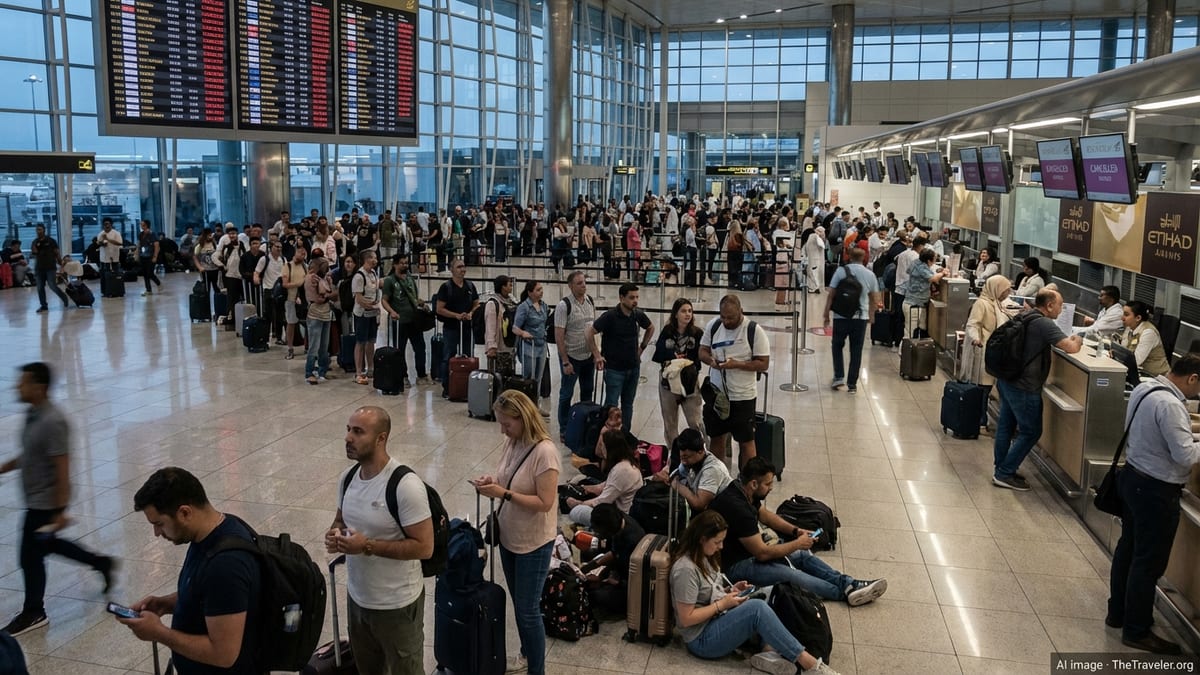
Passengers traveling through Dubai and other major Middle East hubs are being urged to check their flight status as renewed US-Iran hostilities trigger another wave of cancellations, schedule changes and rerouting across the region’s already fragile aviation network.
Get the latest news straight to your inbox!
Fresh disruptions as Gulf carriers recalibrate
Air travel across the Gulf is facing renewed strain as airlines adjust schedules in response to the latest military escalation between the United States and Iran. While core operations at Dubai International and Abu Dhabi’s Zayed International Airport remain largely intact, publicly available information indicates that a growing list of regional and international carriers have suspended or reduced services into the United Arab Emirates and neighboring states.
Recent coverage from regional outlets shows that airlines including Air France, British Airways, Air Canada, Singapore Airlines and several low-cost and regional operators have halted or postponed selected flights to Dubai, Riyadh, Kuwait and Bahrain. Some suspensions, originally expected to lift earlier in the summer, have been extended into late August or even October as airlines continue to reassess security and operational risk on a rolling basis.
Local Gulf carriers have largely maintained long-haul connectivity by reallocating aircraft and capacity to routes that remain viable. Reports on Dubai’s aviation sector suggest that while the number of foreign airlines operating at the city’s airports has fallen sharply since the conflict began in February, home-based carriers have absorbed a portion of the lost capacity, limiting the overall reduction in seats for key intercontinental markets.
Industry analysts note that this patchwork response mirrors the region’s experience during earlier phases of the conflict, when short-notice airspace closures and missile alerts led to temporary shutdowns, followed by gradual restoration of flights under revised routings and timetables.
European and Asian airlines extend suspensions
European and Asian airlines remain among the most cautious operators in the current phase of the crisis. According to recent reporting, British Airways has pushed back the resumption of its Dubai service until late October, with linked suspensions or reductions on routes to Tel Aviv, Bahrain, Amman and Doha. Air France and other European carriers have also extended pauses on selected Dubai and Riyadh flights, citing ongoing regional security concerns.
From Asia, Singapore Airlines has prolonged the suspension of its Dubai flights into late October, while some associated low-cost brands have canceled or consolidated services on certain Gulf routes. Publicly available schedules suggest that several carriers which briefly considered a summer restart have now deferred their return until at least the northern winter season, pending further clarity on the security environment.
These decisions reflect not only risk assessments but also the operational complexity created by rerouting aircraft around sensitive airspace. Longer flight times, higher fuel consumption and crew duty limitations have made some routes commercially marginal, prompting airlines to prioritize more straightforward networks until conditions stabilize.
Regulators flag elevated risks over Gulf airspace
Aviation safety regulators have again highlighted elevated risks to civil aviation over parts of the Persian Gulf and Gulf of Oman. Updated guidance from the European Union Aviation Safety Agency points to the potential hazards posed by missile and drone activity, interceptions and falling debris in airspace linked to Bahrain, Kuwait, Qatar, the UAE and adjacent waters, following repeated military exchanges and strikes on infrastructure.
In parallel, US aviation authorities continue to publish advisories and notices concerning hostile or potentially hostile environments, including areas where military operations and air defense activity may intersect with commercial flight paths. These documents, intended for operators and flight planners, underscore that risk levels can change rapidly as events unfold on the ground and in the air.
As a result, many airlines are maintaining conservative routings that skirt higher-risk zones, even when local airspace is technically open. This has translated into longer detours for some Europe–Asia and Asia–Africa services that previously overflew Iran or nearby waters, further tightening aircraft and crew availability at a time of strong global demand for long-haul travel.
Passengers urged to monitor flights closely
Travel advisories issued in recent days for residents and visitors in the UAE emphasize that passengers should check their flight status directly with airlines or via airport information channels before leaving for the airport. Gulf-based news outlets report that while the majority of flights at major hubs are operating broadly on time, some regional services to Kuwait, Bahrain and parts of the Levant continue to face cancellations or late-notice timetable changes.
Foreign embassies and consular services in the region have also updated security notices, warning that intermittent airspace restrictions, missile alerts or military activity could prompt sudden disruptions. Public guidance typically encourages travelers to allow extra time for connections, maintain flexible itineraries where possible and stay alert to any changes communicated by carriers or travel providers.
Passenger rights vary by airline and jurisdiction, but many carriers have put in place temporary waivers allowing affected travelers to rebook without change fees, accept alternative routings, or request refunds when flights are canceled. Industry observers recommend that passengers retain all documentation related to disrupted travel, including boarding passes and booking confirmations, in case they need to pursue compensation or insurance claims at a later stage.
From acute shutdowns to a protracted, uneven recovery
The latest round of disruption comes several months after the initial US and Israeli strikes on Iran and subsequent Iranian retaliation in late February triggered one of the most severe aviation shutdowns the region has seen in years. At that time, major Gulf hubs including Dubai, Abu Dhabi and Doha experienced abrupt closures, damage to infrastructure and the temporary grounding or diversion of thousands of flights across multiple continents.
Since then, the aviation network has been rebuilt in stages, with local authorities repairing facilities, reopening airspace and adjusting contingency plans. While core hub operations have largely recovered, the system remains vulnerable to renewed spikes in tension, as illustrated by the current wave of selective cancellations and extended suspensions by foreign airlines.
Travel industry analysts describe the present environment as one of protracted, uneven recovery, in which Gulf carriers and airports continue to function as critical global connectors but with a reduced and more volatile cast of international partners. For passengers, that means long-haul journeys involving Dubai and other Middle East hubs can still proceed, but with a greater need for flexibility, vigilance and up-to-date information as the US-Iran conflict continues to cast a shadow over regional air travel.