


Dugi Otok looks made for road trips, but you do not need a car to enjoy it. With a bit of planning, you can reach turquoise bays, fishing villages and cliffs using a combination of ferries, local buses, bikes, scooters and boat tours. This guide focuses on what is realistically possible without your own vehicle, based on current transport options and how visitors are actually moving around the island in 2026.
Get the latest updates straight to your inbox!
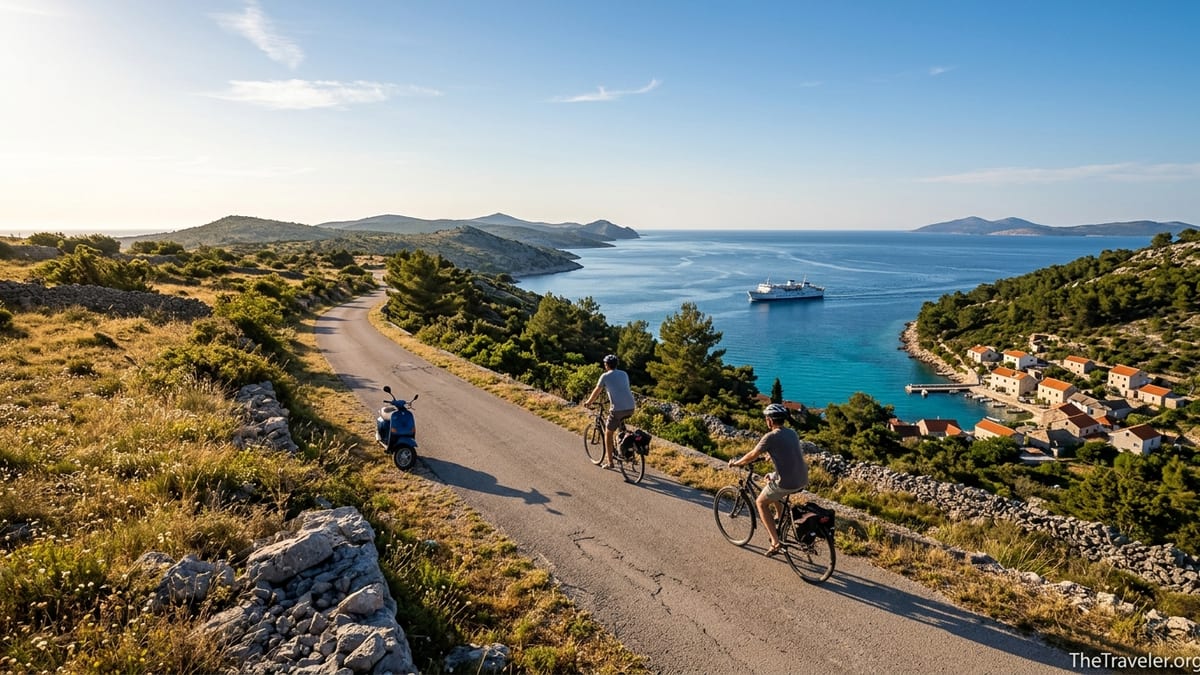
Understanding Dugi Otok’s Layout and Distances
Dugi Otok is about 43 kilometers long and very narrow, with one main road (D109) running down the spine of the island from north to south. Most villages and beaches sit just off this road, often down short side lanes. The main settlements for visitors are Sali in the south, Zaglav slightly north of Sali, Božava and Veli Rat in the north, and Brbinj in the middle where the car ferry from Zadar arrives. When you look at the map, everything seems close, but the island is just large enough that walking between key spots quickly becomes tiring in summer heat.
As a benchmark, Brbinj to Sali is roughly 20 kilometers by road, while Brbinj to Božava is around 16 kilometers. Cycling these stretches is possible for reasonably fit riders, but it is a solid hour or more each way with some hills. From Sali to the entrance of Telašćica Nature Park is about 10 kilometers, then a few more to famous viewpoints like Grpašćak. From Božava to Sakarun beach is around 4 kilometers, which is easy by bike or scooter and technically walkable, though you will feel the sun if you do it in the middle of the day.
Understanding these distances matters, because public transport on the island is limited and does not cover every combination of places. Many travelers discover on arrival that they cannot just hop a bus from Brbinj down to Sali at any time of day, or from Sali up to Sakarun. The key to a good car-free trip is matching where you stay with the specific places you want to visit, and then filling in the gaps with bikes, scooters, or organized boat trips.
Think of Dugi Otok as three functional zones rather than one continuous strip: the north (Božava, Veli Rat, Sakarun, Veli Žal), the central belt (Brbinj and a handful of small villages), and the south (Sali, Zaglav, Telašćica). Moving inside one zone without a car is usually manageable. Trying to cover north and south in a single short stay without your own wheels quickly becomes restrictive.
Getting to Dugi Otok Without a Car
Your gateway to the island is Zadar. From there you choose between the car ferry to Brbinj or a fast boat to the southern end. The main connection is the Jadrolinija car ferry between Zadar’s Gaženica port and Brbinj on Dugi Otok. In summer there are several sailings a day in each direction, typically taking around 1 hour 40 minutes. Foot passengers simply buy a regular ticket; you do not need a reservation if you are not bringing a vehicle, although checking current departure times the day before is wise because seasonal schedules can shift slightly.
For those heading to Sali or Zaglav rather than Brbinj, a separate fast passenger line connects Zadar with Sali and Zaglav. In 2026 this route is operated as a state fast-boat line, with multiple daily departures in high season. Travel time from Zadar to Sali is roughly an hour, slightly more if the boat stops at smaller islands en route. The advantage of this option is that you step off the catamaran directly in the village where many guesthouses and apartments are located, so there is no need for a taxi or long transfer on arrival.
If you arrive in Zadar by long-distance bus or at the main city bus station, getting to the ferry or fast-boat port is straightforward. Local buses run regularly between the central station and Gaženica ferry port, and they are operated by the local company Liburnija. Tickets can be purchased from the driver in cash or through the official city public transport app, which also shows real-time departures. In practice, many travelers simply take a taxi or app-based ride from the old town or main bus station to Gaženica since the ride is short and reasonably priced by European coastal-city standards.
When planning your arrival and departure, build in buffer time. It is not uncommon for visitors to misjudge the connection between an afternoon FlixBus into Zadar and the last ferry to Brbinj, or between a catamaran from Sali and an evening bus onward to Split or Zagreb. Aim for at least one ferry or boat earlier than the last possible option on days when you have flights or onward travel.
Island Buses: What Exists and What Does Not
Dugi Otok does have a local bus network, but it is limited and mainly designed around school and resident needs rather than tourist itineraries. The buses are operated under the wider Zadar County public transport system, with Liburnija in charge of island lines. These services link villages such as Božava, Veli Rat and Sali with the main ferry ports, but they do not run every hour, and some stretches of the island are barely served in summer 2026.
The most consistently useful routes for visitors are in the north, where local buses connect Božava, Veli Rat and sometimes Sakarun area stops with the Brbinj ferry. In practice, this means that if you base yourself in Božava or Veli Rat, you can usually catch a morning bus toward the ferry in Brbinj on departure days and an afternoon or evening bus back towards the north when you arrive. Exact times change seasonally, so it is important to confirm them locally at Brbinj ferry port or with your accommodation host rather than rely on information from previous years.
The biggest gap for car-free travelers is between Brbinj and Sali. As of mid 2026 there is little or no regular bus connection on this stretch that works reliably for visitors, which surprises many people who assume there will be a simple island-long route. There may sometimes be school-oriented or limited local buses, but travelers cannot count on being able to land at Brbinj and then roll south by bus at any hour of the day. The same applies to the idea of bussing from Sali up to beaches around Sakarun and Veli Rat in the north. Without your own vehicle, moving between the southern and northern halves of the island in one day is logistically awkward.
Ticket pricing on the island buses is usually straightforward and paid in cash to the driver. Based on recent island fare lists, short hops between adjacent villages cost just a few euros equivalent, while the longest island routes cost somewhere under the price of a restaurant lunch. However, it is important not to treat buses as your primary mode for exploring beaches and coves. Think of them instead as a way to connect ferry ports to the main villages where you will actually stay, and then rely on bikes, scooters, walking and boats to reach the highlights nearby.
Bikes and Scooters: The Real Workhorses Without a Car
For most visitors without a car, renting a bicycle or scooter is what makes Dugi Otok workable. The main tourist villages have at least one rental outlet or agency that can arrange delivery of bikes or scooters to your accommodation. In Sali, for example, you will find small local agencies and guesthouses offering mountain bikes and e-bikes by the day, usually at prices that are in line with other Adriatic islands. Božava and Veli Rat also have rental options, with simple trekking bikes and small 50 cc scooters popular among younger travelers.
For a realistic idea of effort, consider the ride from Sali to the entrance of Telašćica Nature Park. On a regular bike, most moderately fit riders can complete the 10-kilometer stretch in about 40 to 50 minutes each way, not counting stops. The road is paved but rolling, with some short climbs. In August heat, an e-bike makes this ride much more comfortable, particularly for those not used to cycling in warm conditions. From Božava to Sakarun beach, the 4-kilometer ride on a shaded road takes around 15 to 20 minutes and is easy even for beginners. This is why many Sakarun day-trippers arriving on organized boat tours are given simple bikes to cover the last stretch from the small port to the beach.
Scooters extend your realistic exploration radius. With a 50 or 125 cc scooter from Sali, you can comfortably reach most parts of the southern and central island, including Telašćica viewpoints and smaller coves along the way. Similarly, from Božava or Veli Rat, a scooter makes it straightforward to hop between Sakarun, Veli Žal beach, the lighthouse at Veli Rat and small bays along the coast. The roads are generally quiet compared with the mainland, though you still share them with cars and delivery vans, so basic scooter experience is strongly recommended.
Helmets are legally required on scooters and should be worn on bikes for safety. Rental contracts usually include basic insurance for the vehicle but expect to leave a deposit and show a valid driving license for scooters. When comparing offers, ask specifically whether lights, locks and basic repair kits are included with bikes, especially if you plan to ride outside the main villages around dusk. In many cases, the best approach is to arrange rentals directly through your accommodation, who will know the most reliable local provider and can advise which type of bike or scooter suits the terrain around your base.
Taxis, Private Transfers and Boat Tours
Taxis and private transfers exist on Dugi Otok, but they are limited in number and function more like pre-booked local drivers than city-style taxi fleets. In practical terms, this means you should not count on waving down a cab on the roadside. Instead, arrange transfers in advance, either through your guesthouse or by asking at tourist offices in Sali, Božava or Veli Rat. These drivers are particularly useful for one-off moves such as getting from Brbinj ferry to accommodation in Sali if the timing does not match any bus, or for checking out of one village and relocating to another in the middle of your stay.
Because the supply of island taxis is small, prices tend to reflect both distance and scarcity. A transfer across half the island can easily cost more than a day’s bike rental, so use them strategically rather than as your default mode of transport. It can be good value when shared between three or four people, especially if it avoids the need to rent a car for your entire stay just to solve one difficult transfer day.
Boat tours are a much more central part of getting around Dugi Otok without a car. From Zadar, dozens of agencies run full-day trips by excursion boat or fast RIB to Sakarun beach and the north of Dugi Otok. These tours typically include transport by boat to a small harbor close to Sakarun, then a shuttle or bikes to cover the last few kilometers to the sand. Prices are competitive and usually include lunch or swimming stops around the cliffs and sea caves. For many travelers with limited time who do not want to manage ferries and local logistics, this is the simplest way to see Sakarun.
On the island itself, you will find smaller operators running half-day and full-day trips from Sali and Zaglav into Telašćica Nature Park and the Kornati archipelago. These often include visits to Mir salt lake, high cliffs, snorkeling spots and quiet bays that would be unrealistic to reach overland. If you are staying car-free in Sali, budgeting for at least one or two boat days effectively replaces the need to drive long distances and still gives you access to remote scenery.
Where to Base Yourself Without a Car
Choosing the right base is the single biggest decision for a car-free stay on Dugi Otok. The three most logical choices are Sali in the south, Božava in the north and, for some visitors, Veli Rat near the lighthouse. Brbinj, while practical as a ferry port, is quieter and less convenient as a base if you have no vehicle, since you will still need transport to reach standout beaches and parks.
Sali works well for travelers focused on Telašćica Nature Park and boat trips into the Kornati islands. The village has grocery shops, several restaurants and cafes, and a small harbor where fast boats from Zadar arrive. Many guesthouses are within walking distance of everything. From Sali, it is realistic to get around by a combination of walking, bikes or scooters. You can, for example, cycle to Telašćica for the day, visit cliffs and the salt lake, and return in the evening without needing any bus connection. Sali is also a good base for those who want a bit of nightlife and local festivals in summer.
Božava is the classic base for visitors targeting Sakarun and the north. The village is compact, with accommodation hugging a small bay, and several properties include or can arrange bike rental. A key advantage here is that Sakarun and Veli Žal beaches are both within easy cycling distance. On some summer days, the tourist train, a small road train, operates between Božava and Sakarun, giving yet another option beyond bikes and scooters. From Božava, you can also explore up to Veli Rat lighthouse by scooter or bike, stopping at bays along the way.
Veli Rat itself is quieter and popular with families and couples looking for more seclusion. Staying here makes the lighthouse, nearby coves and northern beaches extremely accessible by foot or bike, but you will have fewer dining and service options. Without a car, this works best for visitors who are happy to stay mostly local and who do not mind doing grocery runs in a small village store. If you want more flexibility in eating out, Božava or Sali will be more convenient.
In most cases, splitting a one-week stay between Sali and Božava gives the best coverage without a car. For example, spend 3 nights in Sali for Telašćica and Kornati boat trips, then move to Božava for 3 or 4 nights focused on Sakarun, Veli Žal and the lighthouse area. You can bridge the gap between the two bases with a pre-booked taxi or a transfer arranged through your hosts, treating it as a single one-way expense instead of paying to have a car sitting unused for most of the week.
Sample Car-Free Itineraries and What Is Realistic
To understand what is realistic, consider a four-day stay in Sali without a car. On day one, you arrive from Zadar by fast boat in the late morning, walk to your guesthouse, and spend the afternoon swimming off local rocks or the nearest small beach. On day two, you rent bikes or e-bikes and ride into Telašćica Nature Park, stopping at viewpoints and Mir salt lake, then cycling back in the evening when the light is softer. On day three, you join a full-day boat trip to Kornati, which includes lunch and several swimming stops. Day four, you enjoy a relaxed morning in the village before catching the fast boat back to Zadar in the afternoon. At no point in this itinerary do you need a bus or car, but you still see much of the southern coastline and the surrounding islands.
Now imagine four days based in Božava. You arrive at Brbinj by car ferry, then take a pre-booked transfer or a scheduled bus to Božava in the afternoon. The first evening is spent exploring the harbor and settling in. Day two, you rent bikes and ride to Sakarun, spending most of the day on the beach before returning by the shaded back road. Day three might involve a scooter rental to reach Veli Rat lighthouse and some small coves on the western coast, returning via Veli Žal for sunset. On the final day, you have a slow morning and then either take the bus or a private transfer back to Brbinj to catch the afternoon ferry. Again, the focus is on short-distance movements easily covered by bikes and scooters, rather than trying to crisscross the whole island.
What is less realistic is trying to combine, for example, Sakarun and Telašćica in a single short stay without your own car. A traveler who books an apartment in Sali but dreams of a spontaneous day trip by bus up to Sakarun will almost certainly be disappointed. They would need to either join an organized boat tour to the north from Zadar as a separate day trip, or move base to Božava. Similarly, someone staying in Božava should not plan to “pop down to Telašćica for a few hours” unless they are prepared to negotiate a long private transfer or rent a car or scooter for the entire length of the island and back.
When planning, build around clusters of sights. From Sali, the natural cluster is Telašćica, Kornati, nearby swimming spots and the atmosphere of the working fishing village. From Božava or Veli Rat, it is Sakarun, Veli Žal, the lighthouse and small bays within a few kilometers. Anything beyond those clusters usually demands an organized excursion or a shift in where you are staying.
When Renting a Car Really Is the Better Option
Despite all the ways to manage without, there are situations where renting a car for Dugi Otok is genuinely the better choice. The first is when you are traveling as a family with young children or older relatives who will find bikes, scooters and long walks exhausting in high summer temperatures. Having air-conditioned, shade-on-demand transport makes a huge difference if you are moving with strollers, beach gear or mobility challenges.
A second scenario is if you are visiting outside the main summer months of July and August. In shoulder seasons like late May, June, September and October, some boat tours run less frequently and the tourist train to Sakarun may not operate every day. Bus schedules may also be oriented around school times rather than tourist flows. In those months, a small hire car gives you the freedom to adapt to weather windows and make last-minute decisions about which bays or viewpoints to visit.
Renting a car on the mainland in Zadar and taking it onto the Brbinj ferry is the common approach. You pay a vehicle fare for the crossing and then use the car for the duration of your island stay. This can be cost-effective for a group of three or four people sharing the price, especially if you would otherwise be booking multiple private transfers and long boat trips. Once on Dugi Otok, driving is relatively straightforward. Traffic is light, and the main road is simple to follow, though you should take care around narrow shoulders and occasional livestock.
For some travelers, a hybrid strategy works best. They rent a car for just one or two days targeted at “big reach” places. For example, a couple staying a week in Sali might remain car-free for most of their stay, walking and using bikes locally, then rent a car for a single long day. On that day they could drive to Sakarun and Veli Rat in the morning, stop at Veli Žal or a few small bays, then return south via central villages, ticking off parts of the island that would otherwise be hard to see. This balances the convenience of a car with the relaxed, slow-travel feel of being mostly vehicle-free.
The Takeaway
Exploring Dugi Otok without a car in 2026 is entirely possible if you plan around the island’s realities rather than expectations shaped by busier destinations. Ferries and fast boats handle the connection to Zadar, local buses provide limited but useful links to and from Brbinj, and bikes, scooters and boat tours do the heavy lifting once you are on the island. The key is to base yourself in the right village for the experiences you care most about and to accept that you will not see every corner in a single short stay.
If your dream is to swim in Sakarun’s turquoise bay and watch sunset by Veli Rat lighthouse, focus on Božava or the northern villages and lean on bikes and scooters. If you are drawn to cliffs, salt lakes and island-hopping boat trips, Sali and the south will suit you better, and you may never miss having a car. For families, off-season visits or travelers determined to cover both ends of the island in a few days, renting a car from Zadar and bringing it on the ferry can be the more practical choice.
What matters most is setting realistic expectations. Dugi Otok rewards slow, local exploration more than box-ticking. With the right base, a rental bike or scooter, and one or two well-chosen boat trips, a car-free visit can feel both relaxed and adventurous, giving you a deeper connection to this long, narrow island than you might have from simply driving end to end.
FAQ
Q1. Can I rely on island buses to get around Dugi Otok without a car?
In practice, no. Island buses are limited and mainly connect villages to the ferry at specific times. They are useful for arrival and departure days, especially in the north, but not reliable for spontaneous day trips between Sali, Sakarun and other sights. Plan to use bikes, scooters or boat tours for most exploring.
Q2. Is it realistic to visit both Sakarun and Telašćica in one short stay without a car?
It is technically possible with private transfers or a very carefully arranged itinerary, but it is not convenient. Without your own vehicle, treating the island as two zones works better: stay in Sali for Telašćica and boat trips, or stay in Božava or Veli Rat for Sakarun and the northern beaches. Trying to cover both ends from a single base will feel rushed.
Q3. How far is Sakarun beach from Božava, and can I walk it?
The distance from Božava to Sakarun is around 4 kilometers by road. Walking is possible for reasonably fit people, taking about 45 to 60 minutes each way, but in midsummer heat most visitors prefer to cycle or take a shuttle or tourist train when available. Renting a simple bike in Božava makes this an easy daily trip.
Q4. Do I need to book ferries from Zadar to Dugi Otok in advance as a foot passenger?
For foot passengers, advance booking is usually not essential on the car ferry between Zadar and Brbinj, though it is sensible in peak August weekends. For fast boats to Sali and Zaglav, buying tickets in advance once you are in Zadar is a good idea, as seating is limited and departures can be popular, especially on Fridays and Sundays.
Q5. Are scooters safe for getting around Dugi Otok?
Roads on Dugi Otok are generally quieter than on the mainland, but scooters still share space with cars, delivery vans and occasionally buses. For riders with some prior scooter or motorbike experience who wear helmets and ride cautiously, scooters are a very practical way to cover distances between villages and beaches. Complete beginners should consider e-bikes instead.
Q6. Can I visit Kornati National Park while staying on Dugi Otok without a car?
Yes. Organized boat excursions to the Kornati archipelago run from Sali and Zaglav during the main season. These tours typically include transport by boat, lunch and several swimming or walking stops. No car is needed, and the tour operator usually takes care of permits and park fees.
Q7. Is Brbinj a good place to stay without a car?
Brbinj is convenient as the island’s main car ferry port, but it is quieter and has fewer services than Sali or Božava. Without a car, most visitors find it more practical to treat Brbinj as a transit point and base themselves instead in Sali for the south or Božava or Veli Rat for the north, where rental bikes, beaches and boat trips are easier to access.
Q8. What is the best base on Dugi Otok for a car-free beach holiday?
For a beach-focused stay, Božava or the nearby northern villages are usually best without a car. From there, Sakarun and Veli Žal are within easy cycling distance, and there are coves and bays reachable by short scooter rides or even on foot. Sali has swimming spots, but it is better suited to those who also want Telašćica and island-hopping boat days.
Q9. How much does it typically cost to move around Dugi Otok without a car?
Bus tickets for short hops cost only a few euros equivalent, while longer island segments remain relatively inexpensive. Daily bike rentals are usually priced in line with other Croatian islands, and scooters cost more but can still be reasonable when shared by two riders. Private taxi-style transfers are the most expensive per trip, so using them only for key moves and relying on bikes and boats day to day keeps overall costs manageable.
Q10. When is renting a car clearly the better choice for Dugi Otok?
Renting a car makes sense if you are traveling with small children or older relatives, visiting outside peak summer when tours and buses are sparse, or determined to explore both the far north and far south of the island in just a couple of days. In those situations, bringing a small hire car on the ferry from Zadar often ends up more comfortable and, for groups, potentially more economical than relying on a patchwork of transfers and rentals.