


Landing at Bogotá’s El Dorado International Airport can feel hectic, especially if it is your first time in Colombia and you are tired from a long flight. Between yellow taxis, ride-hailing apps, airport shuttles and the occasional pushy driver approaching you in the arrivals hall, it is easy to feel unsure about the safest way to leave the airport. This guide walks you through the options step by step, with concrete examples of what you will actually see and how to avoid the most common problems, from overcharging to fake drivers posing as police.
Get the latest updates straight to your inbox!
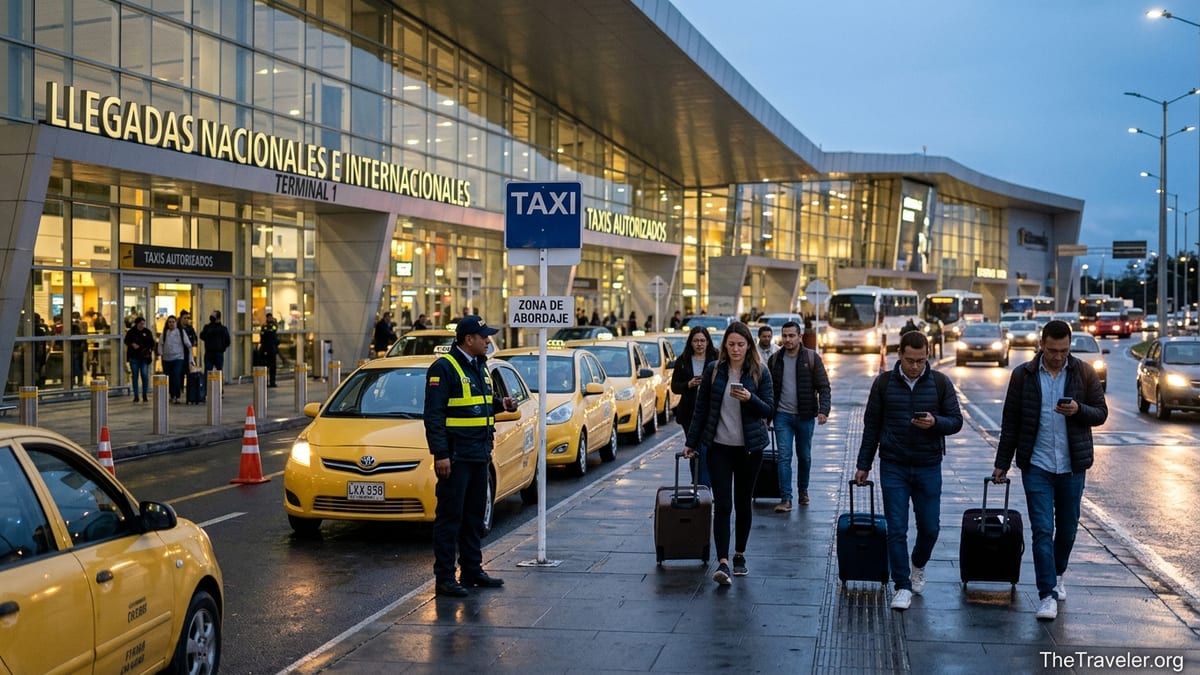
Understanding How Transport Works at El Dorado
El Dorado International Airport (IATA code BOG) is Colombia’s busiest airport and the main gateway to Bogotá. Arrivals, immigration and baggage claim are in Terminal 1, and once you clear customs you will enter a public arrivals hall where family, drivers and taxi staff wait. It is here that you will first be approached by people offering transport. Some will be legitimate, others not. The most important rule as you step out: do not accept the first random offer you hear. Take 60 seconds to look around, find the official signage and make a plan before you move.
In Bogotá, taxis are regulated and painted yellow, while ride-hailing services like Uber, DiDi and Cabify operate in a legal gray zone but are widely used by locals. The airport also has designated official taxi companies authorized to pick up directly from the terminal; recent guidance for international conferences held in the city lists Taxi Imperial and Radio Taxi Aeropuerto as the two official airport providers.([wccl2026.uexternado.edu.co](https://wccl2026.uexternado.edu.co/en/airport-and-transport-in-bogota/?utm_source=openai)) You will also see many other yellow taxis circulating in the access roads who are not formally part of the airport scheme.
Traffic can be heavy, especially between 7:00 and 9:30 in the morning and 4:00 to 8:00 in the evening. A ride to areas popular with visitors, such as La Candelaria, Chapinero or Parque 93, usually takes 25 to 60 minutes depending on traffic. The cost for a licensed taxi from the airport to central Bogotá is commonly in the range of 35,000 to 55,000 Colombian pesos, depending on distance and surcharges, which is roughly 9 to 14 US dollars at current exchange rates. Ride-hailing apps may show similar or slightly higher prices at peak times.
Because of the mix of official providers, independent taxis and app drivers, confusion about who is legitimate creates space for scams. Recent protests by airport taxi drivers over competition from other vehicles show how intense the struggle for passengers has become.([infobae.com](https://www.infobae.com/colombia/2026/04/09/lo-que-hay-detras-de-la-protesta-de-los-taxistas-que-bloquearon-el-aeropuerto-el-dorado-nos-quieren-sacar-del-negocio/?utm_source=openai)) As a traveler, your best defense is to understand which services are authorized and to insist on booking through official counters or apps rather than through unsolicited offers.
Using Official Airport Taxis Safely
The simplest and most recommended option for many first-time visitors is to use the official airport taxi service. When you exit customs into the arrivals hall, look for clearly marked taxi counters operated by the authorized companies. They are typically located before you exit to the street and staffed by personnel in branded uniforms. At these counters, you tell the agent your destination, they enter it into a system, and you receive a printed slip or ticket showing the approximate fare.
For El Dorado, information from local universities, conferences and the airport itself consistently identifies Taxi Imperial and, in some cases, Radio Taxi Aeropuerto as the official airport taxi operators.([wccl2026.uexternado.edu.co](https://wccl2026.uexternado.edu.co/en/airport-and-transport-in-bogota/?utm_source=openai)) Vehicles linked to these companies are yellow, display their company name on the doors, and have a visible taxi meter on the dashboard. Importantly, the drivers are registered, and the plate and taxi number are tracked, which makes it easier to resolve any dispute later on.
As a concrete example, a ride booked at the official counter from El Dorado to the Parque 93 area in the north typically prints out with an estimated fare in the 40,000 to 50,000 peso range, including the airport surcharge. If your hotel is in La Candelaria in the historic center, the printed amount may be closer to 35,000 to 40,000 pesos. The driver should start the meter when you get in the car. At the end of the ride, the meter reading plus the fixed airport supplement should be close to what was printed on your slip. If you see a large difference, quietly take a photo of the meter, the taxi ID card displayed on the passenger side visor and the license plate before paying.
From a safety perspective, the key is to walk directly from the official counter to your assigned taxi. Staff will usually indicate the lane and sometimes even walk you to the car. Decline offers from other drivers who try to intercept you, saying they can do it cheaper or faster. Those are typically informal taxis or drivers trying to avoid the regulated airport system. While many may simply be trying to supplement their income, you have no registration record with them if something goes wrong.
Rideshare Apps: Uber, DiDi, Cabify and Taxi Apps
Ride-hailing apps such as Uber, DiDi and Cabify are widely used in Bogotá. However, their status is sensitive, especially at the airport where licensed taxi companies defend their exclusivity. Official transport information for events hosted in Bogotá often recommends using taxi apps specifically designed for licensed taxis, such as Taxis Libres or Taxi Imperial’s own app, as a safer alternative to hailing on the street.([assets.ippc.int](https://assets.ippc.int/static/media/files/publication/en/2023/10/5.3._Local_Information_M.Hurtado_Lst_Rs7phmg.pdf?utm_source=openai)) These apps let you see the estimated fare in advance and track your trip, while still using regulated yellow taxis.
Uber maintains airport guidance pages indicating that pickups at El Dorado are possible, with a virtual queue for drivers operating in the airport area.([uber.com](https://www.uber.com/global/en/r/airports/bog/driver-information/?utm_source=openai)) In practice, many travelers report that Uber or DiDi drivers may ask you to meet them at a specific point slightly away from the main taxi queue, for example one level up at Departures or at a less crowded section of the curb, to reduce the risk of arguments with taxi drivers or checks by transport inspectors. This arrangement is common in Colombian cities where app-based rides are tolerated but controversial.
If you choose to use an app, the safest routine is to wait until you are in the public arrivals hall, connect to the airport’s free Wi-Fi, and request your ride there. Double-check that the plate number, car model and driver name in the app match the vehicle that pulls up. For example, if the app shows a gray Renault Logan with plate ABC123 and a driver named Carlos, do not get into a white SUV with a different plate even if the driver says they are from the same app. Ask them to show you the trip screen on their phone that matches your name and destination.
Another practical compromise, especially if you are nervous about the app controversy, is to use Uber’s option to request a regular taxi through the app when it is available in Bogotá. The ride then arrives as a yellow licensed taxi, but you still have the app record, GPS route and cashless payment if you choose a card.([help.uber.com](https://help.uber.com/riders/article/requesting-uber-at-the-airport--?nodeId=e0a52f13-7c96-4446-a9b9-46b642e0cd19&utm_source=openai)) This can reduce the risk of disputes over fares while keeping you within the local taxi regulations.
Spotting and Avoiding Fake or Predatory Drivers
The most worrying safety issues at El Dorado involve fake or predatory drivers who target obviously foreign passengers. Colombian press has documented cases where criminals posed as police officers outside the airport, stopping travelers under the pretext of a routine check before robbing them.([eltiempo.com](https://www.eltiempo.com/unidad-investigativa/cuidado-asi-opera-la-red-del-peligroso-falso-policia-que-roba-a-viajeros-a-la-salida-del-aeropuerto-el-dorado-3423506?utm_source=openai)) There are also reports of networks using unmarked cars or even apparently legitimate taxis to follow high-value targets from the terminal.
In practical terms, a typical risk scenario might look like this: after exiting customs, a man in plain clothes approaches you, speaking English, and offers a “special airport shuttle” that is “faster than taxi.” He may show you a laminated card that looks semi-official but does not match any of the major companies you see advertised on the walls. The price he quotes is vague, for example “about 25 dollars” instead of a clear figure in pesos. If you accept, he leads you to a car in a distant corner of the parking area, which may or may not be registered as a taxi, and once you are inside the car the price can suddenly increase or your route may deviate.
Another scenario involves someone in what appears to be a police or security uniform stopping your vehicle shortly after leaving the airport access roads. In previously reported cases, a fake officer would claim they needed to inspect your luggage for drugs or check your cash for counterfeit notes.([eltiempo.com](https://www.eltiempo.com/unidad-investigativa/cuidado-asi-opera-la-red-del-peligroso-falso-policia-que-roba-a-viajeros-a-la-salida-del-aeropuerto-el-dorado-3423506?utm_source=openai)) Once you are out of the vehicle and distracted, an accomplice may grab a bag or wallet. Genuine Colombian police will generally not conduct impromptu cash inspections on the side of the road for arriving passengers. If you are stopped, keep your valuables on your person, and ask the driver to remain present. You can also discreetly note the officer’s name and badge number.
To minimize your exposure to these situations, stick to transport you have initiated yourself via an official counter or a well-known app. Do not get into vehicles that do not match what you booked, even if the driver insists they are a friend or colleague helping out. If someone claiming to be airport staff or police pressures you to change vehicles, you can ask to speak with them at a visible spot near the terminal entrance or inside the building where there are cameras and other people present. Intimidation tactics often rely on isolating you from crowds.
Money, ATMs and Paying Safely for Your Ride
Most airport taxis and app drivers in Bogotá expect to be paid in Colombian pesos. Some upscale hotels can arrange transfers that you pay on your room bill, but if you are taking a regular yellow taxi you should plan to have cash. Inside El Dorado you will find ATMs from major Colombian banks such as Bancolombia and Davivienda, often near baggage claim and in the arrivals hall. These usually accept foreign cards, but there can be occasional outages or withdrawal limits, so it is sensible to arrive with at least a small amount of pesos or a debit card that works internationally.
When using ATMs, choose machines that are inside the terminal in well-lit and monitored areas rather than freestanding units in the parking lots. Withdraw only what you reasonably need for the next couple of days, keep the bulk of your cash in a money belt or hidden pouch, and do not count large stacks of bills in public. Card skimming is not unique to Colombia, and the same basic precautions you would take in any big city apply here.
As a concrete example, a jet-lagged arrival at 22:30 might withdraw 400,000 pesos at an ATM inside the arrival hall, then walk directly to the official taxi counter and pay a 45,000 peso fare to a hotel in Chapinero. The remaining cash is enough for food and small expenses the next day. If you prefer to pay by card, some airport taxis and many app-based rides accept credit cards, but do not assume this. Ask before you get in the car. If a driver offers to take you to an ATM on the way to “get more money,” decline unless you initiated the request and know exactly how much you still owe.
Be wary of drivers who propose converting the fare into dollars at a generous exchange rate. For example, if a driver tells you that a 50,000 peso ride is “25 dollars,” that is a serious overcharge based on recent exchange rates. Keep an offline note on your phone with a rough conversion to refer to in the moment. Paying in local currency and double-checking the meter against the printed fare slip are your best safeguards.
Luggage Awareness and Personal Security Outside the Terminal
Bogotá’s airport is generally well policed, but like any large hub there are opportunistic thieves who watch for distracted travelers. The moments when you are loading luggage into a taxi, checking your phone for the hotel address or juggling kids and carry-ons are when your guard is down. Simple habits can greatly reduce the risk of losing valuables.
First, keep your most important items on your body, not in the trunk. Passports, primary credit cards, cash and phones should be in a small bag that stays with you in the back seat. Larger suitcases, sports equipment or checked baggage can go in the trunk. Before the driver closes the trunk, visually confirm that all your bags are inside. It is rare but not unheard of for a small backpack or camera bag placed on the curb to be “forgotten” and later taken while you are already in motion.
Second, maintain awareness during the ride, especially at traffic lights leaving the airport access road and entering the main highways. In Bogotá, like in many big cities, motorcycle thieves sometimes target cars stopped at lights, reaching in through open windows to grab bags or phones from laps. To avoid this, keep windows mostly closed, especially at night, and avoid leaving a phone on top of your legs or by the window while scrolling. If you are using navigation on your phone to follow the route, hold it discreetly and put it away when not needed.
On arrival at your hotel or apartment, do not rush out and leave doors open with bags unattended. Ask the driver to wait with the trunk closed until reception confirms your reservation or your host answers the door, then take your bags out together. If you are being dropped at a private apartment or an Airbnb late at night, consider asking the driver to wait in sight until you are safely inside. Most drivers are accustomed to this request.
Practical Examples of Safe Trips From El Dorado
To bring all of these points together, imagine three typical journeys. In the first, a solo traveler from the United States lands mid-afternoon, changes a small amount of currency at home in advance, and walks straight to the official taxi counter in arrivals. After giving the address of a hotel in La Candelaria, they receive a printed slip showing an approximate fare of 38,000 pesos. They follow the staff member to a yellow Taxi Imperial car, check the plate and the meter, place their large suitcase in the trunk and sit in the back with their small backpack. The ride takes 35 minutes in moderate traffic, the meter ends at roughly the printed amount, they pay in cash, ask for a receipt and walk directly into their hotel lobby.
In the second example, a group of three friends who already use Uber in their home country prefer an app-based ride. After clearing customs late in the evening, one connects to the airport Wi-Fi, checks that Uber and DiDi both show cars nearby, and compares prices. Uber shows an estimate of 46,000 pesos for a ride to Parque 93. They request the Uber, which appears as a white sedan. The driver messages within the app asking them to meet on the upper level near Departures to avoid tension with taxi drivers. The group walks upstairs inside the terminal, confirms that the plate and car model match the app, gets in with their small carry-ons and keeps luggage in the cabin. The route appears normal on the map, and payment is processed by card through the app.
The third example involves a traveler arriving during a day when taxi protests have partially blocked access roads to El Dorado, something that has occurred in recent months as licensed drivers demonstrate against what they see as unfair competition.([infobae.com](https://www.infobae.com/colombia/2026/04/09/lo-que-hay-detras-de-la-protesta-de-los-taxistas-que-bloquearon-el-aeropuerto-el-dorado-nos-quieren-sacar-del-negocio/?utm_source=openai)) They exit to find long lines at the official counter and a crowd of informal drivers proposing rides for flat cash amounts. Rather than accepting the first pushy offer, the traveler walks back inside the terminal, sits down, and checks both taxi and ride-hailing apps. Seeing that a licensed taxi via app will take 10 minutes to arrive and charge a transparent fare similar to the official rate, they book it, wait inside until the app shows the driver is outside, and then walk directly to the car identified by plate and company name. In this way, they avoid the chaos and keep a digital record of their journey if anything goes wrong.
The Takeaway
Leaving El Dorado Airport safely is largely a matter of preparation, patience and choosing the most traceable options. Official airport taxis booked at the counters give you a printed fare and a regulated driver; taxi apps and ride-hailing services add GPS tracking, price estimates and sometimes cashless payments. What you want to avoid are unregistered, unsolicited offers from drivers who approach you aggressively in the arrivals hall or in the parking lots, as well as any situation where you are being pressured to hand over cash or luggage outside normal procedures.
By arriving with at least a basic sense of expected prices in pesos, using ATMs in secure locations inside the terminal, keeping your valuables with you in the back seat and double-checking vehicle plates against what you have on paper or in your app, you dramatically reduce your risk. Bogotá is a major Latin American capital where millions of trips start and end at El Dorado every year. Following the same cautious habits you would in any large city, combined with the specific tips above, will help ensure that your first ride from the airport is uneventful and that your memories of Bogotá start on the right note.
FAQ
Q1. Are official airport taxis at El Dorado safe to use?
Yes, the official airport taxis are generally considered safe. They are operated by authorized companies such as Taxi Imperial and, in some cases, Radio Taxi Aeropuerto, and you usually receive a printed fare slip before boarding. As with any big city, you should still check that the meter is running and keep valuables with you in the back seat.
Q2. Can I use Uber or other ride-hailing apps from El Dorado Airport?
Yes, many travelers use Uber, DiDi and Cabify from El Dorado, although their status is sensitive and drivers may ask you to meet them at a specific pickup point away from the main taxi queue. Always verify the plate number, car model and driver name in the app before getting in.
Q3. How much should a taxi from El Dorado to central Bogotá cost?
Fares vary by destination and traffic, but a regulated taxi from the airport to central areas like La Candelaria, Chapinero or Parque 93 typically costs around 35,000 to 55,000 Colombian pesos, including the airport supplement. Very high quotes in dollars are a warning sign.
Q4. Should I accept rides from drivers who approach me inside the terminal?
It is safer not to. Instead of accepting unsolicited offers, walk to the official taxi counter or use a well-known taxi or ride-hailing app. Approaching passengers directly is a common method used by informal or fake drivers who may overcharge or operate without proper registration.
Q5. Are there ATMs inside El Dorado, and is it safe to use them?
Yes, there are ATMs from major Colombian banks inside the terminal. Use machines located in well-lit, busy areas such as near baggage claim or arrivals. Withdraw only what you need, shield your PIN and avoid counting large amounts of cash in public.
Q6. Can I pay for my taxi or ride-hailing trip by credit card?
Some airport taxis and many app-based rides accept cards, but not all. Ask before starting the trip, and if you prefer card payment, consider using an app where your card is stored and the fare is charged automatically, which also provides a digital receipt.
Q7. What should I do if a driver refuses to use the meter or quotes a very high price?
If a licensed taxi driver refuses to start the meter or quotes a clearly inflated fare, it is best to politely decline the ride and look for another cab, preferably arranged through the official counter or an app. You can also take a photo of the taxi’s plate and reported behavior in case you wish to make a complaint later.
Q8. How can I protect my luggage and valuables during the ride from the airport?
Keep passports, cash, cards and electronics in a small bag on your body in the back seat, and place larger suitcases in the trunk. Confirm that all bags are loaded before departure and keep windows mostly closed near traffic lights to reduce the risk of someone reaching in from outside.
Q9. What if someone in a police uniform stops my car and wants to inspect my belongings?
Stay calm, keep your valuables on your person and ask the driver to remain present. Genuine police do not normally conduct roadside cash checks on travelers leaving the airport. If you feel uncomfortable, move the interaction to a more public, well-lit area and discreetly note the officer’s name and badge number.
Q10. Is it better to arrange an airport transfer through my hotel?
For nervous or first-time visitors, arranging a pickup directly with your hotel or a reputable private transfer company can be a good option, even if it costs a bit more. You will know the driver’s name and vehicle in advance, and the charge often appears on your room bill, reducing the need to handle cash immediately on arrival.