


El Dorado International Airport in Bogota is the main gateway to Colombia, but its two-terminal layout can be confusing, especially because Terminal 2 is still widely known by its old name, Puente Aéreo. Choosing the correct terminal matters for everything from catching a domestic connection to meeting a driver. This guide explains, in practical terms, which terminal you need, how to move between them, and how much time to allow for connections.
Get the latest updates straight to your inbox!
Terminal 1 vs Terminal 2 in a nutshell
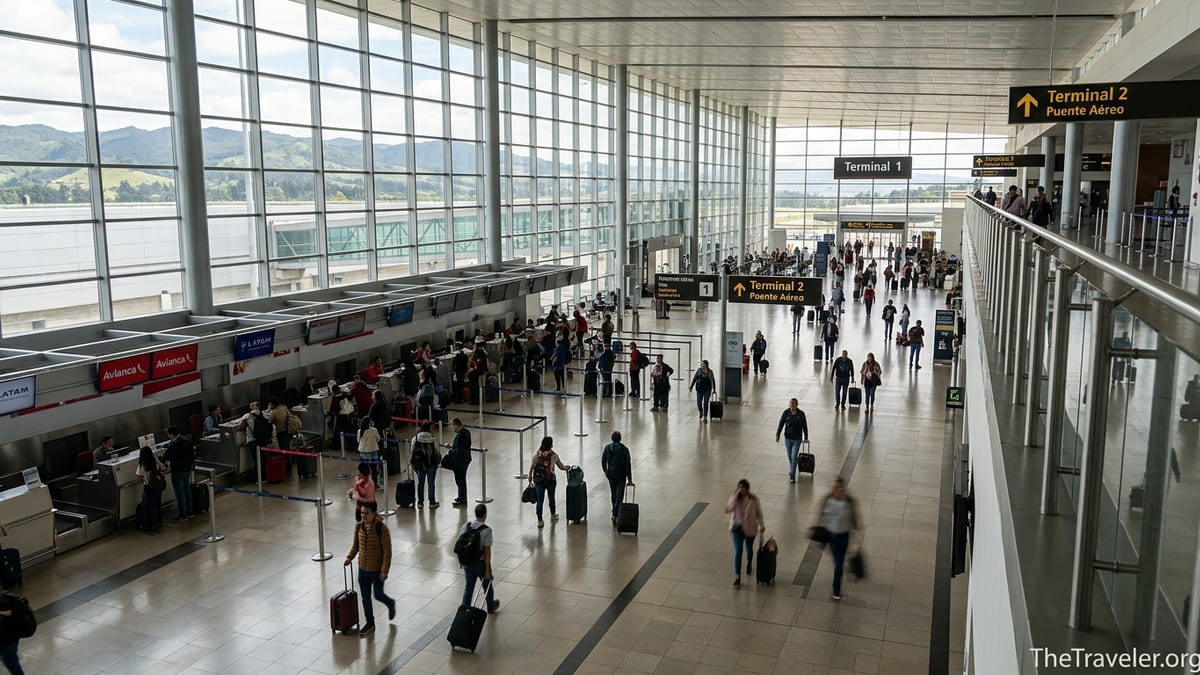
El Dorado operates with two passenger terminals. Terminal 1 is the large, modern main building that handles all international flights and most domestic routes. If you are flying with major carriers like Avianca, LATAM, Copa, American Airlines, Delta, United, or European airlines such as Iberia, Air France, KLM, or Lufthansa, you will use Terminal 1 for both arrivals and departures. This is the terminal most international travelers will see and where almost all connecting itineraries are built by default.
Terminal 2 is a smaller, separate building on the same airport property, officially designated as T2 but still called Puente Aéreo by locals, taxi drivers, and even some airlines in their emails. Today it is used exclusively for domestic flights by regional and low-cost operators such as Clic (formerly EasyFly), JetSmart and Satena. If your ticket shows one of these airlines operating a domestic flight within Colombia, there is a good chance you will depart from or arrive at Terminal 2 rather than the main building.
The key distinction is simple but important in practice. Terminal 1 equals international plus most domestic flights. Terminal 2 equals regional domestic flights only, primarily to smaller or secondary cities such as Villavicencio, Florencia, or La Macarena. When in doubt, check your booking for the airline name and the terminal code (often written as BOG T1 or BOG T2). If nothing is clearly stated, assume Terminal 1 and verify closer to departure using the airline app or the airport’s flight information.
Travelers frequently mix up the two terminals because, historically, Avianca operated a dedicated Puente Aéreo terminal. That changed several years ago when Avianca moved all passenger operations to Terminal 1, but online forums and older blog posts still mention “Avianca at Puente Aéreo.” If your trip is in 2026 and you see Avianca plus “Puente Aéreo” in a guide, you are looking at outdated information; Avianca is now entirely in Terminal 1.
Which terminal handles international vs domestic flights
All scheduled international flights at El Dorado use Terminal 1. This includes long haul services to North America and Europe and regional international flights to destinations such as Lima, Mexico City, Quito, and Panama City. For example, an American Airlines flight from Miami to Bogota, an Avianca route from Bogota to Madrid, and a Copa flight from Bogota to Panama all arrive and depart through the international side of Terminal 1.
Domestic flights are split, but in a predictable way. Most domestic routes, especially those operated by Avianca and LATAM to large Colombian cities such as Medellín, Cali, Cartagena or Barranquilla, depart from the domestic concourses of Terminal 1. These flights share the same check in hall as international services but use separate security and gate areas marked as “domestic” once you clear the initial controls. It is possible to arrive from an international flight and connect to a domestic Avianca or LATAM flight without leaving Terminal 1’s secure areas in many cases.
Terminal 2 focuses on regional domestic operations with smaller aircraft and shorter routes. Clic and Satena, for instance, operate flights from T2 to remote destinations where there is limited or no competition, such as jungle or border regions and smaller departmental capitals. JetSmart has used T2 for low cost domestic services on certain trunk routes. A typical real world itinerary might be an international traveler arriving on United from Houston to Terminal 1, then connecting to a Satena flight out of Terminal 2 to La Macarena for a Caño Cristales trip. In this situation, you already know you must change terminals between flights.
There is no scenario in which you will use Terminal 2 for an international flight. If your e ticket shows an international sector with a T2 designation, treat it as a red flag and confirm directly with the airline, as it is almost certainly a misprint or leftover from older systems. For mixed international domestic itineraries built on a single ticket, airlines generally book both sectors from Terminal 1 to avoid cross terminal transfers, unless the only available onward carrier is based in T2.
Understanding the Puente Aéreo name and how it appears on bookings
The name “Puente Aéreo” predates the current terminal numbering and still causes confusion. Locals, taxi drivers and rideshare apps may ask if you are going to “El Dorado” or to “Puente Aéreo,” as if these were different airports. In reality they are two buildings on the same airport campus, separated by a short internal roadway and linked by a free shuttle bus. When someone in Bogota says “Puente Aéreo,” they mean Terminal 2.
On flight bookings, however, you will usually see the standardized “Terminal 1” or “Terminal 2” label rather than Puente Aéreo. For example, a Satena flight might be shown as departing “BOG Terminal 2,” and the word Puente Aéreo may appear only in the small print or gate description. Some older reservations systems and confirmation emails still add the old name in brackets, such as “BOG T2 (Puente Aéreo).” If you see this, you can safely interpret it as Terminal 2.
The reverse is also common in everyday conversation. A visitor might say they are flying out of “Terminal 2” and the taxi dispatcher responds “Ah, el Puente Aéreo.” This is not an attempt to redirect you to a different place but simply the local shorthand. For peace of mind, it helps to know that the blue airport signs on the access roads use both terms: look for “T2 – Puente Aéreo” written together. Knowing that they are synonymous avoids unnecessary worry while your taxi is weaving through evening traffic.
Where confusion still matters is in online advice. Many trip reports from before Avianca’s move into Terminal 1 describe tight connections where passengers jogged between the main building and Puente Aéreo on short layovers. In 2026 those anecdotes only apply if you are mixing a major carrier in Terminal 1 with a regional or low cost operator in Terminal 2. A Bogota to Cartagena connection entirely on Avianca, for example, would now stay fully within Terminal 1 instead of shuttling over to Puente Aéreo, which is a significant simplification compared with the experience described in older guides.
Getting between Terminal 1 and Terminal 2
A free airport shuttle bus connects Terminal 1 and Terminal 2. It operates throughout the day, with recent schedules indicating a rough frequency of every 10 to 15 minutes at peak times and closer to every 20 minutes during quieter periods. The ride itself takes around 5 to 7 minutes, depending on traffic on the internal airport roads. In practice, if you walk out of arrivals, find the shuttle stop and just miss a bus, you should plan on about 20 to 25 minutes from that moment until you are stepping off the next bus at the other terminal.
The shuttle stops are clearly marked. At Terminal 1, you will find the stop near the ground transportation area outside the arrivals level, alongside spaces for public buses, airport hotel shuttles and rideshares. At Terminal 2, the stop is just outside the small arrivals hall, steps from the curb where taxis queue. Uniformed airport staff and information points in both terminals can direct you if you are unsure; showing them a boarding pass with “T2” or the name of your airline, such as Satena or Clic, makes it easy for them to point you toward the right bus.
There is no convenient way to walk between terminals with luggage. Although the distance on the map appears short, there is no continuous pedestrian sidewalk along a public route that is designed for passengers. Taxis can technically shuttle you between terminals using the main airport road system, but it is usually slower and unnecessarily expensive compared with the free dedicated shuttle. In heavy rain, which is common in Bogota, the shuttle is also the driest and safest option given the covered boarding areas at each stop.
If you are landing from an international flight and have a separate ticket out of Terminal 2, plan your time assuming you will need to clear immigration, collect any checked luggage, pass customs, exit to the public arrivals area, walk to the shuttle stop, ride the bus, and then re check bags and clear security in T2. Each of those steps is straightforward but adds up. On peak travel days, such as Sunday evenings or holiday periods, the immigration queue in Terminal 1 can easily take an hour or more, which has a much bigger impact on your connection than the short shuttle ride itself.
Airline examples and how terminal choice affects your trip
To understand how the terminal split works in real life, it helps to look at some concrete airline and route combinations. If you are flying Avianca from New York to Bogota and then on to Medellín, every sector will be from Terminal 1. You will arrive at the international concourse, follow signs either to immigration and baggage claim or to connections, and then board your domestic Avianca flight from a nearby gate. There is no need to visit Terminal 2 at any point on this itinerary.
Now consider an itinerary that mixed airlines, such as flying LATAM from Miami to Bogota and then continuing on Satena to La Macarena for a nature trip. In this case, both airlines operate in different terminals: LATAM at T1 and Satena at T2. If your journey is ticketed on separate reservations, you would land at Terminal 1, clear formalities, collect your bag, and then take the shuttle to Terminal 2 to check in again with Satena. This is exactly the type of trip where knowing the terminal layout and shuttle timing in advance can stop an already ambitious connection from becoming stressful.
Another real world example is the increasing use of Clic Air and JetSmart for domestic routes. A traveler might book an international flight on Delta from Atlanta to Bogota and then, in an attempt to save money, a separate JetSmart ticket to Cartagena. Delta uses Terminal 1 and JetSmart operates domestic flights from Terminal 2. If that traveler schedules just 90 minutes between the scheduled Delta arrival and the JetSmart departure, small delays could ruin the connection. Airlines on separate tickets will typically not protect you if you misconnect, especially when a terminal change is involved.
Conversely, not every domestic flight to a popular destination requires Terminal 2. Many Colombian cities are served from Terminal 1 by multiple airlines. For instance, Cartagena might be offered at similar times by Avianca in T1 and Satena in T2. If you are already arriving into Terminal 1 and want a stress free connection, choosing the T1 carrier may be worth paying a little extra to avoid the terminal transfer entirely, even if the base fare on the T2 airline looks slightly cheaper.
How much time to allow for connections at El Dorado
Minimum connection times depend on several factors: whether you are on a single ticket, whether you need to clear immigration, whether you are changing terminals, and your own tolerance for risk. Airline booking systems typically allow fairly tight domestic domestic connections within Terminal 1, sometimes around 60 to 75 minutes, because you stay airside and do not have to reclaim baggage or ride the shuttle. Many travelers report making one hour Avianca connections within T1 successfully when flights are on time and they travel with carry on only.
For connections that involve immigration and customs, such as arriving from an international flight and continuing domestically from Terminal 1 on the same airline, aiming for at least 2 hours is more realistic. While some passengers clear everything in under an hour during quiet periods, others find themselves in slow passport control lines that eat up most of a tight layover. Being on a single ticket helps because the airline will rebook you if the inbound leg is delayed and triggers a missed connection, but that does not help much with the stress of sprinting to the gate or worrying about checked luggage making the flight.
The most time sensitive scenario is a self made connection that requires changing from Terminal 1 to Terminal 2 or vice versa, especially when you must also re check luggage. In practice, planning 3 hours from scheduled arrival to scheduled departure is a sensible baseline for international to domestic connections involving the shuttle. That 3 hour window allows for a 45 to 60 minute immigration line, 15 to 30 minutes for baggage claim and customs, a 20 to 25 minute wait and ride on the shuttle, and a full hour for check in, bag drop, security and walking to the gate in the second terminal. On very quiet days you might move faster, but the buffer protects you from common delays.
If you are already inside Colombia and simply moving between domestic flights on separate tickets with a terminal change, you may be tempted to cut things closer. Even then, a minimum of 2.5 hours is advisable, since a late inbound boarding, a bus gate arrival, or a slow baggage belt can easily erode a shorter cushion. It helps to think of El Dorado not as a small regional field but as a busy hub on par with other Latin American capitals, with the same potential for queues and occasional operational hiccups.
Ground transport, check in and services that differ by terminal
From a ground transport perspective, the biggest difference between terminals is the volume of options rather than the type. Both Terminal 1 and Terminal 2 are served by licensed yellow taxis, app based rides, and city buses, but Terminal 1 has a much larger, more organized taxi rank and more space for hotel shuttles. If you are meeting a private driver, they will almost always assume you are coming out of Terminal 1 unless you explicitly say Puente Aéreo or T2 when you book. Providing the correct terminal ahead of time reduces confusion and extra waiting if your car is parked at the wrong curb.
Inside the buildings, Terminal 1 offers the widest range of services. You will find multiple full service banks, ATMs, currency exchange counters, mobile phone shops selling local SIM or eSIM activation, and a diverse selection of restaurants and cafes, from Colombian chains like Crepes & Waffles to international fast food. There are several lounges, including airline operated spaces for Avianca and LATAM plus independent options accessed through lounge programs or paid entry. If you need to spend a long layover catching up on work or resting before an overnight flight, Terminal 1 is the more comfortable environment.
Terminal 2 is more compact and utilitarian. It has basic cafes, snack stands and small shops, but it is not designed for long stays. Seating is more limited, and while it is perfectly adequate for a short domestic hop, you will not find the same range of dining or shopping. This matters if, for example, you are deciding where to buy a local SIM card or where to eat a decent meal when landing late at night and flying on the next morning. In those cases, doing your errands in Terminal 1 before heading to T2 on the shuttle is usually the smarter move.
Check in procedures are similar, but cut off times may be stricter for some regional airlines in Terminal 2, especially on small aircraft with tight weight and balance restrictions. Arriving at the check in desk 45 minutes before departure might be acceptable for a large domestic jet in Terminal 1 but could result in a denied check in for a small regional turboprop in Terminal 2, where baggage handling and boarding logistics are less flexible. Always check your airline’s recommended arrival time, and when in doubt for T2 carriers, aim to be at the check in counter at least 90 minutes before departure.
The Takeaway
If you remember only one thing about El Dorado’s layout, make it this: Terminal 1 handles every international flight and most domestic routes, while Terminal 2, often called Puente Aéreo, is a separate building used by a small group of regional and low cost airlines for domestic services only. Knowing which terminal your airline uses is the single most important detail for a smooth arrival, departure and connection.
Before traveling, check your booking for both the airline and the terminal code. If you see Avianca, LATAM, American, Delta, United or major European carriers, you can safely plan on Terminal 1. If you see Clic, Satena or JetSmart, especially on a route to a smaller Colombian city, assume Terminal 2 and verify your departure time and check in cutoffs carefully. Build generous connection windows, especially for self connected itineraries that involve immigration and a shuttle between terminals.
On the ground, use the free shuttle between T1 and T2 rather than trying to walk or taking an extra taxi, and be ready for the fact that locals and drivers may call Terminal 2 “Puente Aéreo.” Handle most errands, currency and SIM purchases in the better equipped Terminal 1 if your schedule allows, then treat Terminal 2 as a simple staging point for short domestic hops. With these practical details in mind, El Dorado becomes much easier to navigate and your chances of missed flights and stressful dashes between terminals drop significantly.
FAQ
Q1. How do I know if my flight uses Terminal 1 or Terminal 2 at El Dorado?
Check the airline and the terminal code on your booking or boarding pass. Major carriers like Avianca, LATAM, Copa, American, Delta, United and European airlines operate from Terminal 1, while regional and low cost domestic airlines such as Clic, Satena and JetSmart typically use Terminal 2, also known as Puente Aéreo.
Q2. Does any international flight depart from Terminal 2 in Bogota?
No. All scheduled international flights at El Dorado use Terminal 1. Terminal 2 is reserved for domestic operations on a limited number of regional and low cost carriers, so you should never need T2 for a passport control departure or arrival.
Q3. Is Puente Aéreo a different airport from El Dorado?
No. Puente Aéreo is the traditional name for Terminal 2, which is a smaller passenger building on the same airport property as the main El Dorado terminal. When a taxi driver asks if you are going to El Dorado or Puente Aéreo, they are really asking whether you need Terminal 1 or Terminal 2.
Q4. How long does the shuttle between Terminal 1 and Terminal 2 take?
The free airport shuttle bus usually runs every 10 to 20 minutes and the ride itself is around 5 to 7 minutes. In practice, from the moment you walk out to the stop, wait for the next bus and complete the ride, it is wise to allow about 20 to 25 minutes in your plans.
Q5. Can I walk between Terminal 1 and Terminal 2 at Bogota airport?
There is no practical pedestrian route designed for passengers between the two terminals, especially if you have luggage. The recommended way is to use the free shuttle bus that links T1 and T2 along the internal airport roads, which is both safer and usually faster than attempting to walk or taking a taxi between them.
Q6. How much time should I allow to connect from an international flight in T1 to a domestic flight in T2?
If the flights are on separate tickets and you must clear immigration, collect bags, change terminals and re check for a domestic flight, planning around 3 hours is a sensible buffer. That window covers typical queues at passport control, baggage claim, customs and check in, plus the shuttle ride between terminals.
Q7. What happens if my domestic connection in Terminal 1 is only 60 minutes?
A one hour domestic to domestic connection within Terminal 1 can work if both flights are on the same ticket, you arrive on time and you have only carry on luggage. However, it leaves little margin for delay, so many travelers prefer at least 90 minutes when checked bags or tight schedules are involved.
Q8. Which terminal should I tell my hotel driver or taxi to go to?
Always confirm your airline and terminal before you travel and then tell your driver either Terminal 1 or Terminal 2 Puente Aéreo. If you simply say “El Dorado” they will usually assume Terminal 1 by default, which may be wrong if you are flying with Clic, Satena or JetSmart from Terminal 2.
Q9. Are services like currency exchange and SIM cards available in both terminals?
You will find the widest range of services, including currency exchange desks, multiple ATMs, mobile phone shops and a variety of restaurants and cafes, in Terminal 1. Terminal 2 has more limited facilities, so if you need to change money, buy a SIM card or have a proper meal, it is better to do so in Terminal 1 before heading over to T2.
Q10. Is it worth paying more to avoid a terminal change at El Dorado?
In many cases, yes. If you are arriving in Terminal 1 and can choose between a slightly more expensive domestic flight from T1 or a cheaper one from a T2 airline on a separate ticket, avoiding the terminal transfer can significantly reduce stress and the risk of a missed connection, especially after a long international journey.