


More news on this day
Chicago O’Hare International Airport has experienced two separate Federal Aviation Administration ground stops in as many days at the start of the busy Thanksgiving travel period, with arrivals first paused Monday because of air traffic control staffing constraints and again Tuesday afternoon due to an equipment outage, causing knock-on delays across some Midwest routes.
Get the latest news straight to your inbox!
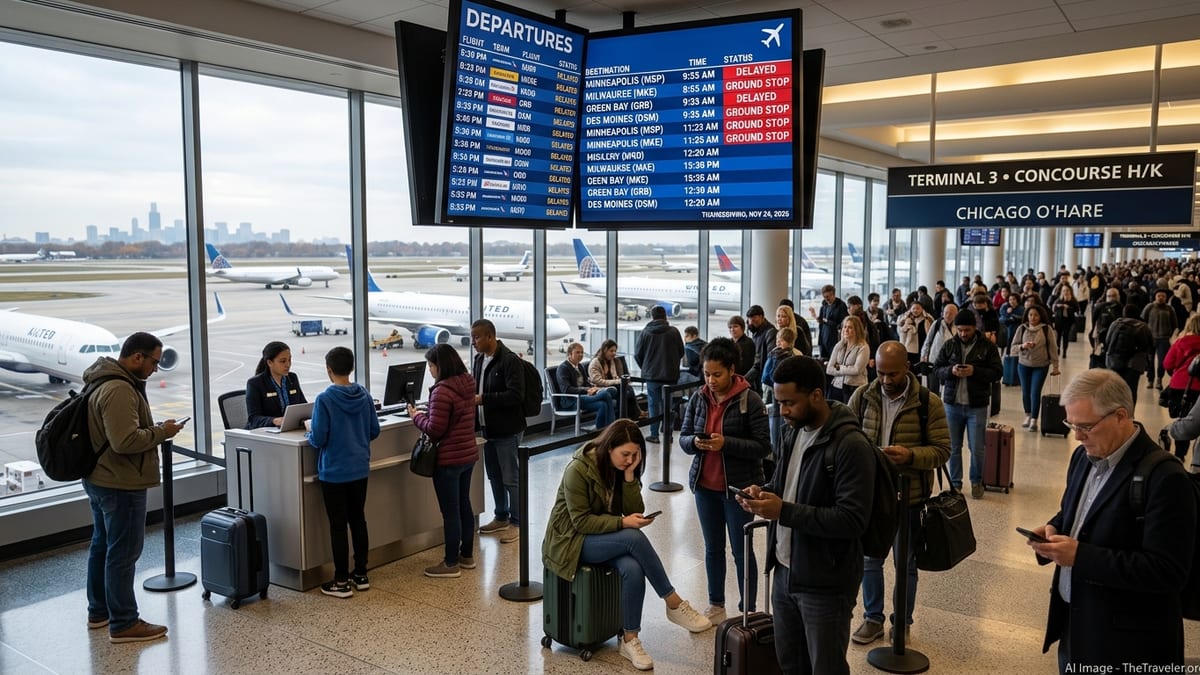
What happened at O’Hare on Monday and Tuesday
The Federal Aviation Administration confirmed that it briefly halted arriving flights to Chicago O’Hare International Airport on Monday 23 November 2026, citing staffing constraints at Chicago Terminal Radar Approach Control, the radar facility that manages approach traffic into the Chicago area. The ground stop began at 10:40 a.m. local time and was lifted at roughly 12:15 p.m., according to multiple FAA statements and summaries of the event. During that period, flights bound for O’Hare were held at their departure airports until the restriction eased, while aircraft already in the air were metered into the airport under reduced arrival rates.
On Tuesday 24 November, the FAA issued a second ground stop affecting O’Hare, this time listing an “equipment/outage” as the impacting condition on its advisory system. Local outlets reported that the order was issued in the afternoon and was expected to remain in effect until approximately 4:15 p.m. Central Time. The equipment reference indicates a technical problem within the air traffic control system supporting O’Hare operations, though the FAA had not publicly detailed the specific system involved at the time of writing.
Initial local reports on Tuesday indicated that the ground stop applied in particular to flights departing from Minneapolis, Milwaukee, Green Bay and Des Moines that were destined for O’Hare, reflecting how the FAA can tailor ground stops to specific departure regions. However, the FAA’s public advisories most clearly documented the overall status for Chicago, confirming that arrivals into O’Hare were again being paused while technicians and controllers worked within the constraints of the outage. As of early evening on Tuesday, tracking services showed the ground stop lifted, with operations transitioning back toward normal but with ongoing delays.
Why the FAA ordered the ground stops
The Monday ground stop was explicitly tied to staffing levels at Chicago TRACON, known by its facility code C90. In a statement released to local media, the FAA said it was “briefly pausing flights into Chicago O’Hare International Airport due to staffing constraints at Chicago Terminal Radar Approach Control.” That type of language is consistent with agency procedures that allow traffic managers to slow or halt arrivals when available controller staffing cannot safely support the volume of flights scheduled during a particular period. According to a subsequent FAA statement reported by Chicago media, operations returned to normal at O’Hare after the brief pause.
By contrast, Tuesday’s action stemmed from an equipment outage noted in FAA alerts, which did not immediately specify whether the issue was within the TRACON facility, the O’Hare airport tower or another part of the regional air traffic system. Industry observers and past FAA guidance indicate that equipment-related ground stops are typically used when a critical navigation, radar, communications or automation system is degraded enough to require a sharp reduction in arrival capacity until redundancy measures or repairs are in place. The FAA’s advisory system listed an end time of 4:15 p.m. Central Time, suggesting that technicians anticipated a relatively short window to stabilize the system.
In both cases, the FAA used ground stops as a short-term tool to keep demand for O’Hare arrivals in line with what the local air traffic control infrastructure could safely manage. Unlike a long-duration ground delay program, which meters departures using assigned slot times, a ground stop temporarily sets the arrival acceptance rate to zero for affected flights, preventing additional aircraft from launching toward an airport that cannot safely receive more traffic. The back-to-back use of that tool at one of the country’s busiest hubs at the outset of Thanksgiving week has focused renewed attention on both controller staffing and the resilience of key control systems in the Chicago area.
Impact on travelers across the Midwest
While the Monday staffing ground stop at O’Hare lasted roughly an hour and a half, the timing coincided with a late-morning bank of departures from airports nationwide, leading to ripple effects far beyond Chicago. Flight-tracking data compiled during and shortly after the event showed more than 170 delayed flights at O’Hare by late morning Monday, though not all could be definitively attributed to the ground stop alone. Because ground stops hold flights at their origins, travelers at distant airports may have experienced extended gate holds or last-minute departure time changes even when local weather appeared calm and operations otherwise seemed normal.
On Tuesday, the equipment-related ground stop again translated into delays and congestion for travelers connecting through Chicago and for those departing from specific Midwest cities feeding the hub. Local reporting highlighted that flights departing from Minneapolis, Milwaukee, Green Bay and Des Moines and bound for O’Hare were among those subject to the Tuesday pause. For passengers on those routes, this meant not only later departures but also potential misconnects at O’Hare for onward domestic and international flights. Airlines generally attempt to re-accommodate misconnecting passengers, but tight Thanksgiving loads limit the number of open seats available on subsequent services.
Traffic congestion around O’Hare added a further layer of difficulty. The Chicago Department of Aviation had already warned motorists to expect heavier-than-normal traffic on roadways serving the airport throughout Thanksgiving week. Travelers driving to O’Hare for departing flights on Monday and Tuesday faced both holiday road congestion and the possibility of extended terminal waits due to altered flight schedules. For some, the two consecutive days of disruption came on top of broader national turbulence earlier in November, when a separate nationwide ground stop unrelated to this week’s events affected flights across the U.S. and raised questions about aviation technology resilience.
How this fits into a strained holiday travel system
The O’Hare interruptions are unfolding against what travel organizations project to be another near-record Thanksgiving travel period in the United States. Data from AAA indicate that more than 80 million Americans are expected to travel at least 50 miles from home between Tuesday 24 November and Monday 30 November, including nearly 6 million domestic air travelers. While that forecast is marginally lower than the previous year’s record, it still represents a very high level of demand on airports, airspace and airline operations nationwide during a compressed window.
Within the Chicago region, O’Hare remains one of the nation’s busiest hubs, serving as a central connecting point for two of the largest U.S. carriers alongside a range of international airlines. Even in a normal year, Thanksgiving week compresses a surge of leisure passengers into a short period, leaving less slack in the system to absorb irregular operations such as weather disruptions, technical outages or staffing shortfalls. The combination of a Monday staffing-related ground stop and a Tuesday equipment-related stop reduces the margin for error even further, particularly for complex itineraries requiring tight connections.
The recent ground stops also come shortly after a separate nationwide FAA ground stop earlier in November, triggered by a communications failure centered in the Chicago area that spread to multiple control centers. That earlier incident was unrelated to the current Thanksgiving-week staffing and equipment issues but has added to a sense among some travelers that the U.S. air traffic system is under strain. Federal officials have recently acknowledged challenges in both modernizing aviation technology and recruiting and training sufficient numbers of air traffic controllers to meet rising demand, although the FAA maintains that safety continues to drive all operational decisions, including the use of ground stops to manage risk.
What travelers should do next
As of Tuesday evening, the FAA’s delay advisory system was no longer listing an active ground stop for Chicago O’Hare, and independent delay-tracking services likewise showed that the Tuesday equipment-related pause had been lifted. However, both Monday’s staffing disruption and Tuesday’s outage left a tail of delayed and re-timed flights that may persist into the night as airlines work to reposition aircraft and crews. Travelers scheduled to fly into or out of O’Hare through the remainder of Tuesday and into Wednesday should expect the potential for residual delays, even though a formal ground stop is no longer in effect.
For passengers with upcoming itineraries that include a connection at O’Hare during the Thanksgiving period, the most practical step is to monitor flight status closely through airline apps or websites from several hours before departure. Because ground stops hold flights at their origins rather than canceling them outright, scheduled times can shift multiple times as traffic managers adjust flows into Chicago. Where airlines offer options to move to an earlier flight free of charge ahead of expected peaks, travelers with flexibility may reduce their exposure to later knock-on delays by taking advantage of those waivers, provided they are still available.
Those driving to O’Hare for departing flights this week should build in additional buffer time, both for highway congestion and for possible schedule changes that may compress check-in and boarding timelines. Travelers who were directly affected by the Monday or Tuesday ground stops and who missed onward connections can check with their carriers regarding rebooking policies and any available accommodations, recognizing that standard contract-of-carriage provisions typically treat ground stops related to air traffic control and equipment issues as outside the airline’s direct control. With the ground stops now lifted, the key question becomes how quickly the Chicago air traffic system and airlines can work through the backlog and return O’Hare to more typical Thanksgiving operating conditions over the coming days.