


More news on this day
Asia’s growing wave of leisure and business travelers to Europe is entering a new phase, as the European Union rolls out a biometric Entry/Exit System that replaces passport stamping with digital identity checks at its external borders.
Get the latest news straight to your inbox!
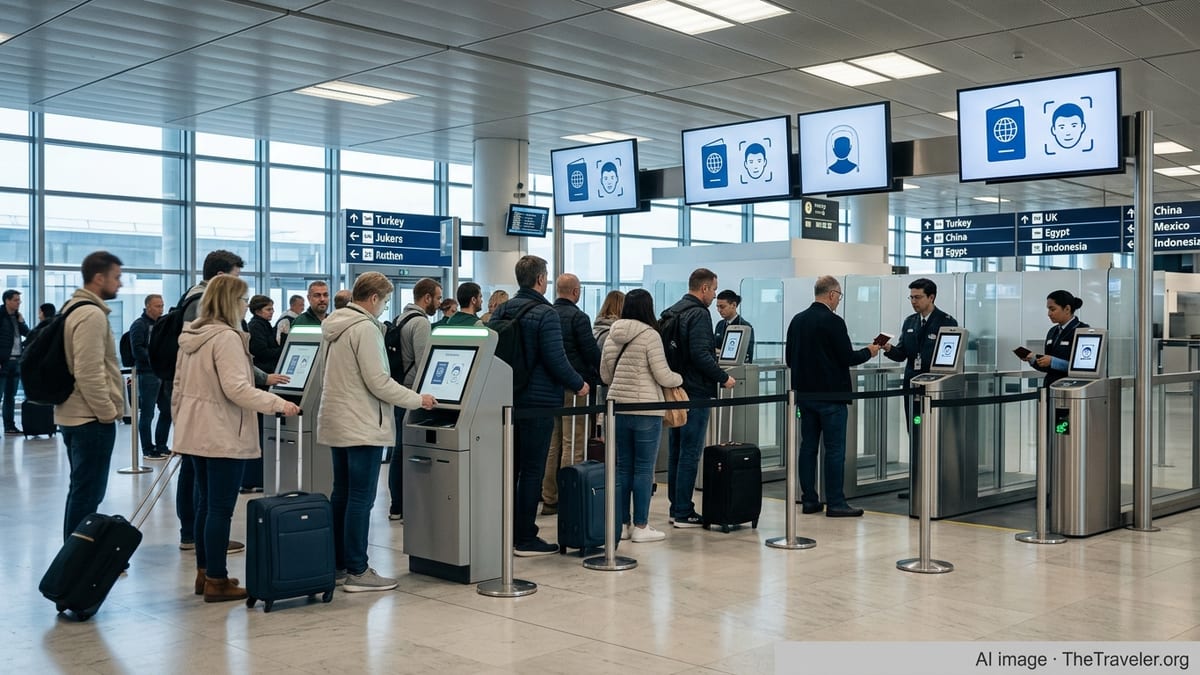
From Passport Stamps to Biometric Profiles
The European Union’s Entry/Exit System, commonly referred to as EES, is transforming how non-EU nationals are processed when they arrive in and depart from the Schengen Area. After several delays, the system was introduced in October 2025 and is moving toward full operational use in 2026, marking a decisive shift from inked passport stamps to automated biometric recording.
Publicly available information from EU institutions describes EES as a large-scale IT platform that registers each border crossing by non-EU travelers, storing the date and place of entry and exit, as well as key personal details taken from travel documents. Crucially, it also captures biometric markers such as facial images and fingerprints during a traveler’s first encounter with the system at a participating border post.
The new framework applies to so-called “third country nationals,” including most visitors from across Asia who do not hold EU or associated citizenship. It covers both travelers who require visas and those who are visa-exempt, although the exact experience at the border can differ depending on whether a Schengen visa has already been issued.
Once fully embedded, EES is expected to standardize border procedures across the Schengen external frontier, from Europe’s major airports to selected land and sea crossings. The gradual phase-in means that conditions can differ between member states and even between individual airports, a reality that Asian travelers are already encountering as they fly into European hubs.
What Asian Travelers Will Experience at the Border
For many Asian visitors, the most visible change is the requirement to provide biometric data on first entry into the system. Reports and guidance from travel providers indicate that new arrivals may be asked to have their fingerprints scanned and their face captured by a camera before crossing the border. This process is in addition to standard checks on passports, visas where required, and supporting documentation such as hotel bookings or return tickets.
Once the biometric profile is created, subsequent trips during the validity period of a visa or visa exemption are expected to be faster, because border systems can retrieve a traveler’s previous record rather than starting from scratch. Industry briefings suggest that some border posts will channel repeat visitors toward automated gates that confirm identity by matching a live facial image to stored biometric data.
The system also automates a long-standing rule that many frequent travelers know only in theory: the limit of 90 days of stay in any rolling 180 day period for most short-term visitors. With EES, this calculation becomes digital, allowing frontier systems to see immediately how long a traveler has already spent in the Schengen Area, reducing the scope for confusion about remaining days but also increasing the likelihood that overstays are detected.
For Asian nationals who rely on multiple-entry Schengen visas for regular business or family visits, this automated tracking may require more careful itinerary planning. Travel advisors are already encouraging clients to retain detailed records of previous trips in case they need to reconcile their own logs with the digital counts that appear in the new system.
Delays, Disruptions and Early Lessons From Rollout
The move to biometric border control has not been seamless. Coverage across European and trade media in late 2025 and early 2026 describes long queues at some airports following the start of EES operations, with reports of travelers waiting several hours to clear passport control during peak holiday periods. In some cases, local authorities temporarily suspended or limited biometric enrollment to ease congestion while technical and staffing issues were addressed.
Industry associations representing airlines and airports have publicly raised concerns about the impact of the transition on punctuality and passenger experience, especially during busy summer seasons. Commentaries in travel and aviation outlets indicate that operators are urging European institutions and national governments to refine procedures, add staff where needed, and coordinate better across countries to minimize disruption.
For Asian travelers, these early challenges translate into practical advice: arrive at the airport with additional time to spare, particularly for the first trip to Europe after EES has become active on a chosen route. Travel management companies and tour operators are beginning to factor potential delays at border control into their recommended minimum connection times for itineraries involving European hubs.
Despite the teething problems, European policymakers describe EES in public documents as a long-term investment intended to speed up crossings once systems and passengers have adapted. The initial difficulties, they argue, reflect a bedding-in phase as millions of existing and first-time visitors are brought into a new digital framework.
Security, Overstays and Data Protection Concerns
A central goal of the biometric border system is to strengthen the EU’s ability to identify security risks and monitor compliance with immigration rules. By providing an accurate record of who has entered and left, and when, EES seeks to make it easier to spot patterns such as repeated overstays or the use of multiple identities, according to official descriptions and policy analysis.
Early statistics cited in European media suggest that the new system has already contributed to a measurable number of refusals of entry, based on issues such as invalid travel documents, insufficient proof of purpose of stay, or previous breaches of permitted time in the Schengen Area. For would-be visitors from Asia, this underlines the importance of carrying clear evidence of accommodation, financial means, and onward travel, along with valid visas where required.
At the same time, civil liberties organizations and data protection specialists have highlighted concerns about how long biometric data will be stored, who can access it, and how it could potentially be shared with other agencies. Analyses in legal journals note that the EES framework includes retention periods, purpose limitations, and oversight mechanisms, but debate continues about whether these safeguards are sufficient given the scale of data collection involved.
Asian travelers familiar with biometric systems at home may find the procedures themselves relatively routine, but expectations around privacy can differ significantly by country. Advocacy groups have encouraged travelers of all nationalities to inform themselves about their rights under European data protection law, particularly the ability to request access to personal records and, in some circumstances, seek correction of inaccurate information.
Preparing for ETIAS and the Next Phase of Digital Travel
The Entry/Exit System is only one element of a broader overhaul of how Europe manages short-term travel. EES is closely linked to the upcoming European Travel Information and Authorisation System, known as ETIAS, which will introduce a pre-travel screening requirement for many visa-exempt visitors, including nationals from several Asian economies.
According to publicly available EU timelines and recent specialist travel briefings, ETIAS is now expected to become operational in the latter part of 2026, roughly a year after EES began functioning. Under the planned regime, eligible travelers would complete an online application and pay a modest fee before departure, with their details checked against security and migration databases. An approved ETIAS authorization would then be required alongside a passport to board transport to the Schengen Area.
The combination of ETIAS and EES means that future trips to Europe for many Asian visitors will involve both advance digital authorization and biometric verification at the border. Travel experts advise that this evolution is part of a global trend, echoing systems already used in destinations such as the United States and parts of the Asia-Pacific region, rather than an isolated European development.
For now, Asian travelers planning journeys to Europe in 2026 are being urged by airlines, travel agencies, and corporate travel managers to monitor updates from official EU channels and national authorities, review entry rules for each country on their itinerary, and build in extra time at airports. As the biometric border system beds in, the promise of smoother, more predictable crossings will depend on how effectively authorities, industry, and travelers themselves adjust to Europe’s new era of digital borders.