


More news on this day
New European Union aviation fuel rules, combined with national tax decisions in Germany, are beginning to reshape the cost structure of flying in Europe, with analysts warning that ticket prices are likely to reflect higher environmental compliance costs even as Berlin moves to soften some existing levies.
Get the latest news straight to your inbox!
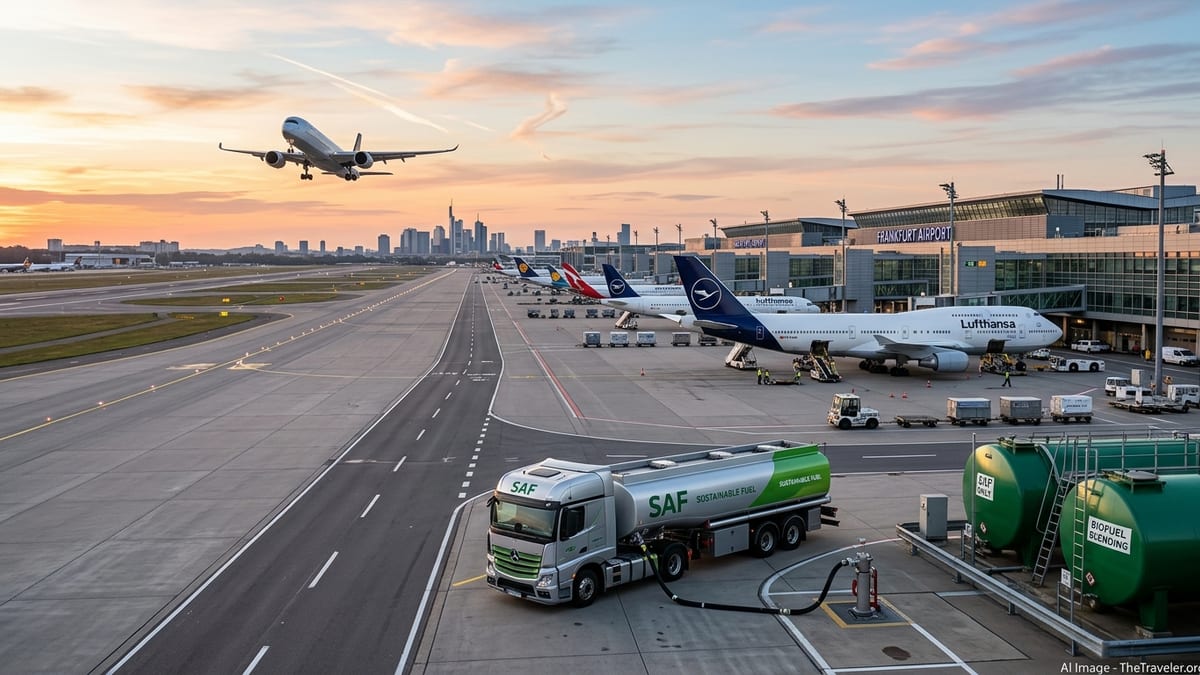
ReFuelEU Aviation ushers in binding fuel blending mandates
The central driver of change is the EU’s ReFuelEU Aviation Regulation, adopted in 2023 as part of the wider “Fit for 55” climate package. The law requires fuel suppliers at major EU airports to start blending a minimum share of sustainable aviation fuel, or SAF, into conventional kerosene from 2025. The initial obligation is set at 2 percent of total aviation fuel supplied, with the share scheduled to rise progressively to 5 percent by 2030 and up to 70 percent by mid century.
Publicly available material from the European Union Aviation Safety Agency describes the regulation as a harmonised mandate that applies to fuel suppliers serving EU airports above certain traffic thresholds, regardless of whether the airline operating the flight is European or foreign. The intention is to prevent carriers from avoiding the use of cleaner fuels by refuelling outside the bloc and to create a single market framework for SAF deployment.
European Commission documentation highlights that the rules are designed to ensure a “level playing field” while gradually decarbonising aviation, one of the hardest sectors to electrify. Alongside the supply obligation on fuel companies, aircraft operators face refuelling rules that discourage tankering practices in which aircraft load extra fossil fuel at airports with lower prices to avoid buying at destinations with higher environmental charges.
Industry cost modelling circulated in Brussels proceedings suggests that SAF is currently several times more expensive than conventional jet fuel, reflecting limited production capacity and the early stage of commercial deployment. As the share of SAF in total fuel consumption rises, these higher input costs are expected to feed into airlines’ operating expenses and, ultimately, into airfares.
Germany adjusts air passenger taxes as EU fuel costs rise
Germany’s policy response to the evolving EU framework has focused so far on the national air passenger tax, known domestically as the Luftverkehrsteuer. This levy is charged per departing passenger and varies by distance band, sitting alongside the cost of fuel and EU emissions trading as one of the key policy-driven components in ticket prices for flights leaving German airports.
Following several earlier increases, including an upward adjustment in May 2024, the Bundestag approved legislation in mid 2026 to roll back part of the burden. Official parliamentary records describe the latest amendment to the air traffic tax law as a measure intended to strengthen Germany as an aviation location after years in which higher charges were described as a significant strain on the sector.
Information published by the federal government indicates that the reduced rates will apply from July 2026, cutting the per-passenger levy across the three distance categories compared with the levels set in 2024. Airlines have argued that the change will help them remain competitive against hubs in neighbouring countries, particularly on long-haul routes where the absolute tax burden can be high.
The tax cut coincides with the ramp-up phase of ReFuelEU Aviation, meaning German carriers and foreign airlines using German airports will experience a mixed policy signal: national departure charges trending lower while EU-level fuel rules increase costs in the background. Analysts note that the net effect on ticket prices will depend on how far airlines pass through each component and how quickly SAF premiums narrow as production scales.
Impact on ticket prices for German and European travelers
For passengers, the most immediate question is how far the new fuel requirements will translate into higher fares on routes within and beyond Europe. Earlier Commission impact assessments for aviation climate policies suggested that incorporating environmental costs into flying, whether through emissions trading or fuel measures, would push up prices by a relatively modest margin per ticket compared with broader swings driven by global oil markets.
However, the combination of SAF mandates, volatile energy prices and airport charges is contributing to what several airline trade groups describe in public statements as a structural upward pressure on operating costs. Carriers serving Germany already factor the national air passenger tax into their pricing, and many also face additional climate-related charges such as the extension of emissions trading to more flights and national levies in other EU states.
Route-level impacts are expected to vary. Short-haul intra-EU flights, which are fully covered by European climate measures, may see more consistent cost pass-through, while long-haul services to non-EU destinations could be influenced by competition from non-European hubs not subject to the same SAF blending rules. Industry observers note that large network airlines based in Germany and other EU countries may have limited scope to absorb higher fuel costs on low-margin routes without adjusting fares.
Low-cost carriers operating dense point-to-point networks within Europe face a particular challenge because their business model relies on thin margins and high price sensitivity among passengers. Some have warned in public commentary that rapid increases in mandatory green fuel usage without parallel support for scaling production could restrain capacity growth or lead to reduced frequencies on marginal routes.
Broader European debate over kerosene taxes and climate fairness
The new fuel rules are unfolding against a wider European debate over whether kerosene itself should be taxed more directly. Historically, jet fuel used on international flights has been exempt from excise duties under international aviation agreements, a practice that critics say has given air travel an implicit subsidy compared with rail and road transport where fuel and value-added taxes are common.
Background material on EU energy and taxation policy notes that this exemption has been repeatedly questioned by environmental organisations and some member states, which argue that a kerosene tax would both curb demand for frequent flying and generate revenue to support cleaner technologies. Others caution that unilateral fuel taxes could distort competition if not applied uniformly across regions and might shift traffic to non-EU hubs.
Germany has so far relied primarily on the passenger-based Luftverkehrsteuer rather than a direct kerosene tax, while supporting EU-wide initiatives such as ReFuelEU Aviation and the inclusion of aviation in the emissions trading system. The current mix means that German travelers effectively pay for the climate impact of their flights through a blend of ticket taxes and higher operating costs stemming from European carbon and fuel policies.
This layered approach is increasingly at the center of political discussions about fairness in the transition to low carbon travel. Consumer advocates have raised concerns that rising costs could disproportionately affect households for whom rail is not a practical alternative, while climate groups call for stricter measures on frequent flyers and premium cabins. The outcome of these debates will help determine whether future reforms focus on fuel taxation, passenger levies, or differentiated pricing by travel class.
Outlook: balancing competitiveness and climate goals
Looking ahead, policy documents linked to ReFuelEU Aviation underscore that the 2 percent SAF target for 2025 is only the first step in a long ramp-up that will require rapid expansion of production capacity and supporting infrastructure at refineries and airports. The regulation envisages a growing role for synthetic aviation fuels produced using renewable electricity, which could eventually reduce dependence on bio-based feedstocks and further cut lifecycle emissions.
For Germany, a key challenge will be to align national measures with this trajectory while safeguarding the role of its major hubs, particularly Frankfurt and Munich, in European and global networks. The recent decision to lower the air passenger tax signals concern about competitive pressures, especially from airports in neighbouring countries that may adopt different mixes of charges and incentives.
Market analysts expect airlines to continue experimenting with fare structures, surcharges and ancillary revenues as they navigate the interaction of EU-level fuel rules, national taxes and fluctuating demand. Business travel patterns, the growth of rail alternatives on key corridors and the willingness of leisure passengers to pay a premium for lower-emission flights will all influence how the cost of cleaner aviation is ultimately distributed.
As the first binding EU fuel targets take effect in the coming years, travelers booking flights from Germany and across Europe are likely to see environmental policy become an increasingly visible factor in pricing debates, even when changes appear in small increments on individual tickets.