


More news on this day
The European Union is pressing ahead with its new biometric border regime at airports, rejecting coordinated appeals from airlines and airport groups to temporarily pause the Entry/Exit System ahead of the busy summer travel period, even as reports point to mounting queues, technical glitches and traveller frustration across the Schengen area.
Get the latest news straight to your inbox!
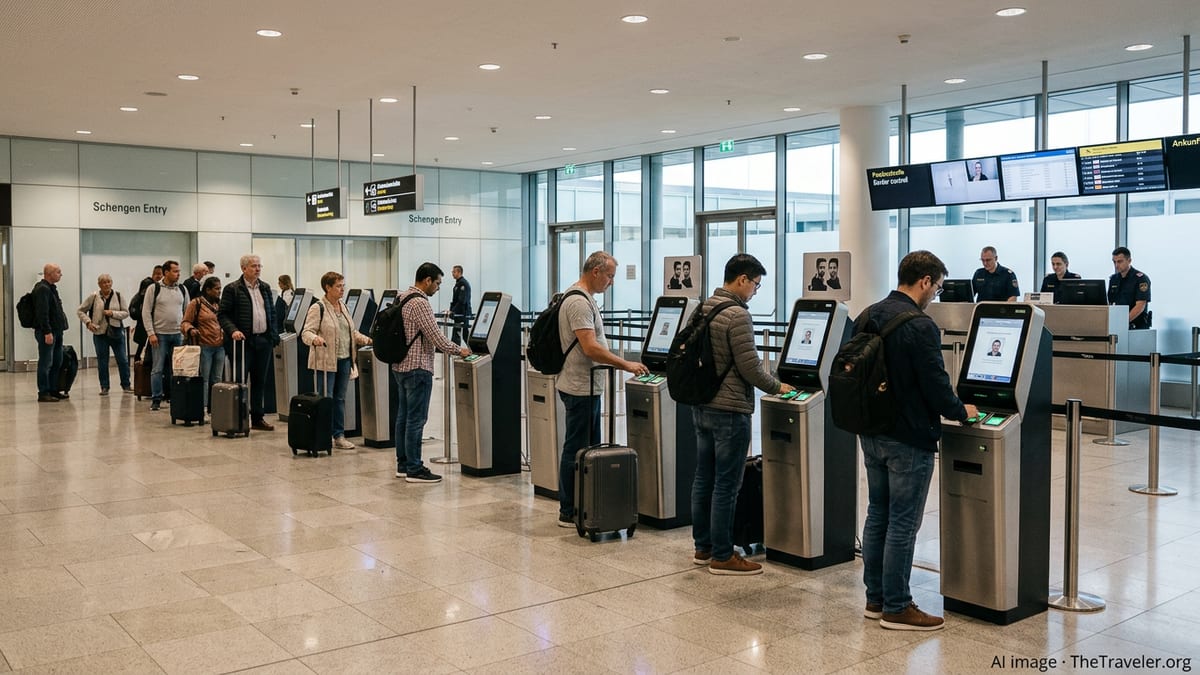
Industry plea to switch off EES rebuffed
The clash over the Entry/Exit System follows weeks of warnings from aviation and tourism bodies that the biometrics rollout is adding significant processing time for non EU travellers just as peak holiday traffic begins. A joint open letter from leading airline and airport associations in late June urged European institutions to authorize a full suspension of EES registrations for the duration of the summer, arguing that existing infrastructure and staffing at many border checkpoints are not yet capable of handling the increased workload.
Published coverage of that appeal describes concerns about waits of several hours at key hubs where long haul arrivals converge, as passengers unfamiliar with the new process are channelled through a limited number of kiosks and manual desks. Industry groups have also stressed that many airports only completed installation and testing of the hardware shortly before EES became fully operational on 10 April 2026, leaving little time to refine passenger flows before the high season.
Despite those warnings, recent reports from Brussels indicate that the European Commission has ruled out any blanket suspension of the scheme. Public statements summarised in regional media emphasise that EES is now a core part of the Schengen border architecture and that a general pause would undermine both legal obligations and years of investment in the technology.
Instead of a switch off, officials have highlighted that the legal framework already contains what are described as flexibility measures. These allow national border authorities, in defined circumstances, to stop taking fresh fingerprints and facial images temporarily when queues reach excessive levels, while still registering travellers’ entry or exit in the system.
Biometric checks blamed for long queues and missed flights
Since EES became fully operational in April, travellers and transport operators have shared a growing number of accounts of disruption at Europe’s external border airports. According to recent coverage in European outlets, some holidaymakers have reported standing in line for two to three hours as bottlenecks form at biometric kiosks or when staff redirect passengers between old and new procedures.
Airports in Italy, Greece, Spain, Portugal and Belgium feature prominently in these accounts, with smaller regional gateways appearing particularly stretched during bursts of arrivals. Reports indicate that flight connections have been missed at several hubs when queues at passport control extended far beyond their usual footprint, forcing airlines to rebook passengers and contributing to baggage congestion further down the chain.
Aviation industry representatives quoted in public briefings argue that the problem lies less with the central EES database than with local implementation on the ground. They point to understaffed border police units, insufficient numbers of functioning kiosks and terminal layouts that make it difficult to separate first time biometric registrations from returning travellers who already have records stored in the system.
While some airports report smoother operations, particularly where advance planning, extra staff and clear signage have been deployed, the overall picture emerging from spring and early summer is uneven. Travellers heading into the core holiday months are being advised by airlines, tour operators and national travel bodies to arrive much earlier than before for flights to and from the Schengen zone, especially if they are non EU nationals.
Commission doubles down on security and data goals
Faced with calls to pause or significantly dilute EES, European institutions have consistently framed the system as a key pillar of the bloc’s security and border management strategy. Publicly available information from the Commission highlights objectives such as replacing manual passport stamping with a harmonised digital trail of entries and exits, improving the detection of overstays and combating document fraud.
The system records a traveller’s personal details alongside biometric data and timestamps of border crossings, accessible to border authorities across all participating Schengen states. According to official summaries, this should allow faster automated checks for repeat visitors once they are enrolled and create a shared repository to support law enforcement investigations subject to strict data protection rules.
In recent weeks, senior European figures have acknowledged the operational strain at certain airports but have argued that national authorities must now accelerate their adaptation. Their message, as reflected in several European news reports, is that the technology is not going away and that member states need to provide sufficient staff, space and equipment to make EES work as intended.
Some commentators note that the stakes extend beyond the current summer. EES is designed to underpin the launch of the separate European Travel Information and Authorisation System, a pre travel permit for visa exempt visitors now scheduled after the main biometrics rollout. Persistent turbulence around EES could therefore have knock on effects for this broader digital border package.
Limited leeway for national pauses at crowded airports
While rejecting a general suspension, the European Commission has recently moved to clarify how much discretion national authorities have to ease pressure points during the summer peak. According to policy updates summarized in specialist travel and aviation media, border control agencies are permitted, under certain conditions, to stop collecting biometric data temporarily at specific crossing points if queues become unmanageable.
Crucially, this flexibility is described as local and time limited. It cannot be applied to particular nationalities or used as a political gesture toward any one country’s tourists. Instead, it is meant to help manage exceptional congestion regardless of where travellers come from, while preserving the overall integrity of the database and the legal requirement to register border crossings.
Airlines and airport operators welcome this clarification but argue it does not fully address their core concern, which is the cumulative effect of mandatory first time biometric enrolment for millions of visitors during a compressed season. They contend that even short term local suspensions will not prevent repeated episodes of long queues if underlying staffing and infrastructure shortfalls remain unresolved.
Some governments have floated or examined more radical workarounds, such as routing charter flights to less congested entry points or staggering arrivals at island airports heavily reliant on British and other non EU tourism. For now, however, the publicly available guidance from Brussels points firmly away from any wide ranging derogation from the EES rules.
What travellers can expect at Schengen airports this summer
For visitors planning European trips in July and August, the immediate implication of the EU’s stance is that EES will remain a central feature of the airport experience. Non EU nationals arriving at Schengen external borders can typically expect to undergo biometric registration if they have not already done so on a previous trip, involving fingerprint scans and a facial image at a kiosk or manual desk.
Travel industry advisories now commonly recommend allowing extra time for departures from and arrivals into the Schengen area compared with pre EES summers. This is especially the case at busy leisure gateways and at times when multiple wide body flights land close together. Families travelling with children, older passengers and those with tight connections are being urged to factor in the possibility of longer waits at passport control.
At the same time, reports from some airports suggest that once travellers are enrolled and familiar with the process, subsequent crossings can be quicker, particularly where dedicated lanes and automated gates are available. The variability between airports means that experiences are likely to differ widely, even within the same country, as local authorities continue to refine layouts, signage and staffing plans.
For now, the message from European institutions is that the troubled biometrics system will not be paused for the high season. Travellers, airlines and airports must instead navigate a bedding in period that could last many more months, even as Europe’s skies fill with peak season traffic.