


More news on this day
Across Europe, policymakers, rail operators and airlines are accelerating efforts to knit together air and rail networks, using new ticketing frameworks, data-sharing rules and digital platforms to create smoother, lower-carbon long-distance journeys within the region and beyond.
Get the latest news straight to your inbox!
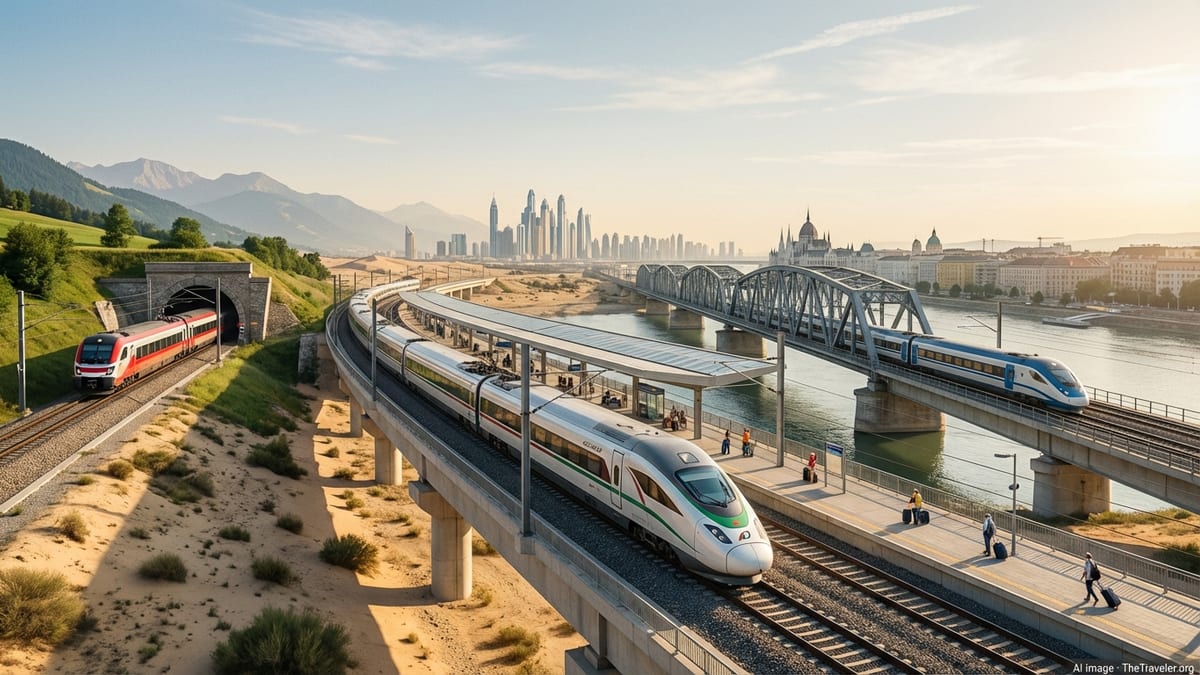
EU Policy Push for Multimodal, Low-Carbon Travel
Publicly available information shows that the European Union increasingly frames integrated air and rail travel as a cornerstone of its climate and transport strategies. The European Green Deal and the Sustainable and Smart Mobility Strategy both call for shifting a substantial share of medium‑haul trips from air and road to rail, supported by better links between modes rather than by rail alone.
A central plank of this agenda is the development of Multimodal Digital Mobility Services, or MDMS, which the European Parliament’s research service describes as platforms that combine different modes such as rail, public transport and shared mobility in a single interface for planning, booking and payment. Recent briefings highlight these services as strategic tools for decarbonisation and for strengthening the EU’s single transport market, since they can make combined rail–air journeys easier to compare and purchase alongside purely rail or air options.
The European Commission has been working on a regulatory framework to remove barriers to such services, including rules on access to real‑time data, fair ticket resale conditions and interoperability between national systems. Background documents linked to the MDMS initiative indicate that the goal is to enable seamless multimodal passenger trips, including those that combine long‑distance rail legs with flights, without creating new transport services but by better linking existing ones.
Complementing the digital agenda, Europe’s Rail Joint Undertaking, a public‑private research partnership, is funding projects to improve the physical and operational interfaces between rail and other modes. Its programmes emphasise interoperable back‑end systems, shared data spaces and station design that makes transfers between regional rail, high speed rail and airports more convenient, so that door‑to‑door journeys can be stitched together more reliably.
From Silos to Shared Data and Single Tickets
Despite growing policy ambition, many of today’s air and rail networks still operate in silos, particularly when it comes to sharing data and coordinating disruption management. An EU‑funded project on multimodal travel noted that aviation, rail and public transport often lack the mechanisms needed to exchange data in real time, which can hinder through‑ticketing, missed‑connection protection and informed passenger choice between combined or single‑mode itineraries.
To address these gaps, EU initiatives are promoting common standards and access rules for transport data. Technical work around National Access Points for transport information, and standards such as NeTEx and SIRI for structured data exchange, is intended to make timetables, fares and availability information easier to integrate into third‑party booking platforms. The aim is that a passenger planning a trip, for example from a regional city to a global hub airport, can see rail and air options together and purchase them under a single contract.
On the rail side, Europe’s Rail has highlighted the importance of interoperable back‑end services, arguing that true multimodality depends on simplifying offers and enabling combined products rather than maintaining parallel distribution systems. Demonstration projects under its Innovation Programme 4 and the MOTIONAL flagship have shown prototypes of cross‑border, multimodal platforms that let passengers plan and pay for complex journeys across rail, buses, on‑demand transport and potentially air connections in one place.
Industry bodies in the air sector are evolving their own systems in parallel. The International Air Transport Association is promoting a shift to an “Offers and Orders” model for distribution, which replaces traditional ticket‑based processes with more flexible, API‑driven records. Public documentation indicates that this framework is designed to support all types of partnerships, including intermodal ones, so that airlines can bundle flights with non‑air segments such as high‑speed rail under a unified commercial process.
Air–Rail Alliances Gain Strategic Importance
Closer commercial alliances between airlines and rail operators are emerging as a practical expression of Europe’s multimodal ambitions. Air‑rail partnerships have existed for decades, but recent developments point to a widening of their scope and strategic relevance. For example, Deutsche Bahn’s long‑standing Express Rail cooperation with Lufthansa was expanded in 2022 when the German railway became the first intermodal partner in the Star Alliance. According to public documentation, that move allowed all Star Alliance carriers to offer German high‑speed rail segments with flight numbers in their booking systems, creating de facto combined air‑rail itineraries across the network.
In 2024, high‑speed operator Eurostar took a step in a similar direction by signing a memorandum of understanding to join SkyTeam as its first non‑airline partner, according to widely cited reports. The agreement is presented as a way to pioneer integrated air‑rail travel, with participating airlines expected to link their long‑haul services to Eurostar’s cross‑Channel trains more systematically and to explore coordinated schedules, baggage handling and loyalty benefits.
These alliances complement airport‑rail infrastructure projects that bring high‑speed lines directly into terminals or major hubs. In Spain, for instance, work has been reported on linking Madrid’s Barajas airport to the national high‑speed rail network, opening the possibility of easier through‑journeys between domestic rail destinations and international flights. Similar concepts are being advanced at other European hubs, where station upgrades and new rail links are intended to offer a viable alternative to short‑haul feeder flights.
Airline distribution reforms and rail liberalisation are expected to further expand the space for such products. As more open‑access rail operators enter high‑speed and night‑train markets, and as airline systems become more capable of handling non‑air segments, analysts anticipate a broader menu of combined tickets that offer guaranteed connections, rebooking rights and transparent carbon information across the whole journey.
Digital Platforms and Pilot Corridors Point to Future Models
Alongside policy frameworks and alliances, a wave of pilots is testing how integrated air and rail travel might work in practice. Europe’s Rail has showcased MaaS platforms that enable passengers to combine cross‑border rail with local buses, car‑sharing and demand‑responsive services in a single booking, with back‑end systems handling real‑time updates and disruption management. These pilots are framed as building blocks for a European‑wide multimodal system that could eventually encompass long‑haul flights and intercontinental travel.
The European Commission’s digital mobility strategy also references the role of 5G and advanced connectivity in supporting seamless multimodal journeys. A recently launched Multimodal 5G corridor project, for example, aims to provide continuous high‑capacity connectivity along key transport routes, allowing real‑time monitoring of trains and other vehicles, as well as richer passenger information and entertainment services en route. Such infrastructure is seen as a prerequisite for scaling up integrated services that depend on live data from multiple operators.
According to published coverage, stakeholders in both the rail and air sectors see these digital enablers as essential to making multimodal travel as convenient as point‑to‑point flying. If itinerary changes, delays or cancellations can be re‑calculated across an entire door‑to‑door journey, and if passengers can manage all legs via a single app or booking reference, the perceived risk of choosing a combined rail‑air option is reduced.
At the same time, analysts caution that technology alone will not resolve all challenges. Issues such as allocation of delay responsibility between carriers, fair sharing of revenue on combined tickets, and alignment of consumer rights rules across modes remain under discussion. Industry and policy reports indicate that the next phase of Europe’s integration effort is likely to focus heavily on these governance questions, while continuing to build out the digital and physical links that make rail and air function as parts of a single network.
European Parliament briefing on Multimodal Digital Mobility Services
European Commission digital mobility and multimodal travel policy
Europe's Rail on interoperable services for multimodal transport
IATA information on Offers and Orders and intermodal partnerships