


More news on this day
A new wave of flight disruption is rolling across Europe, with operational data indicating at least 57 flights cancelled and more than 1,900 delayed in a single day across key hubs in England, Spain, the Netherlands, Russia and other markets, severely affecting services operated by British Airways, KLM, Air Dolomiti and several regional carriers.
Get the latest news straight to your inbox!
Weather, Airspace Limits and Operational Strain Converge
Published coverage and live tracking data indicate that the latest disruption stems from a convergence of factors, including severe summer weather, congested airspace and ongoing capacity constraints at major airports. Thunderstorms and heavy rainfall over parts of the United Kingdom and western Europe have contributed to delays at London Heathrow and Gatwick, with knock-on effects across the continent as aircraft and crews fall out of position.
In parallel, restrictions related to regional security concerns and airspace management are pressuring the wider European network. Adjusted schedules on routes linking Europe to the Middle East and parts of eastern Europe have reduced flexibility for airlines to recover from routine delays, leaving carriers more exposed when storms or technical issues arise elsewhere.
The combined result is a patchwork of cancellations and rolling delays. Real-time aviation dashboards show dozens of short haul flights scrubbed from schedules and nearly two thousand more held on the ground or forced into extended holding patterns, affecting both intra-European trips and long haul services relying on smooth connections through major hubs.
While the total number of cancellations remains a fraction of overall daily traffic, the concentration at a few large airports and the timing during the peak summer holiday period mean that relatively small schedule cuts can strand large numbers of passengers or force extensive rebooking.
British Airways and KLM Struggle at Core Hubs
British Airways and KLM, two of Europe’s largest network carriers, are among the airlines most visibly affected as disruption ripples through Heathrow and Amsterdam Schiphol. Publicly available travel updates from British Airways describe continuing schedule adjustments on a range of routes, with some services cancelled outright and others retimed, particularly where aircraft and crew rotations have been disrupted.
At the same time, information published by KLM highlights a series of flight cancellations and longer than usual delays on European routes feeding into Amsterdam. Recent notices outline scenarios in which passengers have been shifted onto partner airlines or rebooked on later departures when original flights were cancelled or missed due to earlier delays within the network.
Both carriers are also grappling with capacity lost on routes to and from the Middle East, where services to destinations such as Tel Aviv and several Gulf airports have been scaled back or suspended for extended periods. These changes limit the number of spare aircraft and crews available to cover last minute schedule disruptions in Europe, making it harder to stabilize operations after storms, technical faults or air traffic control restrictions.
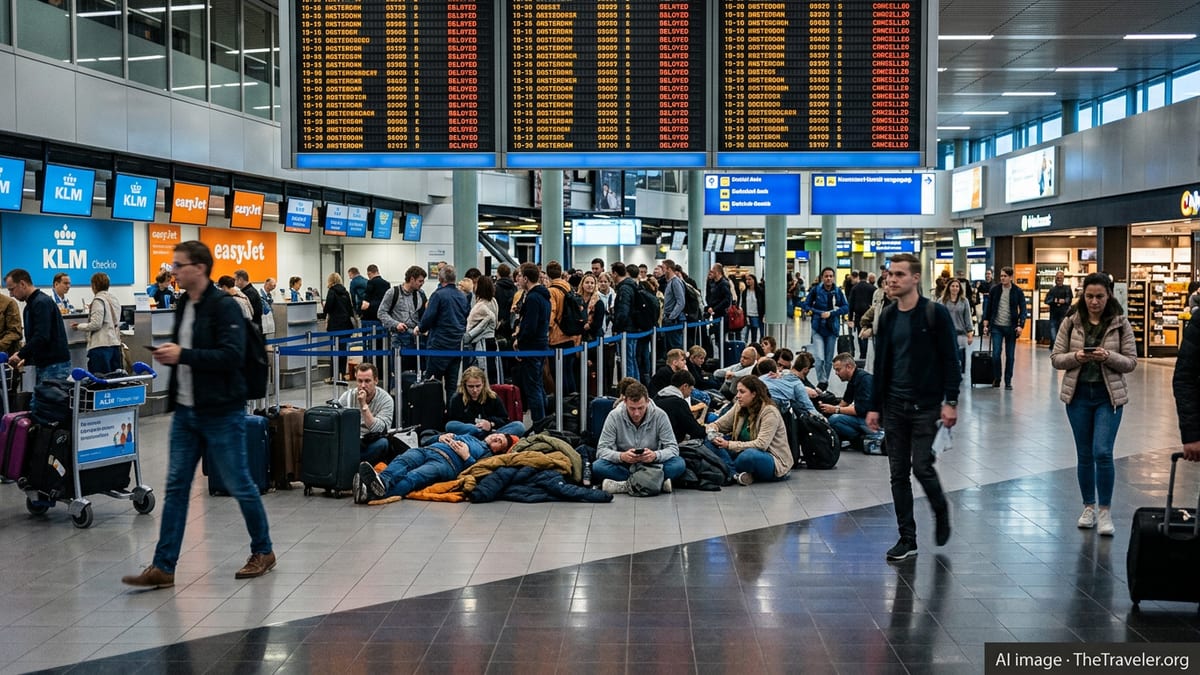
For passengers, the impact is most visible in crowded departure halls and long queues at customer service desks as travellers attempt to secure alternative routings. Reports from recent days describe missed connections, overnight stays near hub airports and complex rebookings that sometimes involve switching between alliances or flying indirect routes to reach final destinations.
Spain, the Netherlands, Russia and Regional Networks Feel the Shockwave
Beyond the main UK hubs, the current wave of cancellations and delays is being felt across a broad swathe of the European network. In Spain, congested holiday airports such as Barcelona and Madrid are absorbing diverted and delayed traffic, with schedule data showing late departures cascading into the evening peak. Low cost and leisure carriers have trimmed individual rotations, which in turn affects connecting passengers booked on separate tickets.
The Netherlands is experiencing particular pressure at Amsterdam Schiphol, where KLM and its partners anchor a dense web of European and intercontinental flights. When individual feeder services from cities such as Bordeaux, Prague or Rome are cancelled or heavily delayed, passengers can miss onward long haul flights, forcing extensive re-accommodation across the alliance network and contributing to the mounting delay count.
To the east, Russia’s airports and airspace continue to generate secondary effects on European scheduling. With many western airlines rerouting long haul operations to avoid certain flight information regions, aircraft are flying longer tracks and consuming additional crew hours and fuel. This reduces slack in airline schedules and limits the ability to recover from unrelated disruptions elsewhere in Europe, contributing indirectly to the number of delays and cancelled services.
Regional carriers such as Air Dolomiti, which feed larger groups’ intercontinental networks from secondary cities in Italy and neighboring countries, are also being touched by the current turbulence. When upstream flights from major hubs are delayed or aircraft are reassigned to cover priority routes, secondary services can be cancelled or consolidated, leaving smaller airports with reduced connectivity for part of the day.
What Disrupted Passengers Can Expect From Airlines
According to information made publicly available by British Airways, KLM and other major European airlines, passengers affected by cancellations or long delays are generally offered a choice between rebooking and refunds. Many carriers state that they will attempt automatic rebooking on the next available flight, often visible in airline apps or via email and text messages, while also giving customers the option to select different dates or routes where permitted by fare rules.
European and UK consumer regulations set a baseline for care and assistance when flights are cancelled or severely delayed, including meals, refreshments and, where necessary, hotel accommodation when passengers are stranded away from home. Guidance from aviation regulators emphasizes that travellers should retain boarding passes, booking confirmations and receipts for reasonable expenses when disruption occurs.
Compensation in the form of fixed cash payments can also apply in some circumstances, particularly when cancellations or long delays are not caused by extraordinary factors such as severe weather or air traffic control strikes. Airlines’ legal pages and passenger rights sections typically outline the distance thresholds, minimum delay times and exceptions that govern eligibility, alongside instructions on how to submit a claim.
However, the current mix of storm activity, airspace constraints and operational knock-on effects means that many of the latest cancellations may fall under categories where compensation is limited or not available. In those cases, the primary support available usually consists of rerouting, refunds and duty of care such as accommodation and transport to and from hotels.
Summer Travel Outlook Across Europe
The timing of this disruption wave is particularly sensitive, arriving during the height of the summer holiday season in Europe. Airports across England, Spain, the Netherlands and other popular destinations are already operating close to capacity as leisure travel demand remains strong, leaving little margin for error when thunderstorms or technical issues strike.
Industry analysts note that while the raw numbers of cancellations may appear modest relative to the thousands of flights operated each day across Europe, concentrated clusters of 50 or more cancelled services combined with nearly 2,000 delays can cause disproportionate inconvenience. Missed connections, lost hotel nights at destination resorts and disrupted cruises or tours can transform a single cancelled leg into a complex travel problem.
Travel experts generally advise passengers flying in and out of Europe during this period to allow extra time for connections, monitor airline apps and airport departure boards closely, and be prepared for rapid changes to itineraries. Flexible tickets and travel insurance that covers missed connections and reasonable out of pocket expenses can also provide a measure of protection when networks become strained.
For now, operational data suggests that airlines are working to stabilize schedules by trimming frequencies on select routes, consolidating lightly booked services and prioritizing flights that connect to long haul and high demand markets. If weather conditions improve and air traffic control restrictions ease in the coming days, the number of cancellations and delays may begin to recede, but travellers across Europe should be prepared for intermittent disruption to persist through the peak summer period.