


Miami International Airport can feel overwhelming at first glance. Instead of separate stand-alone terminals, MIA is really one long U-shaped building divided into six concourses: D, E, F, G, H and J. Each area has its own mix of airlines, security checkpoints, baggage claim belts and connection options, which matters a lot when you are trying to make a tight connection, find the right check-in desk, or meet arriving family at the correct door. This guide breaks down what you actually need to know, concourse by concourse, with real-world examples for typical trips through Miami.
Get the latest updates straight to your inbox!
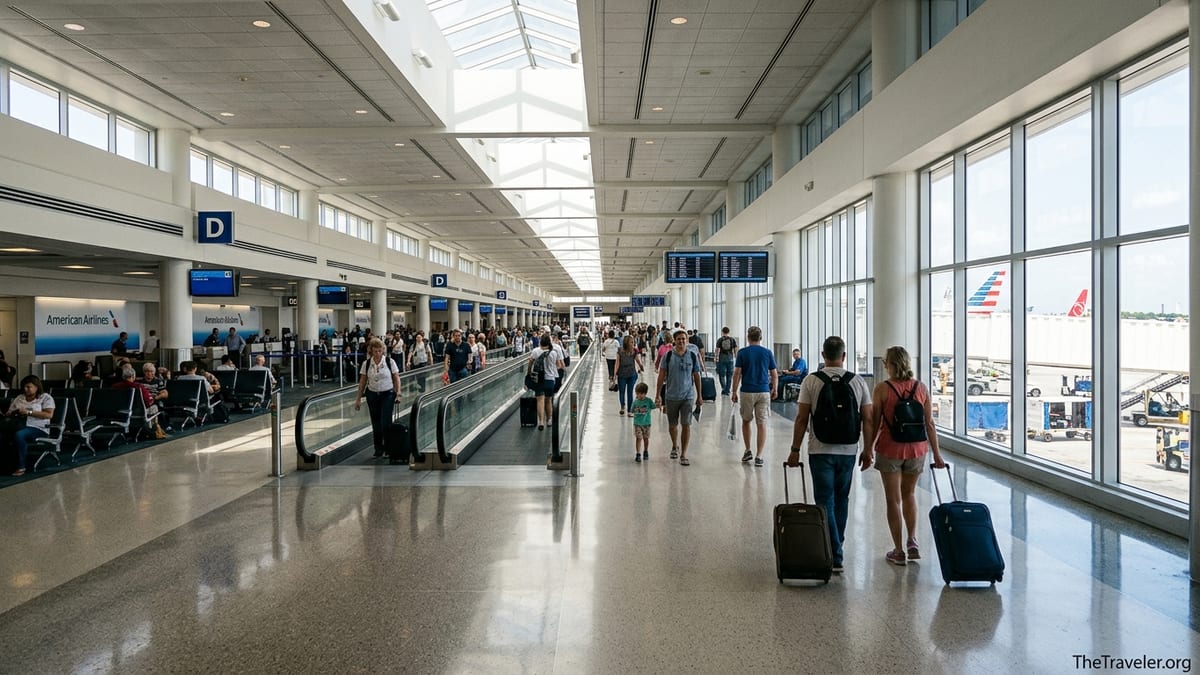
Understanding Miami’s Layout: One Terminal, Six Concourses
Miami International Airport is organized as one continuous U-shaped building with three terminal zones: North, Central and South. The North Terminal is Concourse D, the Central Terminal is Concourses E, F and G, and the South Terminal is Concourses H and J. All six concourses sit on the same horseshoe roadway, so you can drive or be dropped off directly in front of the right area if you know your airline and departure concourse in advance.
Most travelers never see the words “North, Central, South” on their boarding pass. Instead, your airline or booking will list “Concourse D,” “Concourse J,” and so on. In practice, this means you should think in letters first. For example, a New York to Miami flight on American Airlines will almost always use Concourse D, while a Miami to Paris flight on Air France is likely to operate from Concourse J in the South Terminal. Knowing that before you arrive can easily save 15 minutes of walking for check in.
All concourses connect inside the security area in some fashion, but not all connections are equal. D and E share a secure connector, H and J share another, while F and G sit in the middle with less direct airside links to the rest of the airport. On the public (pre-security) side, elevated moving walkways on the departures level let you walk the U-shape from North to South in about 15 to 20 minutes if you keep a steady pace, although most people only walk one or two segments between neighboring concourses.
Another key part of the layout is that the airport’s main international arrivals facilities are concentrated in three zones: North (Concourse D), Central (Concourse E) and South (Concourse J). That is where immigration, customs and international baggage claim are handled for most long-haul arrivals, whether you are coming from London, São Paulo or Mexico City. If you are waiting for arriving passengers, it is worth checking which concourse their flight uses so you can meet them at the right international arrivals door.
Concourse D: American Airlines’ Giant Hub & the Skytrain
Concourse D in the North Terminal is the heart of American Airlines’ operation in Miami and handles the vast majority of American and American Eagle flights. It is a mile-long concourse with around 60 gates that stretch from D1 to roughly D60 and can feel like a small city at peak times. If you are flying American on a typical domestic route like Dallas to Miami or Miami to Orlando, you should expect to check in at the North Terminal and depart from Concourse D in most cases.
Check in for American at Miami is located along the curb in the North Terminal, with multiple entrance doors feeding into different parts of the same huge hall. In practice, this means you can be dropped at almost any “American Airlines” sign and still reach your check-in counter within a few minutes. Domestic baggage claim for American arrivals is directly below, on the first level, while international American flights use the large Federal Inspection Station complex tied to Concourse D before passengers exit into the same arrivals level. That is where you would meet someone arriving from, for example, Madrid or Buenos Aires on American.
Because Concourse D is so long, Miami operates an internal Skytrain that runs along the concourse roofline with four stations spaced roughly every quarter mile. Trains run frequently, typically every few minutes, and can cut a 20-minute gate-to-gate walk down to under 5 minutes. A real-world example: if you arrive from Charlotte at gate D3 and have a connection to a Lima flight departing from gate D45, you can ride the Skytrain from the Station 1 escalator near D1 up to Station 3 or 4 and easily make the connection in under 15 minutes instead of jogging the entire distance.
Concourse D also connects airside to Concourse E, which is helpful if your international partner flight uses the E gates. For instance, some oneworld partners such as British Airways or Iberia may check in or arrive in the E area, but you can still walk from D to E without leaving the secure area. The signage is not always intuitive, so it is worth following the overhead “E Gates” markers carefully, especially if you are moving toward the satellite E gates used for some widebody aircraft. When in doubt, airport staff and American agents are used to helping transfer passengers navigate this corridor.
Concourses E, F and G: The Central Terminal Mix
Concourses E, F and G make up the Central Terminal, which is used by a mix of American overflow flights, oneworld partners, a range of Latin American and Caribbean airlines, and several low-cost or leisure carriers. Concourse E is notable because it includes an international arrivals facility and a satellite pier that can handle larger long-haul aircraft. You might find flights from carriers like Aeromexico, Lufthansa, or Turkish Airlines using E gates, while still seeing some American flights mixed in at peak times.
If you arrive internationally into Concourse E, you will proceed down to immigration and customs in the Central Terminal inspection area before exiting to the public arrivals hall. A typical scenario: you land from Cancun with a mid-sized Mexican carrier using an E gate, clear U.S. passport control and customs in that same building, and then exit to the curb where taxis and rideshares serve all of Central Terminal. If you are connecting onward on American, you can follow signs to recheck bags and then use the secure connector back toward D once you go through TSA screening again.
Concourse F tends to handle a mix of international and domestic services operated by regional or leisure-focused airlines. For example, some South American and Caribbean carriers, as well as charter operations, often use F. The concourse itself is more compact than D or J, and amenities are more limited; travelers frequently comment that food options here are sparse, so grabbing a snack in the main Central Terminal area before heading down to your exact gate is a sensible idea, particularly for late-night departures when only one or two small outlets may be open.
Concourse G is another mid-sized pier that typically sees domestic operations from carriers such as Southwest, along with some international or charter flights. In practical terms, G can be a good place for quick in-and-out domestic trips because the walk from curbside check in to gate is often shorter than in D. However, connections from G to long-haul international flights in H or J can be awkward. Many frequent flyers recommend that if you land in G with a tight connection to a South Terminal flight, the fastest option may be to exit security, walk or use the moving walkways along the terminal front or even through the parking garage, and then re-clear security closer to your departing concourse.
Concourses H and J: The South Terminal International Zone
Miami’s South Terminal, made up of Concourses H and J, is heavily focused on international flights operated by non-oneworld airlines. Concourse H often serves carriers such as Delta and some SkyTeam partners on regional and medium-haul routes, while Concourse J is home to many large international airlines like Air France, TAP Air Portugal, Lufthansa and others that operate widebody aircraft on transatlantic or long South American routes. If you are flying Miami to Paris on Air France, Miami to Lisbon on TAP, or Miami to Santiago on a non-oneworld airline, there is a good chance you will use J.
Check in for South Terminal airlines is located on the red-coded part of the departure level, with counters grouped by airline. For instance, Delta’s check-in desks are typically concentrated in the H area, while carriers like Air France, Turkish Airlines or Lufthansa will be closer to the J zone. Domestic baggage claim for flights using H and J is on the lower level directly below, and there is a significant Federal Inspection Station in J for arriving international flights. Passengers landing from Europe or many South American destinations and clearing customs here will emerge into the South Terminal arrivals hall, which has its own ground transport pickup zones.
An important detail is that H and J are connected airside, creating a shared secure zone once you pass security. That means a traveler arriving on a shorter Delta flight into H, then connecting to a long-haul international flight on another South Terminal airline in J, can move between concourses via internal corridors without leaving security. The walk can take around 10 to 15 minutes at a moderate pace, with moving walkways helping in parts.
Because the South Terminal concentrates so many international departures, it is also where you will find several of Miami’s non-oneworld airline lounges, including spaces used by airlines like Delta, Air France, Turkish Airlines and various Star Alliance carriers. If you hold a premium cabin ticket or certain credit-card-based lounge memberships, you may be invited to one of these lounges prior to departure. For example, a business-class passenger on a Miami to Paris flight with Air France would typically check in at the J counters, clear security nearby, then access the lounge in J before boarding at a nearby gate.
Check In, Baggage Claim and International Arrivals: What Matters for Your Trip
When it comes to which area you “need” at Miami, the most important factors are your airline, whether your flight is domestic or international, and whether you are starting or ending your trip in Miami or simply connecting. For origin passengers departing Miami, you should always follow the airline and concourse listed on your booking. For example, if your itinerary shows “Miami (MIA) to New York (JFK), American Airlines, Departing from Concourse D,” you can plan to be dropped off at the North Terminal under the blue D signage and head straight to American check in.
Baggage claim is generally tied to the concourse and terminal where you arrive. A domestic American Airlines flight from Chicago that uses Concourse D will send bags to the baggage carousels located directly below D in the North Terminal. A domestic Southwest Airlines arrival into G will use the Central Terminal carousels under G. For international flights, however, you will always collect your bags inside the secure Federal Inspection Station associated with D, E or J before clearing customs. For example, a passenger arriving from London on British Airways might arrive at a gate in E, clear immigration and collect checked luggage in the E international hall, clear customs, and only then enter the public arrivals area.
If you are meeting someone at Miami, it is crucial to know which concourse their flight uses and whether it is domestic or international. Meeting an arriving family member from Bogotá on a non-U.S. airline that uses Concourse J will mean waiting near the South Terminal international arrivals doors, not near the central baggage hall used by domestic flights. Airport display boards in the public area list arrivals by airline and show the concourse and door number where passengers emerge, and this can change slightly by day, so always double-check on the day of travel.
For international passengers connecting onward domestically, you will often need to collect your luggage after customs and then recheck it onto your next flight, even if it is tagged through to the final destination. This is common on routes such as Madrid to Miami on American, then Miami to Orlando also on American. In that scenario you arrive into Concourse D, clear immigration and customs, place your checked bag on the recheck belt just beyond customs, then follow signs upstairs to re-enter security in D before heading to your domestic gate. Allowing at least 90 minutes for this kind of connection is wise, and two hours is more comfortable during busy holiday periods.
Getting Around: Connections, Walking Times and the Skytrain
Because MIA is a single connected building, you can technically walk from D to J on the pre-security level, but for most travelers the focus is on how to move efficiently between gates once inside security. Within the North Terminal, the Skytrain is the primary time-saver, slashing travel time along the length of Concourse D. Passengers making tight domestic-to-domestic or domestic-to-international connections within American’s network rely heavily on it, particularly when moving between far-apart gates like D2 and D55.
Between D and E, an airside connector allows you to remain inside security. For example, if you arrive on an American regional flight from Key West at a lower E gate, and your onward British Airways flight to London departs from E’s satellite or a nearby D gate, you can make the entire connection without re-clearing TSA. Walking time between the center of D and the main E concourse is around 10 to 15 minutes, somewhat longer if your flight uses one of the far E20+ gates on the satellite pier.
Connections involving F and G sit in a gray area. There is physical continuity through the Central Terminal, but airside links can be limited or subject to operational changes, and many experienced travelers treat these as “separate” zones in practice. If you land in G on a domestic flight from, say, Nashville and have a 50-minute connection to an international departure in J, the safest choice is often to follow the “Baggage Claim/Exit” signs, walk or use the moving walkways toward the South Terminal, and then re-clear security at the H/J checkpoint rather than risk a slow route through internal corridors.
On the South side, H and J are connected airside, so transfers there are relatively straightforward. A typical example would be arriving from Atlanta on Delta into H, then walking to J for a connection to a long-haul partner flight. Walking time is roughly 10 minutes, and you do not have to exit and re-enter security. If you have a longer layover, you might detour to one of the shared lounges or food courts along the way, then continue to your final gate closer to boarding time.
Ground Transport, Parking and the MIA Mover
Outside the terminal, the U-shaped road system roughly mirrors the internal layout, with clearly marked zones for North, Central and South. If you are driving yourself, the Dolphin Garage is generally most convenient for the North Terminal and Concourse D, while the Flamingo Garage is closer to the Central and South Terminal areas serving E through J. Parking rates and availability can fluctuate, but as a rule you should budget a few extra minutes to locate a space and then use the walkways or elevators to reach your exact concourse check-in area.
Rideshare and taxi pickups are split by terminal section as well. If you arrive on an American flight into D and call a rideshare, your app will typically direct you to a pickup zone labeled with the corresponding terminal letters and door numbers on the lower arrivals level. If, on the other hand, you land on an Air France flight into J late in the evening, you will follow signs to the South Terminal rideshare and taxi locations. Giving the driver your concourse letter when meeting at departures or curbside, such as “Central Terminal, G side,” can reduce confusion and looping around the U-shaped roadway.
For those connecting to regional rail, downtown Miami or rental cars, the MIA Mover automated train links the terminal complex to the Miami Intermodal Center and Rental Car Center. To reach it, follow signs in any concourse toward “MIA Mover / Rental Cars,” typically leading you to an elevated walkway near the center of the U. From there, the automated train ride to the station takes only a few minutes. A real-life scenario: a traveler landing from Los Angeles on American in D who has booked a rental car pickup will collect checked luggage at D’s baggage claim, follow the MIA Mover signs, ride the train to the Rental Car Center, and be at the rental counter in roughly 15 to 25 minutes depending on time of day.
If you are simply dropping off or picking up at Miami and not entering the terminal, the short-term parking decks above each terminal section can still be worthwhile, particularly for international arrivals where waiting at curbside is strictly controlled. Paying a modest hourly parking fee to meet a relative coming in at the J international arrivals might be far less stressful than circling the South Terminal loop for half an hour while they clear customs and collect bags.
The Takeaway
Choosing “which area you need” at Miami International Airport starts with one simple rule: follow your airline and concourse letter. American and most of its hub operation live in Concourse D, a giant North Terminal concourse made manageable by the Skytrain. The Central Terminal’s E, F and G concourses host a mix of American overflow, oneworld partners, and regional and leisure airlines, with E also handling a number of international arrivals. The South Terminal’s H and J concourses serve many non-oneworld international carriers and provide a more compact but still busy environment for long-haul departures and arrivals.
Once you know your concourse, think about your specific travel situation. Starting your trip in Miami means choosing the right drop-off point and check-in hall. Ending your trip there means understanding which baggage claim and arrivals door your flight will use, particularly for international flights into D, E or J. Connecting through MIA adds a third layer: whether you can stay airside between concourses or need to budget extra time to exit and re-clear security, especially when moving between G or F and far-flung H or J flights.
With that framework in mind, Miami becomes less confusing and more predictable. Build in generous connection times for international-to-domestic transfers, use the Skytrain to your advantage in Concourse D, do not hesitate to exit and re-enter security when it is clearly faster for a cross-airport connection, and always check your concourse letter on the day of travel. Treated this way, MIA’s six concourses become six clearly defined neighborhoods rather than a maze, and your path from curb to gate, or gate to gate, can be much smoother.
FAQ
Q1. How do I know which Miami concourse I need for my flight?
Your airline and booking confirmation will list the concourse letter, such as D, E or J, usually alongside the gate number. If it is not printed on the ticket, you can check your airline’s app or the airport’s live departure boards on the day of travel.
Q2. Can I walk between all terminals at MIA without leaving security?
Not easily in every case. D and E are connected airside, and H and J are connected airside, but transfers involving F and G often work better by exiting to the public area and passing through security again closer to your next concourse.
Q3. How long does it take to walk from Concourse D to Concourse J?
Allow around 15 to 20 minutes pre-security using moving walkways along the terminal front, plus any time needed to re-clear security. Airside, most passengers will exit and re-enter rather than attempt a complex internal route.
Q4. Where do international arrivals clear immigration and customs at Miami?
Most international passengers use one of three main inspection areas tied to Concourses D, E and J. You follow the “Arrivals” and “Immigration” signs directly from your gate to the appropriate Federal Inspection Station before exiting into the public arrivals hall.
Q5. Does the Skytrain connect all concourses at MIA?
No. The Skytrain is limited to Concourse D in the North Terminal. It runs along D with four stations and is designed to shorten walking times for American Airlines passengers within that concourse only.
Q6. If I land in Concourse G and depart from Concourse D, what is the best way to connect?
With a short connection, many travelers exit to the public area, walk or use moving walkways toward the North Terminal, and re-clear security at D. With a longer layover, you can take more time and follow internal signage toward D, but allowing plenty of buffer is important.
Q7. Where should I meet arriving family if I do not know their exact gate?
Check their airline and whether the flight is domestic or international, then head to the corresponding terminal arrivals hall: North for most American domestic flights, Central for many E, F, G flights, and South for international carriers using J. Airport screens in the arrivals area list flights with the correct door numbers.
Q8. Is there a difference between North, Central and South terminals for security wait times?
Wait times vary by time of day more than by terminal, but large hubs like American in D can be busier at peak hours. If your airline allows, arriving a little earlier for D at morning and evening peaks is sensible, while Central and South sometimes have slightly shorter lines outside the heaviest bank of departures.
Q9. Which concourses are best for international long-haul flights at Miami?
Many long-haul oneworld and partner flights use Concourses D and E, while a large number of non-oneworld intercontinental routes operate from Concourse J. Checking your airline’s typical concourse pattern can help you plan ahead for lounges, food and walking times.
Q10. How does the MIA Mover fit into the terminal layout?
The MIA Mover is an automated train connecting the main terminal complex to the Intermodal Center and Rental Car Center. You reach it via elevated walkways from the central part of the U-shaped terminal, regardless of whether you arrive into D, E, F, G, H or J.