


I came to Culebra for the postcard version of Playa Flamenco, the white sand, the turquoise bay, the famous tanks in the surf. I stayed for the snorkeling, and I learned quickly that “Flamenco snorkeling” depends on where you enter, what the sea is doing that day, and whether you’re willing to swim away from the crowd. I also spent separate water time at Tamarindo Beach, which Discover Puerto Rico calls one of Culebra’s strongest snorkeling beaches, specifically for turtles and rays. After multiple dips, a few mask floods, and one very humbling current, I walked away with a clear favorite for the better underwater experience.
Get the latest updates straight to your inbox!
What Flamenco Looks Like From the Water (and Why Most People Miss It)
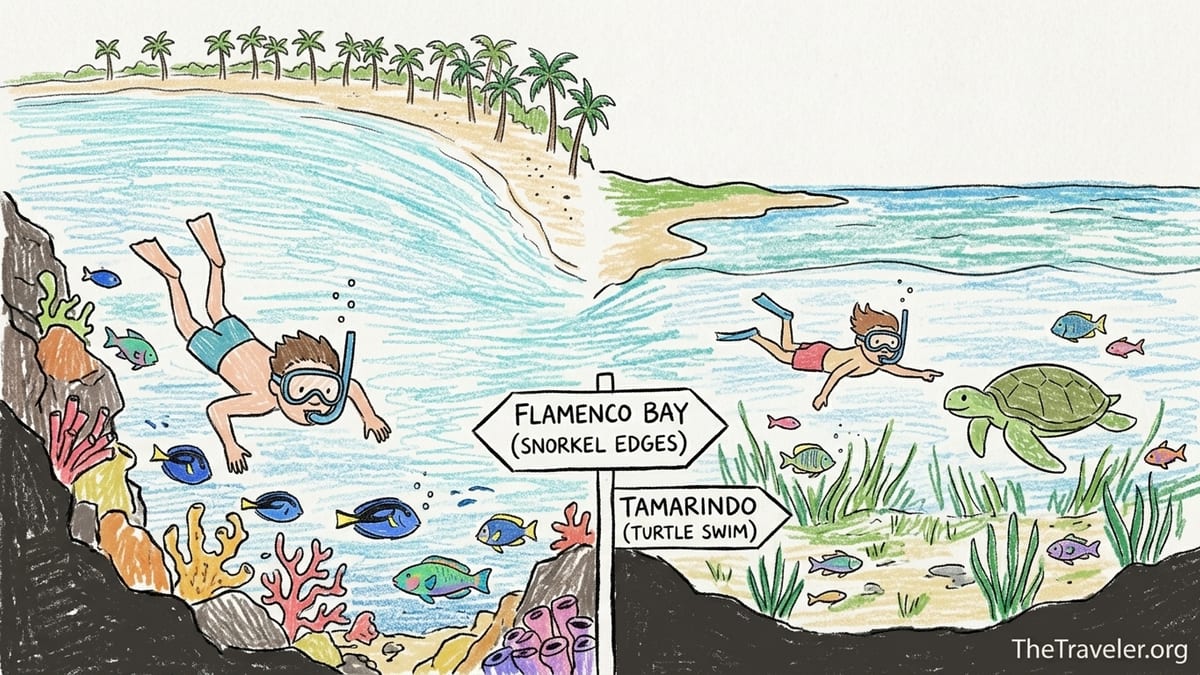
From the sand, Flamenco Bay looks like it was designed for floating. In the middle of the horseshoe, the water usually reads as calm and inviting, and it is. But the center is also where the bottom is often plain sand with fewer “things to look at,” especially if you stay close to shore. The real snorkeling is more of a side quest.
On my first swim at Flamenco, I did what most people do. I walked in near my towel, put my face down, and expected a reef. Instead, I saw wide sand flats and scattered grass patches, with the occasional small fish flashing by like confetti. It was pleasant, but it was not the “Culebra reef moment” I had traveled for.
The payoff starts when you treat Flamenco as a bay with edges. Both ends of the beach have structure. I found darker patches, rock, and coral-like formations as I worked away from the busiest swim zone. That simple change, moving laterally along the bay instead of straight out, turned Flamenco from a beautiful beach with okay snorkeling into a beach with an actual underwater route worth repeating.
Visibility at Flamenco: What I Saw, When It Popped, and What Ruined It
Flamenco’s visibility is one of those things travelers love to talk about in absolutes, but my experience was more conditional. On calmer water, the bay can look glassy and the visibility can feel strong enough that you spot fish before you’re even properly floating. On choppier days, the same beach can look milkier, especially after wind or a surge that stirs sand.
In the best window I had, I could clearly track fish movement several body lengths ahead of me, and I could pick out bottom details without squinting through the mask. In a worse window, I had that “snorkel in a snow globe” effect where sand and micro-bubbles made everything look softened, and I had to get closer to anything interesting to identify it.
What made the biggest difference for me was not time of day as much as the sea state and where I chose to swim. Staying over sand in the middle makes any reduced visibility feel worse, because you’re already light on structure. At the edges, even if the water was slightly hazy, I still had rocks and reef patches to scan, which kept the swim engaging.
Best Entry Points at Flamenco: Where I Got In, and Where I Would Start Next Time
Flamenco is an easy beach entry in the center. You can wade in on sand, settle your mask, and begin with minimal drama. That said, the easiest entry is not automatically the best entry for snorkeling. If you want underwater scenery, your goal is to reach the reefy edges without exhausting yourself in a straight-out swim.
On my most productive Flamenco swim, I entered where the sand transitions toward rock and darker bottom patches. I took a slow, shallow start, kept my fins from scraping anything, and then angled so I was paralleling the shoreline rather than heading into open water. I saw more fish variety almost immediately once the bottom stopped being uniform sand.
I also learned to respect the “nice-looking point” where people casually swim out for photos. Near the points and outer edges, conditions can change quickly. If you feel the water tugging you sideways, that is your early warning. I kept my route conservative, used the shoreline as my reference, and turned back before fatigue became a factor.
Practical note for planning: Flamenco is often managed via an entrance gate with a small per-person fee, and the gate hours matter because they affect access to the facilities and the official parking area. Multiple local guides and trip-planning resources consistently emphasize that the gate typically closes in the late afternoon, and I planned my swim so I was showered off and packed well before that cutoff.
Marine Life at Flamenco: The Fish Were Fun, but the Big Encounters Were Not My Norm
At Flamenco, my most reliable sightings were reef fish and small schools moving along the patchy structure. I spotted fish that look like the classics most travelers recognize, like blue tang style shapes, parrotfish behavior on the reef, and bright tropical fish darting in and out of crevices. The edges of the bay gave me the “aquarium wall” feeling in short bursts, especially when the light hit the bottom just right.
What I did not get at Flamenco, at least not consistently, was the headline animal experience that people chase in Culebra. I had moments where I thought I might see a turtle based on movement in the distance, but I did not have the kind of close, sustained turtle encounter that becomes the story you tell at dinner.
That is not a knock on Flamenco. It is more of a realism check. Flamenco is a big, open, popular beach, and the underwater experience can be great, but it is not automatically the best place on the island for the “I swam with turtles” moment. If that is your top priority, Tamarindo is built differently.
Currents and Reef Conditions: The Flamenco Reality Check
Flamenco can feel calm until it does not. The bay is shaped in a way that can protect swimmers in the middle, but the edges and outer sections can have current and surge that are noticeable once you’re floating and focused on fish. The risk is psychological as much as physical. When you are snorkeling, it is easy to drift farther than you meant to, because you are moving slowly and not looking up every minute.
I had one swim where the current made itself known as a steady sideways slide. Nothing dramatic, but enough that I stopped, looked up, and realized my exit point was no longer “right behind me.” That was my cue to turn back early rather than negotiate the last 10 minutes while tired.
Reef condition at Flamenco, from what I could observe, is patchy. Some areas have lively structure and fish activity, and some areas look like they have been stressed. I treated the reef as fragile, kept my fins up, and avoided standing on anything that wasn’t clearly sand. Even minor contact can do damage, and the healthiest-looking pockets I saw were the ones least disturbed by people milling around in waist-deep water.
If you are newer to snorkeling, Flamenco can still work as a confidence builder. Just pick a calm day, start in the center to get comfortable, then graduate to the edges once you feel stable and you have practiced clearing your snorkel and dealing with small surface chop.
Equipment and Setup: What Actually Helped Me at Flamenco and Tamarindo
I kept my setup simple: a comfortable mask that seals well, a snorkel I can clear easily, and fins I trust. The mask fit mattered more than any brand name, because both Flamenco and Tamarindo can have little surface chop that punishes a leaky seal. If your mask leaks, you spend your best minutes managing water instead of watching fish.
Fins were my non-negotiable. They made a bigger difference at Flamenco when I needed to hold position near structure or return to my chosen exit without feeling like I had done a surprise workout. They mattered even more at Tamarindo because that beach’s snorkeling revolves around moving to the right area of the bay and hovering calmly over seagrass where turtles feed.
I also used a bright rash guard as sun protection rather than relying only on sunscreen, and I packed reef-safe sunscreen for exposed areas. In practice, that meant I could stay in longer without worrying about reapplying every time I dried off. I carried my gear in a basic mesh bag, and I kept a small bottle of drinking water nearby because dehydration sneaks up fast when you are in and out of saltwater in the heat.
If you forgot gear, you can often rent or buy basics on Culebra, including near Flamenco where there are vendors and facilities during operating hours. I still prefer arriving with my own mask, because a bad rental fit can ruin a day that otherwise would have been perfect.
Flamenco vs Tamarindo: My Side-by-Side Underwater Comparison (and the Clear Winner)
Tamarindo Beach felt like a purpose-built snorkeling spot the moment I got in. It is known for calm water and an easy shore entry, and what Discover Puerto Rico highlights matches what I experienced: Tamarindo is one of Culebra’s strongest snorkeling beaches, with chances to encounter sea turtles and rays, and the marine life tends to concentrate where the seagrass and reef structure create a feeding zone.
My best guidance at Tamarindo was also consistent with what local-facing guides say: to see more life, you do not just float in the middle. You swim toward the area where the habitat changes, scanning the seagrass beds for movement, then pausing to watch without chasing. That is where my snorkeling shifted from “nice fish” to “wow, that is a turtle, right there, doing turtle things.” I had the kind of close, sustained turtle encounter at Tamarindo that I never quite landed at Flamenco.
Flamenco gave me a prettier above-water beach scene and a solid snorkeling session when I worked the edges. Tamarindo gave me the richer underwater experience, especially for larger animals and the feeling that I was inside an ecosystem rather than just swimming in clear water. If you are asking me, personally, where I had the better underwater experience, it was Tamarindo. Flamenco is absolutely worth a snorkel, but Tamarindo is where I would send a friend who has one morning to chase the signature Culebra snorkeling memory.
One more nuance: if the sea is up and visibility is down at one beach, the other can sometimes still be workable depending on wind and exposure. I did not treat Flamenco and Tamarindo as an either-or choice. I treated them as complementary: Flamenco for the full beach day with amenities and an easy swim, Tamarindo for the underwater headline act.
The Takeaway
If you snorkel Flamenco like most visitors, straight out from the towel into the sandy middle, you may come away thinking it is only “fine.” If you snorkel it like a guide would, entering thoughtfully and working toward the reefy edges while respecting currents, it becomes a satisfying, scenic swim with bursts of reef life.
But if your goal is to maximize marine-life encounters and you want the best chance at turtles and rays, Tamarindo is the beach that delivered for me. Discover Puerto Rico is not exaggerating when it calls Tamarindo one of Culebra’s strongest snorkeling beaches. My personal best underwater moments on Culebra happened there, in the seagrass and reef zone, where the animals felt closer and the snorkeling felt more alive.
My ideal plan is simple: do Flamenco for the iconic Culebra beach day, then carve out dedicated water time at Tamarindo when you want the most rewarding snorkeling. Bring fins, take your time, and look up often so your swim ends exactly where you intended.
FAQ
Q1. Is Flamenco Beach good for snorkeling or is it mostly for swimming?
Flamenco is great for swimming and can be good for snorkeling, but the best snorkeling is usually toward the reefy edges rather than the sandy center.
Q2. Where should I enter the water at Flamenco for the best visibility and marine life?
I had the best results entering on sand and then swimming laterally toward darker reef patches near the ends of the bay, instead of heading straight out from the busiest middle section.
Q3. What kind of visibility should I expect at Flamenco?
It varies with wind and surge. On calm days it can feel very clear, but after chop or stirred sand it can turn noticeably hazier, especially over the sandy middle.
Q4. Are currents a real concern at Flamenco?
Yes. The middle can feel protected, but near the points and outer edges I felt sideways pull that can move you off your intended exit if you do not check your position often.
Q5. What marine life did you personally see at Flamenco?
I consistently saw reef fish and small schools around patchy structure. I did not personally have a standout turtle encounter there the way I did at Tamarindo.
Q6. Why is Tamarindo Beach considered one of Culebra’s strongest snorkeling beaches?
Tamarindo has calm water and a habitat mix of seagrass and reef that attracts sea turtles and rays. Discover Puerto Rico specifically highlights Tamarindo and nearby areas for those encounters.
Q7. Where did you have the better underwater experience, Flamenco or Tamarindo?
Tamarindo. Flamenco was enjoyable, but Tamarindo delivered more memorable marine-life moments and felt richer underwater.
Q8. Do I need fins for Flamenco and Tamarindo?
I strongly recommend fins for both. They help you hold position, return to your exit without fatigue, and manage any current or surface chop more safely.
Q9. Can beginners snorkel these beaches safely?
Beginners can do both on calm days, especially if they start in shallow water and stay conservative. At Flamenco, I would avoid pushing out near the points unless you are comfortable reading current and floating calmly.
Q10. What is the single biggest mistake snorkelers make at Flamenco?
Staying in the sandy center and assuming the reef will appear. At Flamenco, you usually need to deliberately swim toward the edges where the bottom changes to rock and reef patches.