


More news on this day
Passengers across Asia and South America are facing fresh travel turmoil as major carriers including Hainan Airlines, Japan Airlines, AirAsia, Flybondi and China Eastern collectively cancel around 40 flights and delay more than 960 services, disrupting journeys through key hubs such as Beijing, Tokyo, Kuala Lumpur and Buenos Aires.
Get the latest news straight to your inbox!
Wide-Ranging Disruptions From Beijing to Buenos Aires
Tracking data and operational summaries for the current travel period indicate that flight schedules have come under acute pressure on multiple continents, with a cluster of cancellations and delays concentrated around busy regional hubs. The latest figures attribute roughly 40 outright cancellations and 964 delays to a group of airlines led by Hainan Airlines, Japan Airlines, AirAsia, Flybondi and China Eastern, affecting routes within Asia as well as services linking the region to South America.
In China, Beijing Capital International Airport continues to experience elevated disruption levels. Publicly available information shows that Chinese carriers, including Hainan Airlines and China Eastern, have been contending with congested airspace, adverse weather systems and tight turnaround windows on trunk routes serving the capital. Recent analyses of traffic at Beijing and other major mainland hubs highlight persistent pressure on on-time performance, with delays rippling through domestic and international networks rather than remaining confined to a single city pair.
In Japan, reports from airport-monitoring platforms point to delays and scattered cancellations affecting services into and out of Tokyo, one of Asia’s most tightly scheduled aviation markets. Japan Airlines, which operates an extensive domestic and regional network, features among the carriers adjusting or holding flights, particularly on routes intertwined with broader Asian traffic flows. Even modest disruptions at Tokyo’s airports can have an outsized impact because of dense scheduling and heavy reliance on connections.
Further south, Kuala Lumpur and Buenos Aires are facing their own localized waves of disruption, underscoring how quickly operational stress can spread beyond a single region. AirAsia’s low-cost network, heavily concentrated in Southeast Asia, is particularly exposed when storms, air traffic restrictions or maintenance bottlenecks build up around Kuala Lumpur. In Argentina, Flybondi’s point-to-point model across domestic and near-regional routes means that a small number of cancellations or extended delays can leave passengers with limited immediate alternatives, especially outside peak business corridors.
Weather, Congested Airspace and Operational Strain
Operational data and regional aviation coverage suggest that a combination of seasonal weather, congested airspace and resource constraints is driving the latest bout of irregular operations. Across parts of East and Southeast Asia, intense storm systems have periodically reduced airport capacity, forcing carriers to trim schedules or hold aircraft on the ground. When weather-related flow controls take effect at a major hub like Beijing or Tokyo, the knock-on impact can extend for many hours, or even into the following day’s rotations.
At the same time, airlines are still fine-tuning their post-pandemic network and crew planning. Industry commentary indicates that carriers such as China Eastern and Hainan Airlines are operating complex schedules that stretch aircraft and crew utilization in order to rebuild connectivity while keeping costs in check. When a disruption occurs, there may be fewer spare aircraft or crews available to absorb delays, allowing minor issues to cascade into cancellations affecting multiple cities.
Low-cost operators such as AirAsia and Flybondi face a similar challenge. Their business models depend on high daily aircraft utilization and tight turnarounds, leaving limited slack if weather, technical checks or airport congestion introduce longer-than-expected ground times. A single delayed rotation in Kuala Lumpur or Buenos Aires can push subsequent flights outside their slots or curfews, triggering further schedule changes and, in some cases, cancellations.
In Japan, pressure on air traffic control sectors around Tokyo intersects with these airline-level constraints. Published punctuality analyses have previously highlighted how delays at major Japanese gateways can quickly propagate across domestic and regional routes, as aircraft arriving late from other countries struggle to re-enter already congested traffic flows. This environment makes carriers more vulnerable when they face simultaneous weather issues or airspace restrictions on international sectors.
Impact on Passengers and Key Transit Hubs
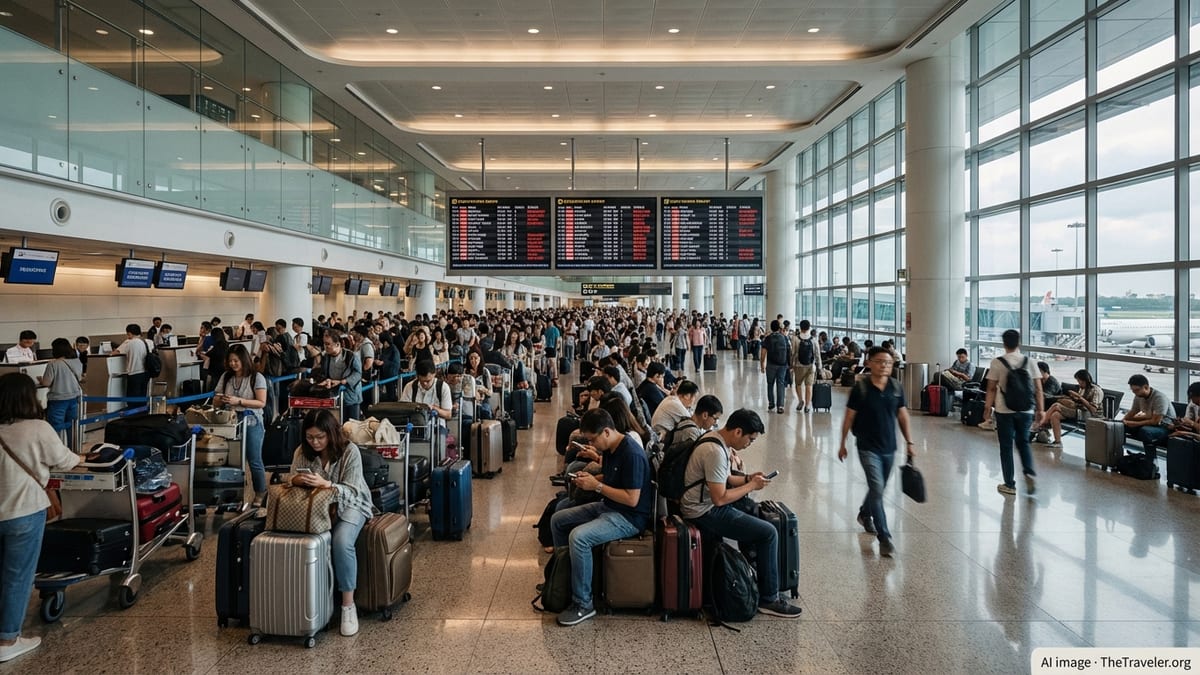
The practical effect for travelers has been long queues at check-in desks and transfer counters, crowded departure halls and uncertainty over missed connections. In Beijing and Tokyo, where many long-haul passengers rely on tight connections to reach onward destinations, even moderate delays can translate into extended layovers or the loss of a same-day onward option. With multiple carriers affected at once, spare seats on alternative flights can be scarce, and rebooking often requires significant rerouting.
In Kuala Lumpur, AirAsia’s position as a dominant carrier magnifies the impact when its operations are disrupted. Travelers using the city as a low-cost connecting hub for routes across Southeast Asia have reported difficulty securing same-day alternatives when flights are delayed or canceled, because many routes operate only a small number of daily frequencies. This can lead to overnight stays for passengers who planned short connections and do not hold flexible tickets.
Buenos Aires faces its own structural challenges. Flybondi’s network focuses heavily on domestic Argentine destinations and select international routes, which means that other carriers do not always operate overlapping services at similar times. When a cancellation occurs, especially on secondary routes, travelers may have to wait until the next scheduled departure on the same airline or purchase new tickets on competing carriers at short notice, often at higher prices.
The wide geographic spread of the current disruption episode also complicates travel planning for passengers stringing together multi-stop itineraries. A delay departing from Beijing can jeopardize a self-connecting onward flight from Tokyo, while issues in Kuala Lumpur or Buenos Aires can undermine intricate schedules involving several budget carriers. This increases the risk that even travelers far from the original source of disruption may find themselves stranded or heavily delayed.
How Airlines Are Managing the Backlog
Publicly available statements, operational notices and passenger accounts indicate that airlines are relying on a mix of rebooking, consolidation and limited schedule reductions to work through the current backlog. When demand permits, carriers may combine lightly booked services, effectively canceling one flight while moving passengers to another departure on the same route. This approach can reduce the number of aircraft and crew rotations needed, but it often lengthens travel times for those moved to later flights.
For routes with multiple daily frequencies, particularly in busy corridors such as those linking Beijing and Tokyo, airlines sometimes prioritize maintaining at least one reliable daily service and temporarily accept degraded performance on other departures. This may involve downgrading some flights from regular operations to delayed or irregular status, with affected passengers offered rerouting or refunds in line with each carrier’s conditions of carriage.
Low-cost carriers like AirAsia and Flybondi, which typically provide fewer complimentary services during disruptions, are instead emphasizing self-service digital tools and airport kiosks to handle rebookings. However, passengers whose journeys involve multiple airlines, online travel agencies or separate tickets can find it more complex to coordinate changes, as each segment may be governed by different rules and handled by different customer-service teams.
Chinese full-service carriers, including Hainan Airlines and China Eastern, have in some recent cases issued irregular-operations notices when large clusters of flights are affected. These documents outline the framework for refunds or changes during extended disruption periods, although eligibility and specific remedies vary by route, fare type and jurisdiction. Industry observers note that the combination of domestic regulations, international consumer-protection rules and airline policies creates a patchwork of outcomes for travelers caught up in the current episode.
What Travelers Can Do Right Now
Travel experts and consumer-rights groups consistently recommend that passengers facing widespread disruption focus first on confirming the status of their immediate departure. Airline mobile apps, airport information displays and independent flight-tracking services can help travelers determine whether a flight is delayed, canceled or still scheduled to operate. In a fast-moving situation, this information may change repeatedly, making regular checks important, particularly on days when weather or airspace issues are affecting multiple hubs.
Once a cancellation or lengthy delay is confirmed, options generally include accepting an alternative itinerary offered by the carrier, requesting a refund where permitted, or asking to be rebooked on a later date. For passengers whose trips touch multiple carriers or continents, keeping detailed records of booking confirmations, change notices and any out-of-pocket expenses can be valuable if they later pursue reimbursement or compensation under applicable consumer-protection frameworks.
Given the ongoing pattern of irregular operations involving airlines such as Hainan Airlines, Japan Airlines, AirAsia, Flybondi and China Eastern, travelers planning near-term trips through Beijing, Tokyo, Kuala Lumpur or Buenos Aires may wish to build more generous connection windows into their itineraries, avoid self-connecting on separate tickets where possible and consider travel insurance that specifically covers delays and cancellations. While schedule reliability typically improves once weather patterns stabilize and airlines complete short-term network adjustments, the current wave of disruptions underscores how quickly conditions can change across interconnected global flight networks.