


More news on this day
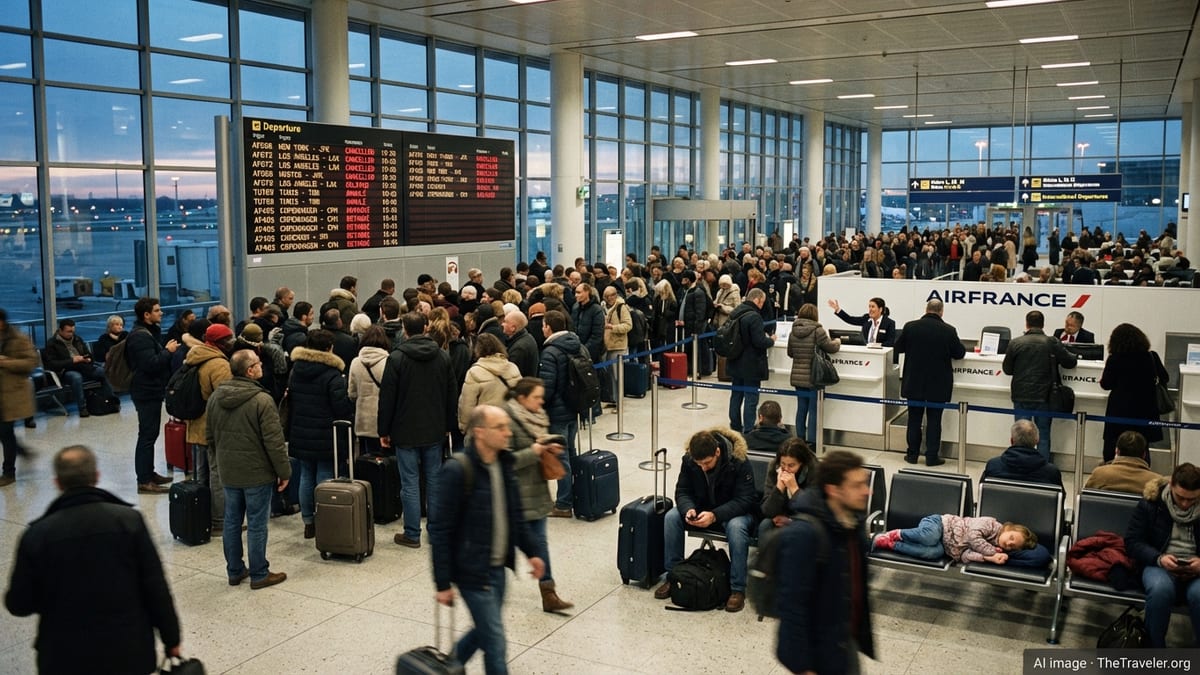
Hundreds of travelers were left in airport terminals across France on Saturday as monitoring platforms logged 981 flight delays and 34 cancellations affecting services by Air France, easyJet, Lufthansa, Ryanair and KLM at key hubs including Paris, Lyon, Nice, Marseille and Toulouse.
Get the latest news straight to your inbox!
Widespread Disruptions From Paris to the Provincial Hubs
Real time aviation tracking dashboards and passenger reporting tools show an unusually high volume of delayed departures and arrivals across the French network, with disruption concentrated at Paris Charles de Gaulle and Orly and rippling out to Lyon Saint Exupéry, Nice Côte d’Azur, Marseille Provence and Toulouse Blagnac. Aggregated data indicate that a total of 981 flights were operating behind schedule and at least 34 had been cancelled within France in the latest daily reporting window, forcing airlines to rework schedules and passengers to improvise onward travel plans.
The pattern appears delay heavy, with far more flights running late than being removed outright from the timetable. That balance is broadly in line with recent operational trends in Europe, where carriers have tried to preserve capacity and avoid mass cancellations, even at the cost of extended ground times and missed connections. For travelers at French airports, however, the practical impact has been the same: long queues at check in and customer service counters, crowded departure halls and uncertainty around when aircraft will actually leave the gate.
Traffic flows at France’s two primary Paris airports have been especially sensitive to disruption, because many short haul legs connect into long haul departures bound for North America, Asia and Africa. When an inbound feeder from a city such as Lyon or Toulouse arrives late, it can trigger a missed connection for dozens of passengers, adding to the number of people who need hotel rooms, meal vouchers and alternative routings at short notice.
Multiple Carriers Affected Across Short and Medium Haul Routes
Publicly available flight status boards and independent tracking platforms show that the disruption has not been confined to a single company. Air France, easyJet, Lufthansa, Ryanair and KLM all appear among the carriers with significant numbers of delayed or cancelled services touching French airports, spanning both domestic sectors and cross border routes within Europe.
For Air France, delays on key domestic links from Paris to cities such as Marseille, Nice, Lyon and Toulouse have knock on effects, as those flights both carry point to point passengers and feed international departures. Low cost operators including easyJet and Ryanair, which run busy leisure oriented schedules into Nice, Marseille and regional French fields, have also seen a tranche of services depart late or be withdrawn, complicating weekend travel for holidaymakers and short break visitors.
Network carriers such as Lufthansa and KLM, meanwhile, are exposed through their dense schedules between French cities and their respective hubs in Germany and the Netherlands. When congestion or late running emerges within French airspace or at French airports, aircraft and crews can miss their planned slots into Frankfurt, Munich or Amsterdam, causing further delays for passengers who are neither starting nor ending their journeys in France but are still reliant on the country’s air traffic flows.
Underlying Pressures: Weather, Congested Airspace and Tight Resources
Recent months have highlighted how quickly a combination of unsettled weather, congested European airspace and tight airline staffing can tip operations into widespread delay. Industry focused coverage has linked earlier waves of French disruption this year to intermittent air traffic control constraints, localized storms and broader geopolitical factors that have rerouted traffic around parts of Eastern Europe and the Middle East, concentrating flows through already busy corridors over Western Europe.
With many airlines operating near the limits of available aircraft and crew, even relatively brief interruptions to normal patterns can have outsized consequences. When a rotation is delayed in the morning, knock on effects can cascade through the day, especially on short haul networks where individual aircraft are scheduled to perform multiple legs. This helps explain why monitoring sites can show hundreds of late departures alongside a more modest number of outright cancellations, yet the cumulative passenger impact is still severe.
France’s hub and spoke model, centered on Paris but heavily dependent on regional bases in cities such as Lyon, Nice and Marseille, adds another layer of vulnerability. If a single high capacity aircraft from a provincial city is delayed or cancelled, it can leave large numbers of travelers without easy alternative options, particularly on routes that do not have competing carriers or frequent rail substitutes at the same time of day.
Stranded Passengers Face Long Waits and Limited Alternatives
The immediate consequence of 981 delays and 34 cancellations has been a surge in stranded or severely delayed passengers across the French network. Travelers on domestic itineraries have in some cases been able to switch to high speed rail, particularly between Paris and major cities such as Lyon or Marseille, but capacity on popular trains is limited and, on short notice, often fully booked.
At airports, publicly available imagery and on the ground accounts circulating via social media point to long lines at ticket desks and self service kiosks as passengers attempt to secure rebooking or seek clarification on revised departure times. For those whose flights departed late but still operated, long hours in crowded terminals have been followed by missed hotel check in windows, lost prepaid reservations and, for business travelers, disrupted meetings and events.
International passengers connecting through France have faced some of the most complex rebooking challenges, particularly when long haul legs are involved. When a once daily transcontinental service is missed because a feeder from a regional French city arrived late, available replacement options may involve overnight stays and multi stop routings, increasing both cost and travel time. Families and elderly travelers, in particular, can find these sudden changes difficult to navigate.
What Travelers Can Do as Disruption Continues
Consumer advisers and travel industry analysts consistently highlight a few practical steps for passengers caught up in widespread disruption of the kind currently affecting France. The first is to monitor flight status frequently through official airline channels and airport information boards, rather than relying solely on initial departure times printed on boarding passes. Conditions can change quickly, and a service marked as on time in the morning may show a significant delay by the time travelers arrive at the airport.
Second, travelers are encouraged to build generous buffers into itineraries that involve connections, particularly when routing through hub airports such as Paris Charles de Gaulle. In the present environment, where systems are already under pressure, minimum connection times printed in booking engines may prove too tight, especially if inbound flights experience even minor delays.
Finally, passengers should familiarize themselves in advance with applicable air passenger rights within the European Union, including circumstances in which airlines are expected to provide meals, accommodation and, in some cases, financial compensation when flights are significantly delayed or cancelled. Knowing these frameworks before disruption strikes can help travelers make informed decisions at the airport and ensure they request the assistance to which they may be entitled as the French air network works through the current backlog.