


More news on this day
Travelers across Asia are facing fresh disruption after more than 60 flights were cancelled or heavily delayed in recent days, stranding passengers at airports in Hong Kong, Taiwan, Malaysia and Indonesia and disrupting links to major hubs including Singapore, Macau, San Francisco and Jeddah.
Get the latest news straight to your inbox!
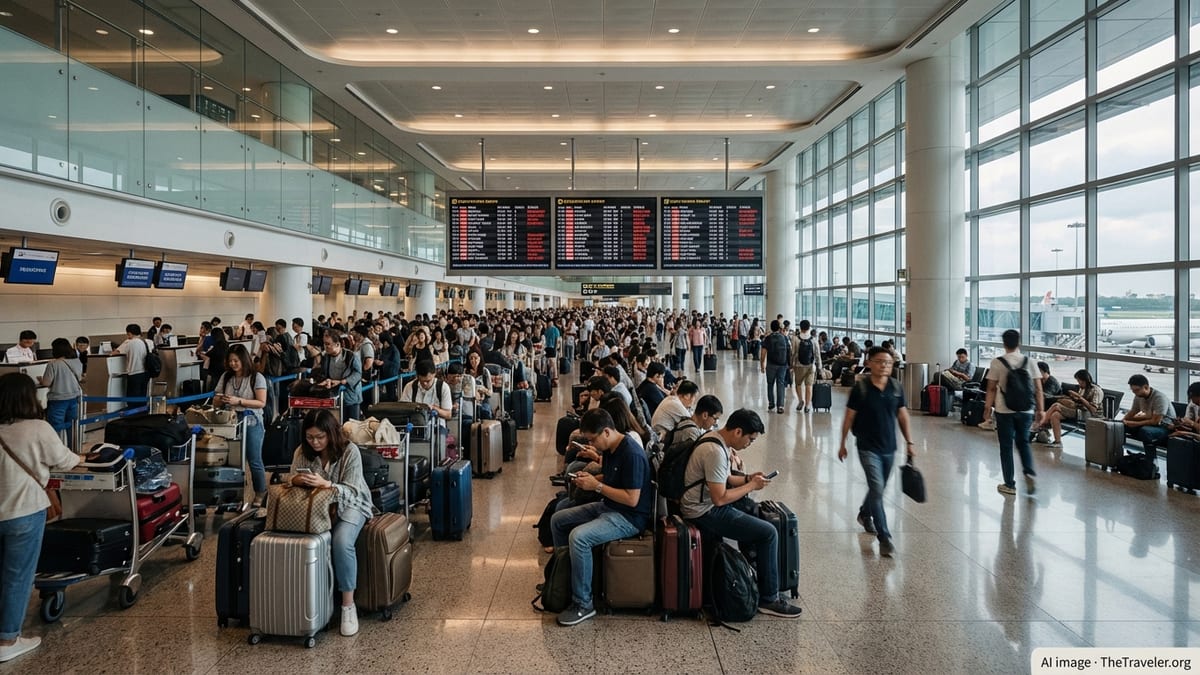
Wave of Cancellations Hits Key Asian Gateways
Operational data from flight-tracking dashboards and published aviation analytics for early May indicate that carriers including Batik Air, AirAsia, Garuda Indonesia, United Airlines, Saudia and several regional operators have cancelled or consolidated dozens of services across Asia. The pattern mirrors broader turbulence in the region’s aviation network this year, which has seen repeated spikes of cancellations and delays across multiple countries.
Recent disruption reports describe clusters of affected flights in and out of Hong Kong, Taiwan, Malaysia and Indonesia, with onward connections to Singapore, Macau and other Southeast Asian destinations particularly exposed. Long haul sectors linking Asia to North America and the Middle East, including routes serving San Francisco and Jeddah, have also been caught in the knock-on effects as aircraft and crews fall out of position.
While overall cancellation rates at major airports remain in the low single digits, the targeted withdrawal or retiming of specific services has created bottlenecks at key transfer points. Passengers whose itineraries depend on tight connections through these hubs are finding that a single scrubbed or heavily delayed sector can cascade into missed long haul departures and extended unplanned stays airside.
In several cases highlighted by regional travel coverage, same-day cancellations on short-haul legs within Southeast Asia have disrupted complex multi-stop itineraries, particularly for travelers routing from secondary Indonesian or Malaysian cities via Jakarta or Kuala Lumpur and onward to Hong Kong, Taipei or Singapore before continuing to North America or the Middle East.
Hong Kong and Taiwan Feel the Strain
In Hong Kong, airport departure boards and local media reports show a relatively small number of outright cancellations compared with total traffic, yet individual services on regional and long haul carriers have been withdrawn or rescheduled at short notice. These targeted changes are enough to strand travelers who planned same-day onward connections to destinations such as Jakarta, Bali or Kuala Lumpur.
Taiwan has seen a similar pattern, with cancellations and long delays reported on selected departures to Southeast Asian cities and onward links to North America. When flights from Taipei to intermediate hubs such as Hong Kong or Singapore are disrupted, passengers with through-tickets to cities like San Francisco face the prospect of rebooking across multiple airlines, often on already busy departures.
The complexity of scheduling through congested airspace and busy terminals adds to the pressure. Even minor shifts in departure times can undermine legal connection windows, prompting airlines to proactively move passengers off itineraries that no longer meet minimum transfer standards. This can leave travelers stuck in transit areas for many hours while carriers search for alternative routings.
For some itineraries, especially those tied to fixed events or limited-availability visas, the loss of a long haul sector out of Hong Kong or Taipei can effectively end the trip. Travel forums are carrying fresh accounts of passengers opting to abandon journeys entirely rather than wait multiple days for the next available connection to their final destination.
Malaysia and Indonesia See Repeated Disruptions
Malaysia and Indonesia have been at the heart of several recent regional disruption episodes, with Kuala Lumpur and Jakarta repeatedly appearing in cancellation and delay tallies compiled by aviation tracking services. Low-cost and full-service carriers alike, including Batik Air, AirAsia and Garuda Indonesia, feature in reports describing reduced frequencies, ad hoc consolidations and last-minute schedule changes.
Analysts point to a combination of factors behind the instability, including severe weather across parts of Southeast Asia, air traffic control bottlenecks and aircraft utilisation challenges as airlines juggle growing demand with finite fleets. When storms or congestion slow departures from Jakarta or Kuala Lumpur, knock-on delays ripple outward to secondary cities and onward international hubs.
Published disruption summaries for recent months show multiple spikes where Indonesia and Malaysia recorded some of the highest numbers of same-day cancellations and long delays in the region. Those events strained connections not only within Southeast Asia but also to long haul destinations in the Middle East and North America, with Jeddah and key United States gateways repeatedly cited as affected endpoints.
For religious and migrant-worker travel in particular, interruptions on routes linking Indonesia and Malaysia to Saudi Arabia have had outsized impacts. Earlier this year, reports described pilgrims and overseas workers stranded for extended periods in Jeddah and other Saudi cities after schedule cuts and reroutings, underscoring how sensitive these flows are to any reduction in capacity.
Knock-On Effects for Singapore, Macau and Long Haul Links
Singapore and Macau, both significant transfer points for regional and international journeys, are feeling the secondary impact of cancellations that originate elsewhere. Even when their own airports maintain relatively stable operations, the non-arrival of inbound aircraft from disrupted cities means that onward departures may leave with fewer passengers, depart late or be removed from schedules altogether.
Singapore’s role as a major connecting hub between Southeast Asia, the Middle East and North America makes it particularly vulnerable to schedule shocks upstream. When flights from Indonesia, Malaysia, Hong Kong or Taiwan are cancelled or delayed, passengers booked to continue to destinations such as Jeddah or San Francisco can see their entire itinerary unravel, often with limited alternative options on the same day.
Macau, which relies heavily on short-haul traffic from neighboring markets, also experiences immediate pressure when services from cities such as Manila, Kuala Lumpur or Jakarta are cut or rescheduled. Travelers relying on Macau as a lower-cost gateway for onward journeys into mainland China or regional leisure destinations may find themselves stuck overnight with little advance warning.
Travel advisories and consumer advocacy groups across the region have responded by urging passengers to allow longer connection windows and to verify flight status repeatedly in the 24 hours before departure. The recurring waves of disruption suggest that even routes with historically strong on-time performance can be affected, particularly when weather, airspace issues or regional demand shifts converge.
What Travelers Can Expect in the Coming Weeks
The recent batch of more than 60 cancellations is part of a broader pattern of volatility in Asia-Pacific aviation during 2026. Industry commentary notes that airlines are still fine-tuning post-pandemic networks while managing geopolitical uncertainties and infrastructure constraints, leaving less slack in schedules when unexpected events occur.
For passengers, this means that itineraries touching multiple Asian hubs, especially those chaining together low-cost and full-service carriers, may remain vulnerable to disruption. Routes involving Hong Kong, Taiwan, Malaysia, Indonesia, Singapore and Macau, as well as long haul links to San Francisco, Jeddah and other major cities, warrant close monitoring in the days leading up to departure.
Travel planning guidance increasingly emphasizes flexibility, encouraging the use of longer layovers, single-ticket itineraries on alliance partners where possible and robust travel insurance that covers missed connections and extended delays. Publicly available information on passenger rights frameworks in different jurisdictions suggests that compensation and care obligations vary widely, adding another layer of complexity for international travelers.
With regional demand continuing to grow and airlines striving to restore profitability, observers expect that operational resilience will remain under scrutiny. For now, passengers across Asia can expect occasional days of relative calm punctuated by sharp spikes of cancellations and delays that strain the system and leave thousands temporarily stranded in airports from Hong Kong and Taipei to Kuala Lumpur, Jakarta and beyond.