


More news on this day
Flights across Australia and New Zealand faced significant disruption on Tuesday as mass cancellations at Melbourne Tullamarine, Sydney and Wellington International Airport left hundreds of passengers stranded and raised fresh questions about the resilience of the region’s aviation networks.
Get the latest news straight to your inbox!
Weather and Operational Pressures Converge on Key Gateways
Published coverage and live flight tracking data indicate that a fast-moving weather system combined with existing operational pressures prompted extensive cancellations across the trans-Tasman corridor on May 26. Services at Melbourne Tullamarine, Sydney Kingsford Smith and Wellington International were particularly affected, with knock-on delays reported throughout the day.
Reports from Australian and New Zealand media describe low cloud, strong winds and heavy rain disrupting take-offs and landings, especially in Wellington, where crosswinds frequently push airport operations to their limits. At the same time, tightly scheduled fleets left limited spare capacity for airlines to recover when early-morning services ran late or were cancelled.
These conditions built on a month of elevated weather-related disruption across the region. Earlier in April, aviation advisories highlighted how repeated storm systems had already triggered hundreds of cancellations and delays across both countries, stretching airline and airport resources and exposing structural bottlenecks in ground handling and air traffic management.
On Tuesday, those vulnerabilities reappeared as airport departure boards in Melbourne, Sydney and Wellington showed clusters of cancelled services, particularly on the busy domestic and short-haul international routes linking Australia’s east coast with New Zealand’s capital and major cities.
Qantas, Jetstar, Virgin Australia and Sounds Air Forced to Trim Schedules
The disruption hit a broad mix of carriers, with Qantas, Jetstar, Virgin Australia and regional operator Sounds Air all cancelling or significantly delaying services according to publicly available timetables and tracking sites. Domestic trunk routes such as Melbourne to Sydney, as well as trans-Tasman links between Australia and Wellington, saw multiple rotations removed from schedules during peak periods.
For Qantas and Jetstar, the latest wave of cancellations comes during a period of tight capacity management and fleet transition. Recent investor presentations and government briefings have noted that both brands are running dense schedules with limited spare aircraft, a strategy that can magnify the impact of any weather or technical disruption when it occurs on key routes or early-morning departures.
Virgin Australia, which has been reshaping its network in response to rising fuel costs and softer demand on some routes, also faced cancellations and heavy delays at Sydney and Melbourne. Trade updates and industry analysis have highlighted the carrier’s efforts to improve on-time performance, but Tuesday’s events illustrate how even improved reliability metrics can be overwhelmed when several operational challenges converge at once.
Across the Tasman, New Zealand regional carrier Sounds Air reported cancellations and schedule changes on routes feeding into Wellington, a critical link for smaller communities. With a compact fleet and limited slack in its timetable, the airline is particularly exposed when weather or air traffic restrictions reduce runway capacity at the capital’s airport.
Passengers Confront Long Queues, Rebooking Scramble and Limited Options
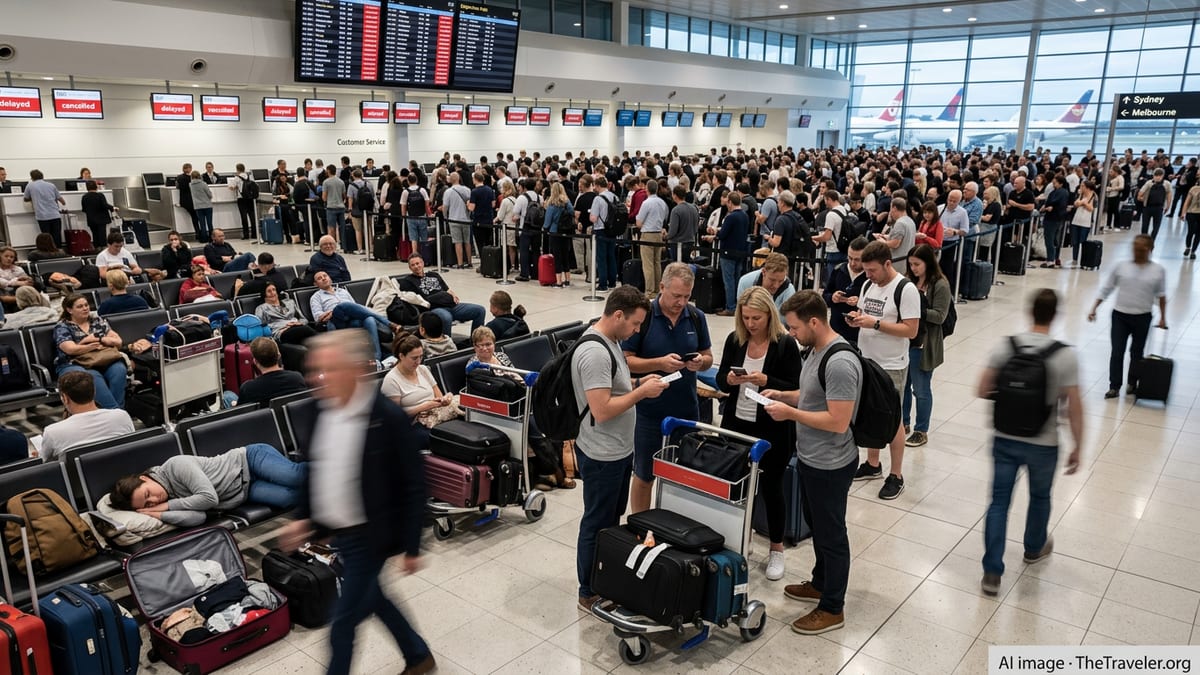
For travellers at the affected airports, the immediate impact was visible in long check-in and customer service queues, packed departure lounges and repeated public address announcements advising of changes. Social media posts and local coverage described passengers queuing for rebooking assistance while monitoring changing departure times on their phones.
With Qantas, Jetstar and Virgin Australia already operating close to full loads on many domestic and trans-Tasman sectors, same-day alternative options were limited. Some passengers were offered rebooking on later departures or next-day services, while others were reportedly encouraged to accept travel credits or make use of flexible change policies introduced during recent bouts of disruption.
The strain was particularly acute for travellers connecting from domestic flights in Melbourne and Sydney onto international departures, or from regional New Zealand routes into Wellington-based long-haul services. When early flights were cancelled, connection windows evaporated, forcing some passengers to arrange overnight accommodation or reroute through alternative hubs such as Auckland or Brisbane.
Travel industry analysts note that the pattern reflects a broader regional challenge. After several years of capacity cuts and fleet retirements, carriers across Australia and New Zealand are still rebuilding redundancy into their networks. That leaves little buffer when airports reduce arrival and departure rates due to weather or when staffing shortages slow turnaround times on the ground.
Regulators and Consumer Advocates Renew Focus on Passenger Rights
The latest wave of cancellations has added momentum to ongoing policy debates around airline accountability and passenger protections in Australia and New Zealand. In recent weeks, federal budget documents and parliamentary discussions in Canberra have outlined plans to tighten aviation consumer protections, including clearer obligations for refunds, accommodation and compensation when flights are disrupted.
Consumer groups have argued that current arrangements place too much risk on travellers when weather and operational issues collide. They point to recurring scenes of passengers sleeping in terminals or scrambling to secure last-minute hotel rooms, particularly at major hubs like Sydney and Melbourne where airport curfews and slot constraints can limit late-night recovery flights.
Industry submissions to government, including from Qantas and Virgin Australia, have cautioned that stricter compensation rules would increase costs and could force airlines to trim marginal routes. However, advocates counter that more predictable standards would improve transparency and restore confidence after several years of high-profile disruption incidents and schedule reductions.
In New Zealand, commentators are drawing parallels with European-style passenger rights frameworks, suggesting that a coordinated trans-Tasman approach could help align expectations and streamline responses when storms or technical failures ripple across both countries’ tightly interconnected aviation markets.
Calls Grow for Long-Term Resilience in Trans-Tasman Aviation
Beyond the immediate disruption, Tuesday’s events are prompting renewed scrutiny of how resilient the trans-Tasman aviation corridor has become. Airlines have highlighted investments in newer, more efficient aircraft and digital tools to improve forecasting and crew planning, yet frequent weather-related cancellations continue to expose vulnerabilities at major hubs.
Aviation analysts note that Melbourne Tullamarine and Sydney are simultaneously dealing with infrastructure pressures, evolving airspace management requirements and strong post-pandemic travel demand. When storms, strong winds or low visibility hit, there is often little room to adjust schedules without cascading delays, especially on popular routes shared by Qantas, Jetstar and Virgin Australia.
In Wellington, the physical constraints of a short, weather-exposed runway mean that even modest deteriorations in wind and cloud conditions can quickly trigger a backlog of delayed or cancelled services. Sounds Air and larger carriers alike must juggle safety margins, payload restrictions and tight turnaround times as they attempt to keep services moving.
As passengers across Australia and New Zealand wait for operations to stabilise following the latest round of cancellations, pressure is likely to build on airlines, airports and policymakers to accelerate efforts that strengthen operational resilience. That includes better cross-industry planning for severe weather, clearer communication protocols and more robust contingency capacity so that a single turbulent day at Melbourne, Sydney or Wellington does not so easily tip the entire region’s travel plans into jeopardy.