


More news on this day
Travel across China’s busiest air corridors has been thrown into fresh turmoil as more than 110 flights operated by China Eastern, China Southern, Air China, Delta and other carriers were grounded over recent days, disrupting links between Los Angeles and major hubs including Shanghai, Beijing, Guangzhou, Shenzhen, Chengdu, Hangzhou, Xi’an and Kunming.
Get the latest news straight to your inbox!
Wave of Cancellations Across Chinese Megacities
Publicly available aviation data and compiled media coverage for the period around May 23 to 25 indicate that Chinese carriers have collectively grounded well over 100 domestic and international flights, intensifying a pattern of rolling disruption that has dogged the country’s aviation system through the spring of 2026. Reports point to clusters of cancellations at key airports serving Beijing, Shanghai, Guangzhou and Shenzhen, alongside secondary hubs such as Chengdu, Hangzhou, Xi’an and Kunming.
Monitoring of schedule feeds and flight-tracking dashboards shows China Eastern, China Southern and Air China at the center of the latest shake-up, with their networks linking eastern coastal cities to the country’s interior particularly affected. Routes in and out of Shanghai Pudong and Hongqiao, Beijing Capital and Daxing, Guangzhou Baiyun and Shenzhen Bao’an feature prominently among the services listed as cancelled or heavily delayed.
The current disruption builds on earlier cuts reported in April and early May, when Chinese airlines had already withdrawn dozens of weekly frequencies on selected domestic and regional corridors. The latest wave has compounded those reductions, leaving some routes with only a thin skeleton of remaining departures and forcing passengers onto already crowded alternative flights.
Although the precise causes vary by airport and day, published coverage points to a combination of operational constraints, tight air-traffic control slots and earlier schedule rationalizations by carriers seeking to manage costs in a volatile demand and fuel-price environment.
International Links Between Los Angeles and China Under Strain
The turbulence is not confined to domestic Chinese sectors. Long-haul links between the United States and China, including services touching Los Angeles International Airport, are also under pressure as Chinese and US carriers adjust capacity. Schedule summaries for late May show a reduced number of departures between Los Angeles and major Chinese gateways such as Beijing, Shanghai and Guangzhou compared with earlier in the year.
Routes ordinarily operated or codeshared by China Eastern, China Southern, Air China and Delta are among those experiencing disruption, according to timetable snapshots and reservation-system checks. In some cases, cancellations appear only a short time before departure, with replacement options offered on different days, via alternative hubs, or under different flight numbers.
Travel advisers and frequent-flyer communities following the situation note that the cumulative effect is a more fragile transpacific schedule in which a single cancellation can cascade into missed onward connections across China’s domestic network. Passengers starting or ending journeys in cities such as Chengdu, Hangzhou, Xi’an or Kunming are particularly exposed when long-haul links into Beijing or Shanghai are withdrawn or retimed.
For travelers in Los Angeles planning summer trips to China, the latest developments underline the importance of checking not only headline flight numbers but also operating carriers, intermediate stops and minimum connection times, as these can change repeatedly while the situation remains fluid.
Passengers Face Long Queues, Rolling Rebookings and Route Changes
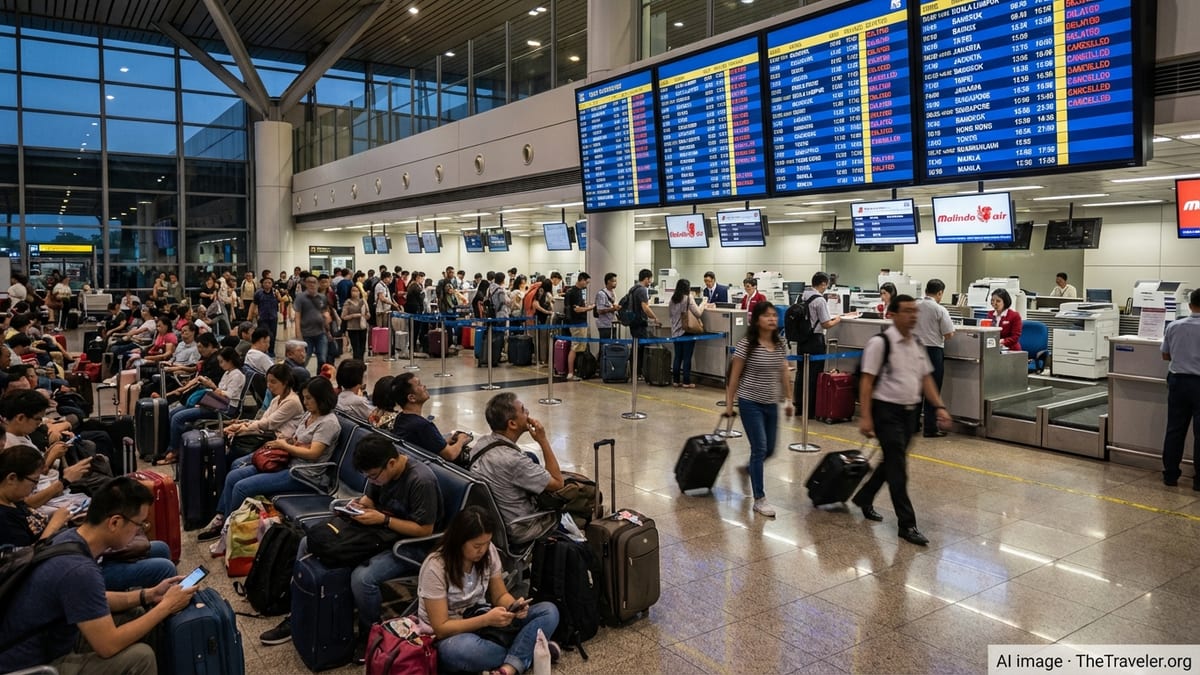
Accounts gathered from public forums and social media posts in recent days describe scenes of long queues at ticket counters and crowded departure halls across several Chinese hubs as travelers seek rebooking or refunds. In cities including Shanghai, Beijing, Guangzhou, Shenzhen and Chengdu, some passengers report being shifted to later departures, different airlines or circuitous routings involving extra domestic stops.
Those connecting to or from international flights have encountered particular difficulties when domestic legs are cancelled at short notice. With limited spare capacity on remaining services linking cities such as Xi’an, Hangzhou and Kunming to the main coastal gateways, same-day alternatives are often unavailable, forcing overnight stays or complete itinerary changes.
Publicly available information from airline notices indicates that many of the cancellations are being processed as “operational adjustments” rather than tied to a single weather or airspace incident. That classification typically governs the level of assistance and compensation on offer, and can leave passengers navigating a patchwork of policies depending on the carrier and the type of ticket they hold.
Travel analysts observing the Chinese market suggest that both leisure and corporate travelers may need to build in greater buffers around key events and international meetings, as even well-planned itineraries can be upended by late-breaking schedule changes on domestic feeder routes.
Underlying Pressures on China’s Aviation Network
The latest bout of disruption comes against a backdrop of persistent structural pressures on China’s aviation system. Earlier assessments of the market in 2026 highlighted air-traffic management constraints, periodic weather disruptions and uneven demand recovery on some long-haul corridors as recurring sources of instability.
In recent weeks, reporting has also linked sections of the cancellations to broader economic headwinds and higher fuel costs tied to global energy market tensions. Carriers have been trimming frequencies on select domestic and regional routes, while attempting to preserve capacity on trunk corridors that feed major hubs such as Beijing, Shanghai, Guangzhou and Shenzhen.
Industry observers note that Chinese airlines are simultaneously managing complex fleet and crew rotations as they rebuild international networks that were dramatically scaled back in previous years. When unexpected bottlenecks arise, the knock-on effects can spread quickly across far-flung points in the network, from Kunming and Xi’an to overseas gateways including Los Angeles.
While there is no indication of a single, nationwide shutdown, the pattern of localized cancellations and ad hoc schedule adjustments has created an environment in which reliable long-term planning is difficult, particularly for travelers combining domestic Chinese sectors with long-haul legs to North America and Europe.
What Travelers Should Watch in the Coming Days
With China’s peak summer travel season approaching, the immediate question for many passengers is whether the current turbulence will ease or intensify. Published aviation statistics and timetable updates over the next week will offer the clearest signals as to whether grounded flights are progressively reinstated or if further cuts are introduced.
Travel specialists recommend that passengers scheduled to fly with China Eastern, China Southern, Air China, Delta and partner airlines monitor their bookings closely through official airline channels and travel-agency platforms. Same-day checks of flight status before leaving for the airport are increasingly important, given the potential for late operational changes.
For those planning new trips, particularly involving Los Angeles and the key Chinese hubs of Shanghai, Beijing, Guangzhou and Shenzhen, building extra time into connections and considering flexible or changeable fare types may provide a measure of protection. Travelers heading onward to secondary cities such as Chengdu, Hangzhou, Xi’an or Kunming may also wish to explore alternative routings through different hubs if their preferred nonstop options show limited frequency.
As airlines adjust to shifting demand and operational realities, the pattern of cancellations remains subject to change. For now, the latest wave of grounded flights underscores how fragile China’s air-travel recovery still is, and how quickly localized schedule cuts can ripple across some of Asia’s busiest corridors and out to major intercontinental gateways.